
Last Updated: August 25, 2026
Private Defence in Tort Law — General Defence
1. Meaning of Self-Defence
Lawful self-defence, also called private defence, is a general defence in tort law that allows a person to use reasonable and necessary force to protect their person or property from an unlawful attack or immediate threat.
In simple words:
A person may use reasonable force to protect themselves, another person, or property from an unlawful threat, but the force must not be excessive.
The basic principle is:
Lawful threat → Necessary response → Reasonable force → No tortious liability
However, the defence is limited. A person cannot use unlimited force merely because they are acting to protect themselves or their property.
Don’t Miss New Law Opportunities!
Join our WhatsApp community for verified updates on Law Jobs, Internships, Competitions, Scholarships, LLB Notes & more.
2. What Does Private Defence Protect?
Private defence may arise in protecting:
A. Person
A person may use reasonable force to protect themselves or another person from an unlawful attack.
Example:
A attacks B with a stick. B pushes A away to prevent the attack. If the force used is reasonable in the circumstances, B may rely on private defence.
B. Property
Reasonable force may also be used to protect property from unlawful interference, trespass or attack.
Example:
A person attempts to forcibly enter B’s premises. B takes reasonable steps to prevent the entry.
But the response must remain proportionate to the threat.
3. Essential Conditions of Lawful Self-Defence/Private Defence
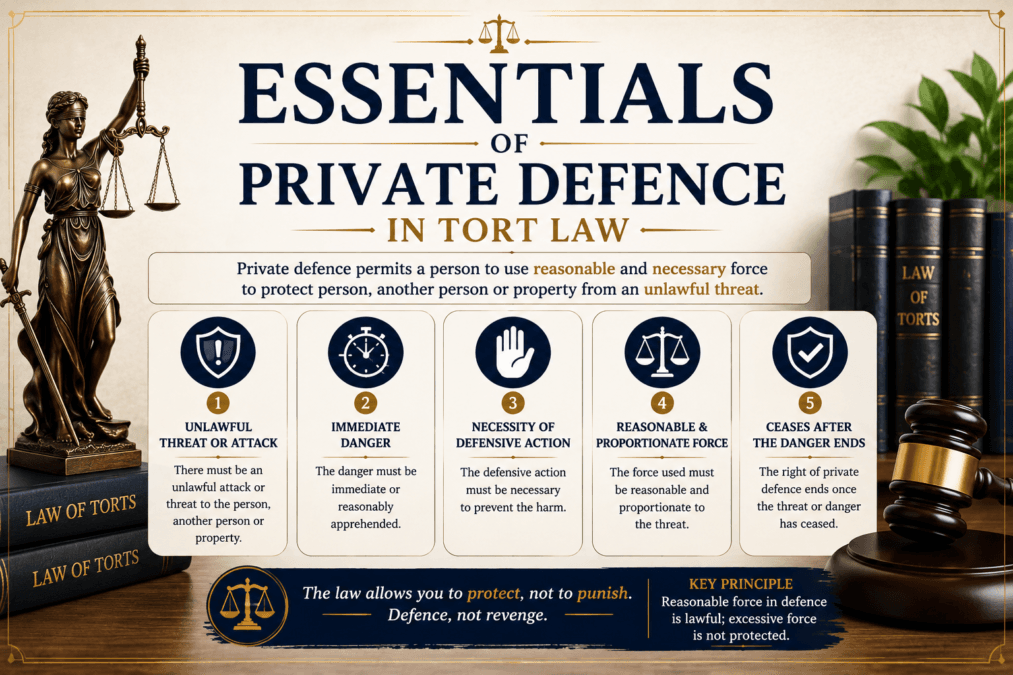
1. There must be an unlawful threat or attack
The defence generally arises where the defendant is responding to an unlawful attack, trespass or immediate threat.
A person cannot ordinarily justify violence simply because they dislike another person’s conduct.
2. The danger must be immediate or reasonably apprehended
The defendant should have reasonable grounds to believe that an attack or harm is occurring or is about to occur.
The law does not require a person to wait until they have actually been injured before taking reasonable defensive action.
3. The force must be necessary
The force used must be reasonably necessary in the circumstances.
If the danger can safely be avoided without force, excessive force may not be justified.
4. The force must be reasonable and proportionate
This is one of the most important principles.
Private defence permits reasonable force, not unlimited force.
The court considers the circumstances in which the defendant had to act, including the nature and immediacy of the threat.
A person suddenly confronted with danger cannot always be expected to calculate their response with perfect precision.
5. The force must not continue after the danger has ended
Once the threat has ceased, continued violence may become unlawful.
For example:
A attacks B. B reasonably pushes A away and A runs away. If B then chases A and seriously injures him, the later conduct may not be protected by private defence.
4. Leading Case —
Bird v Holbrook (1828)
Bird v Holbrook is one of the classic cases on private defence of property.
Facts
The defendant set a spring gun in his garden to protect his property against trespassers.
He did not give adequate warning of the device.
The plaintiff entered the garden and was injured by the spring gun.
Decision
The defendant was held liable.
Principle
A person cannot use dangerous or excessive means of protecting property, particularly where the danger is concealed and the person entering the property has not been warned.
Important lesson
A person has a right to protect property, but cannot set dangerous traps that may cause serious injury without lawful justification.
Exam memory
Bird v Holbrook → Spring gun → Excessive protection of property → Liability
Revill v Newbery (1996)
This is a particularly important modern case for understanding the limits of private defence.
Facts
The defendant, an elderly man, slept in a shed on his allotment because of previous problems with theft and vandalism.
At night, the plaintiff and another person attempted to break into the shed.
The defendant took a shotgun and fired through a hole in the shed door.
The plaintiff was struck and injured.
The defendant argued that he was protecting himself and his property.
Decision
The court held that the force used was greater than the reasonable limits of lawful self-defence.
The plaintiff was himself engaged in criminal activity and was found substantially contributorily negligent, but that did not give the defendant an unlimited right to use force. The Court of Appeal upheld the finding of negligence and accepted a substantial reduction in the claimant’s damages for contributory negligence.
Principle
Even a trespasser or burglar does not lose all protection against unreasonable or excessive force.
Revill v Newbery → Burglar → Shotgun → Excessive force → Defence failed
This is an excellent case to demonstrate that:
Protection of property ≠ unlimited use of violence.
Ramanuja Mudali v M. Gangan
This is an important Indian case concerning private defence of property.
Facts
The defendant placed live electric wires on his land to protect the property from trespassers.
The plaintiff passed through the land and was injured by the electric wires.
Decision
The defendant was held liable because the method adopted to protect the property went beyond the permissible limits of private defence.
Principle
The right to protect property does not authorise the use of dangerous methods that are disproportionate to the threat.
Exam memory
Ramanuja Mudali → Live electric wires → Protection of property exceeded → Liability
Morris v Nugent
This case illustrates the requirement that the danger must be present and continuing.
Facts
The defendant’s dog was initially involved in an attack. The defendant shot the dog after it had already moved away and was no longer attacking him.
Principle
Where the immediate danger has ended, the continued use of force cannot ordinarily be justified as private defence.
Key point
The defensive act must be connected with the actual threat.
Ashley v Chief Constable of Sussex Police (2008)
This case is important for understanding self-defence in civil proceedings, particularly where the defendant honestly believes that an attack is occurring.
The House of Lords considered the circumstances in which self-defence may be relied upon in a civil claim involving battery. The case emphasises that the law must distinguish between the necessity for defensive action and whether the force used was reasonable or proportionate. (Supreme Court UK)
Important principle
In civil proceedings, the court examines the circumstances and the defendant’s belief about the threat, but the defensive response must still satisfy the requirements of lawful self-defence.
Why important?
It demonstrates that self-defence in civil law cannot simply be assumed because the defendant honestly believed there was danger.
Cattle v Stockton Waterworks Co. — Do Not Confuse
Students sometimes encounter cases concerning accidental injury while defending property.
The important point for examination purposes is to distinguish:
- lawful defensive action, from
- negligent or excessive methods of protection.
A person may have a legitimate purpose but still be liable if the manner in which they act is unreasonable.
5. Private Defence of Property
The law gives a person a legitimate interest in protecting their property.
However:
The value of the property does not automatically justify unlimited force.
Example
A person attempts to steal a bicycle.
The owner may take reasonable steps to prevent the theft.
But deliberately causing serious bodily injury merely to protect a low-value object may be regarded as disproportionate.
This principle is illustrated particularly well by Bird v Holbrook, Ramanuja Mudali v M. Gangan and Revill v Newbery.
6. Private Defence vs Necessity
| Private Defence | Necessity |
| Protects against unlawful attack or threat | Prevents a greater harm |
| Usually involves a person or property being threatened | Danger may arise from natural circumstances or an emergency |
| Reasonable defensive force is used | Reasonably necessary action is taken |
| Example: stopping an attacker | Example: breaking a door to escape a fire |
| Bird v Holbrook | Cope v Sharpe |
Easy distinction
Private defence = protection from an unlawful threat.
Necessity = prevention of a greater harm.
7. Private Defence vs Volenti
These are also completely different.
Volenti non fit injuria
The defence is based on the plaintiff’s voluntary acceptance of a known risk.
Private defence
The defence is based on the defendant’s reasonable response to an unlawful threat.
Therefore:
Volenti = consent to risk
Private defence = reasonable response to threat
8. What Is Excessive Force?
Excessive force means force that goes beyond what is reasonably necessary in the circumstances.
Example
A person is lightly pushed by B.
A responds by using extreme violence that causes serious injury.
The original threat may not justify the later response.
Similarly, in Revill v Newbery, the fact that the claimant was unlawfully entering the defendant’s property did not give the defendant an unlimited right to use dangerous force.
9. The Court Looks at the Circumstances
The question is not:
“Was the force exactly equal to the force used by the attacker?”
Instead, the court examines whether the defendant’s response was reasonable in the circumstances as the defendant reasonably perceived them.
Factors may include:
- nature of the threat;
- immediacy of the danger;
- whether the defendant was suddenly confronted;
- seriousness of the threatened harm;
- availability of alternative responses;
- nature of the force used;
- whether the threat had already ended.
This is why the law recognises that a person confronted with sudden danger cannot always make a perfectly measured calculation.
10. Important Cases — Quick Revision Table
| Case | Principle |
| Bird v Holbrook (1828) | Dangerous spring gun used to protect property → liability |
| Morris v Nugent | Force must relate to an existing/continuing threat |
| Ramanuja Mudali v M. Gangan | Live electric wires to protect property → excessive method → liability |
| Revill v Newbery (1996) | Excessive force against burglar not protected by self-defence |
| Ashley v Chief Constable of Sussex Police (2008) | Self-defence in civil proceedings; necessity and reasonableness of response examined |
11. Most Important Cases for LL.B. Students
Bird v Holbrook
Dangerous trap → protection of property has limits
Ramanuja Mudali v M. Gangan
Live electric wire → excessive protection of property
Revill v Newbery
Burglar → excessive force → no complete self-defence
Ashley v Chief Constable
Self-defence in civil proceedings → reasonable response
These cases together give students a strong understanding of both the existence and limits of private defence.
Remember:
Unlawful Threat + Immediate Danger + Necessary Action + Reasonable & Proportionate Force = Lawful Private Defence
And the most important rule:
A person may defend themselves or their property, but the right of private defence does not permit excessive or disproportionate force.
One-line conclusion
Private defence protects reasonable defensive conduct, not revenge, punishment or excessive violence.
Don’t Miss New Law Opportunities!
Join our WhatsApp community for verified updates on Law Jobs, Internships, Competitions, Scholarships, LLB Notes & more.
Explore more
- ✔ Law Study Material
- ✔ Practical Legal Guides
- ✔ Legal writing
- ✔ Artificial Intelligence
- ✔ Best Tools & Resources
- ✔ Career Opportunities
- ✔ Best Books
- ✔ Professional Writing Services
FAQs — Private Defence in Tort Law
1. What is private defence in tort law?
Private defence is a general defence in tort that permits a person to use reasonable and necessary force to protect themselves, another person, or property from an unlawful attack or immediate threat.
2. What are the essentials of private defence?
The main essentials are an unlawful threat, immediate danger, necessity of defensive action, and reasonable and proportionate force. The force must stop when the danger has ended.
3. Can excessive force be used in private defence?
No. Private defence permits only reasonable force. Excessive or disproportionate force can make the defendant liable. Revill v Newbery (1996) is an important case illustrating this limitation.
4. Can private defence be used to protect property?
Yes. A person may use reasonable force to protect property against unlawful interference. However, dangerous traps or disproportionate methods are not generally protected. Bird v Holbrook (1828) is the leading case.
5. What is the difference between private defence and necessity?
Private defence involves protection against an unlawful attack or threat, whereas necessity involves taking reasonable action to prevent a greater harm. For example, resisting an attacker is private defence, while breaking a door to escape a fire may be necessity.
Classmate Pulse Spiral Notebook ✏️ Need a Spiral Notebook for Everyday Writing? A spiral notebook…

Latest Scholarships & Fellowships 2026–27: Open Opportunities for Upcoming call
Latest Scholarships & Research Fellowships 2026–27 Last Verified: 30 September 2026 Students, researchers, PhD scholars…
Writing & Research Resources: Useful Books, Tools & Essentials for Writers and Researchers
Whether you are an author, content writer, law student, academic researcher, PhD scholar, teacher, or…

International Treaties as a Source of International Law | LL.B. Notes
International Treaties as a Source of International Law Introduction International treaties are one of the…

The Ultimate Guide to Organizing LLB Notes for Exam Success
LLB Notes for Exam Success Studying law is not simply about reading hundreds of pages….
What Is the Best AI Tool for Legal Research in 2026? A Practical Guide for Lawyers, Law Students and Researchers
What Is the Best AI Tool for Legal Research in 2026? Last updated: September 2026…