
- A General Defence Act of God in Tort Law
- A General Defence Inevitable Accident in Tort Law
- Volenti Non Fit Injuria — Law of Tort Notes
Necessity in Tort Law — A General Defence
1. Meaning of Necessity
Necessity is a general defence in tort law where an act that would otherwise amount to a tort is done to prevent a greater or more serious harm.
In simple words:
Necessity means doing a lesser harm to prevent a greater harm.
The defence is based on the idea that the law may excuse an interference with another person’s rights when the interference is reasonably necessary to protect life, property, or public safety from a more serious and imminent danger.
Simple Example
A fire suddenly breaks out in a building. To prevent the fire from spreading to the neighbouring buildings, A breaks down part of B’s wall.
Normally, intentionally damaging B’s property could constitute a tort. However, if the action was reasonably necessary to prevent a much greater danger, necessity may provide a defence.
2. Essential Conditions of the Defence
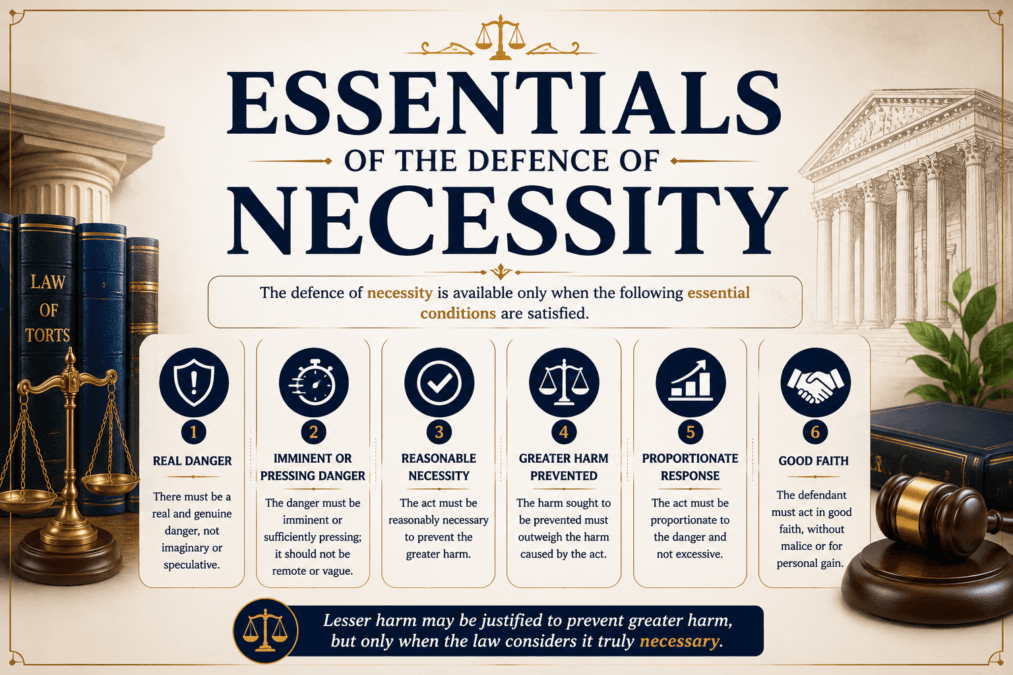
For necessity to operate as a defence, the following factors are important.
1. There must be a real danger
The defendant should generally act in response to a genuine danger, rather than an imaginary or speculative threat.
2. The danger must be imminent or sufficiently pressing
The act should be reasonably connected with the need to deal with the danger.
A person cannot ordinarily interfere with another’s rights merely because some harm might occur at some indefinite time in the future.
3. The act must be reasonably necessary
The defendant must show that the interference was reasonably necessary to prevent the greater harm.
The defence does not give a person unlimited freedom to cause damage.
4. The harm prevented should outweigh the harm caused
The underlying principle is:
Lesser harm may be justified to prevent greater harm.
If the defendant causes a greater harm than the danger being prevented, the defence may fail.
5. The act must be proportionate to the danger
The response should be reasonable and proportionate to the circumstances.
6. The defendant should act in good faith
The defence is intended to protect legitimate efforts to prevent harm, not acts done for personal advantage under the pretence of necessity.
3. Types of Necessity
For LL.B. purposes, necessity is commonly explained under three broad situations.
A. Public Necessity
Public necessity arises where an act is done to protect the public or a large number of people from serious danger.
Example
A fire is spreading rapidly through a city. Authorities destroy a building to create a firebreak and prevent the fire from spreading to an entire neighbourhood.
The destruction of the building may otherwise amount to interference with property, but the act may be justified by public necessity.
B. Private Necessity
Private necessity arises where an act is done to protect an individual or private property from serious and immediate danger.
Example
A person takes shelter in another person’s building during a sudden and dangerous storm.
The entry may technically interfere with the owner’s possession, but necessity may justify the entry if it was reasonably required to protect life.
C. Necessity to Protect Property
A person may interfere with another’s property where this is reasonably necessary to prevent greater damage to property.
Example
During a fire, a person removes furniture from a burning building and temporarily places it on a neighbour’s land to save it from destruction.
The interference may be justified by necessity depending upon the circumstances.
4. Leading Case —
Cope v Sharpe (No. 2) (1912)
This is one of the most important cases for understanding necessity.
Facts
The defendant entered the plaintiff’s land without permission because a fire was threatening to spread onto the defendant’s employer’s property.
The defendant entered the land in order to prevent the spread of the fire.
The plaintiff alleged trespass.
Decision
The defendant was not held liable for trespass because the entry was reasonably necessary to prevent the spread of the fire.
Principle
An otherwise unlawful interference may be justified where it is reasonably necessary to prevent a serious and imminent danger.
Exam Memory
Cope v Sharpe → Fire → Entry on land → Necessity
Leigh v Gladstone (1909)
This case is often discussed in connection with necessity involving medical treatment.
Facts
The plaintiff was a prisoner who refused food and attempted to starve herself.
A medical officer forcibly fed her in order to preserve her life.
Principle
The case is traditionally cited to illustrate that interference with a person’s bodily autonomy may, in certain circumstances, be justified by necessity where the purpose is to preserve life.
Important qualification
Modern law concerning medical consent, bodily autonomy and capacity is considerably more developed. Therefore, students should use this case as a historical tort-law illustration, not as a complete statement of modern medical law.
Mouse’s Case (1608)
Mouse’s Case is a classic early authority associated with necessity.
Facts
A passenger travelling by boat was forced to throw another person’s goods into the river during a violent storm to prevent the boat from sinking and save the passengers.
Decision
The act was treated as justified because it was done under necessity to preserve human life.
Principle
An act that would ordinarily amount to a wrong may be justified when reasonably necessary to prevent a greater danger.
Exam Memory
Mouse’s Case → Storm → Goods thrown overboard → Save lives → Necessity
Vincent v Lake Erie Transportation Co. (1910)
This is a very useful case for understanding the distinction between justification and compensation.
Facts
A ship was lawfully docked at the plaintiff’s dock when a severe storm arose.
The ship remained secured to the dock, and the storm caused the ship to pull against the dock, damaging it.
The defendant argued that the circumstances justified the ship’s continued use of the dock.
Principle
The court recognised the necessity of the ship remaining at the dock during the storm, but treated the resulting property damage separately.
The case is often used to demonstrate an important distinction:
An act may be justified by necessity, yet compensation may still be required for the actual damage caused.
Why it is important
This helps students understand that necessity does not always mean “no liability or no compensation whatsoever.”
Southwark London Borough Council v Williams (1971)
This is one of the most important cases for understanding the limits of necessity.
Facts
During a housing shortage, homeless persons occupied council-owned properties without permission.
They argued that their difficult living conditions justified the occupation on the ground of necessity.
Decision
The defence of necessity was rejected.
The court was concerned that accepting such a broad defence would undermine property rights and allow people to justify unlawful conduct merely because they were experiencing hardship.
Principle
Necessity must involve a sufficiently compelling danger; ordinary hardship or economic difficulty does not automatically justify interference with another person’s legal rights.
Southwark LBC v Williams → Homelessness → Necessity rejected
Carter v Thomas (1951)
This case is important in relation to necessity and trespass to land.
Facts
The defendants entered the plaintiff’s property claiming that they were acting to extinguish a fire.
However, when they entered, the fire had already been extinguished.
Decision
The defence of necessity was not accepted because the circumstances did not justify the continued interference with the plaintiff’s property.
Principle
Necessity must exist at the time of the interference; once the necessity has ended, continued interference cannot be justified merely by relying on the earlier danger.
Carter v Thomas → Fire already extinguished → Necessity unavailable
Esso Petroleum Co Ltd v Southport Corporation (1956)
This case is useful when discussing necessity and emergency action.
Facts
An oil tanker was in danger and oil was discharged into the sea as part of the steps taken to deal with the emergency.
The corporation claimed damages for the resulting pollution.
Principle
The case illustrates the importance of examining whether an emergency act was reasonably necessary in the circumstances and whether the defendant can establish the facts supporting the defence.
It is also important because it demonstrates that necessity cannot simply be assumed merely because an emergency exists.
11. Necessity and Consent
Necessity is different from Volenti non fit injuria.
Volenti
The plaintiff:
knows the risk + understands the risk + freely accepts the risk
Necessity
The defendant:
interferes with the plaintiff’s rights to prevent a greater harm
Therefore:
| Volenti | Necessity |
| Based on plaintiff’s consent | Based on emergency circumstances |
| Plaintiff voluntarily accepts risk | Defendant acts to prevent greater harm |
| Consent is central | Consent is generally not required |
| Example: voluntarily participating in a risky activity | Example: entering land to escape a dangerous fire |
5. Necessity vs Private Defence
These two defences are also different.
Necessity
The defendant acts to prevent harm or danger, which may arise from natural circumstances or other sources.
Private Defence
The defendant acts to protect themselves or another person/property from an unlawful attack or threat.
Example
Necessity:
A breaks B’s door to escape from a rapidly spreading fire.
Private defence:
A uses reasonable force to stop B from unlawfully attacking A.
6. Necessity vs Act of God
Act of God
The harm is caused by an extraordinary natural event.
Example:
An unprecedented flood causes damage.
Necessity
The defendant takes an action to prevent greater harm.
Example:
During a flood, A breaks through a wall to allow trapped people to escape.
Thus:
Act of God concerns the natural event; necessity concerns the emergency action taken to prevent greater harm.
7. Necessity Is Not a Licence to Cause Damage
This is an important examination point.
A person cannot simply claim:
“I was acting out of necessity.”
The court will examine:
- Was there a genuine danger?
- Was the danger sufficiently imminent?
- Was the defendant’s action necessary?
- Was there a less harmful alternative?
- Was the response proportionate?
- Was the action taken in good faith?
- Did the necessity continue when the interference occurred?
Therefore:
Necessity is a limited defence, not a general permission to violate another person’s rights.
8. Necessity and Compensation
Students often make an important mistake:
“If necessity is proved, the defendant can never be required to compensate the plaintiff.”
This is too broad.
The legal consequences can depend upon the nature of the act, the circumstances and the applicable cause of action.
Vincent v Lake Erie Transportation Co. is particularly useful for showing that an act may be justified by necessity while compensation for actual property damage may still arise.
Therefore, in your notes, it is safer to write:
Necessity may justify the interference, but it does not necessarily eliminate every possible claim for compensation.
9. Important Cases — Quick Revision Table
| Case | Principle |
| Mouse’s Case (1608) | Necessity to save life during a storm |
| Cope v Sharpe (No. 2) (1912) | Entry on land justified to prevent spread of fire |
| Leigh v Gladstone (1909) | Necessity and preservation of life; historical medical illustration |
| Carter v Thomas (1951) | Necessity must exist when interference occurs |
| Southwark LBC v Williams (1971) | Mere hardship does not constitute necessity |
| Esso Petroleum Co Ltd v Southport Corporation (1956) | Emergency action and necessity; circumstances must justify the act |
| Vincent v Lake Erie Transportation Co. (1910) | Necessity may justify conduct, but compensation for damage may still arise |
10. Most Important Cases for LL.B. Students
For a student-friendly answer, I recommend remembering these six core cases:
Mouse’s Case
Necessity to save life
Cope v Sharpe
Entry onto land to prevent fire
Carter v Thomas
Necessity must actually exist
Southwark LBC v Williams
Hardship ≠ necessity
Vincent v Lake Erie
Justification does not necessarily eliminate compensation
Esso Petroleum v Southport Corporation
Emergency action must be reasonably justified
Remember:
Genuine Danger + Imminent Threat + Necessary Action + Proportionate Response = Necessity
And the easiest case sequence:
Mouse → Save life
Cope → Stop fire
Carter → Necessity ended
Southwark → Hardship insufficient
Vincent → Damage may still require compensation
Conclusion
Necessity is an important general defence in the law of torts because it recognises that, in exceptional circumstances, a person may lawfully interfere with another’s rights to prevent a greater and more immediate harm. However, the defence is narrowly applied. The danger must be genuine, the response reasonably necessary and proportionate, and the circumstances must justify the interference.
For LL.B. students, the most important principle to remember is:
The law may excuse the lesser harm when it is reasonably necessary to prevent a greater harm, but necessity does not give unlimited authority to interfere with another’s rights.
Explore more
- ✔ Law Study Material
- ✔ Practical Legal Guides
- ✔ Legal writing
- ✔ Artificial Intelligence
- ✔ Best Tools & Resources
- ✔ Career Opportunities
- ✔ Best Books
- ✔ Professional Writing Services
FAQs — Necessity in Tort Law
1. What is necessity as a defence in tort law?
Necessity is a defence where the defendant interferes with another person’s rights to prevent a greater or more serious harm.
2. What are the essential conditions of the defence of necessity?
There should generally be a real and imminent danger, the defendant’s act must be reasonably necessary to prevent it, and the response should be proportionate to the danger.
3. What is the leading case on necessity in tort law?
Cope v Sharpe (No. 2) (1912) is an important case. The defendant entered the plaintiff’s land to prevent a fire from spreading, and the entry was justified by necessity.
4. Is necessity a complete defence to tortious liability?
Not always. Necessity may justify an otherwise wrongful act, but depending on the circumstances, compensation for actual damage may still be payable. Vincent v Lake Erie Transportation Co. is an important illustration.
5. Does poverty or hardship amount to necessity?
Generally, no. Mere hardship or economic difficulty is not sufficient. In Southwark London Borough Council v Williams (1971), the defence was rejected because homelessness did not justify unlawful occupation of another’s property.
Classmate Pulse Spiral Notebook ✏️ Need a Spiral Notebook for Everyday Writing? A spiral notebook…

Latest Scholarships & Fellowships 2026–27: Open Opportunities for Upcoming call
Latest Scholarships & Research Fellowships 2026–27 Last Verified: 30 September 2026 Students, researchers, PhD scholars…
Writing & Research Resources: Useful Books, Tools & Essentials for Writers and Researchers
Whether you are an author, content writer, law student, academic researcher, PhD scholar, teacher, or…