
Act of God in Tort Law
General Defences in Law of Torts — General Exceptions | LL.B. Notes
1. Meaning of Act of God
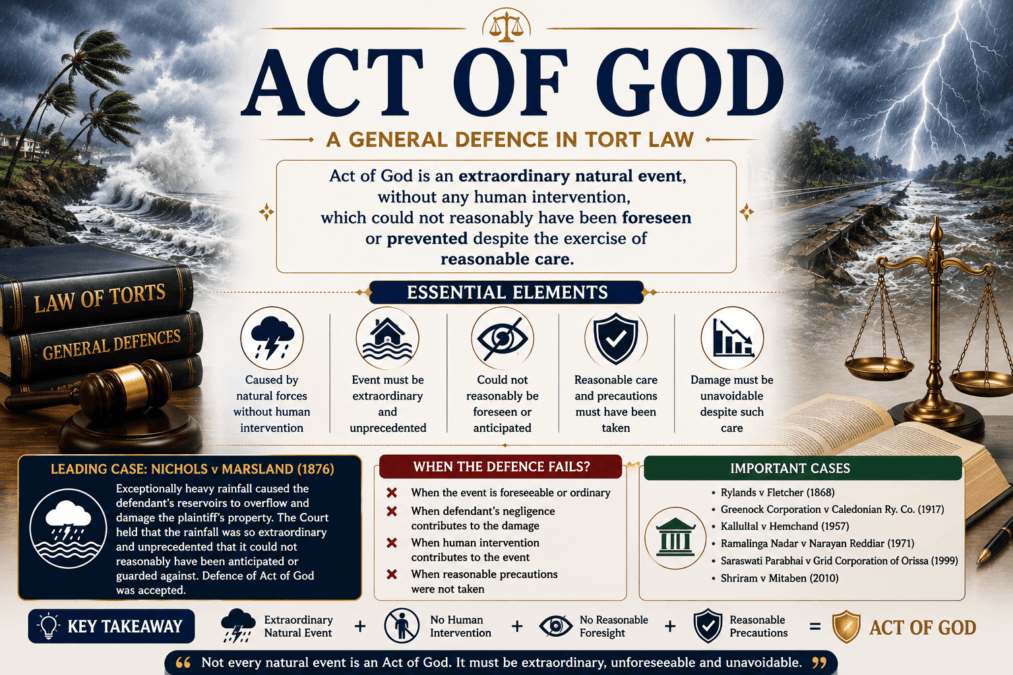
Act of God is a general defence in tort law where the defendant escapes liability because the damage was caused by an extraordinary natural event that occurred without human intervention and could not reasonably have been foreseen or prevented despite reasonable care.
It is also expressed by the Latin term Vis Major, meaning superior or irresistible force.
In simple words
When an extraordinary natural event causes harm, and no reasonable human care or foresight could have prevented it, the defendant may rely on the defence of Act of God.
Examples
- Extraordinary floods
- Unprecedented rainfall
- Exceptional storms or cyclones
- Earthquakes
- Lightning
- Extraordinary tidal waves
However, every natural event is not an Act of God. The event must satisfy the legal requirements of the defence. (Indian Kanoon)
2. Essential Elements of Act of God
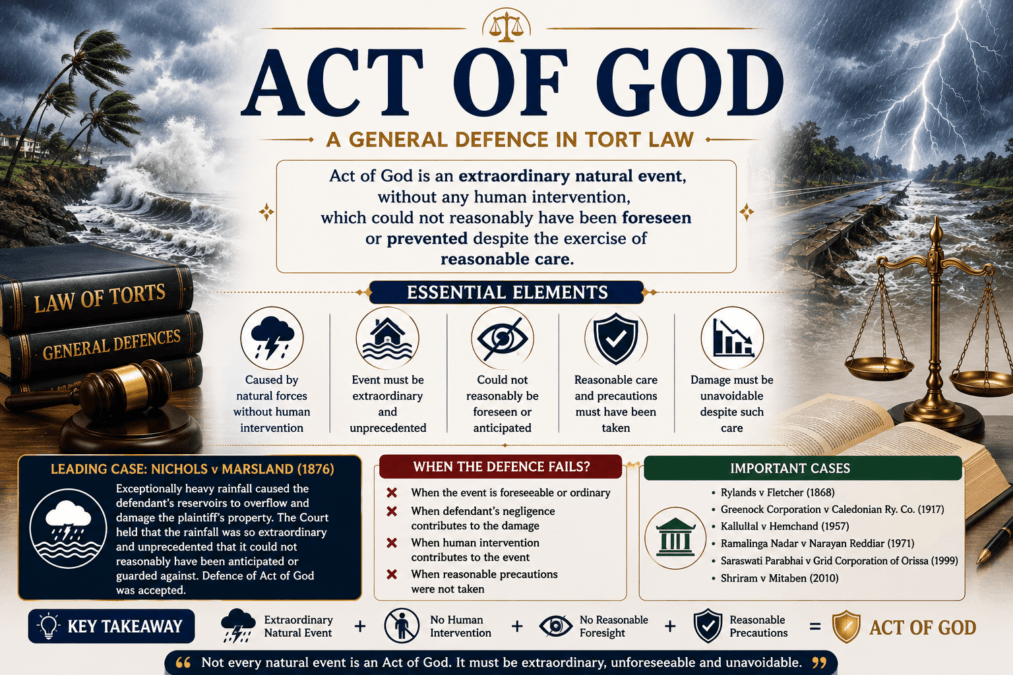
1. Natural forces must be involved
The damage must result from the operation of natural forces without human intervention.
For example:
An extraordinary earthquake causes a properly constructed structure to collapse.
This may potentially constitute an Act of God.
But where human conduct contributes to the event, the defence may fail. Indian courts have emphasised that an event caused wholly or partly by human agency cannot ordinarily be characterised as an Act of God. (Indian Kanoon)
2. The event must be extraordinary
The natural event must be sufficiently extraordinary or exceptional.
Ordinary natural occurrences are generally not enough.
For example:
- Ordinary seasonal rain (not)
- Normal monsoon flooding (not)
- An exceptionally unprecedented flood (yes)
- An extraordinary storm beyond reasonable anticipation (yes)
The question is not simply whether the event was “severe”, but whether it was so extraordinary that reasonable foresight could not have anticipated and guarded against it.
3. The event must be unforeseeable in the relevant circumstances
The defendant must show that the event was one which reasonable human foresight could not have anticipated, considering the place, time and circumstances.
Therefore, an event that regularly occurs in a particular area may not qualify merely because it caused substantial damage.
4. The damage must be unavoidable despite reasonable care
The defendant must have taken the precautions that a reasonable person would take.
Thus:
Natural event + reasonable precautions + unavoidable damage = possible Act of God
If the defendant’s own negligence contributed to the damage, the defence may fail.
5. No human intervention
This is an important distinction between Act of God and inevitable accident.
An inevitable accident may occur because of an unexpected human or mechanical event.
But an Act of God requires the relevant cause to arise from natural forces without human intervention. (Indian Kanoon)
3. Leading Cases
— Nichols v Marsland (1876)
Facts
The defendant had constructed artificial ornamental lakes on her land. The lakes were properly constructed and maintained.
An exceptionally heavy and unprecedented rainstorm occurred. The rainfall was described as being of extraordinary severity, causing the embankments to break and large quantities of water to escape.
The escaping water damaged the plaintiff’s bridges.
The plaintiff claimed damages.
Defence
The defendant pleaded that the damage was caused by an Act of God.
Decision
The Court of Appeal accepted the defence.
The rainfall was so extraordinary and unprecedented that reasonable human foresight could not have anticipated or guarded against it.
Therefore, the defendant was not liable.
Principle
An extraordinary natural event that could not reasonably have been anticipated or prevented may constitute an Act of God. (LawStories)
Remember
Nichols v Marsland → Extraordinary rainfall → Unforeseeable natural event → Act of God
Rylands v Fletcher (1868) and Act of God
The defence of Act of God is particularly important in relation to the rule of strict liability.
In Rylands v Fletcher, the defendant was held liable when water escaped from a reservoir and caused damage to the plaintiff’s property.
However, Act of God is one of the recognised exceptions to the rule of strict liability.
The significance of Nichols v Marsland is that the court accepted Act of God as a defence where extraordinary rainfall caused the escape despite reasonable construction and precautions.
Act of God is traditionally recognised as an exception to the rule in Rylands v Fletcher.
Greenock Corporation v Caledonian Railway Co. (1917)
This case is extremely important because it shows when Act of God will fail.
Facts
The Corporation constructed a concrete paddling pond in the bed of a stream and altered the natural course of the water.
Later, exceptionally heavy rainfall occurred and caused the water to overflow, resulting in damage to the railway companies’ property.
Decision
The defence of Act of God failed.
Although the rainfall was extraordinarily heavy, the defendant’s human intervention had altered the natural flow of water and contributed to the damage.
Principle
An extraordinary natural event will not excuse liability where the defendant’s own acts or alterations contributed to the damage. (Indian Kanoon)
Easy comparison
Nichols v Marsland → Defence succeeded
Greenock Corporation → Defence failed
Kallulal v Hemchand (1957)
This is an important Indian case.
Facts
A wall of the defendant’s house collapsed during rainfall and resulted in the death of the plaintiffs’ children.
The defendants argued that the collapse was caused by an Act of God.
Decision
The defence was not accepted.
The rainfall was not shown to be of such an extraordinary character that it could not reasonably have been anticipated or guarded against. (Indian Kanoon)
Principle
Ordinary or reasonably foreseeable rainfall cannot ordinarily be treated as an Act of God.
Exam memory
Kallulal v Hemchand → Ordinary rainfall → Act of God rejected
Saraswati Parabhai v Grid Corporation of Orissa (1999)
This is a particularly useful Indian authority.
Facts
An electric pole was uprooted during heavy rain and storm. A live electric wire fell onto the road and caused the death of a person by electrocution.
The electricity authorities argued that the accident resulted from rain and storm, and therefore amounted to an Act of God.
Decision
The Orissa High Court rejected the defence.
The court held that rain and storms during the rainy season were not, in the circumstances, so extraordinary that the authorities could simply rely upon Act of God. Proper precautions should have been taken while installing and maintaining the electric poles. (Indian Kanoon)
Principle
A natural event does not become an Act of God merely because it causes an accident; reasonable precautions must still be taken against foreseeable natural conditions.
Saraswati Parabhai → Rain + storm + inadequate precautions → Defence failed
A. Krishna Patra v Orissa State Electricity Board (1996)
The Orissa High Court considered the defence of Act of God in the context of strict liability and natural events.
The court referred to Nichols v Marsland and explained that the defence may succeed where an extraordinary natural event directly causes the damage and the defendant has not been negligent. It also discussed Greenock Corporation, where the defence failed because human intervention contributed to the consequences.
Principle
The court must examine both the natural event and the defendant’s conduct before accepting an Act of God defence.
General Traders Ltd. v Pierce Leslie (India) Ltd. (1986)
This is an important Kerala High Court authority.
Facts
Goods being transported by sea were lost during deteriorating weather conditions. The defendants claimed that the loss resulted from an Act of God.
Decision
The defence was rejected because it was not established that the weather conditions were so extraordinary and unprecedented that reasonable precautions could not have been taken. The court emphasised that mere bad or rough weather is not necessarily an Act of God. (Indian Kanoon)
Principle
A defendant cannot rely on Act of God merely because weather conditions suddenly become difficult; the event must satisfy the stringent requirements of the defence.
Ramalinga Nadar v Narayan Reddiar (1971)
This case is useful for understanding the distinction between Act of God and human intervention.
The Kerala High Court explained that accidents may occur because of natural forces, human intervention, or both. However, an event can properly be called an Act of God only when it can be traced to natural forces without human intervention.
Principle
Human agency takes the event outside the true scope of Act of God.
This case is especially useful when explaining why Act of God is narrower than inevitable accident.
Shriram v Mitaben (2010)
This Indian case provides an important modern illustration.
A building collapsed during an earthquake, and the defendants attempted to rely on Act of God.
The court did not accept the defence merely because an earthquake had occurred. The defendants had to establish that they had taken necessary and reasonable care and complied with the relevant construction requirements. The court found that the burden had not been discharged. (Indian Kanoon)
Principle
Even where a natural disaster occurs, the defendant must establish that reasonable precautions were taken.
Important lesson
Earthquake ≠ automatic Act of God.
The court still examines whether the defendant’s own negligence contributed to the harm.
Pullur Periya Panchayat v Karthiyayini (1996)
The Kerala High Court considered damage associated with heavy rain and monsoon conditions.
The court observed that mere ravages of weather or monsoon do not automatically constitute an Act of God. The natural event must be of such extraordinary force or dimension that reasonable human foresight could not have anticipated it.
Principle
Ordinary monsoon conditions are not automatically an Act of God.
4. When Does Act of God Succeed?
The defence is more likely to succeed where:
- the cause is purely natural;
- there is no human intervention;
- the event is extraordinary;
- the event could not reasonably have been foreseen;
- reasonable precautions were taken; and
- the damage could not reasonably have been prevented.
Example
A properly constructed dam withstands all historically foreseeable rainfall. An unprecedented natural event produces rainfall far beyond anything reasonably anticipated, causing the dam to fail.
If the defendant proves proper construction and reasonable precautions, Act of God may be available.
5. When Does Act of God Fail?
The defence is likely to fail where:
- the natural event was foreseeable;
- reasonable precautions were not taken;
- the defendant’s negligence contributed to the damage;
- human intervention contributed to the event; or
- the event was merely an ordinary natural occurrence.
Example
A building owner knows that the roof is structurally weak but does nothing to repair it. Ordinary heavy monsoon rain causes the roof to collapse.
The owner cannot simply say:
“It rained, so it was an Act of God.”
The failure to repair the roof may constitute negligence.
6. Act of God vs Inevitable Accident
| Basis | Act of God | Inevitable Accident |
| Cause | Natural forces | May involve natural, mechanical or other causes |
| Human intervention | Must be absent | May potentially be involved |
| Natural event | Essential | Not essential |
| Extraordinary nature | Generally essential | Not necessarily |
| Reasonable care | Important | Important |
| Example | Unprecedented flood | Unexpected mechanical failure |
| Leading case | Nichols v Marsland | Stanley v Powell |
Easy formula
Act of God = Extraordinary natural event + No human intervention + No reasonable foresight/prevention
7. Act of God vs Inevitable Accident — Important Point
An inevitable accident may result from an unexpected mechanical or human-related circumstance, provided the accident could not reasonably have been prevented.
An Act of God is narrower because the cause must arise from natural forces without human intervention. Indian courts have expressly recognised this distinction.
8. Act of God and Strict Liability
Act of God is particularly relevant to the rule in Rylands v Fletcher.
Rule
A person who brings and keeps something likely to cause harm if it escapes may be strictly liable for damage caused by its escape.
Exception
One traditional exception is:
Act of God
Thus, if the escape was caused by an extraordinary natural event that could not reasonably have been anticipated or prevented, the defendant may avoid strict liability.
Important cases
- Rylands v Fletcher
- Nichols v Marsland
- Greenock Corporation v Caledonian Railway Co.
9. Important Cases — Quick Revision Table
| Case | Principle |
| Nichols v Marsland (1876) | Extraordinary and unprecedented rainfall → Act of God succeeded |
| Rylands v Fletcher (1868) | Act of God recognised as an exception to strict liability |
| Greenock Corporation v Caledonian Railway Co. (1917) | Human intervention contributed → defence failed |
| Kallulal v Hemchand (1957) | Ordinary/foreseeable rainfall → defence failed |
| Ramalinga Nadar v Narayan Reddiar (1971) | Act of God requires natural forces without human intervention |
| General Traders Ltd. v Pierce Leslie (1986) | Ordinary/sudden bad weather insufficient without proof of extraordinary event |
| A. Krishna Patra v Orissa State Electricity Board (1996) | Natural event must be examined along with defendant’s conduct |
| Pullur Periya Panchayat v Karthiyayini (1996) | Ordinary monsoon/weather is not automatically Act of God |
| Saraswati Parabhai v Grid Corporation of Orissa (1999) | Rain/storm did not excuse inadequate precautions |
| Shriram v Mitaben (2010) | Earthquake alone does not automatically establish Act of God |
10. Most Important Cases for LL.B. Students
You do not need to memorise all ten cases for an ordinary LL.B. answer.
I recommend these six core authorities:
1. Nichols v Marsland
Extraordinary natural event → defence succeeds
2. Greenock Corporation v Caledonian Railway
Human intervention → defence fails
3. Kallulal v Hemchand
Ordinary rainfall → defence fails
4. Ramalinga Nadar v Narayan Reddiar
Natural forces without human intervention
5. Saraswati Parabhai v Grid Corporation
Foreseeable natural conditions + inadequate precautions → defence fails
6. Shriram v Mitaben
Natural disaster does not automatically establish Act of God
11. Key Takeaway
Remember the defence through this formula:
Natural Force + Extraordinary Event + No Human Intervention + No Reasonable Foresight + Reasonable Precautions = Act of God
And remember the most important distinction:
Every Act of God may be an unavoidable event, but every unavoidable accident is not an Act of God.
For exam purposes, the best case pair is:
Nichols v Marsland → defence succeeds
Greenock Corporation → defence fails
That pair makes the rule exceptionally easy to understand and remember.
FAQs — Act of God in Tort Law
1. What is an Act of God in tort law?
An Act of God is an extraordinary natural event that could not reasonably have been foreseen or prevented despite reasonable care.
2. Is every natural event an Act of God?
No. Ordinary and foreseeable natural events, such as normal rainfall, generally do not qualify. The event must be extraordinary and unavoidable.
3. What is the leading case on Act of God?
Nichols v Marsland (1876) is the leading case. Extraordinary and unprecedented rainfall caused flooding, and the defence of Act of God was accepted.
4. Is Act of God a defence to strict liability?
Yes. Act of God is traditionally recognised as an exception to the rule of strict liability under Rylands v Fletcher.
5. What is the difference between Act of God and inevitable accident?
Act of God requires an extraordinary natural event, whereas an inevitable accident may arise from natural, mechanical, or other causes. The leading case on inevitable accident is Stanley v Powell (1891).
Classmate Pulse Spiral Notebook ✏️ Need a Spiral Notebook for Everyday Writing? A spiral notebook…

Latest Scholarships & Fellowships 2026–27: Open Opportunities for Upcoming call
Latest Scholarships & Research Fellowships 2026–27 Last Verified: 30 September 2026 Students, researchers, PhD scholars…
Writing & Research Resources: Useful Books, Tools & Essentials for Writers and Researchers
Whether you are an author, content writer, law student, academic researcher, PhD scholar, teacher, or…