
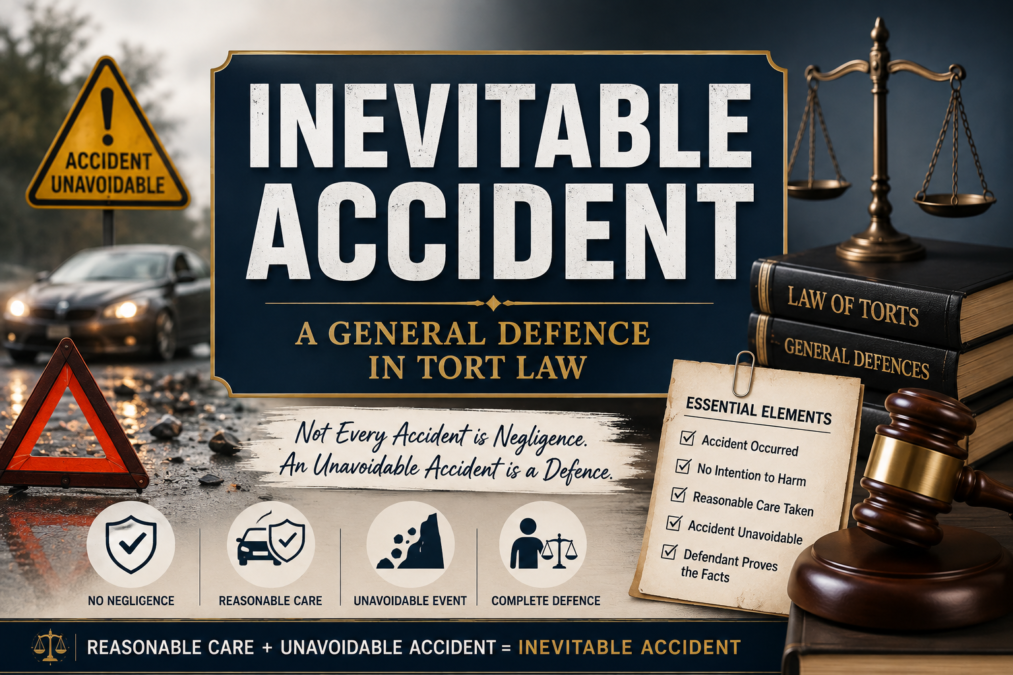
Inevitable Accident in Tort Law
Law of Torts Complete Notes LLB
General Defences in Law of Torts — General Exceptions | LL.B. Notes
1. Meaning of Inevitable Accident
Inevitable accident is a general defence in tort law. It applies where an injury is caused by an accident that could not have been avoided even though the defendant took reasonable care and precautions.
In simple words:
An inevitable accident is an accident that happens without the defendant’s negligence and could not reasonably have been prevented.
The important point is that an accident by itself does not establish liability. The defendant may avoid liability if they can show that the accident occurred despite taking reasonable care.
Simple Example
A is driving a car carefully and at a reasonable speed. Suddenly, a properly maintained component of the car breaks without any warning, causing the car to hit B.
If A can prove that the failure could not reasonably have been detected or prevented despite proper care, A may rely on inevitable accident.
2. Essential Elements of Inevitable Accident
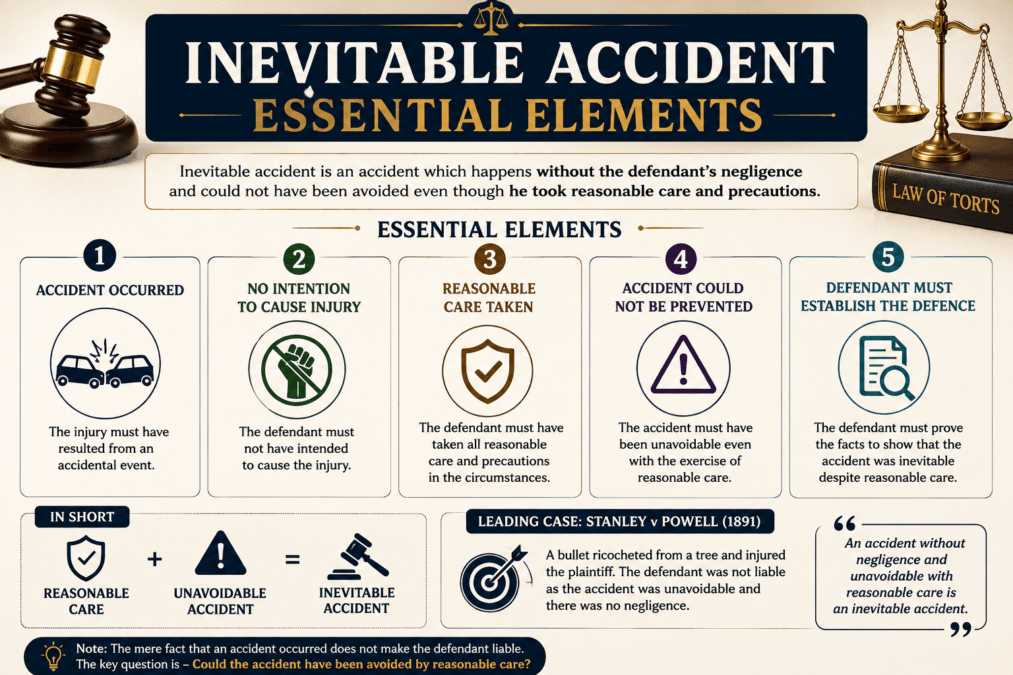
For this defence to succeed, the defendant generally needs to establish the following:
1. An accident occurred
The injury must have resulted from an accidental event, rather than an intentional act.
2. The defendant did not intend to cause the injury
The harm must not have been deliberately caused by the defendant.
3. The defendant exercised reasonable care
The defendant must show that reasonable precautions were taken in the circumstances.
4. The accident could not reasonably have been prevented
Even with reasonable care, the accident must have been unavoidable or practically impossible to prevent.
5. The defendant must establish the defence
Where the defendant relies upon inevitable accident, the relevant facts must be proved sufficiently to show that the accident was unavoidable despite reasonable care.
3. Inevitable Accident Does Not Mean “No One Knows What Happened”
This is an important point for students.
The fact that the exact cause of an accident is unknown does not automatically make it an inevitable accident.
The defendant should be able to demonstrate that:
Even if reasonable care had been exercised, the accident could not reasonably have been avoided.
Therefore:
Unknown cause ≠ Inevitable accident
and
Accident despite reasonable care = Possible inevitable accident
4. Leading Case:
Stanley v Powell (1891)
Facts
The plaintiff and defendant were involved in a shooting expedition.
The defendant fired at a pheasant.
The bullet struck a tree and ricocheted from it, hitting and injuring the plaintiff.
The defendant had not intended to shoot the plaintiff.
Decision
The defendant was not held liable.
The court considered the accident to be an unavoidable accident because the defendant had not been negligent and the injury occurred through an unexpected ricochet.
Principle
Where an injury occurs accidentally without negligence and could not reasonably have been prevented, the defendant may rely on inevitable accident.
Exam Memory
Stanley v Powell → Ricocheted bullet → No negligence → Inevitable accident
Brown v Kendall (1850)
Facts
Two dogs were fighting.
The defendant attempted to separate them by using a stick.
While doing so, he unintentionally struck and injured the plaintiff.
Decision
The court held that the defendant would not be liable if he had acted with reasonable care and without negligence.
The case is important for the broader principle that accidental injury does not automatically create liability where the defendant has exercised reasonable care.
Principle
Where a person acts lawfully and carefully, an accidental injury may not give rise to liability.
Holmes v Mather (1875)
The defendant’s horses suddenly became uncontrollable. Although the defendant made every reasonable effort to control them, they ran onto the pavement and injured the plaintiff.
Held: The defendant was not liable because he had taken reasonable care and the accident could not reasonably have been avoided.
Principle: Where an unexpected event occurs despite the defendant’s reasonable efforts to prevent it, the defence of inevitable accident may apply.
Important Indian Cases
Indian Trade & General Insurance Co. Ltd. v Madhukar Govind Rao Bhagade (1965)
The Madhya Pradesh High Court explained that where a defendant relies on inevitable accident, the defendant must establish that the accident could not have been prevented by ordinary care, caution and skill. The court also recognised that the burden of establishing the defence lies on the person relying upon it.
Principle:
Inevitable accident requires proof of reasonable care and unavoidable circumstances.
Pushpabai Purshottam Udeshi v Ranjit Ginning & Pressing Co. (P) Ltd. (1977) — Supreme Court
The defendants pleaded inevitable accident in a motor accident claim but failed to produce evidence establishing that the accident could not have been avoided by ordinary care and caution.
The Supreme Court emphasised that the burden of proving inevitable accident rests on the party relying upon the defence.
Principle:
The defendant must show either:
- what caused the accident and why the result was unavoidable; or
- the possible causes of the accident and why none could have been avoided by reasonable care.
State of M.P. v Pehlajrai Dwarkadas (1975)
The court explained that not every accident is an inevitable accident. In legal terminology, the expression refers to an accident that could not have been foreseen and consequently could not have been prevented through reasonable care and skill.
Very useful exam principle:
Every inevitable accident is an accident, but every accident is not an inevitable accident.
5. Inevitable Accident vs Negligence
The defence becomes clearer when we compare it with negligence.
Negligence
The defendant:
Had a duty → failed to take reasonable care → caused injury
Therefore, liability may arise.
Inevitable Accident
The defendant:
Took reasonable care → unexpected accident occurred → injury resulted
Therefore, the defendant may avoid liability.
Easy Formula
Reasonable Care + Unavoidable Accident = Inevitable Accident
6. Inevitable Accident vs Volenti Non Fit Injuria
Students often confuse these two defences.
| Basis | Inevitable Accident | Volenti Non Fit Injuria |
| Main idea | Accident could not reasonably be prevented | Plaintiff voluntarily accepted the risk |
| Plaintiff’s consent | Not required | Essential |
| Focus | Defendant’s conduct and preventability | Plaintiff’s knowledge and consent |
| Main question | Could the accident have been prevented by reasonable care? | Did the plaintiff freely accept the risk? |
| Example | Unexpected mechanical failure despite proper maintenance | Voluntarily participating in a risky activity |
| Important case | Stanley v Powell | Smith v Baker |
Remember:
Inevitable accident:
“I took reasonable care, but the accident could not be prevented.”
Volenti:
“You knew the risk and freely accepted it.”
7. Inevitable Accident vs Act of God
These two defences are also closely related but not identical.
Inevitable Accident
An accident may result from:
- human activity;
- mechanical failure;
- unexpected circumstances; or
- natural causes.
The central requirement is that the accident could not reasonably have been prevented despite reasonable care.
Act of God
The event must result from an extraordinary and unforeseeable natural event that could not reasonably have been anticipated or prevented.
Examples may include exceptionally severe:
- floods;
- storms;
- earthquakes; or
- other extraordinary natural phenomena.
Easy distinction
Every Act of God may involve an inevitable event, but every inevitable accident is not an Act of God.
8. Burden of Proof
The defendant who relies upon inevitable accident must establish the circumstances showing that:
- reasonable care was taken;
- the accident was unexpected; and
- the accident could not reasonably have been avoided.
The defence should therefore not be pleaded merely by saying:
“It was an accident.”
The defendant must explain why it was unavoidable despite reasonable care.
9. Important Limitation
Inevitable accident cannot be used where the accident was caused by the defendant’s negligence.
Example
A drives a car with defective brakes despite knowing that the brakes are faulty.
The brakes fail and A injures B.
A cannot simply argue:
“The brake failure was an accident.”
The accident was potentially preventable because A failed to take reasonable care.
Therefore:
A preventable accident caused by negligence is not an inevitable accident.
10. Mechanical Failure and Inevitable Accident
Mechanical failure can sometimes support this defence, but not automatically.
The defendant should generally show that:
- the machinery was properly maintained;
- reasonable inspections were carried out;
- there was no known defect;
- reasonable precautions were taken; and
- the failure occurred without reasonable warning.
Example
A maintains a machine properly and carries out regular inspections. An internal component suddenly fails because of a hidden defect that could not reasonably have been detected.
If the failure causes injury, A may potentially rely upon inevitable accident.
But if A ignored repeated warnings that the machine was defective, the defence is unlikely to succeed.
11. Is Every Unavoidable Accident a Defence?
Not necessarily.
The defence depends upon the nature of the particular tort and the applicable legal rule.
For example, where liability is imposed on a strict or absolute basis, absence of negligence may not necessarily provide a complete defence.
Therefore, students should remember:
Inevitable accident is primarily relevant where liability depends upon fault or negligence.
It should not automatically be used to defeat every form of tortious liability.
12. Key Cases for LL.B. Students
| Case | Principle |
| Stanley v Powell (1891) | Unintentional injury caused by ricochet; no negligence; inevitable accident |
| Brown v Kendall (1850) | Accidental injury while acting lawfully and carefully |
| Holmes v Mather (1875) | An unexpected event may excuse liability where the defendant exercised reasonable care |
Most important case
If you remember only one case:
Stanley v Powell (1891) — classic case on inevitable accident.
13. Exam-Oriented Example
A is driving carefully within the speed limit. His vehicle has been properly maintained and inspected. Suddenly, an unforeseeable mechanical defect causes the steering system to fail. A loses control and injures B.
If A proves that:
- the vehicle was properly maintained;
- reasonable precautions were taken;
- the defect could not reasonably have been discovered; and
- the accident could not reasonably have been prevented,
A may rely upon inevitable accident.
However, if A knew that the steering system was defective and continued driving, the defence would fail because the accident was reasonably preventable.
14. Quick Revision
Inevitable Accident
Meaning:
An accident that could not reasonably have been prevented despite reasonable care.
Essential Requirements
- Accident occurred.
- No intention to cause injury.
- Defendant exercised reasonable care.
- Accident was unavoidable.
- Defendant establishes the necessary facts.
Leading Case
Stanley v Powell (1891)
Key Principle
Accident + Reasonable Care + Unavoidable Circumstances = Inevitable Accident
Conclusion
Inevitable accident protects a defendant from liability where an injury occurs accidentally despite the exercise of reasonable care and precautions, and the accident could not reasonably have been avoided. The defence is therefore based not merely on the fact that an accident occurred, but on the defendant’s ability to show that there was no negligence and no reasonable means of preventing the accident.
Best case to remember:
Stanley v Powell — an accidental injury caused by an unforeseeable ricochet, without negligence, was treated as an inevitable accident.
FAQs — Inevitable Accident
1. What is an inevitable accident in tort law?
An inevitable accident is an accident that could not reasonably have been prevented despite the exercise of reasonable care and caution by the defendant.
2. Is every accident an inevitable accident?
No. Mere occurrence of an accident does not establish the defence. The defendant must show that the accident could not reasonably have been avoided despite proper care.
3. Who has the burden of proving inevitable accident?
Generally, the defendant who relies on the defence must establish it. In Pushpabai Purshottam Udeshi v. Ranjit Ginning & Pressing Co., the Supreme Court held that the burden rests on the party pleading inevitable accident and requires proof that the accident could not have been avoided through ordinary care and caution.
4. What is the leading case on inevitable accident?
Stanley v. Powell (1891) is the classic case. An injury caused by an unexpected ricochet during a shooting expedition was treated as an inevitable accident because there was no negligence.
5. What is the difference between inevitable accident and Act of God?
Inevitable accident is concerned with an accident that could not reasonably have been prevented despite reasonable care, whereas Act of God specifically involves an extraordinary natural event. Thus, an inevitable accident need not be caused by nature.
Classmate Pulse Spiral Notebook ✏️ Need a Spiral Notebook for Everyday Writing? A spiral notebook…

Latest Scholarships & Fellowships 2026–27: Open Opportunities for Upcoming call
Latest Scholarships & Research Fellowships 2026–27 Last Verified: 30 September 2026 Students, researchers, PhD scholars…
Writing & Research Resources: Useful Books, Tools & Essentials for Writers and Researchers
Whether you are an author, content writer, law student, academic researcher, PhD scholar, teacher, or…