
Volenti Non Fit Injuria — Consent as a Defence in Tort
- Law of Torts — Meaning and Definition
- Is It “Law of Tort” or “Law of Torts”?
- Essential Elements of Tortious Liability Law of Torts
- Mental Elements — Intention, Motive, Malice and Fault in Tort
- Tort and Other Civil Wrongs — LL.B. Notes
Volenti non fit injuria is one of the most important general defences in the Law of Torts. It is based on the principle that a person who knowingly and freely accepts a particular risk cannot ordinarily complain of injury resulting from that accepted risk.
The doctrine is often translated as:
“To a willing person, no injury is done.”
However, students should remember that the doctrine is not as simple as “if the plaintiff knew about the danger, the defendant is not liable.” The law requires knowledge, understanding and voluntary acceptance of the relevant risk. The distinction between mere knowledge and true consent is the heart of this defence.
1. Meaning of Volenti Non Fit Injuria
The maxim volenti non fit injuria literally means:
- Volenti — to a willing person
- Non fit — no injury is done
- Injuria — legal injury
Thus, the maxim means:
“No injury is done to one who consents to it.”
In tort law, the more accurate explanation is:
Volenti non fit injuria means that if a person knowingly and willingly accepts a particular risk, they cannot later claim compensation for injury caused by that risk.
“If you knowingly and freely accept the risk, you cannot complain about the harm caused by that risk.”
Simple example
A voluntarily participates in a boxing match.
A knows that boxing involves the ordinary risk of being struck and injured.
If A suffers an injury from an ordinary and permitted incident of the match, the defendant may rely upon volenti, depending on the facts.
But if the opponent deliberately attacks A after the match or uses conduct completely outside the accepted nature of the sport, A cannot simply be said to have consented to that conduct.
Therefore:
Consent to an activity does not necessarily mean consent to every possible manner in which harm may occur.
2. The Two Important Parts of the Doctrine
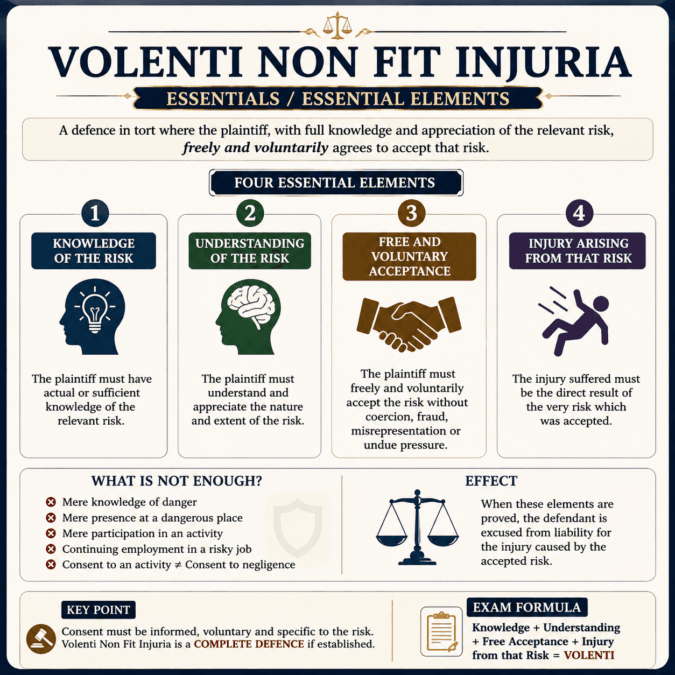
For examination purposes, divide volenti into two broad requirements:
A. Knowledge and understanding of the risk
The plaintiff must know and understand the nature of the relevant risk.
B. Free and voluntary acceptance of the risk
The plaintiff must freely choose to accept that risk.
Therefore:
Knowledge + understanding + free acceptance = Volenti
But:
Mere knowledge ≠ Volenti
This distinction is extremely important.
3. Essential Conditions of Volenti Non Fit Injuria
3.1 The Plaintiff Must Have Knowledge of the Risk
The plaintiff must have actual or sufficiently established knowledge of the danger involved.
For example, a person who enters a motor-racing event as a spectator ordinarily knows that fast-moving racing cars involve certain risks.
However, simply proving that the plaintiff knew that “something dangerous might happen” is not necessarily enough.
The defendant must connect the plaintiff’s knowledge to the relevant risk.
3.2 The Plaintiff Must understand the Nature of the Risk
Knowledge and understanding are closely related but should not be treated as identical.
A person may know that an activity is “dangerous” without understanding the particular danger involved.
Example
A patient agrees to an operation knowing that surgery involves risks.
That does not necessarily mean that the patient has consented to negligent performance of the operation.
The scope of consent depends upon what risk was actually understood and accepted.
4. Mere Knowledge Is Not Consent
This is the most important principle of volenti non fit injuria.
The classic authority is:
Smith v Baker & Sons (1891)
Facts
The plaintiff was employed by the defendants at a quarry.
Heavy stones were being lifted by a crane and passed over the place where the plaintiff was working.
The plaintiff knew about the dangerous practice and had continued working there.
A stone eventually fell and injured him.
The employers argued that the plaintiff knew about the danger and had therefore voluntarily accepted the risk.
Decision
The House of Lords rejected the defence.
The plaintiff’s knowledge of the danger and continued employment did not amount to voluntary consent to waive his right to compensation.
The case established the crucial distinction between:
Knowledge of a risk
and
Agreement to accept that risk.
The House of Lords explained that volenti requires more than mere knowledge and acquiescence; it requires an agreement to run the risk and give up the right to compensation for the resulting injury.
Principle
Mere knowledge of danger is not the same as voluntary acceptance of risk.
Exam line
Smith v Baker → Knowledge ≠ Consent
5. Free and Voluntary Consent Is Essential
Consent must be free.
If a person accepts a risk because of:
- coercion;
- fraud;
- misrepresentation;
- undue pressure; or
- circumstances leaving no reasonable alternative,
the defence may fail.
This is particularly important in employment relationships.
An employee may know that a workplace is dangerous but continue working because leaving the job is not a realistic choice.
Therefore, the court will not automatically say:
“You knew the workplace was dangerous, so you consented.”
This principle is clearly illustrated by Smith v Baker.
6. Consent Must Relate to the Particular Risk
A person does not consent to every conceivable risk merely by participating in an activity.
For example:
A person buys a ticket to watch a cricket match.
The spectator accepts ordinary risks associated with watching the match, such as a ball accidentally entering the spectator area.
But it does not necessarily follow that the spectator has consented to injuries caused by completely improper conduct or a failure to take precautions that the organiser was legally required to take.
Thus:
Consent has a scope.
The defendant must show that the risk which caused the injury was within the scope of the plaintiff’s voluntary acceptance.
7. Consent to Risk Is Different from Consent to Negligence
This is another important examination point.
Suppose A agrees to participate in a dangerous activity.
A may have accepted the ordinary risks inherent in the activity.
But that does not automatically mean A has consented to the defendant’s negligence.
For example, a person who participates in a sport may accept ordinary sporting risks but not necessarily negligent conduct outside the ordinary rules and nature of that sport.
Therefore:
Consent to a dangerous activity ≠ blanket consent to negligent conduct.
8. CASES
Hall v Brooklands Auto-Racing Club (1933)
Citation
Hall v Brooklands Auto-Racing Club [1933] 1 KB 205
Facts
The defendants operated a motor-racing track.
The plaintiff was a spectator at a motor race.
During the race, two cars collided. One car was thrown over the barrier into the spectator area, causing injury to the plaintiff.
The plaintiff claimed that the defendants were liable for failing to provide adequate protection.
The case concerned both the organiser’s duty of care and the extent to which a spectator accepts the inherent risks of a dangerous sporting event.
Decision and Principle
The case is traditionally cited in tort law for the principle that a spectator at a properly conducted dangerous sporting event may be taken to accept the ordinary and inherent risks of the event.
The organisers are not insurers against every accident merely because the activity is dangerous.
Important qualification
The case should not be understood as saying that spectators consent to every form of negligence.
The relevant question is whether the injury arose from a risk that was ordinary and inherent in the activity and whether the event was being conducted with reasonable precautions.
Exam memory
Hall v Brooklands → Sporting event + inherent risk
Wooldridge v Sumner (1963)
Facts
The plaintiff was a photographer attending a horse show.
While photographing the event, he moved close to the course.
A horse being ridden during the competition moved towards him and injured him.
Principle
The case is important in relation to sporting activities and the duty owed to spectators.
A participant in a sporting event is not ordinarily liable merely because an accident occurs. The conduct must be assessed against the standard applicable to the sport and the circumstances.
The case is often studied alongside Hall v Brooklands when explaining the risks inherent in sporting activities.
Exam point
Ordinary sporting risk does not automatically establish negligence.
ICI Ltd v Shatwell (1965)
This is one of the most important cases for understanding when volenti actually succeeds.
Citation
Imperial Chemical Industries Ltd v Shatwell [1965] AC 656
Facts
The plaintiffs were experienced workers involved in shot-firing operations.
Their employers had established safety rules and had instructed the workers to follow them.
The workers knew the safety requirements.
Despite those instructions, the two brothers deliberately decided to carry out the operation without taking the required safety precautions.
An explosion occurred and one of the brothers was injured.
Defence
The employer relied upon volenti non fit injuria.
Decision
The House of Lords accepted the defence in the circumstances.
The workers were experienced, knew the danger and deliberately chose to disregard the safety instructions. The facts therefore went substantially beyond the mere knowledge and acquiescence involved in Smith v Baker.
Principle
Where a person knowingly and freely chooses to undertake a specific risk, volenti may operate as a complete defence.
Comparison
Smith v Baker
Knowledge → No genuine voluntary acceptance → Defence fails.
ICI v Shatwell
Knowledge → Deliberate choice → Voluntary acceptance → Defence succeeds.
Exam memory
ICI v Shatwell → Deliberate acceptance of known risk
9. Employment and Volenti
Employment situations require special caution.
Historically, employers sometimes attempted to argue:
“The worker knew the work was dangerous, so the worker accepted the risk.”
Modern tort law does not accept such reasoning automatically.
The employee must have freely and voluntarily accepted the relevant risk.
Therefore:
Smith v Baker
Danger known by employee
↓
Employee continued working
↓
No genuine voluntary acceptance
↓
Volenti failed.
ICI v Shatwell
Danger known
↓
Safety instructions understood
↓
Deliberate disregard of safety precautions
↓
Voluntary assumption of risk
↓
Volenti succeeded.
9. Rescue Cases — A Major Limitation
One of the most important limitations of volenti arises in rescue situations.
Suppose a defendant creates a dangerous situation.
A third person sees someone in danger and attempts a reasonable rescue.
The defendant cannot ordinarily argue:
“The rescuer knew it was dangerous, therefore the rescuer consented to the risk.”
The law recognises that rescue behaviour is often a natural and reasonable response to danger.
Haynes v Harwood (1935)
Citation
Haynes v Harwood [1935] 1 KB 146
Facts
The defendant’s horse-drawn vehicle was left unattended in a crowded street.
The horses bolted, creating a serious danger to people nearby.
The plaintiff, a police officer, saw the danger and attempted to stop the horses to protect people in the street.
He was injured while doing so.
The defendant argued that the plaintiff had voluntarily exposed himself to danger.
Decision
The defence of volenti failed.
The plaintiff’s intervention was a reasonable response to the danger created by the defendant. The Court of Appeal treated the rescue situation differently from an ordinary case of voluntary risk-taking.)
Principle
A person who reasonably attempts to rescue others from danger does not ordinarily consent to the risk merely because the danger is obvious.
Exam memory
Haynes v Harwood → Rescue → Volenti fails
Baker v T.E. Hopkins & Son Ltd (1959)
This case further illustrates the rescue principle.
Facts
Employees of the defendant company were working in a well where dangerous fumes were present.
The situation became life-threatening.
A doctor came to the scene and attempted to rescue the workers despite being warned about the danger.
The doctor was overcome by the fumes and died.
The defendant argued that the doctor knew the danger and therefore had voluntarily accepted it.
Decision
The Court of Appeal rejected that approach.
The doctor’s knowledge of the danger did not mean that he had voluntarily consented to the risk in the legal sense. The court regarded it as inappropriate to treat a person who responded reasonably to an emergency as having freely waived his legal rights merely because he understood the danger. (Wikipedia)
Principle
Knowledge of danger in a rescue situation does not necessarily amount to voluntary assumption of risk.
Exam memory
Baker v Hopkins → Rescue + known danger ≠ consent
Cutler v United Dairies (1933)
This case provides a useful contrast with rescue cases.
A person who intervenes to control an animal may not always be able to rely upon the rescue principle.
The important question is whether there was a genuine emergency involving danger to human life or property and whether the claimant’s intervention was a reasonable response.
Therefore, the law does not say:
“Every person who voluntarily goes near danger is a rescuer.”
The circumstances must be examined carefully.
Nettleship v Weston (1971)
Facts
The plaintiff was teaching the defendant, a learner, how to drive.
The plaintiff knew that the defendant was inexperienced.
During the driving lesson, the defendant lost control of the vehicle and injured the plaintiff.
The defendant argued, among other things, that the plaintiff knew she was a learner and had therefore accepted the risk.
Decision
The Court of Appeal did not accept volenti as a defence.
The plaintiff’s knowledge that the defendant was inexperienced did not amount to voluntary acceptance of the risk of negligent driving. The court also applied the ordinary objective standard of care to the learner driver. (Wikipedia)
Principle
Knowing that another person is inexperienced does not automatically mean that one has consented to their negligent conduct.
Exam memory
Nettleship v Weston → Knowledge of inexperience ≠ acceptance of negligence
Morris v Murray (1991)
This case represents the other end of the spectrum.
Facts
The defendant was a qualified pilot.
He and the plaintiff had been drinking heavily.
Despite the circumstances, the defendant proposed flying a light aircraft.
The plaintiff voluntarily joined him.
The aircraft crashed and the plaintiff was injured.
The plaintiff subsequently claimed damages.
Decision
The Court of Appeal accepted the volenti defence.
The circumstances showed an exceptionally obvious and serious risk, and the plaintiff had actively and voluntarily participated in the flight despite that risk. (Wikipedia)
Principle
Where the plaintiff freely chooses to participate in an activity involving an exceptionally obvious and serious risk, the circumstances may establish voluntary assumption of risk.
Exam memory
Morris v Murray → Extremely obvious risk + voluntary participation
Dann v Hamilton (1939)
This case is useful for understanding the limits of volenti in cases involving an intoxicated driver.
The plaintiff accepted a lift from a driver who had been drinking.
The defendant argued that the plaintiff had voluntarily accepted the risk.
The court did not treat the circumstances as sufficient to establish volenti.
The case demonstrates that the mere fact that a passenger knew the driver had consumed alcohol does not automatically establish voluntary acceptance of the legal risk.
The degree of obviousness of the danger and the plaintiff’s knowledge of the defendant’s condition are relevant.
Slater v Clay Cross Co Ltd (1956)
Facts
The plaintiff was walking along a road at a railway crossing.
A train approached and struck her.
The railway company argued that the plaintiff had voluntarily encountered a known danger.
Decision
The defence of volenti was not accepted.
The case illustrates that a person’s mere awareness that a place or activity involves danger does not mean that the person has voluntarily agreed to waive legal rights against negligent conduct.
Principle
General awareness of danger is not equivalent to consent to negligent conduct.
This is particularly useful when distinguishing volenti from mere contributory negligence.
Indian Case — Padmavati v Dugganaika (1975)
Padmavati v Dugganaika, 1975 ACJ 222 / 1 Kant LJ 93
Facts
Two persons voluntarily took a lift in a jeep.
While the jeep was being used, a mechanical defect occurred involving the wheel/axle, causing the jeep to topple.
The passengers suffered injuries, and one passenger died.
The court considered the circumstances and held that the defendants were not liable on the facts; the case is commonly cited in Indian tort-law materials for the application of volenti non fit injuria, along with inevitable accident.
Principle
The case illustrates that where a person voluntarily enters into a situation and accepts its ordinary risks, the doctrine may become relevant.
Important caution
Students should not state that every passenger who voluntarily accepts a lift automatically accepts all risks. The actual facts, negligence, knowledge and nature of the risk must be examined.
Indian Judicial Approach — Kaushnuma Begum v New India Assurance Co.
The Supreme Court has referred to volenti non fit injuria while discussing exceptions associated with strict liability and the law of torts. (Indian Kanoon)
This is useful for Indian students because it shows that the doctrine is not merely an English textbook concept; it appears in Indian judicial reasoning as well.
However, students should avoid applying volenti mechanically to every motor accident or insurance claim. The precise statutory framework, facts and nature of the claim must be examined.
10. Burden of Establishing Volenti not fit injuria
The defendant who relies upon volenti must establish the necessary facts.
The defendant should therefore show, in substance, that:
- the plaintiff knew of the relevant risk;
- the plaintiff understood or appreciated the nature of that risk;
- the plaintiff had a genuine opportunity to choose;
- the plaintiff freely accepted the risk; and
- the injury resulted from the risk that was actually accepted.
A mere assertion such as:
“The plaintiff knew it was dangerous”
is not enough.
11. What Is Not Sufficient for Volenti?
The following circumstances do not automatically establish volenti:
Mere knowledge
Knowing that something is dangerous is not enough.
Case: Smith v Baker
Mere presence
Being present at a dangerous place does not automatically constitute consent.
Mere participation
Participation in an activity does not mean acceptance of every possible risk.
Mere continuation of employment
Continuing to work despite known danger does not automatically establish consent.
Case: Smith v Baker
Knowledge of another person’s inexperience
Knowing that someone is inexperienced does not necessarily amount to accepting negligent conduct.
Case: Nettleship v Weston
Attempting a reasonable rescue
A rescuer’s knowledge of danger does not automatically establish voluntary assumption of risk.
Cases: Haynes v Harwood; Baker v T.E. Hopkins
12. When Is Volenti More Likely to Succeed?
The defence becomes stronger where the facts show:
- the risk was obvious;
- the plaintiff had full knowledge of it;
- the plaintiff understood its nature;
- the plaintiff had a genuine choice;
- the plaintiff deliberately chose to participate;
- the risk was the very risk that caused the injury; and
- there was no coercion, fraud or misrepresentation.
Cases:
- ICI Ltd v Shatwell
- Morris v Murray
- Hall v Brooklands — in relation to inherent sporting risks.
13. Volenti and Contributory Negligence — Important Difference
Students frequently confuse these two doctrines.
| Basis | Volenti Non Fit Injuria | Contributory Negligence |
| Meaning | Voluntary acceptance of risk | Failure to take reasonable care |
| Consent | Essential | Not essential |
| Main question | Did plaintiff freely accept the risk? | Did plaintiff fail to take reasonable care? |
| Effect | Generally complete defence if established | Generally reduces damages |
| Example | Deliberately accepting an exceptionally obvious risk | Failing to wear reasonable protective equipment |
| Key case | ICI v Shatwell | Depends on facts |
Easy formula
Volenti:
“I knew and freely accepted the risk.”
Contributory negligence:
“I failed to take reasonable care.”
14. Volenti vs Inevitable Accident
These are also different.
Volenti
The plaintiff consented to the risk.
Inevitable accident
The defendant argues that the accident occurred despite reasonable care and could not reasonably have been avoided.
Therefore, do not write:
“The accident was inevitable, therefore volenti applies.”
They are separate defences and must be analysed separately.
15. Volenti and Strict Liability
Volenti may appear as one of the recognised exceptions to the rule of strict liability under Rylands v Fletcher.
But remember:
Strict liability is a principle of liability, whereas volenti is a defence.
So your LL.B. notes should treat:
Strict Liability → Rule of Liability
and
Volenti → Defence/Exception
as separate concepts.
16. Limitations of Volenti Non Fit Injuria
The doctrine is subject to several important limitations.
1. Mere knowledge is insufficient
Smith v Baker
2. Consent must be free
Pressure or lack of meaningful choice may prevent genuine consent.
3. Consent must relate to the particular risk
Consent is not unlimited.
4. Consent to an activity is not necessarily consent to negligence
The defendant cannot use volenti as a blanket defence.
5. Rescue situations receive special protection
Haynes v Harwood
Baker v T.E. Hopkins
6. Employment relationships require special scrutiny
Smith v Baker
7. The defence must be established by the defendant
It cannot simply be presumed.
8. Children and persons lacking sufficient understanding
A person’s age, capacity and actual understanding may be relevant to whether there was genuine consent.
30. The Most Important Cases — Revision Table
| Case | Main Principle |
| Smith v Baker (1891) | Mere knowledge of danger is not consent |
| Hall v Brooklands (1933) | Ordinary inherent risks of properly conducted sporting events |
| Cutler v United Dairies (1933) | Limits of treating intervention as rescue |
| Dann v Hamilton (1939) | Knowledge of intoxicated driver did not automatically establish volenti |
| Haynes v Harwood (1935) | Reasonable rescue is generally not voluntary assumption of risk |
| Slater v Clay Cross (1956) | Mere awareness of danger does not amount to consent |
| Baker v T.E. Hopkins (1959) | Rescuer’s knowledge of danger does not necessarily amount to consent |
| Wooldridge v Sumner (1963) | Sporting activity and inherent risks |
| ICI Ltd v Shatwell (1965) | Deliberate acceptance of a known risk |
| Nettleship v Weston (1971) | Knowledge of learner’s inexperience is not consent to negligence |
| Padmavati v Dugganaika (1975) | Indian authority commonly associated with voluntary assumption of risk |
| Morris v Murray (1991) | Exceptionally obvious risk voluntarily undertaken |
16. Four Cases Every LL.B. Student Should Remember
If the examination asks a short question on volenti, remember these four first:
1. Smith v Baker
Mere knowledge ≠ consent
2. Hall v Brooklands
Inherent sporting risk
3. Haynes v Harwood
Rescue → volenti generally fails
4. ICI v Shatwell
Deliberate acceptance → volenti succeeds
Then add:
5. Morris v Murray
Exceptionally obvious risk voluntarily undertaken
For an Indian law answer, add:
6. Padmavati v Dugganaika
Indian illustration of voluntary assumption of risk
Exam-Oriented Conclusion
Volenti non fit injuria is a consent-based defence in the Law of Torts. It applies where the plaintiff knows, understands and freely accepts the particular risk that results in injury.
The doctrine should not be confused with mere knowledge of danger.
The central rule can be expressed as:
Mere knowledge of a risk is not consent; there must be free and voluntary acceptance of that risk.
The contrast between Smith v Baker and ICI Ltd v Shatwell is especially important. In Smith v Baker, the plaintiff knew about the danger but had not freely consented to it. In ICI v Shatwell, the workers knowingly and deliberately chose to disregard safety instructions and undertake the risk.
Likewise, Haynes v Harwood and Baker v T.E. Hopkins show why the doctrine is generally unsuitable where a person reasonably responds to an emergency and attempts a rescue.
One-line definition for examination
Volenti non fit injuria is a defence in tort whereby a defendant is excused from liability where the plaintiff, with full knowledge and understanding of the relevant risk, freely and voluntarily agreed to accept that risk.
Volenti Non Fit Injuria = KNOW → UNDERSTAND → FREELY CHOOSE → ACCEPT THE RISK
If any of these essential components is missing, the defence of volenti may fail.
FAQs — Volenti Non Fit Injuria
1. What is Volenti Non Fit Injuria?
It means that a person who knowingly and freely accepts a particular risk generally cannot claim compensation for injury resulting from that accepted risk.
2. What are the essential elements of Volenti Non Fit Injuria?
The main requirements are knowledge of the risk, understanding of the risk, and free and voluntary acceptance of the risk.
3. Is mere knowledge of danger enough to establish Volenti Non Fit Injuria?
No. Mere knowledge is not the same as consent. The plaintiff must also have freely accepted the risk. This principle is illustrated by Smith v Baker.
4. What is the difference between Volenti Non Fit Injuria and contributory negligence.
Volenti is based on voluntary acceptance of risk, while contributory negligence is based on the plaintiff’s failure to take reasonable care for their own safety.
5. What are the important cases on Volenti Non Fit Injuria?
Important cases include Smith v Baker, Hall v Brooklands Auto-Racing Club, Haynes v Harwood, ICI Ltd v Shatwell, Nettleship v Weston and Morris v Murray.
Classmate Pulse Spiral Notebook ✏️ Need a Spiral Notebook for Everyday Writing? A spiral notebook…

Latest Scholarships & Fellowships 2026–27: Open Opportunities for Upcoming call
Latest Scholarships & Research Fellowships 2026–27 Last Verified: 30 September 2026 Students, researchers, PhD scholars…
Writing & Research Resources: Useful Books, Tools & Essentials for Writers and Researchers
Whether you are an author, content writer, law student, academic researcher, PhD scholar, teacher, or…

International Treaties as a Source of International Law | LL.B. Notes
International Treaties as a Source of International Law Introduction International treaties are one of the…

The Ultimate Guide to Organizing LLB Notes for Exam Success
LLB Notes for Exam Success Studying law is not simply about reading hundreds of pages….
What Is the Best AI Tool for Legal Research in 2026? A Practical Guide for Lawyers, Law Students and Researchers
What Is the Best AI Tool for Legal Research in 2026? Last updated: September 2026…