
Cluster Post 2 | Module 5: Thesis Writing and Submission
From Concept to Submission Series | 2026
Writing the Thesis Abstract and Introduction
Two clarifications before we begin. First, terminology varies by institution and country: what Indian universities often call an ‘executive summary’ or ‘abstract submitted with the thesis,’ UK universities call the ‘abstract,’ US universities call the ‘dissertation abstract,’ and Australian universities sometimes call the ‘summary.’ This post uses ‘thesis abstract’ throughout — the universal term for the same document across all systems.
Second, this post is about the thesis abstract — not the synopsis. The synopsis (called research proposal or prospectus in many international systems) is written before research begins and is covered separately in Cluster Post 6 of this module. The thesis abstract is written after the research is complete.
| Document | When written | System / purpose |
| Thesis Abstract | After research is complete — submitted with the final thesis | Universal: required at all universities globally. Summarises completed research in past tense. Deposited in institutional repository (Shodhganga in India; ProQuest in USA; EThOS in UK; DART-Europe in Europe). |
| Synopsis / Research Proposal / Prospectus | Before research begins — submitted for registration approval | Varies by name and format. Called ‘synopsis’ in Indian universities (DRC approval); ‘research proposal’ in UK/Australia; ‘dissertation prospectus’ in USA. Covered in Cluster Post 6. |
| Journal Article Abstract | After the paper is written | Standalone summary for publication. 150–250 words. Covered in Module 6. |
The Thesis Abstract: What It Must Do
The thesis abstract is the most widely read part of your thesis — and the most underwritten. Database searches return abstracts. Examiners read them before approaching the full document. Future researchers use them to assess relevance. The abstract does more work per word than any other section you will write.
The most common failure: an abstract that describes the topic without reporting what the research found. ‘This thesis examines AI surveillance and constitutional rights’ tells the reader only the subject area. A complete abstract tells the reader what was investigated, how, what was found, and what it contributes. A reader who finishes it should know the thesis’s core argument without reading the document itself.
Word limits by system
| University system | Typical abstract word limit |
| India (UGC guidelines) | 300–500 words. Shodhganga requires the abstract for online deposit. |
| United Kingdom | 300 words is standard at most UK universities (University of Oxford, UCL, Edinburgh). Some allow up to 500. |
| United States | 350 words is the ProQuest standard for dissertation abstracts. Some universities allow up to 500. |
| Australia | Usually 300–500 words. Go8 universities vary; check institutional requirements. |
| Europe | Varies by country and institution. 200–400 words is the most common range. |
| Rule of thumb | If your institution does not specify, 300 words is a safe universal target. Always check your institution’s regulations first. |
The eight-sentence structure
The following structure produces a complete abstract in approximately 200–300 words. Each sentence has a specific job. This structure works across all disciplines and all university systems.
- Sentence 1 — Context: One sentence establishing the real-world or disciplinary situation that makes the research significant. Do not begin with ‘This thesis examines…’ — begin with the world the research inhabits.
- Sentence 2 — The gap: What is missing from existing knowledge or practice that this research addresses.
- Sentence 3 — The consequence: Why the gap matters — what problem it creates, who it affects.
- Sentence 4 — The research aim: What this thesis set out to do. One sentence, past tense.
- Sentence 5 — The method: How the research was conducted. Name the methodology and key features.
- Sentence 6 — Scope or supplementary method: The scope boundary or any additional methodological dimension.
- Sentence 7 — The key finding: What the research found. This is the most important sentence. Be specific — name the actual finding, not just that findings exist.
- Sentence 8 — Contribution and implication: What the research contributes to knowledge and what its practical or policy implication is.
Fully worked example
The proliferation of AI-powered surveillance technologies across public spaces has outpaced the constitutional frameworks designed to regulate state power over citizens. While proportionality has emerged as the governing standard for privacy rights adjudication across democratic legal systems, courts have not developed principled frameworks for applying this standard to AI-enabled surveillance — facial recognition, predictive policing, and ambient data collection. As a result, judicial review of these technologies remains inconsistent, leaving citizens and state actors without reliable constitutional guidance. This thesis developed a doctrinal framework for judicial review of AI surveillance under constitutional privacy protections. A doctrinal methodology was employed, analysing appellate court decisions on privacy and surveillance from 2017 to 2025 across three jurisdictions: India, the European Union, and the United Kingdom. Three recurring patterns of doctrinal incoherence were identified across all three systems. The analysis established proportionality — operationalised through a necessity-based three-stage analysis — as the most constitutionally grounded basis for a comprehensive review framework applicable across democratic legal systems. The proposed framework offers courts a principled basis for balancing security interests against privacy rights in AI surveillance contexts, with direct implications for constitutional adjudication and legislative design. [Word count: 196 words. Past tense throughout. All eight elements present. No mention of ‘This thesis examines’ as an opener. Specific finding named in sentence 7.]
Notice what this abstract does not do: it does not begin with ‘This thesis examines…’ — that opener wastes the first sentence on structure rather than substance. It does not say ‘findings were presented’ — it states what the findings were. It does not use future tense anywhere — the research is complete.
Tense is the clearest marker between documents
| Document | Tense — and why |
| Synopsis / Research Proposal / Prospectus | Future tense — ‘This research will examine… the study will use…’ The research has not yet happened. |
| Thesis Abstract (this post) | Past tense throughout — ‘This thesis examined… the study used… the analysis identified…’ The research is complete. |
| Journal Article Abstract | Past tense for findings; present tense for conclusions that remain true — ‘The study found… The findings suggest that…’ |
The Introduction Chapter: Five Jobs in Order
Key distinction from the abstract: the abstract reports what was done and found, in compressed form. The introduction chapter builds the intellectual case for why the research was worth doing — progressively constructing the problem and culminating in the research questions. The abstract is a report; the introduction is an argument.
The introduction’s job is to create the intellectual problem the thesis solves, justify why that problem matters, and commit to what the thesis will do about it. These five jobs should be done in sequence.
Job 1: Establish the world (1–3 sentences)
Open with the broadest frame relevant to your research. The goal is to locate the reader in the context that makes your question significant — not to provide background for its own sake. Every sentence should be pulling toward the problem.
Weak — too broad, no direction: ‘Privacy has been recognised as a fundamental human right across many democratic systems worldwide. In recent decades, significant social and legal changes have occurred. Technology has also changed rapidly.’ Strong — establishes world and moves toward the problem: ‘The proliferation of AI-powered surveillance technologies across public spaces has outpaced the constitutional frameworks designed to regulate state power over citizens. Courts are being asked to adjudicate privacy claims against systems — facial recognition, predictive policing, ambient sensors — that existing doctrine did not anticipate.’
Job 2: Identify the specific problem
Narrow from the broader context to the precise problem your research addresses — specific enough that it could not describe any other thesis. The gap is introduced here in compressed form; the literature review chapter will establish it in full detail.
Too general: ‘There are many unanswered questions about privacy and AI surveillance.’ Specific: ‘Post-2017 case law in multiple jurisdictions has applied privacy doctrine inconsistently in AI surveillance contexts: courts invoke proportionality, necessity, and legitimate aim as review criteria without establishing their relationship or individual requirements. This doctrinal incoherence produces unpredictable outcomes and prevents lower courts from applying the framework consistently.’
Job 3: State why the problem matters
The problem statement establishes what is missing. The significance statement establishes why it matters — who is affected, what consequence follows from the gap. Both are necessary. A research gap is not self-evidently significant.
‘This doctrinal incoherence has practical consequences. Citizens whose biometric data is collected without consent cannot predict whether a constitutional challenge will succeed. State actors deploying AI surveillance cannot plan around a stable framework. And the constitutional promise that privacy protects the individual from state power remains incompletely redeemed in precisely the contexts where that protection is most needed.’
Job 4: State the research aim and questions
The research questions are the commitment the thesis must honour. State them precisely — an examiner will assess whether the thesis has answered them. Vague questions cannot be answered, only discussed.
Vague: ‘This thesis examines the relationship between AI surveillance and privacy.’ Precise and answerable: ‘Three questions guide this thesis: (1) What doctrinal principles do courts apply when reviewing AI surveillance under constitutional privacy protections? (2) Are those principles internally consistent across cases and jurisdictions? (3) If not, what framework would provide doctrinal coherence and reliable guidance to courts?’
Job 5: Scope, limitations, and chapter overview
Scope and limitations define the territory the thesis covers and the points at which it stops — not as defensive apology, but as intellectual honesty. Naming what is not covered tells the reader that these absences are deliberate choices, not oversights.
The chapter overview should be one sentence per chapter stating what each does for the overall argument — not just what it contains.
Contents note (weak): ‘Chapter 2 reviews the existing literature on privacy and AI surveillance.’ Functional description (strong): ‘Chapter 2 maps the doctrinal development of constitutional privacy jurisprudence across the three jurisdictions studied and identifies the specific coherence problems that post-2017 surveillance decisions have produced — establishing the precise gap this thesis addresses.’
Chapter overview sentence formula: ‘Chapter [N] [establishes / develops / analyses / tests / argues] [specific content], [showing / demonstrating / establishing] [what this achieves for the overall argument].’
Introduction length: what is normal by system
| University system | Typical introduction chapter length |
| India (most universities) | 12–20 pages. Often longer than international equivalents because institutional conventions require more contextual background. |
| United Kingdom | 8–15 pages. UK examiners generally prefer concise, argument-driven introductions over comprehensive scene-setting. |
| United States | 10–20 pages. Varies by discipline — STEM dissertations shorter; humanities and social science longer. |
| Australia | 10–18 pages. Similar to UK conventions at research-intensive universities. |
| Rule of thumb | The introduction should be long enough to create the problem clearly and commit to the research questions — and no longer. If background is extensive, move it to Chapter 2. |
The four most common introduction failures
- Starting too broadly: opening with universal history of the topic when the thesis addresses a specific contemporary question. The opening frame should be exactly as broad as necessary to establish significance — no broader.
- Burying the research question: stating the research question on page 10 of a 15-page introduction after extensive background. The problem and research questions should appear within the first third of the introduction.
- Describing rather than arguing: ‘AI surveillance is widespread’ is a description. ‘AI surveillance is widespread and courts lack a principled framework for evaluating constitutional challenges to it’ is the beginning of a problem. The introduction must create a problem, not describe a landscape.
- Chapter overview as contents list: ‘Chapter 3 covers X, Chapter 4 covers Y’ without showing how each chapter advances the argument. The overview should convey architecture, not inventory.
For Law Students
Thesis abstract for doctrinal legal research
The eight-sentence structure applies directly to doctrinal theses with one adaptation: sentence 7 (the key finding) states the doctrinal conclusion or reform proposal, not statistical results. A doctrinal thesis that concludes that ‘proportionality, operationalised through a necessity-based three-stage analysis, provides the most constitutionally grounded framework for AI surveillance review’ has a specific, examinable finding. An abstract that says only ‘the thesis examines relevant case law and presents conclusions’ has no finding.
Indian law journals (JILI, NUJS Law Review, NLSIR, NALSAR Law Review) typically require abstracts of 150–250 words for article submissions — shorter than the thesis abstract. Rewrite completely when moving from thesis abstract to journal article abstract. Do not simply trim: the framing, emphasis, and audience are different. The journal abstract must stand alone and persuade an editor that the article is worth reviewing; the thesis abstract is a summary for examiners who will read the full document regardless.
The three types of doctrinal introduction
In doctrinal legal research, the intellectual problem is usually one of three types. Knowing which type you are addressing determines what kind of contribution the thesis makes — and therefore how the introduction must be framed.
- Unsettled law: courts have reached inconsistent conclusions on the same question across cases or jurisdictions. The thesis synthesises doctrine and proposes a coherent framework. The introduction establishes the inconsistency as the problem.
- Incomplete law: established doctrine has not addressed a new situation. The thesis extends existing principles to the new context. The introduction establishes the new situation and the doctrinal silence as the problem.
- Problematic law: the law is coherent but produces unjust outcomes, conflicts with constitutional values, or rests on flawed reasoning. The thesis argues for reform. The introduction establishes the current rule and demonstrates why it is inadequate.
Knowing which type of thesis you are writing before drafting the introduction prevents the most common doctrinal introduction failure: being unclear about what the thesis claims to contribute — and therefore writing an introduction that neither creates a problem nor commits to resolving it.
References
- Booth, W. C., et al. (2024). The Craft of Research (5th ed.). University of Chicago Press.
- Murray, R. (2011). How to Write a Thesis (3rd ed.). Open University Press.
- Swales, J. M., & Feak, C. B. (2012). Academic Writing for Graduate Students (3rd ed.). University of Michigan Press.
- Paltridge, B., & Starfield, S. (2020). Thesis and Dissertation Writing in a Second Language (2nd ed.). Routledge.
- ProQuest Dissertation Abstracts guidelines. proquest.com
- Shodhganga thesis deposit guidelines. shodhganga.inflibnet.ac.in
Module 5 Cluster Post 2
See also: Cluster Post 6 — Writing the PhD Synopsis (India) / Research Proposal (International)

The Complete Guide to Research Paper Structure: IMRAD Format, Thesis Organization & Academic Writing (2026)
From Concept to Submission: A Complete Guide to Research Paper and Thesis Writing Module 1:…
The IMRAD Framework: Why It Exists, How It Really Works, and Where It Breaks Down
Cluster Post 1 | Module 1: Understanding the Structure of Research Papers and Theses From…

How to Write a Research Introduction That Reviewers Cannot Ignore
Cluster Post 2 | Module 1: Understanding the Structure of Research Papers and Theses From…

How to Write a Methods Section That Reviewers Will Trust
Cluster Post 3 | Module 1: Understanding the Structure of Research Papers and Theses From…
The Results Section: How to Present Findings Without Letting Interpretation Slip In
Cluster Post 4 | Module 1: Understanding the Structure of Research Papers and Theses From…
The Discussion Section: How to Turn Findings Into Knowledge
Cluster Post 5 | Module 1: Understanding the Structure of Research Papers and Theses From…
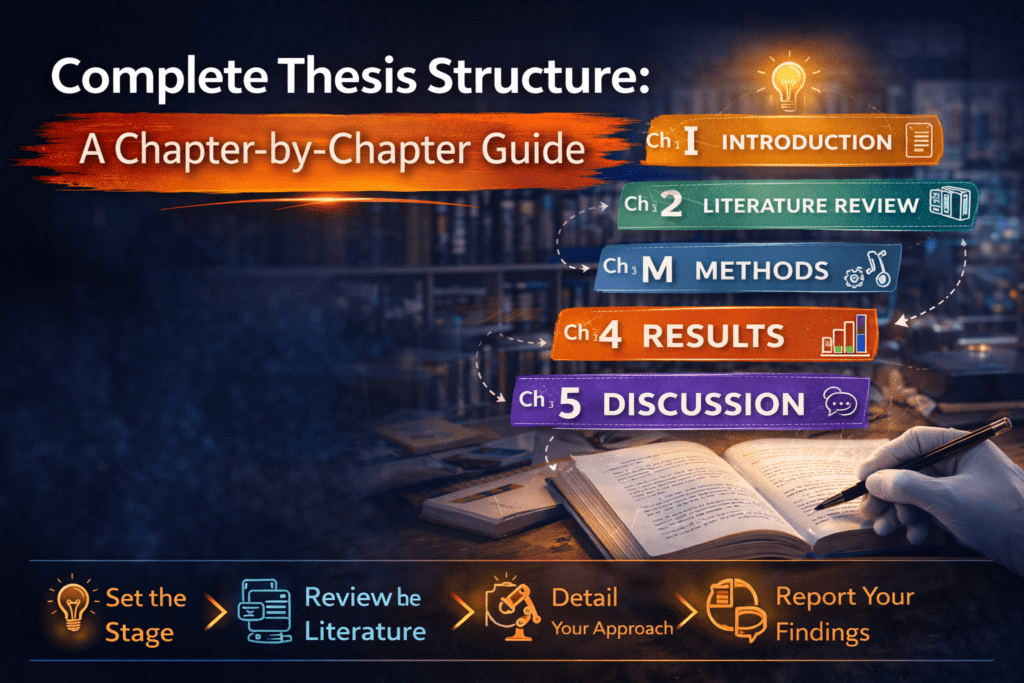
Complete Thesis Structure: A Chapter-by-Chapter Guide
Cluster Post 6 | Module 1: Understanding the Structure of Research Papers and Theses From…

10 Structural Mistakes That Get Research Papers Rejected — And How to Fix Every One
Cluster Post 7 | Module 1: Understanding the Structure of Research Papers and Theses From…
The Academic Writing Process: Complete Guide from First Draft to Submission (2026)
From Concept to Submission: A Complete Guide to Research Paper and Thesis Writing Module 2,…
How to Start Writing — and Keep Going
Cluster Post 1 | Module 2: The Academic Writing Process From Concept to Submission Series …

How to Write Clear Engaging Academic Prose
Cluster Post 2 | Module 2: The Academic Writing Process From Concept to Submission Series …
The Revision Process: How to Turn a Draft Into a Submission
Cluster Post 3 | Module 2: The Academic Writing Process From Concept to Submission Series …
Citation Styles Explained: APA, MLA, Chicago, IEEE, and Bluebook
Cluster Post 4 | Module 2: The Academic Writing Process From Concept to Submission Series …
Reference Management: Zotero and Mendeley from Setup to Submission
Cluster Post 5 | Module 2: The Academic Writing Process From Concept to Submission Series …
Research Methodologies: Complete Guide to Quantitative, Qualitative, Mixed Methods & Legal Research (2026)
Why Methodology Determines Research Quality Here’s what thesis examiners focus on first: your methodology section…

Research Paradigms: Why Your Philosophical Stance Shapes Everything
Cluster Post 1 | Module 3: Research Methodologies From Concept to Submission Series | 2026 ←…
Quantitative Research Design: From Hypothesis to Valid Results
Cluster Post 2 | Module 3: Research Methodologies From Concept to Submission Series | 2026…
Qualitative Research Design: Choosing the Right Approach
Cluster Post 3 | Module 3: Research Methodologies From Concept to Submission Series | 2026…
Qualitative Data Collection and Analysis: Interviews, Coding, and Trustworthiness
Cluster Post 4 | Module 3: Research Methodologies From Concept to Submission Series | 2026…
Mixed Methods Research: When and How to Combine Approaches
Cluster Post 5 | Module 3: Research Methodologies From Concept to Submission Series | 2026…
Sampling: Choosing Who to Study and How Many
Cluster Post 6 | Module 3: Research Methodologies From Concept to Submission Series | 2026…
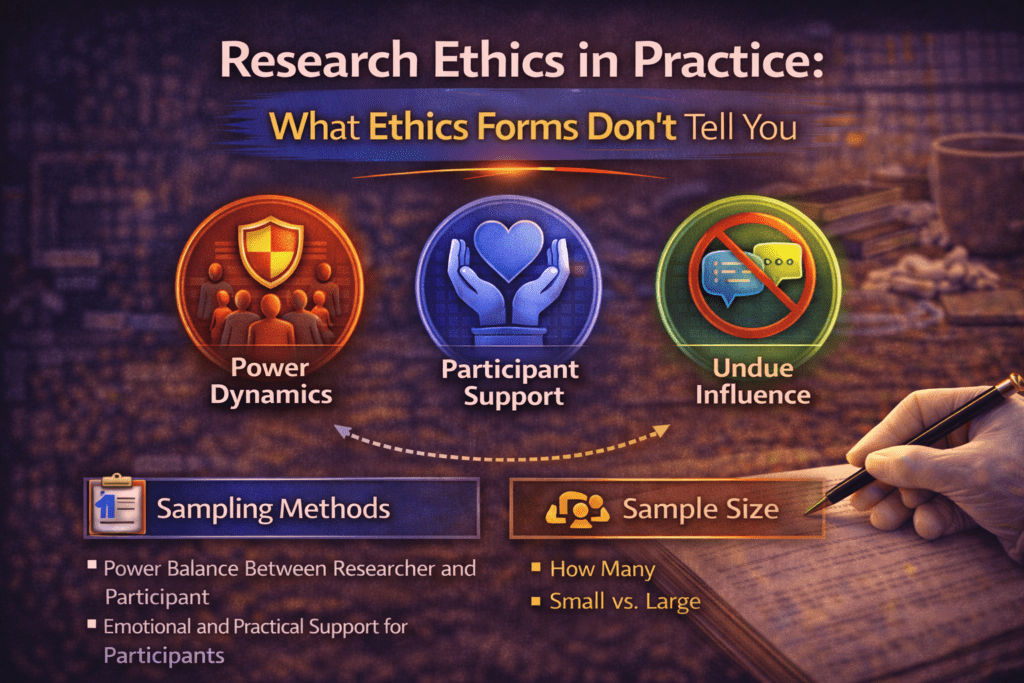
Research Ethics in Practice: What Ethics Forms Don’t Tell You
Cluster Post 7 | Module 3: Research Methodologies From Concept to Submission Series | 2026…
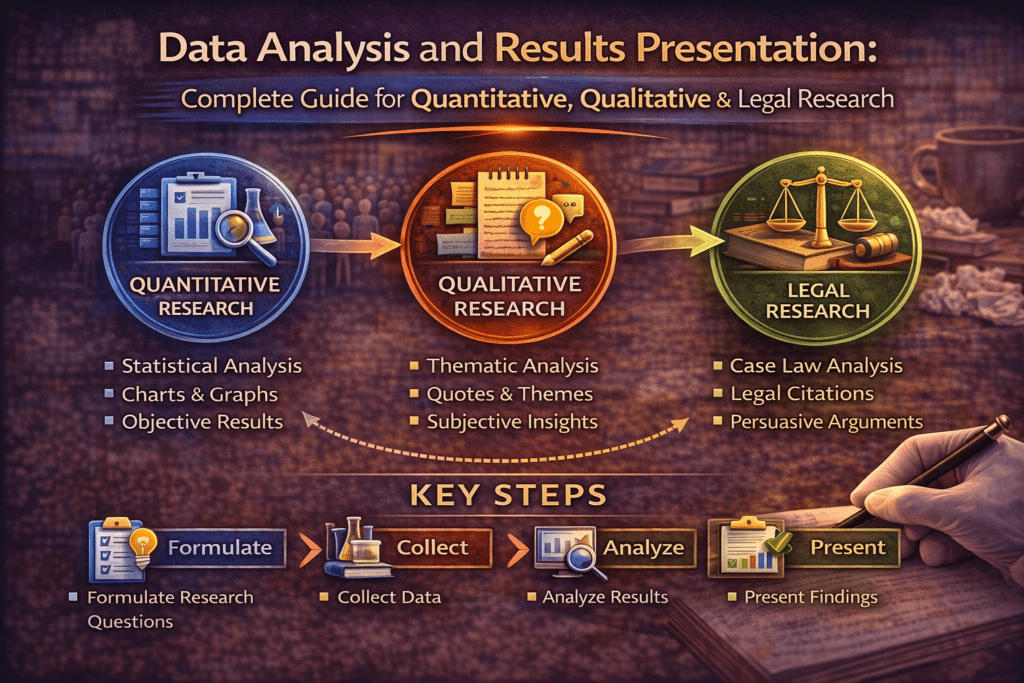
Data Analysis and Results Presentation: Complete Guide for Quantitative, Qualitative & Legal Research (2026)
Data Analysis and Results Presentation: Why Data Analysis Determines Research Credibility Here’s what separates published…
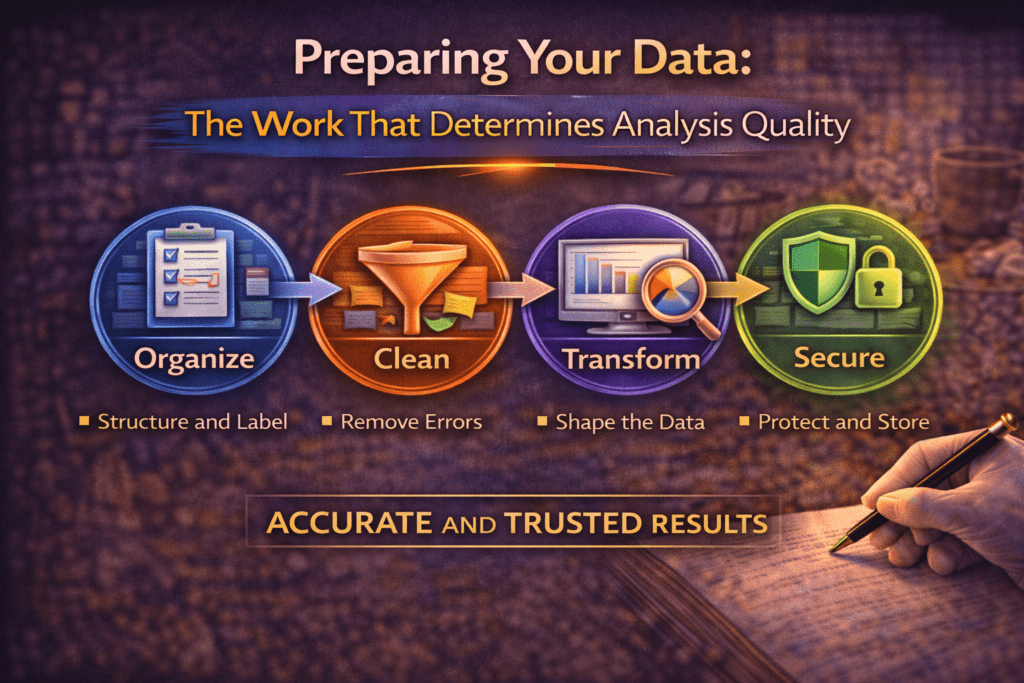
Preparing Your Data: The Work That Determines Analysis Quality
Cluster Post 1 | Module 4: Data Analysis and Presenting Results From Concept to Submission…
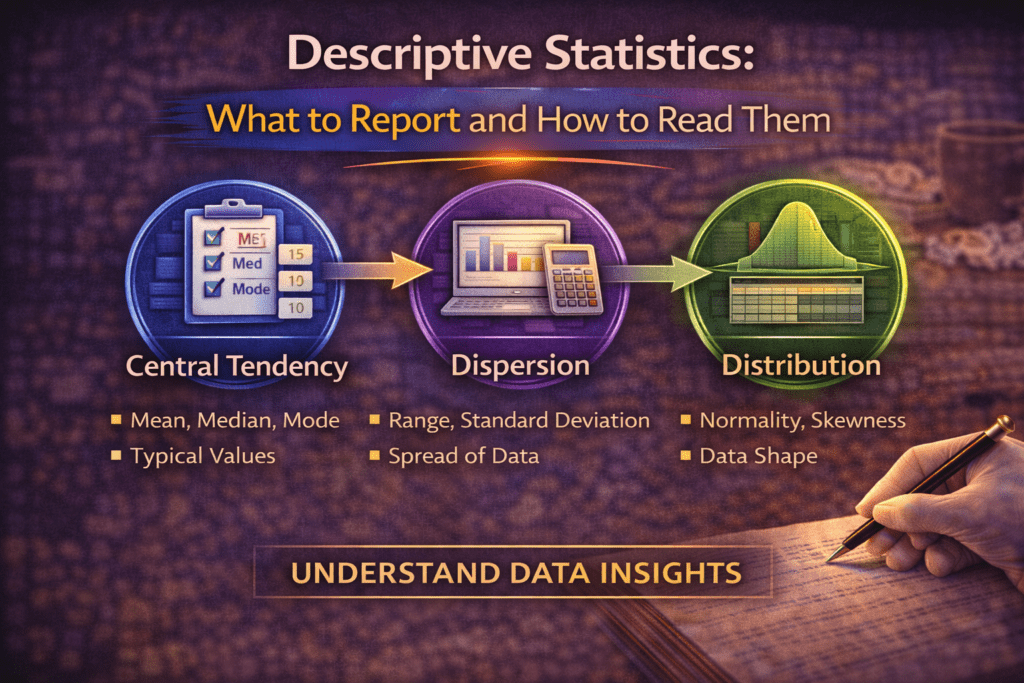
Descriptive Statistics: What to Report and How to Read Them
Cluster Post 2 | Module 4: Data Analysis and Presenting Results From Concept to Submission…
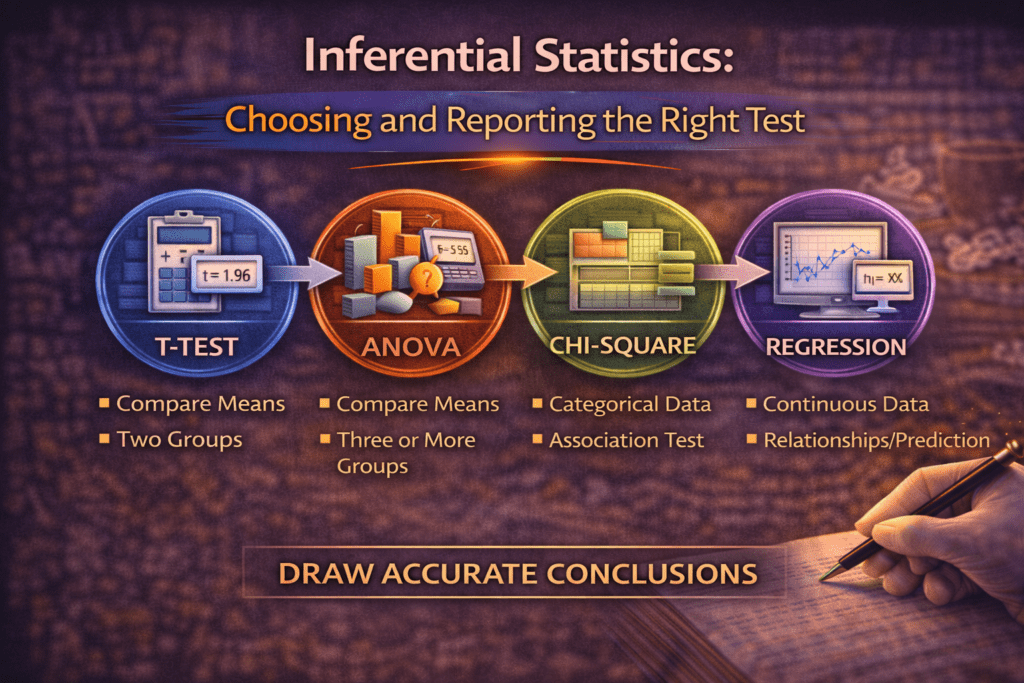
Inferential Statistics: Choosing and Reporting the Right Test
Cluster Post 3 | Module 4: Data Analysis and Presenting Results From Concept to Submission…
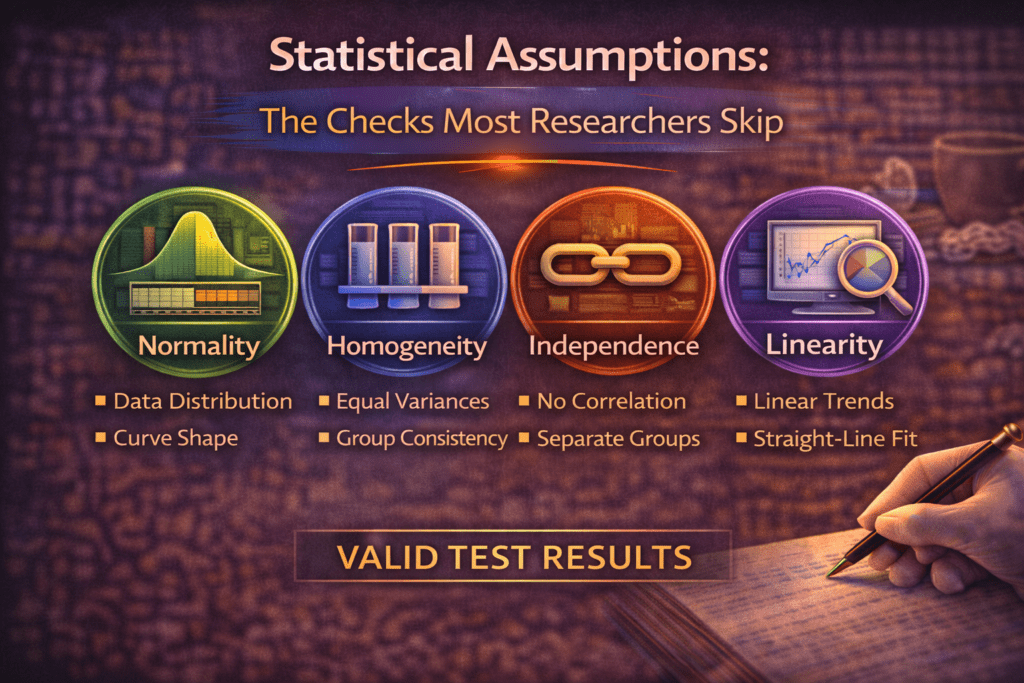
Statistical Assumptions: The Checks Most Researchers Skip
Cluster Post 4 | Module 4: Data Analysis and Presenting Results From Concept to Submission…
Presenting Qualitative Findings: Quotes, Themes, and the Balance Between Showing and Telling
Cluster Post 5 | Module 4: Data Analysis and Presenting Results From Concept to Submission…
Writing the Results Section: Separating Findings from Interpretation
Cluster Post 6 | Module 4: Data Analysis and Presenting Results From Concept to Submission…
Organization and Academic Tone: Complete Guide to Professional Scholarly Writing (2026)
Why Organization and Academic Tone Matter More Than You Think Here’s what thesis examiners notice…