
Last Updated: March 18, 2026
Cluster Post 1 | Module 4: Data Analysis and Presenting Results
From Concept to Submission Series | 2026
Academic Writing Mastery: The Complete 2026 Guide To Research Papers, Thesis & Dissertation Writing
Preparing Your Data: The Work That Determines Analysis Quality
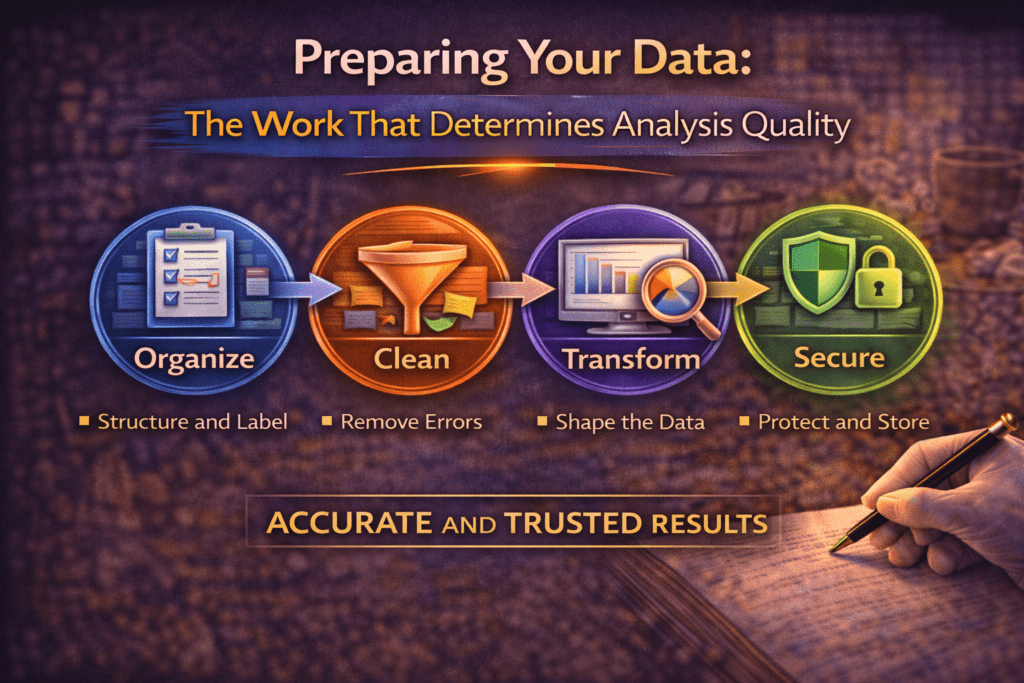
The module overview mentions data preparation briefly before moving to analysis techniques. This post goes deeper: how to build a codebook that prevents analysis errors six months later, the specific cleaning checks that every quantitative dataset needs before a single statistical test is run, how to handle missing data without introducing bias, and how to organise qualitative data so that analysis is systematic rather than impressionistic.
Why Data Preparation Is Not a Preliminary Step
Most research methods courses present data preparation as the unglamorous preamble to the real work of analysis. Run your cleaning checks, set up your files, then do the analysis. This framing underestimates how consequential preparation decisions are.
Every analysis you run is only as trustworthy as the data it runs on. A regression model built on data with uncorrected entry errors will produce precise-looking but inaccurate estimates. A thematic analysis conducted on poorly organised transcripts will miss patterns that are present in the data. The most sophisticated statistical technique cannot compensate for corrupted input data. Getting preparation right is not a preliminary — it is a precondition.
Preparation errors are also disproportionately difficult to catch after analysis. A data entry error that produced one impossible value — an age of 300 — is easy to fix if caught before analysis. If caught after analysis, you need to know whether that error affected your results: re-run the descriptives, check whether the outlier was influential in your regressions, decide whether the published results need correction. The same hour spent on cleaning before analysis saves many hours after it.
Building a Quantitative Codebook
A codebook is a document that defines every variable in your dataset: what it represents, how it was measured, how it is coded in the spreadsheet, and any transformations applied. It is the bridge between your data collection instrument and your analysis files, and it is essential for research that will be written up months after data was collected.
The codebook must be created before data entry begins, not after. Deciding how to code variables after you have already collected data produces inconsistency. If some respondents wrote “Male” and others wrote “M” and you enter both without standardising, your software will treat them as two different categories.
What every codebook entry needs
| Codebook field | What to include |
| Variable name | Short, consistent label used in the spreadsheet (e.g., gender, age, Q3_anxiety). No spaces; use underscores. |
| Variable label | Full description of what the variable measures (e.g., ‘Participant self-reported gender identity’) |
| Variable type | Nominal, ordinal, interval, or ratio — this determines which statistics are appropriate |
| Response options and codes | Every possible value and its numeric code (e.g., 1 = Male, 2 = Female, 3 = Non-binary, 4 = Prefer not to say, 99 = Missing) |
| Source | Which question on which instrument this variable came from (e.g., ‘Demographic questionnaire, Q2’) |
| Notes | Any transformations applied, reverse-scoring instructions, or special cases to be aware of |
Separate missing data codes from valid response codes. If your scale runs from 1 to 5, do not code a missing response as 0 — it will be treated as a valid data point lower than 1, distorting means and correlations. Use a clearly out-of-range code (99 or -9) and tell your software to treat it as missing before analysis.
Reverse-scored items: the most common codebook omission
Many psychological scales include reverse-scored items — questions where a high score indicates the opposite of a high score on other items. On an anxiety scale, most items might be scored so that higher = more anxious, but an item like “I feel calm and in control” requires that the scoring be reversed (5 becomes 1, 4 becomes 2, and so on) before computing the scale total.
Reverse-scoring failures are among the most common analysis errors in quantitative social science research. They produce scale scores that are internally inconsistent, which suppresses the reliability of the measure and attenuates correlations with other variables. Every codebook entry for a scale must identify which items are reverse-scored and confirm that reversal was applied before computing composite scores.
Data Cleaning: The Specific Checks
Data cleaning is not reading through the spreadsheet and hoping you notice problems. It is a systematic series of checks, each targeting a specific category of error. The following sequence applies to any quantitative dataset.
Check 1: Range checks
For every variable, verify that all values fall within the possible range. A participant who scores 8 on a scale that runs from 1 to 7 has been incorrectly entered. An age of 5 in a study of university students is impossible. A completion time of 0 seconds means something went wrong.
Run frequency distributions and descriptive statistics for every variable as your first analysis step. Sort variables and look at the minimum and maximum values. Flag anything outside the legitimate range and return to the original data source — the survey response, the interview recording, the observation form — to determine the correct value.
Check 2: Logical consistency checks
Some values are individually possible but logically inconsistent with other values in the same row. A participant who reports being in their third year of study but who has been at the institution for six months. A student who reports having a PhD as their highest qualification in a study of first-year undergraduates. A respondent who skipped question 4 (“Are you currently employed?”) but answered questions 5 through 9, which were conditional on a “yes” to question 4.
Example consistency check: In a study of peer mentoring, cross-check the variable ‘has_a_mentor’ (1 = yes, 0 = no) against ‘mentor_contact_frequency’ (number of times per month). Any row where has_a_mentor = 0 but mentor_contact_frequency > 0 is internally inconsistent and requires investigation.
Check 3: Duplicate case checks
In online surveys, participants sometimes submit responses multiple times — accidentally (refreshed the page) or deliberately (completed the survey twice to receive incentives). Check for duplicate participant IDs, and for studies without participant IDs, check for rows that are identical or near-identical across multiple variables simultaneously.
Your decision rule for duplicates must be stated in your methodology: keep the first response, keep the most complete response, keep neither, or contact the participant to determine which is valid. Whatever rule you apply, apply it consistently and document it.
Check 4: Missing data analysis
Missing data is not simply absent information — it is a potential source of bias. Whether missing data threatens your conclusions depends on why data is missing: the missing data mechanism.
- Missing completely at random (MCAR): The probability of data being missing is unrelated to any variable in the study. Dropping cases with missing data does not introduce bias, though it reduces sample size.
- Missing at random (MAR): The probability of missing data depends on other observed variables but not on the missing value itself. Statistical techniques like multiple imputation can address this without bias.
- Missing not at random (MNAR): The probability of missing data depends on the missing value itself. For example, students with the highest anxiety might be most likely to skip the anxiety items. This is the most problematic mechanism and requires careful analysis and transparent reporting.
Report your missing data: how many cases have missing values on each variable, what pattern the missingness takes, what mechanism you believe is operating and why, and what approach you used to address it. Listwise deletion (dropping any case with any missing value) is the default in most software but is rarely the best approach — it can reduce your sample substantially and introduces bias if data is not MCAR.
Organising Qualitative Data for Systematic Analysis
The module says to get qualitative data into a consistent format. This section explains what that means in practice and why consistency at the organisation stage makes a material difference to analysis quality.
Transcription standards
Verbatim transcription — capturing every word, including false starts, hesitations, and filler words — is the standard for most qualitative analysis. It preserves information about how something was said as well as what was said: hesitation before answering a question, laughter that changes the meaning of a statement, a participant who starts to say one thing and self-corrects.
Decide your transcription conventions before you begin and apply them consistently: Do you transcribe “um” and “uh”? How do you mark laughter, pauses, or overlapping speech? Do you use pseudonyms in the transcript or a participant code? Inconsistent transcription conventions across a dataset introduce noise into your analysis that cannot be corrected after the fact.
Consistent transcription convention example: [Laughs] = audible laughter [Pause] = pause of more than 3 seconds … = trailing off / incomplete thought [inaudible] = section too unclear to transcribe All names anonymised to codes: P1, P2, P3 etc. at time of transcription
The analytical memo: your first analysis step
An analytical memo is a short note you write to yourself after each interview or observation session — before you begin formal coding. It captures immediate impressions, patterns that struck you, questions the data raised, and connections to other interviews you have conducted. It takes fifteen minutes and is among the highest-return investments in qualitative research.
Analytical memos are not peripheral to analysis — they are the beginning of it. The patterns you notice in early memos often become your first codes. The questions you raise become directions for subsequent data collection. The connections you notice become the basis for theoretical integration. Researchers who skip memos in the interest of time typically find that their analysis takes longer, not shorter, because they have no record of early pattern recognition to build on.
File organisation that supports systematic analysis
A disorganised file structure does not just slow down analysis — it introduces error. When you cannot find the transcript you need, you may inadvertently analyse an older version of the file. When files are not clearly named, you may duplicate coding work or miss data you intended to include.
- Name files with consistent structure: Interview_P03_2024-03-15.docx — participant code, date. Never use participant names in file names.
- Keep original and working versions separate: Store original transcripts in a read-only folder. Work on copies. If a coding error corrupts a working file, you can always return to the original.
- Maintain a dataset log: A simple spreadsheet recording every data collection event: participant code, date, duration, status (raw / transcribed / coded / member-checked). At a glance, you can see what has been done and what remains.
For Law Students
Data preparation in legal research has two distinct applications depending on whether the research is doctrinal, quantitative empirical, or qualitative empirical.
Preparing doctrinal data: the case dataset
For doctrinal research, preparation means building the case dataset before beginning analysis. This requires: listing every case included, recording the basic bibliographic information for each (case name, citation, court, date, bench composition), and identifying the specific provisions, principles, or issues that are the focus of analysis.
A case analysis matrix — a spreadsheet with one row per case and columns for each doctrinal variable you are tracking — is the quantitative equivalent of the codebook for legal research. Before reading cases for analysis, decide what you will record from each one: outcome (upheld/dismissed), reasoning type (textual/purposivist/historical), citation of precedents (which cases cited), presence or absence of a dissent, and any other variables relevant to your doctrinal question. Deciding this in advance prevents the most common doctrinal analysis error — reading the first five cases and recording one set of features, then reading the next five and noticing different features, with no consistent record to compare across the full dataset.
Preparing quantitative legal data
Quantitative legal datasets — drawn from NJDG, SCC Online exports, or manually collected court records — require the same cleaning steps described above, with additional challenges specific to legal data. Case classification is inconsistent across reporters and databases: the same type of case may be classified under different subject matter categories in different sources. Outcome coding requires careful definition — what counts as a “win” for the petitioner depends on how you define win, and that definition must be recorded in the codebook before coding begins.
Sentencing data, bail data, and case duration data from Indian courts frequently contain outliers that reflect genuine variation (cases that took thirty years due to adjournments) rather than data entry errors. These must be handled analytically — through winsorisation, log transformation, or stratified analysis — rather than simply deleted, and the approach must be documented and justified.
Q: What is data cleaning in research?
Data cleaning is the process of identifying and correcting errors, inconsistencies, and missing values in a dataset before analysis. Steps include: checking for out-of-range values (an age of 200, a Likert score of 8 on a 1–5 scale); identifying duplicate entries; handling missing data; recoding variables consistently; and verifying that variable labels match the data they contain. Data cleaning typically takes longer than analysis. Analysing uncleaned data produces misleading results regardless of how sophisticated the statistical method.
Q: How do you handle missing data in research?
Missing data handling depends on the pattern of missingness. Missing completely at random (MCAR): data is missing independently of any variables — listwise deletion is acceptable. Missing at random (MAR): missingness is related to observed variables — multiple imputation is recommended. Missing not at random (MNAR): missingness is related to the missing value itself — requires sensitivity analysis and transparent reporting. Never simply delete all cases with missing data without examining the pattern — this introduces bias and reduces statistical power without justification.
Q: What is coding in quantitative research data preparation?
Coding in quantitative research is assigning numerical values to categorical variables before analysis — not the same as qualitative coding. Examples: coding gender as 1 = male, 2 = female, 3 = non-binary; coding yes/no as 1 = yes, 0 = no; coding Likert scale responses as 1–5. Reverse-coding is needed for negatively worded scale items before computing composite scores. Document every coding decision in a codebook before analysis — inconsistent coding across a dataset is one of the most common data preparation errors.
Q: What is a codebook in research?
A codebook is a document that records every variable in the dataset: its name, label, coding scheme, valid value range, and how missing values are coded. It is created during instrument development and updated during data entry. The codebook allows any researcher to understand the dataset without asking the original researcher. It is required for data archiving, replication, and secondary analysis. Every quantitative dataset should have a codebook — it is not optional documentation but an essential part of research integrity.
Q: How do you check data entry accuracy in research?
Check data entry accuracy through: double entry (two people enter the same data independently, then compare — discrepancies flagged for resolution); range checks (set valid minimum and maximum for each variable and flag values outside range); frequency checks (run frequencies on every variable and visually inspect for implausible values); and logical checks (verify that logically dependent variables are consistent — a participant cannot be ‘never married’ and ‘divorced’). For large datasets, double-entering a random 10% sample and comparing with the full dataset detects systematic entry errors.
References
- Field, A. (2024). Discovering Statistics Using IBM SPSS Statistics (6th ed.). Sage.
- Tabachnick, B. G., & Fidell, L. S. (2022). Using Multivariate Statistics (8th ed.). Pearson.
- Saldaña, J. (2021). The Coding Manual for Qualitative Researchers (4th ed.). Sage.
- Miles, M. B., Huberman, A. M., & Saldaña, J. (2024). Qualitative Data Analysis: A Methods Sourcebook (5th ed.). Sage.
- van Buuren, S. (2018). Flexible Imputation of Missing Data (2nd ed.). CRC Press. (Available free online: stefvanbuuren.name/fimd)
- National Judicial Data Grid (NJDG) — India court statistics. njdg.gov.in
Next: Cluster Post 2 — Descriptive Statistics: What to Report and How to Read Them
Module 1 (Pillar Post)- The Complete Guide To Research Paper Structure: IMRAD Format, Thesis Organization & Academic Writing (2026)
Module 2 (Pillar Post) –The Academic Writing Process: Complete Guide from First Draft to Submission (2026)
Pillar Post: Research Methodologies: Complete Guide to Quantitative, Qualitative, Mixed Methods & Legal Research (2026) (Module 3)
Next in Series
- Pillar Post : Organization and Academic Tone: Complete Guide to Professional Scholarly Writing (2026) (Module 5)
- Pillar Post : Peer Review and Publication: Complete Guide from Submission to Acceptance (2026) (Module 6)
- Pillar Post : AI Tools in Academic Research: Opportunities, Ethics, and Best Practices (2026) (Module 7)
- Pillar Post: Grant Writing and Research Funding: Complete Guide to Finding Money for Your Research (2026) (Module 8)
- Pillar Post : Academic Career Development: Complete Guide to Building Your Professional Life in Research (2026) (Module 9)
- Pillar Post : Research Ethics and the IRB Process: Complete Guide to Doing Research Responsibly (2026) (Module 10)
No post found!