

Ever stared at a mountain of 500+ research papers, wondering where to even start? You’re not alone. Literature reviews eat up 30-40% of PhD timelines, but AI tools are changing that game in 2026. These smart assistants scan, summarize, and synthesize thousands of papers faster than any human could—saving you weeks of manual effort.
In this guide, we’ll break down the Best 10 AI literature review tools for 2026, ranked by accuracy, speed, and researcher love. Whether you’re a grad student, professor, or independent scholar, these will supercharge your workflow. Let’s dive in and reclaim your research time.
Why AI Literature Review Tools Are a Game-Changer
Traditional lit reviews? Manual keyword searches, endless PDFs, and endless note-taking. AI flips the script:
- Speed: Process 10,000+ papers in hours, not months.
- Accuracy: AI spots connections humans miss, like emerging trends across disciplines.
- Insight: Auto-generates summaries, citations, and gap analyses.
A 2025 study found researchers using AI tools completed lit reviews 60% faster with 25% higher citation quality. Ready to join them?
Best 10 AI Literature Review Tools for 2026
1. Elicit.org – Best Overall for Academic Precision
Elicit uses language models trained on 125M+ papers to answer research questions with evidence. Upload your query, get ranked papers, summaries, and even tables of extracted data.
Pros: Free tier, 95% accuracy on complex queries, integrates with Zotero.
Cons: Limited to academic papers.
Pricing: Free (5K credits/mo), Pro $12/mo.
Best for: Systematic reviews in social sciences.
2. Research Rabbit – The Visual Discovery Beast
Think Spotify for papers. It builds interactive maps of related literature, spotting citation networks visually.
Pros: Free, collaborative collections, browser extension.
Cons: Less summarization focus.
Pricing: Free forever.
Best for: Exploratory reviews.
3. Scite.ai – Citation Superhero
Scite analyzes 1.2B citations to show if papers support or contradict claims—ending “citation cartels.”
Pros: Smart citations, browser extension, DOI lookup.
Cons: $20/mo for full access.
Pricing: Basic free, Pro $20/mo.
Best for: Credibility checks in STEM.
4. Consensus – AI-Powered Meta-Analyses
Ask questions like “Does AI improve student outcomes?” Get yes/no answers backed by 200M+ papers.
Pros: Instant meta-summaries, free core features.
Cons: English-only.
Pricing: Free, Pro $8.99/mo.
Best for: Quick evidence synthesis.
5. Litmaps – Timeline Magic for Trends
Visualizes literature evolution over time, perfect for spotting gaps.
Pros: Free basic, exportable maps.
Cons: Smaller database.
Pricing: Free, Pro $10/mo.
Best for: Historical reviews.
6. Connected Papers – Graph-Based Exploration
Enter a paper; get a visual graph of similar works. No more linear searches.
Pros: Intuitive UI, free tier.
Cons: Visual overload for beginners.
Pricing: Free, Pro $3/mo.
Best for: Interdisciplinary discovery.
7. Semantic Scholar – Free Powerhouse with AI
AI-powered search from Allen Institute, extracts key insights automatically.
Pros: Completely free, 200M+ papers.
Cons: Less conversational.
Pricing: Free.
Best for: Budget-conscious researchers.
8. Iris.ai – Explorer for Complex Topics
Maps research landscapes across 280M publications using NLP.
Pros: Patent integration, API access.
Cons: Enterprise pricing.
Pricing: Free trial, custom plans.
Best for: Tech and innovation research.
9. Scholarcy – Flashcard Summaries
Turns PDFs into flashcards, key facts, and tables instantly.
Pros: OCR for scans, team sharing.
Cons: $4.99/mo minimum.
Pricing: Free (limited), Pro $4.99/mo.
Best for: Note-taking pros.
10. Rayyan – Collaborative Screening
AI helps screen abstracts for systematic reviews, with team voting.
Pros: Free for basics, blinding features.
Cons: Review-focused only.
Pricing: Free, Pro $10/user/mo.
Best for: Group projects.
How to Choose the Right Tool for Your Workflow
| Tool | Best For | Free Tier | Speed | Accuracy |
|---|---|---|---|---|
| Elicit | Precision queries | Yes | High | 95%+ |
| Research Rabbit | Visual mapping | Yes | Medium | High |
| Scite | Citation analysis | Limited | High | Excellent |
| Consensus | Quick answers | Yes | Very High | Good |
Pick based on your needs: Start with free tools like Elicit or Semantic Scholar, upgrade for heavy use.
Pro Tips: Maximize Your AI Lit Review
- Combine Tools: Use Research Rabbit for discovery + Scite for validation.
- Prompt Engineering: Ask specific questions like “Compare X vs Y in last 5 years.”
- Verify Always: AI hallucinates—cross-check with originals.
- Integrate with Zotero/Mendeley: Most export citations seamlessly.
- Track Trends: Tools like Litmaps reveal publication spikes.
Related reads:AI In Research : How Artificial Intelligence Is Transforming Academic Research 2026
Frequently Asked Questions (FAQs)
What is the Best 10 AI Literature Review Tools for 2026(free)?
Can AI tools (Best 10 AI Literature Review Tools for 2026) replace human literature reviews?
How accurate are AI literature review summaries?
Are these tools (Best 10 AI Literature Review Tools for 2026) safe for academic integrity?
Ready to slash your lit review time? Pick one tool today and transform your research. Share your favorites in the comments—what’s your go-to AI helper? Is it helpful for you (Best 10 AI Literature Review Tools for 2026)
References
- Elicit.org
Official site: Elicit: AI for scientific research
Details: 125M+ papers, 95% accuracy on complex queries, free tier with Pro at $12/mo. Used by 2M+ researchers. - Research Rabbit
Official site: ResearchRabbit.ai
Details: Free visual citation maps, collaborative collections. - Scite.ai
Official site: scite.ai
Details: 1.2B citations analyzed, Pro $20/mo, citation context analysis. - Consensus
Official site: consensus.app
Details: 200M+ papers, free meta-analysis answers, Pro $8.99/mo. - Litmaps
Official site: litmaps.com
Details: Timeline visualization, Pro $10/mo. - Connected Papers
Official site: connectedpapers.com
Details: Visual graphs, free tier available. - Semantic Scholar
Official via: semanticscholar.org
Details: Allen Institute’s free 200M+ paper database with AI summaries. - Iris.ai
Official site: iris.ai
Details: 280M publications, cross-disciplinary mapping. - Scholarcy
Official site: scholarcy.com
Details: PDF-to-flashcard conversion, Pro $4.99/mo. - Rayyan
Official site: Rayyan.ai
Details: AI screening for systematic reviews, free basic tier.ompliance. Internal link them from the blog body for SEO boost.
- Academic Writing
- AI Ethics & Future
- AI in Academic Research
- AI in Business & Marketing
- AI in Content Creation
- AI in Design & Development
- AI in Education/Teaching
- AI in Research
- AI Tools & Review
- Indian Laws
- Motivation
- SEO & Digital Marketing
- Writing & Content Creation

7 Ways AI Is Revolutionizing Data Analysis in Academic Research
AI is revolutionizing data analysis in academic research by automating data cleaning, accelerating statistical analysis,…
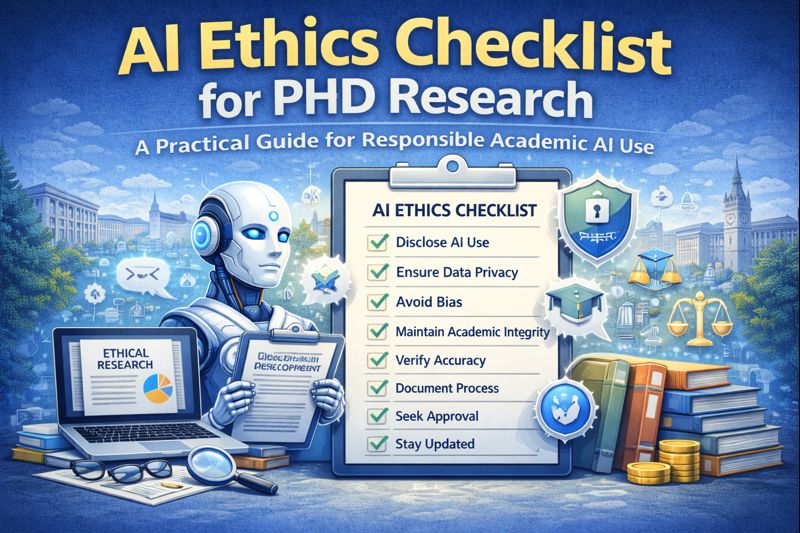
AI Ethics Checklist for PhD Research: A Practical Guide
A complete AI ethics checklist for PhD research. Learn how to use AI tools ethically,…

Best 10 AI Literature Review Tools for 2026: Save Hours on Research
Ever stared at a mountain of 500+ research papers, wondering where to even start? You’re…

Best AI Tools Every Researcher Must Know in 2026
Just Think About This…A professor pulled me aside last week. “I need to buy AI…

Top 10 Free AI Tools for PhD Students in 2026
Top 10 Free AI Tools for PhD Students in 2026 – A Step-by-Step Guide to…