
Last Updated: March 21, 2026
Cluster Post 4 | Module 9: Academic Career Development
From Concept to Submission Series | 2026
Academic Writing Mastery: The Complete 2026 Guide To Research Papers, Thesis & Dissertation Writing
The Indian Academic Job Market
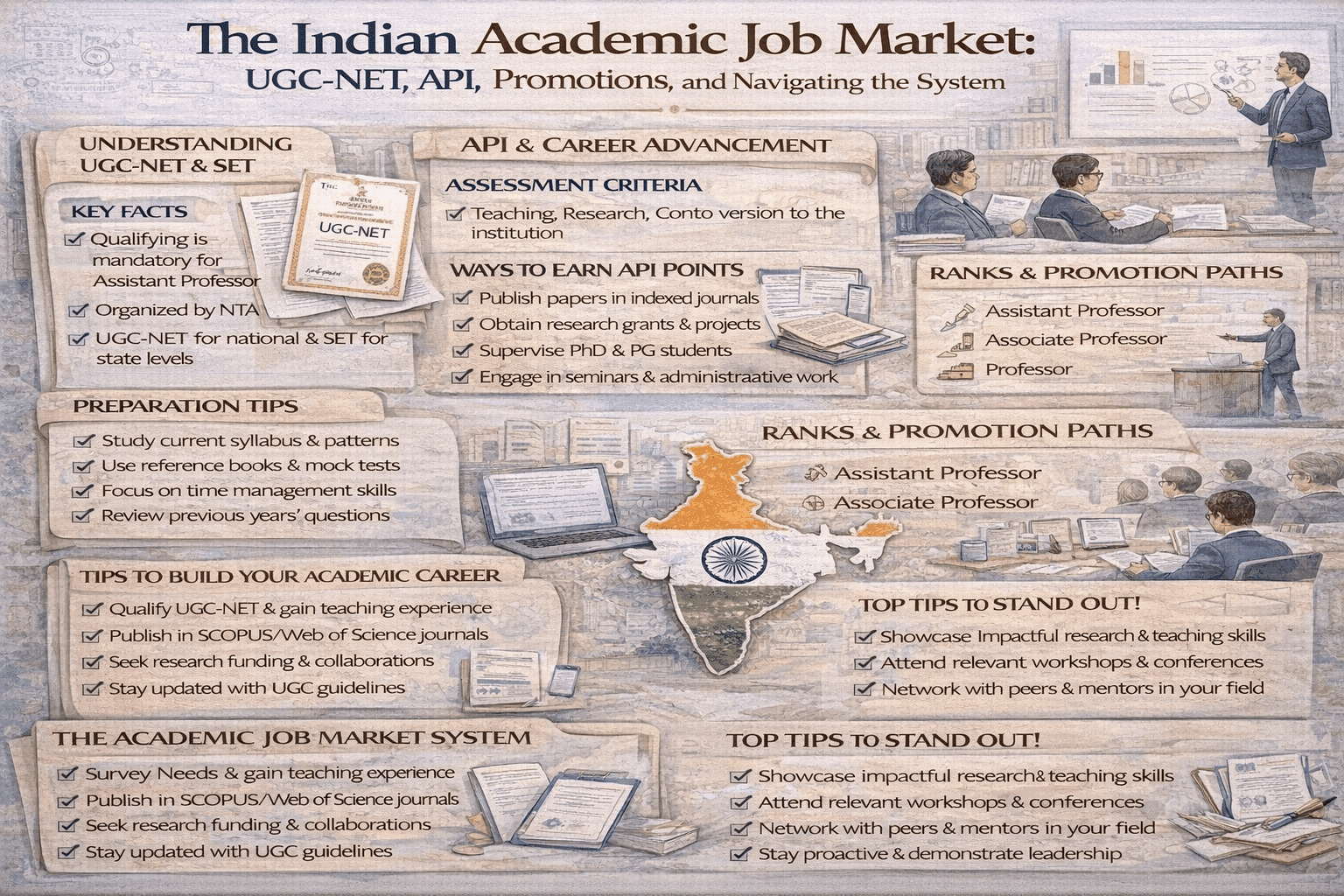
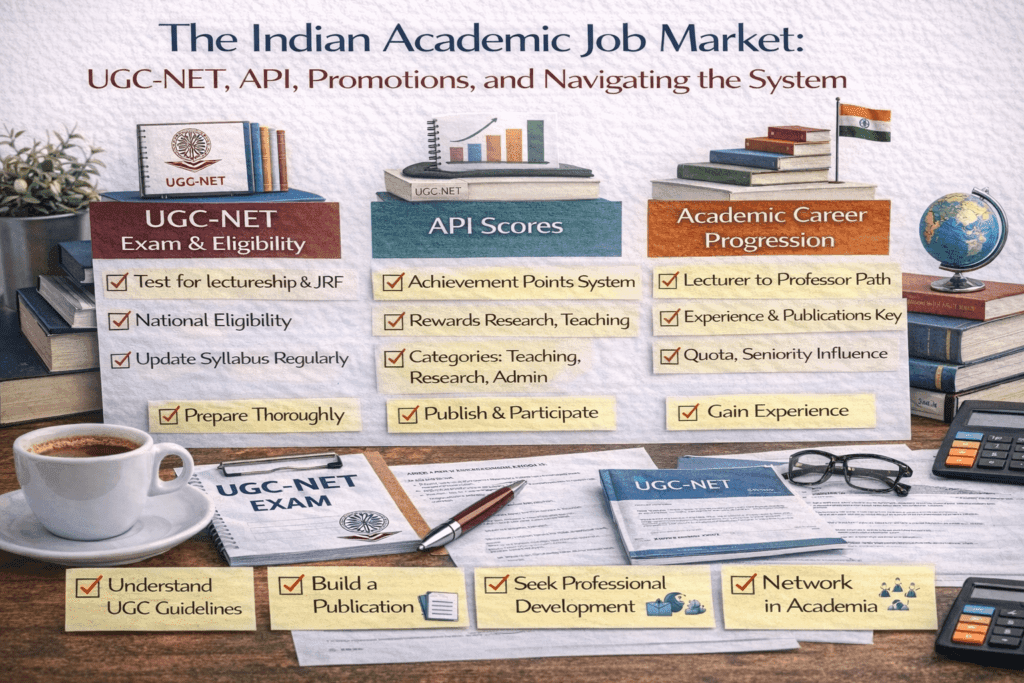
The module overview does not cover the Indian academic job market in detail. This post fills that gap: the UGC-NET and SLET qualification requirements, how API scores are calculated and what they mean for career progression, the difference between the central university, state university, deemed university, and NLU hiring systems, and the realistic career progression timeline for Indian academics.
The Qualification Requirement: UGC-NET and SLET
For most teaching and research positions at Indian colleges and universities, qualification at the National Eligibility Test (UGC-NET) or the State Level Eligibility Test (SLET/SET) is mandatory. Understanding the system is the starting point for Indian academic career planning.
UGC-NET
UGC-NET is conducted by the National Testing Agency (NTA) twice a year in approximately 100 subjects. It qualifies candidates for: Junior Research Fellowship (JRF) — the highest category, qualifying for both fellowship and lectureship; and Assistant Professor eligibility — qualifying for lectureship only (no fellowship). The JRF category requires a higher percentile score and has an age limit (usually 30 years, with relaxations for reserved categories and women). The Assistant Professor category has no age limit.
For PhD holders: since the UGC (Minimum Standards and Procedure for Award of Ph.D. Degree) Regulations 2022, a PhD from a UGC-recognized university exempts candidates from the UGC-NET requirement for Assistant Professor eligibility. Verify current regulations and whether your institution and degree qualify, as implementation varies.
SLET/SET
State Level Eligibility Tests are conducted by state agencies and qualify candidates for teaching positions at colleges affiliated with universities in that state. If you plan to work in a specific state, SLET eligibility for that state may be required in addition to or as an alternative to UGC-NET. Check the specific requirements of the state and institution you are targeting.
API Scores: How Career Progression Works
The Academic Performance Indicator (API) system is the UGC’s framework for evaluating faculty performance for appointment, promotion, and career advancement at universities and colleges. Understanding API is essential for strategic career planning.
API scores are calculated across three categories: Category I (Teaching, Learning and Evaluation), Category II (Co-curricular, Extension and Professional Development Activities), and Category III (Research and Academic Contributions). Category III — research — carries the most weight for promotion from Assistant Professor to Associate Professor and above.
Category III: Research and what actually counts
Research contributions are scored by type of publication and activity:
| Activity | Approximate API score (verify current UGC norms) |
| Article in UGC-CARE Group I journal (Scopus/WoS indexed) | 25 points per article |
| Article in UGC-CARE Group II journal | 10 points per article |
| Book chapter in edited volume with ISBN | 5 points per chapter |
| Book (authored, with ISBN, evaluated publisher) | 30–50 points depending on publisher category |
| Conference paper (peer-reviewed, published proceedings) | 5–10 points |
| PhD supervision (awarded) | 10 points per PhD awarded (shared if co-supervised) |
| Externally funded research project (PI) | 20 points (government agency) or 10 points (other) |
| Patent filed/granted | Points vary; granted patent carries more weight than filed |
Important caveats: API norms have been revised multiple times and continue to evolve. The figures above are approximate and the current UGC regulation should be consulted for precise scoring. Institutions also have discretion in applying API norms. Always verify current requirements with your institution’s API documentation.
What API means for strategic career planning
The API system creates specific incentives that should inform publication and research strategy for Indian academics. Publishing in UGC-CARE Group I journals (25 points each) is far more efficient for API accumulation than publishing book chapters (5 points each) or conference papers (5–10 points). A single article in a Scopus-indexed journal outscores five conference papers.
The strategic implication: for Indian academic career advancement, targeting UGC-CARE Group I journals — particularly those indexed in Scopus or Web of Science — should be a priority alongside aiming for the best journals in your field. The two aims are often compatible: many of the best journals in social science and law are also CARE Group I listed. Where they diverge, understand the trade-off you are making.
The Hiring System: Central, State, Deemed, and NLU
| Institution type | Hiring characteristics |
| Central universities (Delhi, Hyderabad, Jawaharlal Nehru, etc.) | Positions advertised centrally; UGC-NET typically required; competitive selection process with written examination, interview, and sometimes teaching demonstration. Academic culture tends to be research-oriented. Pay scales: 7th Pay Commission levels. |
| State universities and affiliated colleges | More heterogeneous. Some are strong research institutions; many are primarily teaching-focused. Hiring through state-level processes, often including state PSC (Public Service Commission) involvement. SLET/SET eligibility important for state-level positions. |
| Deemed universities and private universities | More variable in quality and process. Some top deemed institutions (TISS, Manipal, Amity) have rigorous hiring; many do not. Academic freedom and research support vary widely. Check carefully before applying. |
| National Law Universities (NLUs) | Hiring directly by the institution (not through UGC process for most positions). Strong emphasis on publications and research profile. More competitive than many state law schools for entry-level faculty. Some NLUs have internal promotion processes; others follow UGC norms. |
| IITs and IISc | Primarily relevant for STEM researchers. Highly competitive. Research profile drives selection almost entirely. Postdoctoral experience often expected. Among the most research-intensive academic positions in India. |
The Realistic Career Progression Timeline
The module does not address timelines. This section gives a realistic picture of the Indian academic career path, which differs significantly from the international model described implicitly in much career advice.
| Stage | Typical timeline | Key requirements |
| PhD completion | 4–6 years from registration at most Indian universities | Thesis submission, viva, corrections |
| UGC-NET/SLET (if not PhD-exempt) | Can be cleared before or during PhD; recommended before PhD completion | NET qualification or PhD-based exemption |
| First academic position (Ad Hoc/Temporary) | Often the entry point: ad hoc positions at colleges, often 1-semester renewals. Common but precarious. | NET/SLET or PhD; publications help but often not required at this level |
| Assistant Professor (permanent) | Competitive open positions; typically requires PhD and NET/SLET; 1–3 years post-PhD is typical for strong candidates with publications | API minimum (varies); usually 1–3 publications for competitive applications |
| Associate Professor | Typically 8–10 years of service as Assistant Professor; requires minimum API score in Category III (research) | API threshold met; usually requires significant publication record and PhD supervision record |
| Professor | Additional 3–5 years from Associate Professor; higher API threshold; competitive at research universities | Strong publication record, externally funded research, doctoral students supervised |
The ad hoc appointment problem: a significant number of Indian academics spend years in successive temporary ad hoc appointments before securing a permanent position. This is particularly acute in law and social sciences where permanent positions are fewer relative to PhD output. Planning for this possibility — building a publication and conference record during the ad hoc period, maintaining financial stability, and tracking permanent position openings — is part of realistic career planning.
Legal Research and Writing: Complete Guide for Law Students and Legal Researchers
FAQs
Q: How does UGC-NET qualification work in India?
UGC-NET (National Eligibility Test) is conducted by NTA (National Testing Agency) twice a year — June and December cycles. It has two papers: Paper I (general teaching and research aptitude, common to all subjects) and Paper II (subject-specific knowledge). Passing NET qualifies candidates for Assistant Professor positions at UGC-recognised universities. JRF (Junior Research Fellowship) is awarded to top scorers and provides a monthly stipend for full-time PhD research. Subject-specific Paper II covers the full syllabus of your discipline — check the current syllabus at ntanet.ac.in.
Q: What is the API score and how is it calculated for faculty promotion?
API (Academic Performance Indicator) scores are calculated across three categories: Category I (teaching, learning, and evaluation); Category II (co-curricular, extension, and professional activities); and Category III (research and academic contributions). For promotion, specific minimum API scores in each category must be met. Category III is most competitive — research publications earn the highest points (15 per Scopus/WoS or UGC-CARE Group I article). The API calculation format is available in UGC 2018 Regulations Appendix III. Maintain a running API calculation document from your first year as faculty.
Q: How do promotions work in Indian universities?
Faculty promotions in Indian universities follow the Career Advancement Scheme (CAS) under UGC regulations. Assistant Professor to Associate Professor: minimum 8 years as Assistant Professor with API score threshold met and two peer-reviewed publications in the assessment period. Associate Professor to Professor: minimum 3 years as Associate Professor with higher API threshold. Promotions require: a self-appraisal report; verification of API calculations by the institution; and assessment by a Selection Committee including external subject experts. NLUs may have institution-specific promotion criteria supplementing UGC requirements.
Q: How competitive is the academic job market in India for social science researchers?
The Indian academic job market for social science researchers is highly competitive, particularly at NLUs and central universities. A typical advertised position at a research-active NLU receives 50–200 applications. Shortlisting typically requires: UGC-NET or PhD qualification; publications in UGC-CARE listed or Scopus-indexed journals; relevant teaching experience; and a PhD from a recognised institution. Candidates with only the minimum qualifications are rarely shortlisted. The gap between minimum requirements and competitive candidacy is substantial — meeting the minimum is necessary but not sufficient.
Q: What is the difference between a temporary and permanent faculty position in India?
Permanent (regular) faculty positions are advertised through the formal selection committee process under UGC regulations and provide job security with pay scales under the 7th Pay Commission. Temporary positions include: ad hoc (term-by-term appointment without selection committee); contractual (fixed-term contracts, typically 1–3 years); and guest faculty (per-lecture or per-course payment without benefits). Temporary positions provide teaching experience for the CV but do not count fully toward CAS promotion timelines. Institutions vary in how they transition temporary faculty to permanent positions — clarify before accepting any temporary appointment.
References
- UGC — API scoring regulations. ugc.gov.in
- NTA UGC-NET. ugcnet.nta.nic.in
- UGC Minimum Standards for PhD 2022. ugc.gov.in
Next: Cluster Post 5 —Alternative and Hybrid Careers for Indian Research Scholars
- Module 1 The Complete Guide to Research Paper and Thesis Structure
- Module 2 The Academic Writing Process: Complete Guide from First Draft to Submission (2026)
- Module 3 Research Methodologies: Complete Guide to Quantitative, Qualitative, Mixed Methods & Legal Research (2026)
- Module 4 Data Analysis and Results Presentation: Complete Guide for Quantitative, Qualitative & Legal Research (2026)
- Module 5 Organization and Academic Tone: Complete Guide to Professional Scholarly Writing (2026)
- Module 6 Peer Review and Publication: Complete Guide from Submission to Acceptance (2026)
- Module 7 AI Tools in Academic Research: Opportunities, Ethics, and Best Practices (2026)
- Module 8 Grant Writing and Research Funding: Complete Guide to Finding Money for Your Research (2026)
- Module 9Academic Career Development: Complete Guide to Building Your Professional Life in Research (2026)
Next in series
Module 10 Research Ethics and the IRB Process: Complete Guide to Doing Research Responsibly (2026)

Research Ethics for Legal Researchers: Privilege, Confidentiality, Vulnerable Participants, and the DPDPA 2023
Research Ethics for Legal Researchers Academic Writing Mastery: The Complete 2026 Guide To Research Papers,…

Academic Career Development for Legal Researchers
Academic Career Development for Legal Researchers: NLU Faculty Pathways, Law School Hiring, and Building a…

Grant Writing and Research Funding for Legal Researchers
Academic Career Development: Complete Guide To Building Your Professional Life In Research (2026) Back to…
Peer Review and Publication in Legal Research
Peer Review and Publication in Legal Research: Law Reviews, Response Letters, and the Path to…

Academic Writing Mastery: The Complete 2026 Guide to Research Papers, Thesis & Dissertation Writing
Academic Writing Master From Concept to Submission Series Academic Writing Mastery Whether you are writing…

Research Integrity: Data Handling Authorship Ethics and the Indian Regulatory Framework
Cluster Post 5 | Module 10: Research Ethics and the IRB Process From Concept to…