
Cluster Post 4 | Module 3: Research Methodologies
From Concept to Submission Series | 2026
Qualitative Data Collection and Analysis: Interviews, Coding, and Trustworthiness
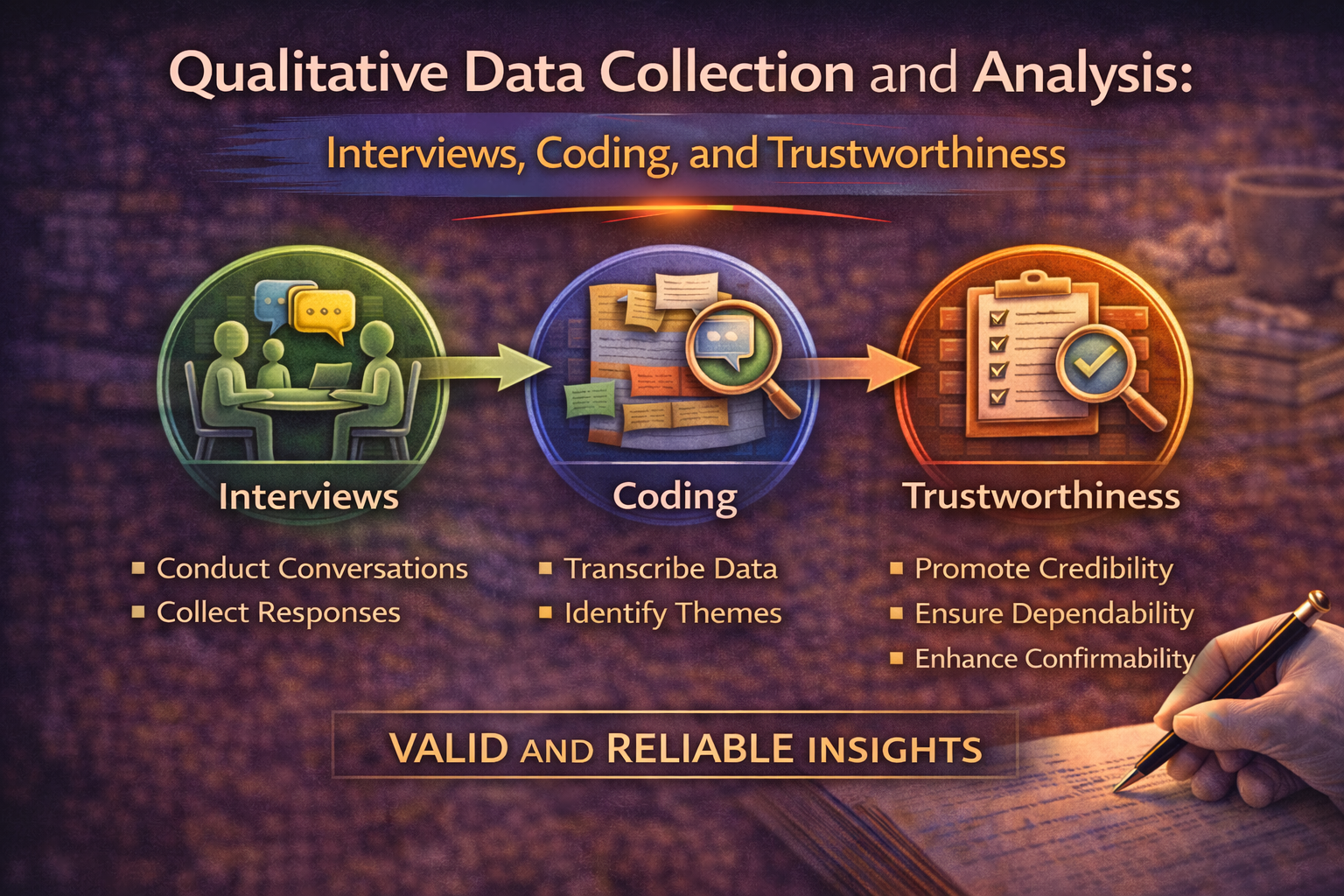
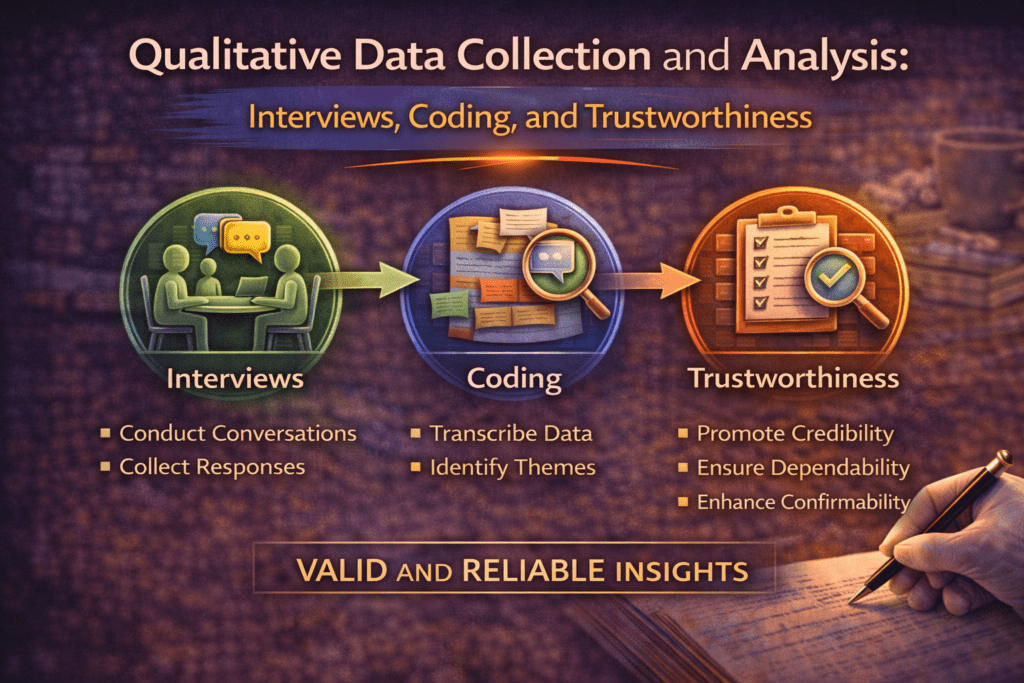
The module overview covered interview types, focus groups, observation, and thematic analysis. This post goes deeper: how to design and conduct interviews that generate rich data rather than thin responses, the step-by-step coding process with a worked example, the four trustworthiness criteria and how to demonstrate each one in your methodology chapter, and the specific mistakes that make qualitative analysis appear unreliable to reviewers.
Designing the Interview Guide
The interview guide is not a questionnaire. A questionnaire extracts predetermined answers to predetermined questions. An interview guide opens a space for participants to tell you what matters to them about the phenomenon you are studying — including things you did not know to ask about.
A well-designed interview guide for a semi-structured interview has three components: an opening that establishes rapport and explains the purpose, a set of main questions that cover the key areas of interest, and probes for each main question that invite elaboration without directing the response.
Main questions: the open-ended imperative
Every main question should be genuinely open-ended — designed so that the participant cannot answer it with yes, no, or a single word, and so that the researcher’s theoretical assumptions are not embedded in the question itself.
Closed: “Did peer mentoring help you feel more confident?” Leading: “How did peer mentoring help you navigate the challenges of first year?” Open: “Can you tell me about your experience of peer mentoring in your first year?” The closed question presupposes that mentoring helped. The leading question presupposes that there were challenges and that mentoring helped navigate them. The open question presupposes nothing — it invites the participant to describe whatever their experience was, including experiences where mentoring was not helpful or where challenges were not the dominant feature.
A good interview guide has six to ten main questions for a sixty-to-ninety-minute interview. More questions than this produce a rushed interview that skims across topics without depth. The depth comes from probes — follow-up questions that invite the participant to say more about something they have raised.
Probes: the source of rich data
Probes are where qualitative interviews generate their most useful data. A probe is a short, neutral follow-up that signals to the participant that you are interested in more detail about what they just said, without steering the direction of the elaboration.
- Elaboration probe: “Can you say more about that?” / “What do you mean by that?”
- Example probe: “Can you give me an example of when that happened?”
- Clarification probe: “I want to make sure I understand — are you saying that…?”
- Contrast probe: “How did that compare to what you’d expected?” / “Was that different from earlier?”
- Silence: Pausing after a participant finishes speaking often prompts further elaboration without requiring any words from the interviewer.
Probes cannot be scripted in advance for each question — they respond to what the participant actually says. The interviewer must listen closely enough to identify what is worth probing. This is a skill that develops with practice, and piloting your interview guide with two or three participants before the main study is the most effective way to develop it.
Conducting Interviews: What the Module Does Not Tell You
Recording and transcription
Record every interview with the participant’s permission. Attempting to take notes during an interview means you are simultaneously listening, writing, evaluating, and planning your next question — none of which you can do well simultaneously. Recording allows you to be fully present in the interview and to produce a complete, verbatim record for analysis.
Transcribe within 48 hours of the interview while the conversation is fresh in memory. Verbatim transcription — including pauses, hesitations, laughter, and overlapping speech — captures more information than edited transcription, but the appropriate level of detail depends on your analytical approach. Thematic analysis usually requires verbatim but edited transcription (hesitations and filler words removed). Conversation analysis requires exact notation of every sound and pause.
Managing your own role: reflexivity in practice
The module mentions reflexivity as a qualitative quality criterion. What it does not explain is that reflexivity is not just something you write about in your methodology — it is something you practise during data collection.
Keep a reflexive journal throughout your data collection period. After each interview, write for ten to fifteen minutes: What questions felt like they led the participant? What did you assume rather than ask? What surprised you, and why were you surprised? What did you notice about your own reactions to what participants said? These notes are part of your data and part of your audit trail. They also help you spot patterns in your own interviewing that you can correct in subsequent interviews.
Thematic Analysis: The Step-by-Step Process
Braun and Clarke’s reflexive thematic analysis is the most widely used qualitative analytical method, and also one of the most widely misunderstood. “We used thematic analysis” in a methodology chapter tells an examiner almost nothing unless it is followed by a description of the specific steps taken. This section gives you those steps, with a worked example.
Phase 1: Familiarisation
Read your transcripts repeatedly before you begin coding — at minimum twice, once for general orientation and once more closely, taking informal notes. The goal is to move from seeing the text as words on a page to engaging with it as data: noticing things that recur, things that seem significant, things that surprise you.
Do not begin coding in this phase. Premature coding produces codes that are too broad, based on first impressions rather than thorough familiarity with the dataset. Familiarisation cannot be rushed, and it is the step most often skipped by researchers under time pressure — with visible consequences for the quality of the analysis that follows.
Phase 2: Initial coding
Code systematically across the entire dataset. An initial code is a short label that captures what is interesting about a specific segment of data — it stays close to the data language rather than abstracting immediately to conceptual categories.
Data extract (from interview with P3, Arts student): “My mentor told me which professor to go to for extension requests, because apparently you can’t just ask anyone — there’s a whole system and if you don’t know it you just… you just don’t get the extension. I had no idea. I would have just failed the assignment.” Initial codes applied: – Institutional knowledge gap – Mentor as navigator – Hidden rules of academic system – Consequential ignorance – Social capital transfer
Each code names something different about this segment. “Institutional knowledge gap” focuses on what the student lacked. “Mentor as navigator” focuses on the mentor’s role. “Hidden rules” focuses on the structure of the institution. Multiple codes per segment is normal and appropriate — each represents a different dimension of what is analytically interesting.
Phase 3: Generating initial themes
Group codes that share a conceptual similarity into potential themes. This is where pattern recognition begins — you are looking for clusters of codes that together describe something important about the dataset. At this stage, themes are candidate patterns, not final conclusions.
Codes clustered into candidate theme: Codes: Mentor as navigator / Institutional knowledge gap / Hidden rules / Social capital transfer / Knowing who to ask / System access through relationship Candidate theme: “Peer mentors as institutional navigators who transfer hidden cultural knowledge”
Phase 4: Reviewing themes
Test each candidate theme against two criteria. First: does it hold together internally? Do all the coded segments grouped under this theme actually fit it, or are some segments there because you had nowhere else to put them? Second: does it work in relation to the full dataset? Does the theme capture something that is genuinely present and significant in the data, or does it reflect only a few isolated moments?
This is the phase where negative cases matter most. For each theme you are developing, ask: are there participants whose data contradicts or complicates this theme? If twelve participants describe mentors as navigators but three describe mentors primarily as emotional support rather than instrumental guides, the theme needs qualification — not abandonment, but accurate scoping.
Phase 5: Defining and naming themes
Write a one-paragraph definition of each theme that specifies its scope and boundaries. What does this theme include? What does it exclude? How is it different from the adjacent themes? The definition forces you to be precise about what you are claiming, and it directly produces the theme descriptions you will use in your results chapter.
Phase 6: Producing the report
Each theme in your results chapter follows the structure described in Cluster Post 4 of Module 1: name, definition, description of how it manifested across the dataset, supporting quotes from multiple participants. The analytical work is done — the results chapter presents its output.
Trustworthiness: The Four Criteria and How to Demonstrate Them
Qualitative research does not use reliability and validity in their quantitative forms. Instead, Lincoln and Guba’s four trustworthiness criteria — credibility, transferability, dependability, and confirmability — provide the framework for evaluating qualitative rigour. The module introduces these; this section explains specifically how to demonstrate each one.
| Criterion | How to demonstrate it in practice |
| Credibility (parallel to internal validity) | Member checking: share your theme descriptions with participants and ask whether they recognise their experience in them. Prolonged engagement: sustained time in the field before and during data collection. Triangulation: multiple data sources or methods that converge on the same patterns. Negative case analysis: actively searching for and addressing data that contradicts your themes. |
| Transferability (parallel to external validity) | Provide thick description of your setting, participants, and context — enough that readers can judge whether findings might transfer to their own contexts. You cannot claim generalisability; you can provide the information readers need to make their own transfer judgments. |
| Dependability (parallel to reliability) | Maintain an audit trail: document all decisions made during data collection and analysis, including what you changed and why. Your reflexive journal, coding memos, and theme development notes constitute this trail. |
| Confirmability (parallel to objectivity) | Show that findings emerge from the data rather than from your assumptions. The audit trail serves confirmability as well as dependability. Reflexive bracketing — acknowledging your prior assumptions and how you managed them — demonstrates that you distinguish your perspective from your participants’. |
The most commonly omitted trustworthiness measure in Indian qualitative theses is negative case analysis — actively looking for data that does not fit your themes. Including a sentence in your methodology chapter stating that you conducted negative case analysis, and then actually demonstrating it in your results (by noting where themes do not apply and why), signals qualitative rigour that examiners notice and value.
For Law Students
Qualitative data collection in legal research — particularly interviews with judges, lawyers, litigants, or legal aid workers — has specific ethical and methodological features that the general guidance above does not fully address.
Interviewing legal professionals: access and power dynamics
Legal professionals — particularly judges and senior advocates — are high-status participants who control access to legal processes and who may be cautious about what they say on record. Gaining access often requires institutional gatekeeping: a letter of introduction from a supervisor, approval from a court registrar, or a warm referral from a trusted intermediary.
Power dynamics run in both directions. Legal professionals may be reluctant to criticise institutions or colleagues on record, which means some of the most useful information may come through implication, omission, and body language rather than explicit statement. Qualitative analysis in this context requires attention to what is not said as well as what is said — a skill that takes practice and that should be noted in your reflexive journal.
Coding legal interview data: a specific challenge
Lawyers and judges use precise technical language that carries specific legal meaning. When coding interview data from legal professionals, be careful not to treat technical legal terms as synonyms for colloquial equivalents. A judge who says an argument “lacks proportionality” is making a specific legal claim, not a casual observation about balance. Your codes should reflect the technical meaning, not a lay interpretation.
This also means that member checking — having participants review your theme descriptions — is particularly important in legal research. A theme that accurately summarises what participants said in lay terms may misrepresent what they meant in legal terms. Verification by participants who have the technical expertise to identify such misrepresentations strengthens your analysis considerably.
Observation in courts: permissions and ethics
Observing court proceedings in India requires navigating the open court principle alongside specific restrictions on recording and note-taking. Most Indian courts permit observation of proceedings in open court without special permission. Recording — audio or video — requires court permission, which is rarely granted. Detailed note-taking during proceedings is generally permitted but should be conducted unobtrusively.
Include in your methodology chapter: the courts you observed, the period of observation, the total number of sessions, what you observed and what you excluded, and how you managed the ethical considerations of observing participants (parties, witnesses, lawyers) who did not individually consent to being observed in an open court setting.
References
- Braun, V., & Clarke, V. (2022). Thematic Analysis: A Practical Guide. Sage.
- Braun, V., & Clarke, V. (2006). Using thematic analysis in psychology. Qualitative Research in Psychology, 3(2), 77–101.
- Lincoln, Y. S., & Guba, E. G. (1985). Naturalistic Inquiry. Sage.
- Saldaña, J. (2021). The Coding Manual for Qualitative Researchers (4th ed.). Sage.
- Smith, J. A., Flowers, P., & Larkin, M. (2009). Interpretative Phenomenological Analysis: Theory, Method and Research. Sage.Interpretative Phenomenological Analysis | SAGE India
- Flick, U. (2018). An Introduction to Qualitative Research (6th ed.). Sage.
Next: Cluster Post 5 — Mixed Methods Research: When and How to Combine Approaches

The Complete Guide to Research Paper Structure: IMRAD Format, Thesis Organization & Academic Writing (2026)
From Concept to Submission: A Complete Guide to Research Paper and Thesis Writing Module 1:…
The IMRAD Framework: Why It Exists, How It Really Works, and Where It Breaks Down
Cluster Post 1 | Module 1: Understanding the Structure of Research Papers and Theses From…

How to Write a Research Introduction That Reviewers Cannot Ignore
Cluster Post 2 | Module 1: Understanding the Structure of Research Papers and Theses From…
How to Write a Methods Section That Reviewers Will Trust
Cluster Post 3 | Module 1: Understanding the Structure of Research Papers and Theses From…
The Results Section: How to Present Findings Without Letting Interpretation Slip In
Cluster Post 4 | Module 1: Understanding the Structure of Research Papers and Theses From…

The Discussion Section: How to Turn Findings Into Knowledge
Cluster Post 5 | Module 1: Understanding the Structure of Research Papers and Theses From…

Complete Thesis Structure: A Chapter-by-Chapter Guide
Cluster Post 6 | Module 1: Understanding the Structure of Research Papers and Theses From…

10 Structural Mistakes That Get Research Papers Rejected — And How to Fix Every One
Cluster Post 7 | Module 1: Understanding the Structure of Research Papers and Theses From…

The Academic Writing Process: Complete Guide from First Draft to Submission (2026)
From Concept to Submission: A Complete Guide to Research Paper and Thesis Writing Module 2,…

How to Start Writing — and Keep Going
Cluster Post 1 | Module 2: The Academic Writing Process From Concept to Submission Series …

How to Write Clear Engaging Academic Prose
Cluster Post 2 | Module 2: The Academic Writing Process From Concept to Submission Series …
The Revision Process: How to Turn a Draft Into a Submission
Cluster Post 3 | Module 2: The Academic Writing Process From Concept to Submission Series …
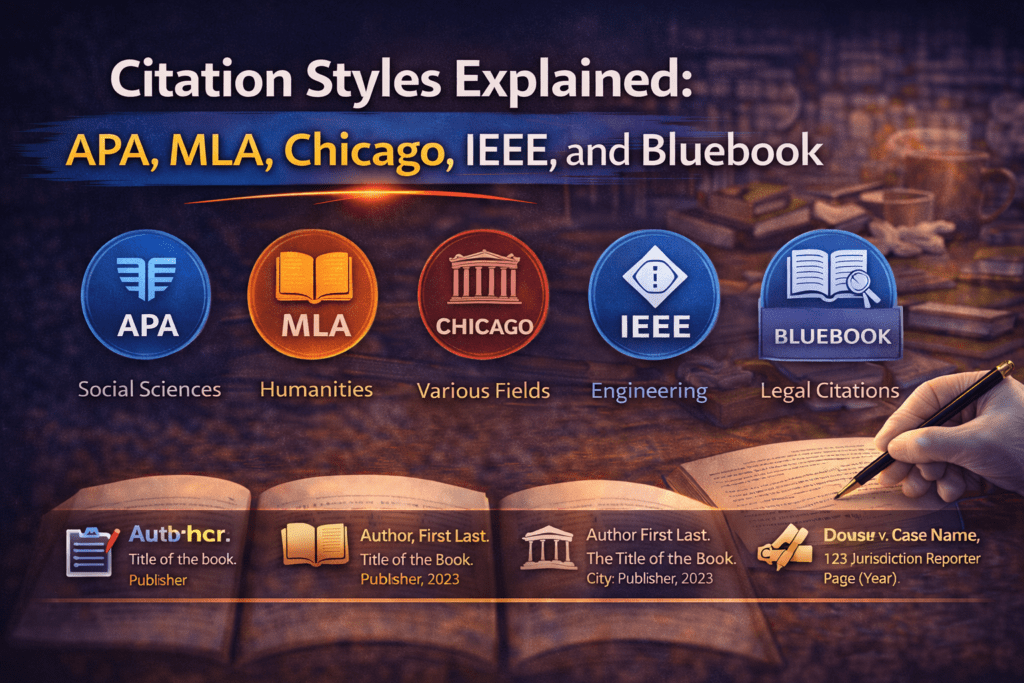
Citation Styles Explained: APA, MLA, Chicago, IEEE, and Bluebook
Cluster Post 4 | Module 2: The Academic Writing Process From Concept to Submission Series …
Reference Management: Zotero and Mendeley from Setup to Submission
Cluster Post 5 | Module 2: The Academic Writing Process From Concept to Submission Series …
Research Methodologies: Complete Guide to Quantitative, Qualitative, Mixed Methods & Legal Research (2026)
Why Methodology Determines Research Quality Here’s what thesis examiners focus on first: your methodology section…

Research Paradigms: Why Your Philosophical Stance Shapes Everything
Cluster Post 1 | Module 3: Research Methodologies From Concept to Submission Series | 2026 ←…
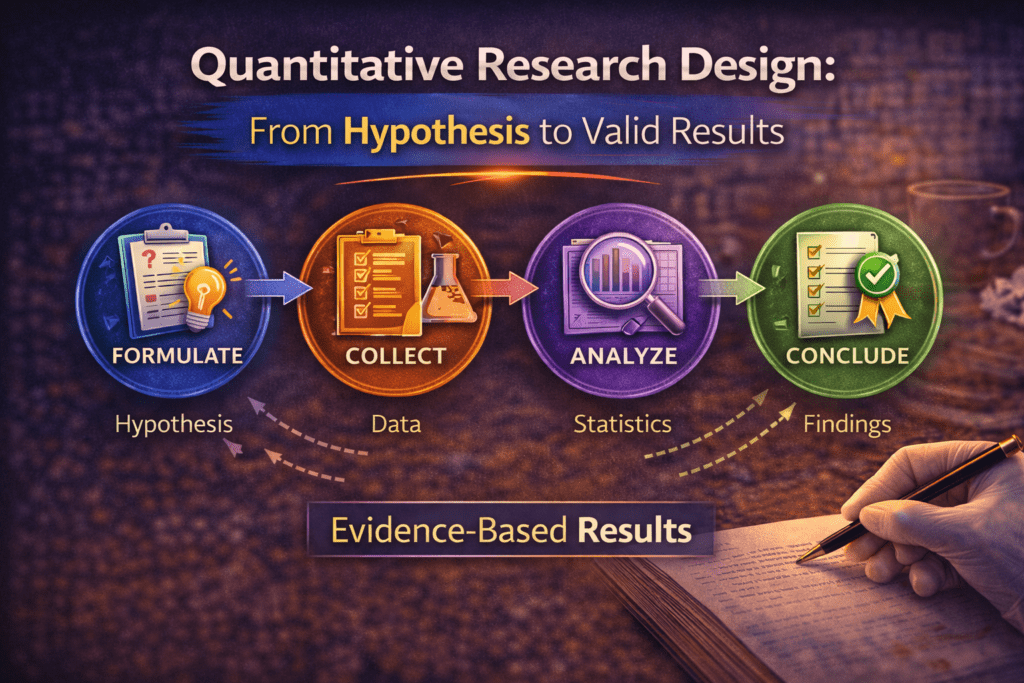
Quantitative Research Design: From Hypothesis to Valid Results
Cluster Post 2 | Module 3: Research Methodologies From Concept to Submission Series | 2026…
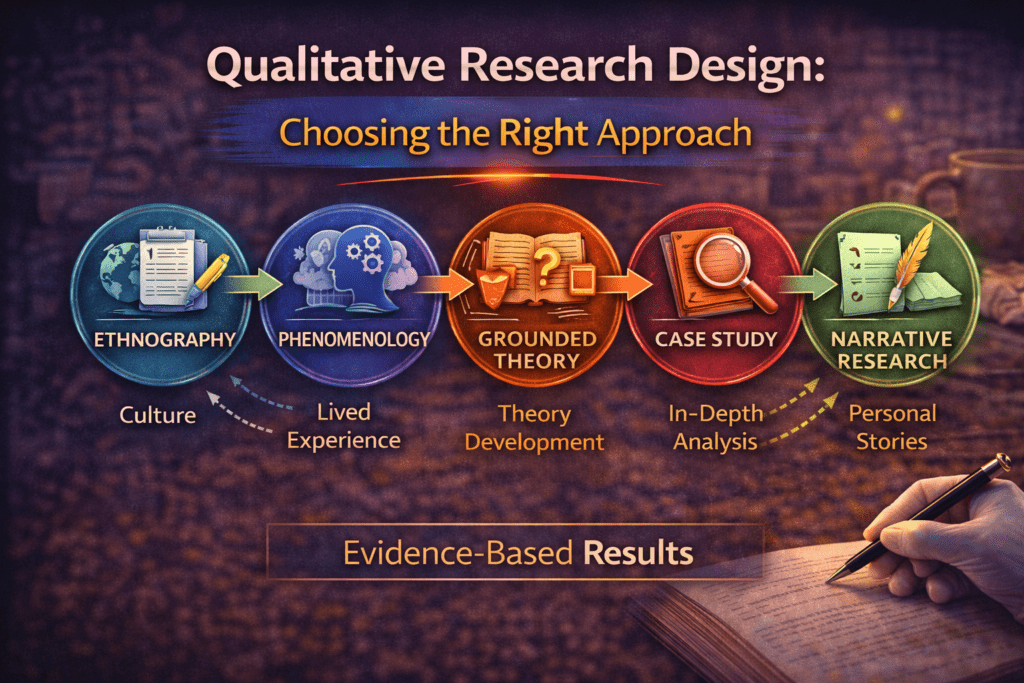
Qualitative Research Design: Choosing the Right Approach
Cluster Post 3 | Module 3: Research Methodologies From Concept to Submission Series | 2026…
Qualitative Data Collection and Analysis: Interviews, Coding, and Trustworthiness
Cluster Post 4 | Module 3: Research Methodologies From Concept to Submission Series | 2026…
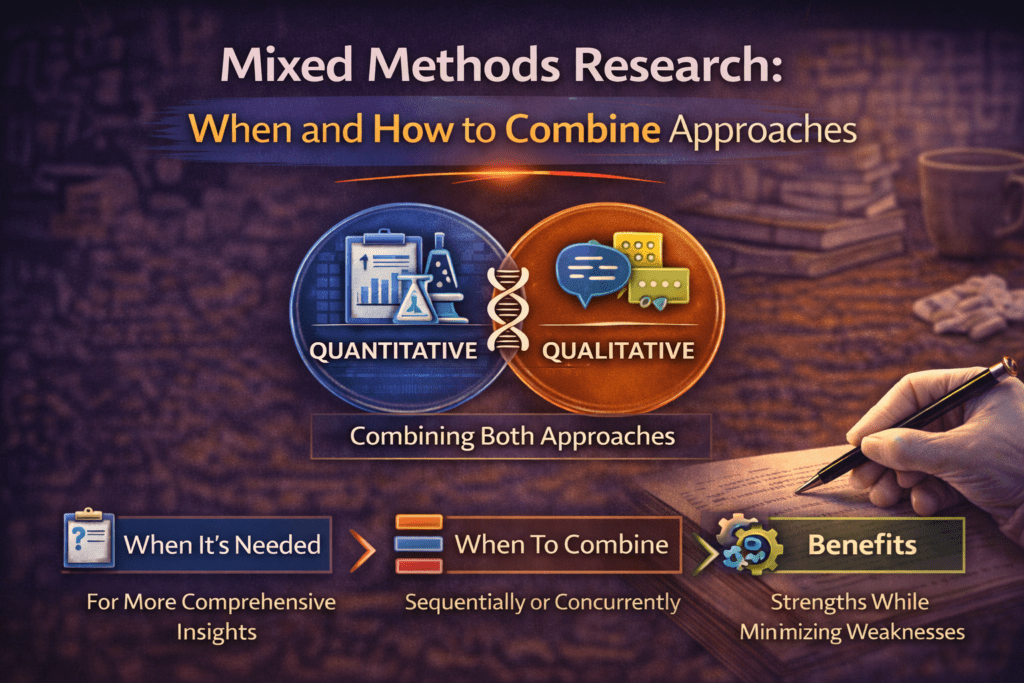
Mixed Methods Research: When and How to Combine Approaches
Cluster Post 5 | Module 3: Research Methodologies From Concept to Submission Series | 2026…
Sampling: Choosing Who to Study and How Many
Cluster Post 6 | Module 3: Research Methodologies From Concept to Submission Series | 2026…
Research Ethics in Practice: What Ethics Forms Don’t Tell You
Cluster Post 7 | Module 3: Research Methodologies From Concept to Submission Series | 2026…
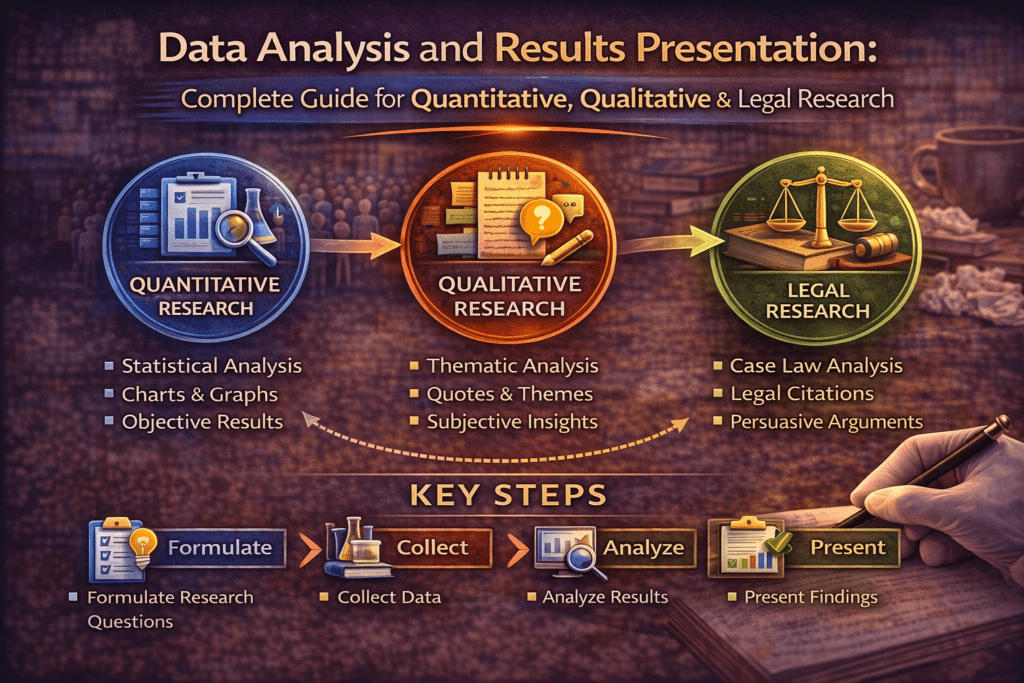
Data Analysis and Results Presentation: Complete Guide for Quantitative, Qualitative & Legal Research (2026)
Data Analysis and Results Presentation: Why Data Analysis Determines Research Credibility Here’s what separates published…
Preparing Your Data: The Work That Determines Analysis Quality
Cluster Post 1 | Module 4: Data Analysis and Presenting Results From Concept to Submission…
Descriptive Statistics: What to Report and How to Read Them
Cluster Post 2 | Module 4: Data Analysis and Presenting Results From Concept to Submission…
Inferential Statistics: Choosing and Reporting the Right Test
Cluster Post 3 | Module 4: Data Analysis and Presenting Results From Concept to Submission…
Statistical Assumptions: The Checks Most Researchers Skip
Cluster Post 4 | Module 4: Data Analysis and Presenting Results From Concept to Submission…
Presenting Qualitative Findings: Quotes, Themes, and the Balance Between Showing and Telling
Cluster Post 5 | Module 4: Data Analysis and Presenting Results From Concept to Submission…
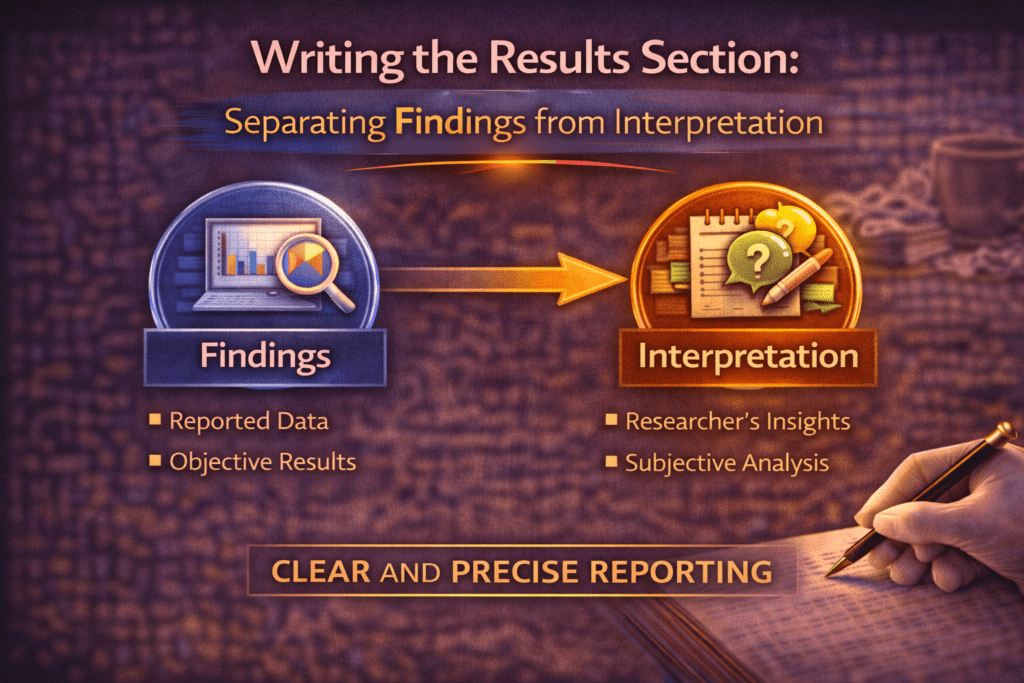
Writing the Results Section: Separating Findings from Interpretation
Cluster Post 6 | Module 4: Data Analysis and Presenting Results From Concept to Submission…
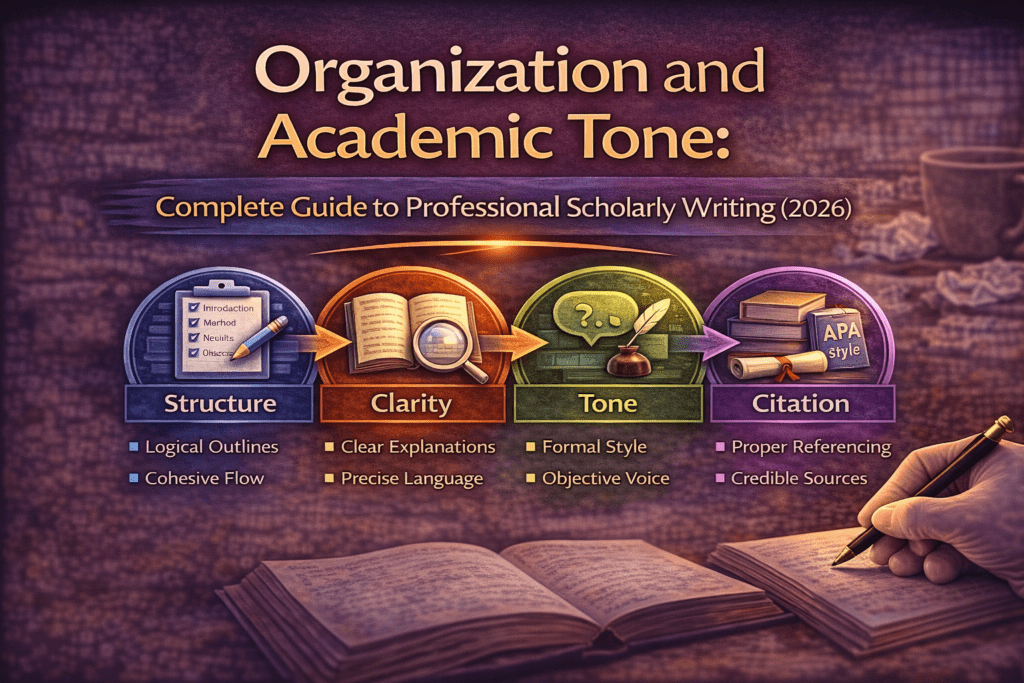
Organization and Academic Tone: Complete Guide to Professional Scholarly Writing (2026)
Why Organization and Academic Tone Matter More Than You Think Here’s what thesis examiners notice…