
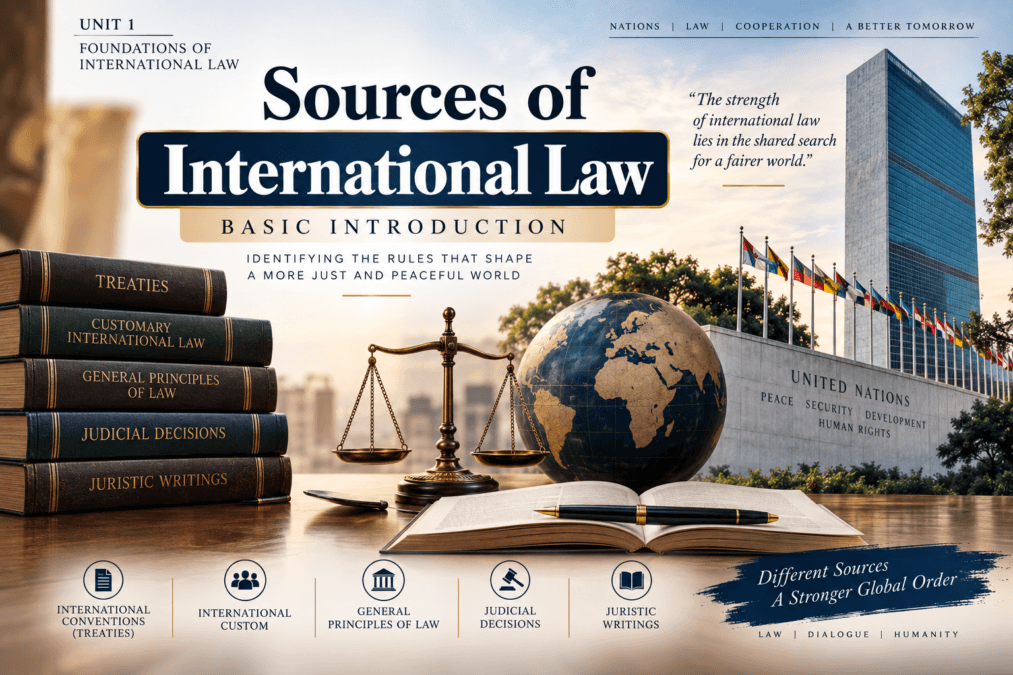
Sources of International Law
Quick Answer: What are the Sources of International Law?
The sources of International Law are the recognized legal materials and processes through which international legal rules are identified, established, developed or applied.
The most important starting point is Article 38(1) of the Statute of the International Court of Justice (ICJ). It refers to:
- International conventions (treaties);
- International custom;
- General principles of law; and
- Judicial decisions and the teachings of highly qualified publicists as subsidiary means for determining rules of law.
Article 38(2) also provides for the possibility of deciding a case ex aequo et bono when the parties agree.
Unit 1: Foundations of International Law
- Meaning, Definitions, Nature, Scope and Importance of International Law
- Basis, Binding Force and Sanctions of International Law
- Historical development of International Law
1. What is meant by a “Source” of International Law?
In simple terms, a source tells us where a legal rule comes from or how we identify the rule that is applicable to a particular international legal question.
For example:
- If two States have entered into a treaty containing a particular obligation, the treaty may provide the applicable rule.
- If a rule has developed through general State practice accepted as law, customary International Law may provide the applicable rule.
- Where an applicable rule cannot be identified from treaty or custom, general principles of law may become relevant.
- Judicial decisions and scholarly writings can assist in determining what the law is.
Sources of International Law are the recognized legal materials and processes used to identify the rules and principles governing international relations and international legal obligations.
2. Why are Sources of International Law important?
Knowing the sources is essential because International Law does not operate through a single world legislature comparable to a domestic parliament.
When an international legal dispute arises, it becomes necessary to determine:
- What rule applies?
- Where does that rule come from?
- Is the rule contained in a treaty?
- Has a customary rule developed?
- Is a general principle relevant?
- What evidence supports the existence of the rule?
- What role can judicial decisions or scholarly writings play?
Therefore, the study of sources helps students understand how an international legal rule is identified and applied.
3. What does Article 38 of the ICJ Statute provide?
Article 38(1) states that the ICJ, when deciding disputes submitted to it, shall apply:
(a) International conventions
These are treaties or international agreements establishing rules expressly recognized by the States concerned.
(b) International custom
Article 38 describes international custom as evidence of:
a general practice accepted as law.
This is commonly expressed through the two constituent elements:
State practice + acceptance as law (opinio juris)
The International Law Commission’s 2018 Conclusions explain this two-element approach to identifying customary International Law.
(c) General principles of law
Article 38 also refers to general principles of law recognized by States.
The precise content and scope of this category has been the subject of legal scholarship and judicial consideration, so students should avoid treating every principle of fairness or morality as automatically constituting a general principle of law.
(d) Judicial decisions and scholarly writings
Article 38(1)(d) refers to:
- judicial decisions; and
- teachings of highly qualified publicists,
as subsidiary means for the determination of rules of law.
4. Is Article 38 itself a complete list of all sources of International Law?
Article 38 is the principal and most commonly used starting point for identifying the sources of International Law, but students should be cautious about describing it as an absolutely exhaustive theoretical list.
Article 38 was drafted as a provision concerning the law to be applied by the Court.
It identifies the principal categories of legal material the ICJ applies.
Modern International Law also involves other legally relevant materials and processes, including:
- subsequent treaty practice;
- resolutions of international organizations in appropriate contexts;
- unilateral acts and declarations in appropriate circumstances;
- institutional practice;
- evidence relevant to identifying customary International Law.
However, the legal significance of these materials varies. They should not automatically be described as independent sources equivalent to treaties or customary International Law.
5. Classification of Sources under Article 38
For examination purposes, Article 38 can be organized as follows:
| Category | Article 38 | Basic role |
| International conventions | 38(1)(a) | Treaty-based rules |
| International custom | 38(1)(b) | General practice accepted as law |
| General principles of law | 38(1)(c) | General legal principles recognized in law |
| Judicial decisions | 38(1)(d) | Subsidiary means |
| Scholarly writings | 38(1)(d) | Subsidiary means |
| Ex aequo et bono | 38(2) | Possible only where parties agree |
6. Treaties as a Source of International Law
A treaty is an agreement between subjects of International Law governed by International Law.
Treaties are one of the most important means through which States create expressly agreed international obligations.
Examples include treaties dealing with:
- human rights;
- diplomatic relations;
- law of the sea;
- environmental protection;
- international humanitarian law;
- trade;
- extradition; and
- international cooperation.
Simple example
Suppose State A and State B enter into a treaty requiring cooperation in extradition proceedings.
The obligations contained in that treaty may constitute the applicable law between those States, subject to the treaty’s terms and applicable rules of International Law.
A treaty generally creates treaty obligations for its parties, subject to the applicable rules of treaty law.
Exam Point
Treaty = express agreement creating international legal obligations for the parties.
A detailed study of treaties will be undertaken separately under:
Unit 2 → Law of Treaties.
7. Customary International Law
Customary International Law develops from:
- general State practice, and
- acceptance of that practice as law (opinio juris).
The International Law Commission’s 2018 Conclusions expressly identify these as the two constituent elements for identifying customary International Law.
State practice
State practice may appear in different forms, including:
- diplomatic correspondence;
- governmental statements;
- legislation;
- executive practice;
- national judicial decisions;
- treaty practice;
- conduct in international organizations; and
- other relevant State conduct.
Opinio juris
Opinio juris concerns whether the practice is followed because it is regarded as legally required, permitted or entitled to be followed as law.
Formula
General State Practice + Opinio Juris = Customary International Law
Important authority
The ILC’s 2018 Conclusions contain 16 conclusions dealing with matters including:
- the two constituent elements;
- assessment of evidence;
- State practice;
- generality of practice;
- opinio juris;
- treaties;
- resolutions;
- judicial decisions;
- teachings;
- persistent objection; and
- particular customary International Law.
8. General Principles of Law
Article 38(1)(c) identifies general principles of law as another category to be applied by the ICJ.
This category is important because International Law cannot always be reduced to written treaties or customary rules.
General principles may assist in addressing legal questions where an applicable treaty or customary rule does not provide a complete answer.
Think of general principles as fundamental legal principles recognized within legal systems and relevant to the international legal order, rather than simply general moral ideas.
Important caution
The identification and scope of general principles of law have been debated in international legal scholarship and practice.
9. Judicial Decisions
Article 38(1)(d) recognizes judicial decisions as subsidiary means for the determination of rules of law.
This means that judicial decisions can help determine:
- whether a rule exists;
- what the rule means;
- how a rule should be applied;
- how customary International Law has been understood.
Article 59 of the ICJ Statute
Article 59 provides:
“The decision of the Court has no binding force except between the parties and in respect of that particular case.”
Therefore, an ICJ judgment does not operate as a general precedent binding on every State in every future case.
Judicial decisions are subsidiary means, not an independent legislative system for creating universally binding precedent.
10. Writings of International Law Scholars
Article 38(1)(d) also refers to the teachings of the most highly qualified publicists of the various nations.
These writings may assist courts, lawyers, governments and scholars in:
- identifying existing rules;
- interpreting legal principles;
- understanding State practice;
- analysing treaties;
- studying customary International Law.
Examples of scholarly contribution
The works of major international-law scholars have historically contributed to the systematic study and development of the discipline.
However:
A scholar’s opinion is not automatically a binding rule of International Law merely because the scholar is respected.
Juristic writings are persuasive/subsidiary materials, not treaties or customary rules by themselves.
11. What is the significance of Ex Aequo et Bono?
Article 38(2) provides that Article 38 does not prejudice the power of the Court to decide a case ex aequo et bono, if the parties agree.
The expression broadly refers to deciding according to considerations of fairness or equity rather than applying only the ordinary legal rules.
Important limitation
The ICJ cannot simply decide a case ex aequo et bono whenever it considers fairness desirable.
The parties must agree.
Article 38(2) → ex aequo et bono → requires agreement of the parties.
12. Are Treaties and Custom the Same?
No.
Treaty
A treaty is based on express agreement.
Custom
Customary International Law develops through:
general practice + acceptance as law.
| Treaty | Custom |
| Usually written | May be unwritten |
| Based on agreement | Develops through practice and opinio juris |
| Obligations generally arise for parties | May bind States according to the applicable rules of customary law |
| Interpretation depends on treaty text and applicable treaty law | Identification depends on evidence of practice and opinio juris |
This distinction is fundamental to the study of International Law.
13. What is the Relationship Between Article 38 and Customary International Law?
Article 38(1)(b) provides the classic formulation of international custom:
general practice accepted as law.
The ILC’s 2018 Conclusions provide a more detailed methodology for identifying customary International Law.
They emphasize that the existence of a customary rule must be assessed through evidence of both general practice and acceptance as law.
Therefore:
Article 38 → basic framework
ILC 2018 Conclusions → detailed methodology for identifying custom
This distinction is useful for advanced examination answers.
14. Are UN General Assembly Resolutions a Source of International Law?
A UN General Assembly resolution should not automatically be described as an independent source of binding International Law merely because the General Assembly adopted it.
Its legal significance depends on:
- the nature and content of the resolution;
- the circumstances of its adoption;
- the practice and views of States;
- whether it reflects or contributes evidence concerning customary International Law; and
- the particular legal context.
The ILC’s work on customary International Law specifically recognizes that resolutions of international organizations and intergovernmental conferences may have evidentiary significance when identifying customary law.
Important distinction
Resolution ≠ automatically binding treaty
and
Resolution ≠ automatically customary International Law
However, a resolution may have significant legal relevance in a particular context.
15. Is There a Strict Hierarchy Among the Sources Listed in Article 38?
Students often memorize Article 38 as though it creates a strict hierarchy:
Treaty → Custom → General Principles → Judicial Decisions → Writings
That is an oversimplification.
Article 38 lists the categories of legal materials the Court applies, but it does not expressly establish a universal hierarchy of validity among all these categories.
The practical relationship between sources can be more complex.
For example:
- treaty provisions may coexist with customary rules;
- a treaty may reflect or contribute to customary law;
- customary rules may exist independently of treaties;
- general principles may assist in addressing legal questions;
- judicial decisions may assist in identifying the applicable rule.
Article 38 should not be mechanically understood as establishing a simple hierarchy in which every treaty rule always prevails over every customary rule.
The legal relationship depends on the particular rules and circumstances involved.
17. What is the Difference Between Primary and Subsidiary Materials?
Article 38 can be understood through two broad groups.
Main categories
- International conventions;
- International custom;
- General principles of law.
Subsidiary means
- Judicial decisions;
- Teachings of highly qualified publicists.
Article 38 itself expressly describes judicial decisions and scholarly writings as subsidiary means.
17. Why is Article 38 Important for Law Students?
Article 38 is important because it provides the classic framework through which the ICJ determines the rules of International Law applicable to disputes.
It helps students organize the subject into four major areas:
1. Treaty Law
What have States expressly agreed to?
2. Customary International Law
What general practice is accepted as law?
3. General Principles
What general legal principles are recognized and relevant?
4. Subsidiary Materials
What do judicial decisions and authoritative scholarly writings tell us about the rule?
18. Sources of International Law: A Student-Friendly Diagram
ARTICLE 38 — ICJ STATUTE
↓
1. International Conventions
Treaties
↓
2. International Custom
General Practice + Opinio Juris
↓
3. General Principles of Law
↓
4. Subsidiary Means
Judicial Decisions + Scholarly Writings
↓
Article 38(2)
Ex Aequo et Bono
Only if parties agree
1. Relationship with the Next Unit
This Topic 4 is intentionally a foundation.
The detailed study should proceed as follows:
Unit 1 — Basic Introduction
Topic 4: Sources of International Law — Basic Introduction
↓
Unit 2 — Detailed Sources
Topic 1: Article 38 of the ICJ Statute
Topic 2: International Treaties as a Source
Topic 3: Customary International Law
Topic 4: General Principles of Law
Topic 5: Judicial Decisions and Juristic Writings
Topic 6: Resolutions and Other Relevant Materials
Topic 7: Jus Cogens and Related Concepts
21. Important Legal Authorities
| Authority | Relevance |
| Article 38, ICJ Statute | Principal framework for sources applied by ICJ |
| Article 59, ICJ Statute | Limits binding effect of ICJ judgments to parties and the particular case |
| ILC 2018 Conclusions on Identification of Customary International Law | Methodology for identifying customary International Law |
| UN General Assembly Resolution 73/203 (2018) | Took note of and annexed the ILC’s Conclusions on customary International Law |
| Article 38(2), ICJ Statute | Ex aequo et bono with consent of parties |
The ILC’s 2018 Conclusions were adopted on second reading and subsequently brought to the attention of States and others who may be called upon to identify customary International Law by General Assembly Resolution 73/203.
22. Long-Answer Questions
Question 1
Explain the sources of International Law with reference to Article 38 of the ICJ Statute.
Question 2
Discuss the significance of Article 38 of the Statute of the International Court of Justice.
Question 3
What are the principal sources of International Law? Explain with reference to Article 38.
Question 4
Distinguish between treaties and customary International Law.
Question 5
Explain the role of judicial decisions and juristic writings in International Law.
Question 6
What is the significance of general principles of law under Article 38(1)(c)?
Question 7
Explain the concept of customary International Law and the role of opinio juris.
23. Quick Revision Table
| Source/Material | Remember |
| Treaty | Express international agreement |
| Custom | General practice + opinio juris |
| General principles | General legal principles recognized in law |
| Judicial decisions | Subsidiary means |
| Juristic writings | Subsidiary means |
| UN resolutions | Legal significance varies; not automatically binding |
| Article 59 | ICJ judgment binds parties in that particular case |
| Ex aequo et bono | Requires agreement of parties |
FAQs
1. What are the main sources of International Law?
The main categories identified in Article 38(1) of the ICJ Statute are international conventions, international custom and general principles of law, while judicial decisions and highly qualified scholarly writings are identified as subsidiary means for determining rules of law.
2. What is Article 38 of the ICJ Statute?
Article 38 sets out the legal materials that the International Court of Justice applies when deciding disputes according to International Law.
3. What are the two elements of customary International Law?
The identification of customary International Law generally requires evidence of general practice and acceptance of that practice as law (opinio juris).
4. Are ICJ judgments binding on all States?
No. Under Article 59 of the ICJ Statute, an ICJ decision has binding force only between the parties and in respect of that particular case.
5. Are UN General Assembly resolutions binding sources of International Law?
Not automatically. Their legal significance depends on their content and context; they may, for example, provide evidence relevant to identifying customary International Law, but adoption of a resolution does not by itself make it a universally binding rule.
24. Key Takeaways
- Article 38 of the ICJ Statute is the essential starting point for studying sources of International Law.
- It identifies international conventions, international custom and general principles of law.
- Judicial decisions and scholarly writings are expressly described as subsidiary means.
- Customary International Law requires general practice + opinio juris.
- Article 59 limits the binding effect of ICJ judgments to the parties and particular case.
- UN resolutions should not automatically be treated as binding sources of International Law.
- Article 38 does not provide a simplistic hierarchy that resolves every relationship between different legal rules.
- The ILC’s 2018 Conclusions provide detailed guidance on identifying customary International Law.
- Sources tell us where/how to identify the law; history tells us how the international legal system developed.
- Detailed treatment of each source belongs in Unit 2, so students can study this introductory topic without unnecessary repetition.
Sources examined
- ICJ Statute, Article 38 — verified the exact categories of sources, subsidiary means and ex aequo et bono.
- ICJ Statute, Article 59 — verified the limited binding effect of ICJ judgments.
- ILC, 2018 Conclusions on Identification of Customary International Law — verified the two constituent elements and the treatment of practice, opinio juris, resolutions, judicial decisions and teachings.
- ILC 2018 session materials — verified adoption of the Conclusions on second reading and their subsequent treatment by the General Assembly.
- UN General Assembly Resolution 73/203 — verified the UN’s treatment of the ILC Conclusions.