
Functions of Jurisprudence
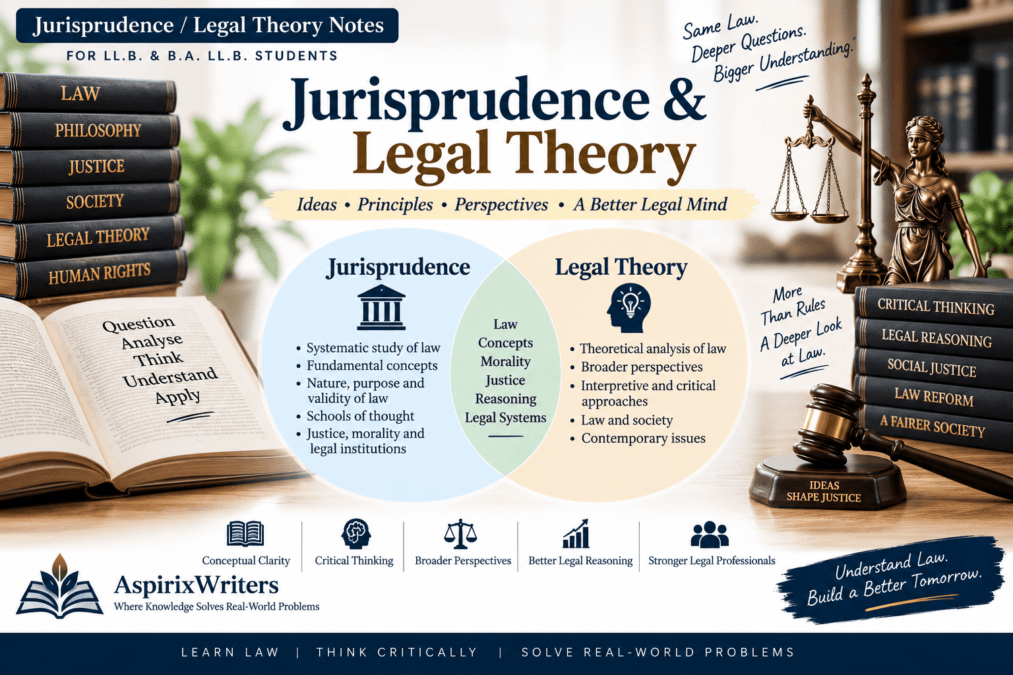
Jurisprudence is the systematic and theoretical study of law. It does more than explain legal rules; it helps us understand the concepts, principles, foundations and purposes underlying law.
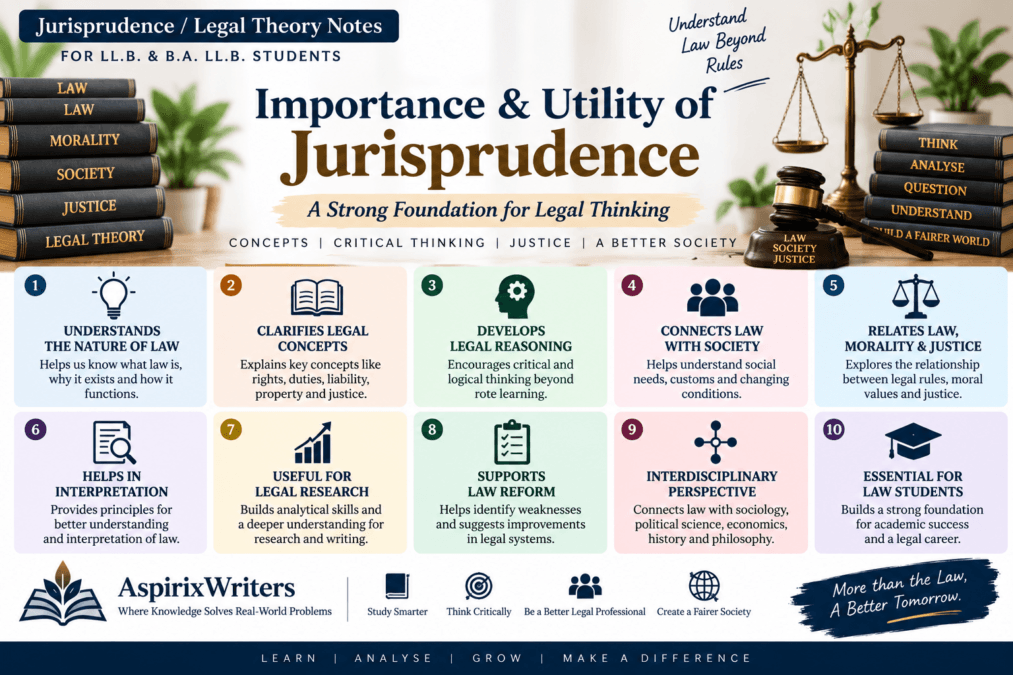
The functions of jurisprudence explain how the study of legal theory contributes to legal education, legal reasoning, interpretation, research and the development of law.
1. Explains the Nature and Meaning of Law
One of the primary functions of jurisprudence is to examine fundamental questions such as:
- What is law?
- What is the nature of law?
- What makes a rule legally valid?
- Why does law have authority?
Thus, jurisprudence provides a theoretical foundation for understanding law.
2. Clarifies Legal Concepts
Jurisprudence explains important concepts used throughout the legal system, including:
- Rights
- Duties
- Liability
- Possession
- Ownership
- Property
- Legal personality
- Obligation
- Justice
This conceptual clarity helps students and legal professionals understand legal rules more effectively.
3. Develops Legal Reasoning
Jurisprudence develops the ability to analyse legal problems logically and critically.
Instead of merely asking “What is the rule?”, jurisprudential thinking also asks:
“Why does this rule exist, what principle supports it, and how should it be applied?”
This makes jurisprudence particularly useful in legal education and professional reasoning. The National Law School of India University similarly describes jurisprudence as engaging with the theoretical foundations that have implications for everyday legal practice. (National Law School of India University)
4. Analyses Different Theories of Law
Jurisprudence provides a framework for comparing different theories and schools of legal thought.
For example:
- Natural Law → law, morality and justice
- Analytical Positivism → positive law and legal validity
- Historical School → history, customs and social development
- Sociological School → law and society
- Realism → practical operation of law
- Feminist Jurisprudence → law and gender
This comparative approach helps students understand that law can be examined from different perspectives.
5. Examines Law and Morality
Jurisprudence critically examines whether law and morality are necessarily connected.
It considers questions such as:
- Can an unjust law still be valid law?
- Should morality influence legal rules?
- Is there a duty to obey every law?
These questions form an important part of modern jurisprudential study. (National Law School of India University)
6. Helps in Understanding Justice
Jurisprudence examines the meaning and different theories of justice.
It helps explain ideas such as:
- Legal justice
- Social justice
- Distributive justice
- Corrective justice
- Equality and fairness
Therefore, jurisprudence provides a theoretical basis for evaluating whether laws and legal institutions promote justice.
7. Helps in Interpretation of Law
Legal rules may sometimes be ambiguous, incomplete or capable of more than one interpretation.
Jurisprudential principles help lawyers and judges understand the ideas and values underlying legal rules and develop reasoned interpretations.
Modern jurisprudence also examines questions concerning legal interpretation and the role of judges. (University of Minnesota Law School)
8. Supports Legal Research
Jurisprudence provides a foundation for conceptual and critical legal research.
It helps researchers:
- identify legal principles;
- examine competing theories;
- analyse inconsistencies;
- question existing assumptions;
- develop legal arguments; and
- suggest possible reforms.
9. Helps in Law Reform
Jurisprudence can identify weaknesses or inconsistencies in existing legal systems.
By examining law critically, jurisprudence can contribute to discussions about:
- Legal reform
- Social change
- Equality
- Justice
- Human rights
- Development of new legal principles
Thus, jurisprudence is not limited to studying existing law; it can also contribute to thinking about how law may develop.
10. Connects Law with Society and Other Disciplines
Jurisprudence helps examine law in its wider social context.
It connects legal theory with:
- Sociology
- Political Science
- History
- Economics
- Philosophy
- Ethics
This interdisciplinary approach helps explain how social, political, economic and moral factors influence legal systems. University-level jurisprudence courses similarly emphasize these interdisciplinary connections. (University of Technology)
Functions of Jurisprudence at a Glance
| Function | What it Does |
| Explains Law | Examines the nature and meaning of law |
| Clarifies Concepts | Explains rights, duties, liability, ownership, etc. |
| Develops Reasoning | Promotes logical and critical legal thinking |
| Analyses Theories | Compares different schools of jurisprudence |
| Examines Morality | Studies the relationship between law and morality |
| Explains Justice | Examines different concepts and theories of justice |
| Aids Interpretation | Helps understand principles behind legal rules |
| Supports Research | Provides tools for conceptual and critical analysis |
| Encourages Reform | Helps identify weaknesses and consider legal change |
| Connects Disciplines | Relates law to society, philosophy, economics and politics |
Functions vs. Importance of Jurisprudence
These two topics are closely related but should not be treated as identical.
Importance & Utility asks:
Why is the study of jurisprudence useful?
Functions asks:
What does jurisprudence do as a field of legal study?
For example, developing legal reasoning is a function, while the benefit of having better legal reasoning for a law student is part of its utility.
Quick Revision Trick
Remember the main functions as:
E – C – R – T – M – J – I – R – L – S
- E → Explains law
- C → Clarifies legal concepts
- R → Develops reasoning
- T → Analyses legal theories
- M → Examines law and morality
- J → Studies justice
- I → Helps interpretation
- R → Supports research
- L → Helps law reform
- S → Connects law with society
Important Exam Questions
Short Questions
- What are the functions of Jurisprudence?
- How does jurisprudence clarify legal concepts?
- How does jurisprudence help in legal reasoning?
- What is the role of jurisprudence in legal research?
Long Questions
- Explain the functions of Jurisprudence.
- Discuss the role of jurisprudence in the development of legal reasoning.
- Explain how jurisprudence contributes to legal interpretation and law reform.
- Discuss the role of jurisprudence in understanding law, morality and justice.
Key Takeaway
Jurisprudence helps us understand, analyse and critically evaluate law.
It explains the foundations of law, clarifies legal concepts, develops legal reasoning, examines law and morality, supports interpretation and research, and contributes to the development and reform of legal systems.
Prepared for LL.B. and B.A. LL.B. students by AspirixWriters – Where Knowledge Solves Real-World Problems.
About the Author: Dr. Rekha Khandelwal is a legal researcher, academic writing expert, author and Founder of AspirixWriters, helping students and researchers understand complex legal and academic concepts in simple language. View Author Profile – Dr. Rekha Khandelwal
Unit 1:
1.1 Meaning & Definition of Jurisprudence → 1.2 Nature of Jurisprudence → 1.3Scope of Jurisprudence → 1.4 Classification of Jurisprudence → 1.5 Importance & Utility of Jurisprudence → 1.6 Functions of Jurisprudence.
Don’t Miss New Law Opportunities!
Join our WhatsApp community for verified updates on Law Jobs, Internships, Competitions, Scholarships, LLB Notes & more.
Classmate Pulse Spiral Notebook ✏️ Need a Spiral Notebook for Everyday Writing? A spiral notebook…

Latest Scholarships & Fellowships 2026–27: Open Opportunities for Upcoming call
Latest Scholarships & Research Fellowships 2026–27 Last Verified: 30 September 2026 Students, researchers, PhD scholars…
Writing & Research Resources: Useful Books, Tools & Essentials for Writers and Researchers
Whether you are an author, content writer, law student, academic researcher, PhD scholar, teacher, or…