Jurisprudence and Legal Theory
Introduction
Jurisprudence and Legal Theory are closely connected areas of the theoretical study of law. In many law programmes, the terms are used together or even interchangeably.
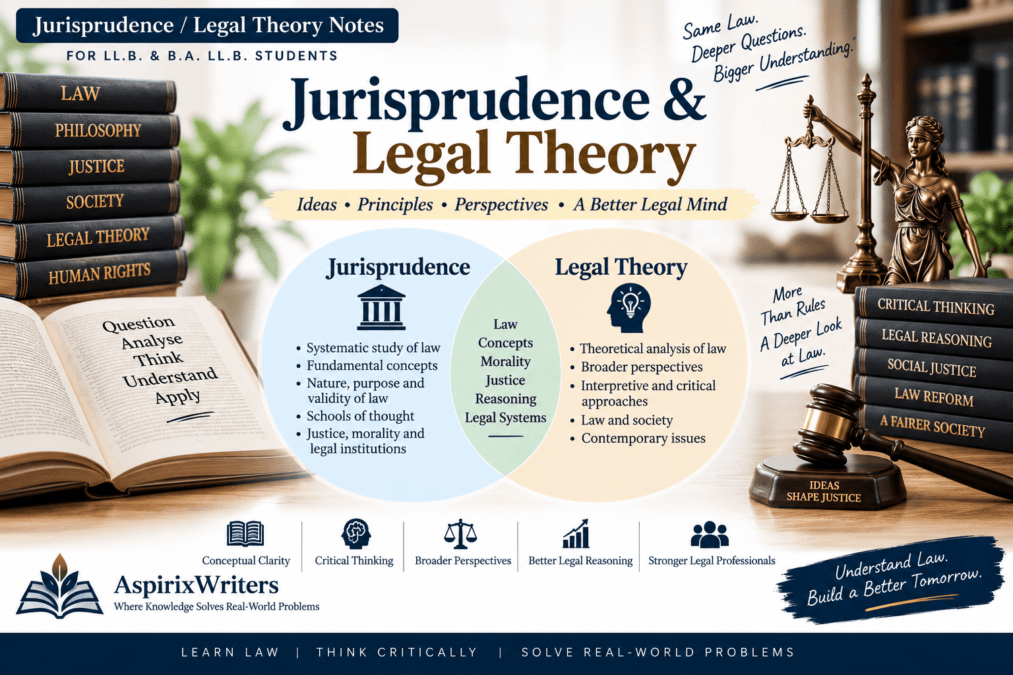
Jurisprudence studies the nature, meaning, foundations, principles and concepts of law, while Legal Theory provides theoretical and analytical approaches for understanding these questions.
For law students, the subject helps answer deeper questions such as:
- What is law?
- Why does law exist?
- What makes a rule legally valid?
- Why should law be obeyed?
- What is the relationship between law and morality?
- What is justice?
- How should law be interpreted?
- How does law relate to society?
These questions form an important part of modern jurisprudential study. Current law curricula in India commonly combine jurisprudence with legal theory and include schools of thought, legal concepts, justice, morality and the nature of law.
1. Meaning of Jurisprudence
Jurisprudence is the systematic and theoretical study of law.
It examines the fundamental principles and concepts underlying legal systems rather than focusing only on individual legal rules.
Jurisprudence may study:
- Nature and meaning of law
- Sources of law
- Legal rights and duties
- Possession and ownership
- Liability and obligation
- Justice
- Law and morality
- Schools of jurisprudence
- Law and society
- Legal institutions
- Theoretical foundations of legal systems
Thus, jurisprudence helps students understand law beyond the bare text of legal rules.
2. Meaning of Legal Theory
Legal Theory refers to the theoretical and conceptual study of law.
It examines different theories and approaches that attempt to explain:
- What law is
- How law derives its authority
- What makes law valid
- Why people should obey law
- The relationship between law and morality
- The meaning of justice
- Legal interpretation and reasoning
- The relationship between law and society
Legal Theory therefore provides different intellectual frameworks for understanding and analysing law.
Jurisprudence and Legal Theory substantially overlap. Legal Theory may be understood as a theoretical and analytical dimension of jurisprudential study, although the terms are sometimes used interchangeably.
3. Relationship Between Jurisprudence and Legal Theory
The relationship can be understood through their common subject matter.
1. Nature of Law
Both examine the fundamental question:
“What is law?”
Different schools provide different answers.
2. Legal Validity
They examine what makes a rule legally valid and how legal systems recognise valid laws.
3. Legal Concepts
Both deal with fundamental concepts such as:
- Rights
- Duties
- Liability
- Ownership
- Possession
- Obligation
- Personality
4. Law and Morality
They examine whether law must necessarily be connected with morality.
5. Justice
They study different ideas and theories concerning justice.
6. Legal Reasoning
They help explain how lawyers and judges reason about legal rules, principles and difficult cases.
7. Law and Society
They examine the relationship between legal systems and social, political and economic conditions.
8. Schools and Theories
Natural Law, Analytical Positivism, Historical, Sociological, Realist, Feminist and other approaches provide different ways of understanding law.
4. Difference Between Jurisprudence and Legal Theory
Although the terms overlap, a general distinction can be made for academic understanding.
| Basis | Jurisprudence | Legal Theory |
| Meaning | Systematic study of the nature, principles and fundamental concepts of law. | Theoretical and conceptual analysis of law. |
| Scope | Generally broad and may cover legal concepts, schools, justice, morality, sources and law-society relationships. | Focuses particularly on theories and frameworks used to explain and critically analyse law. |
| Main Concern | Understanding the fundamental nature and functioning of law. | Developing and examining theories about law. |
| Approach | May include analytical, philosophical, historical, sociological, realist, economic and feminist approaches. | Primarily theoretical, analytical, philosophical and critical. |
| Subject Matter | Law, legal concepts, justice, morality, schools and legal institutions. | Nature, validity, authority, obligation, interpretation, justice and morality of law. |
| Relationship | May be treated as the broader field of jurisprudential study. | May be treated as an important theoretical dimension of jurisprudence. |
| Academic Usage | Often used as the name of the law-school subject. | Often used alongside or interchangeably with Jurisprudence. |
Important Note
This distinction is not absolute.
In Indian legal education, the terms are frequently combined. Some curricula use “Jurisprudence / Legal Theory” as the course title, while others use “Jurisprudence” and include Legal Theory within the course.
5. Major Areas of Jurisprudence and Legal Theory
The subject may include the following major areas:
A. Foundations of Jurisprudence
- Meaning and definition
- Nature
- Scope
- Classification
- Importance
- Functions
B. Schools of Jurisprudence
- Natural Law
- Analytical / Positivist
- Historical
- Sociological
- Realist
- Economic / Marxist
- Feminist
- Critical approaches
C. Legal Concepts
- Rights and duties
- Possession
- Ownership
- Property
- Liability
- Obligation
- Legal personality
D. Law, Morality and Justice
- Law and morality
- Legal obligation
- Justice
- Theories of justice
- Relationship between law and ethics
E. Modern Legal Theory
- H.L.A. Hart
- Ronald Dworkin
- Lon Fuller
- Critical Legal Studies
- Feminist jurisprudence
- Contemporary theories of law
Modern jurisprudence courses increasingly include these theoretical debates. For example, NLSIU’s current Jurisprudence course examines Hart, Dworkin and Fuller along with contemporary critiques including Critical Legal Studies and feminist jurisprudence.
6. Important Jurists and Legal Theorists
Some important thinkers commonly studied under Jurisprudence and Legal Theory include:
| Jurist | Major Contribution |
| Jeremy Bentham | Utilitarianism and analytical approach |
| John Austin | Command theory / Analytical Positivism |
| Hans Kelsen | Pure Theory of Law |
| H.L.A. Hart | Primary and secondary rules |
| Ronald Dworkin | Rights, principles and law as integrity |
| Lon Fuller | Morality of law |
| Savigny | Historical School and Volksgeist |
| Henry Maine | Historical and anthropological approach |
| Roscoe Pound | Sociological Jurisprudence and Social Engineering |
| Oliver Wendell Holmes Jr. | American Legal Realism |
| Karl Marx & Friedrich Engels | Economic/Marxist approach to law |
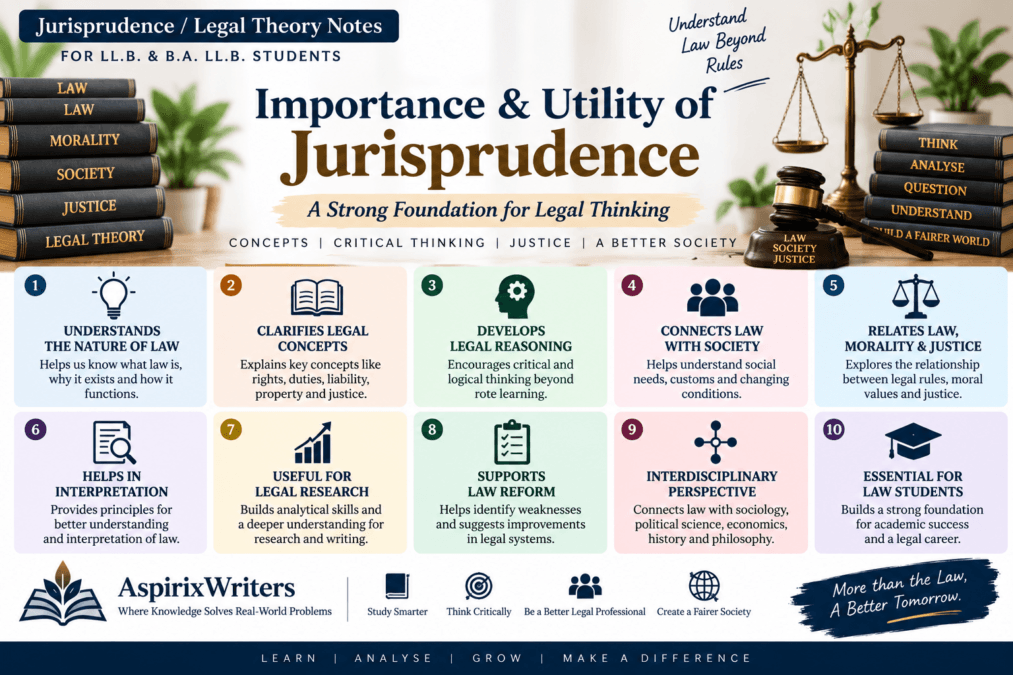
8. Why Should Law Students Study Jurisprudence and Legal Theory?
The subject helps students to:
- understand the foundations of law;
- develop analytical thinking;
- understand different schools of legal thought;
- clarify fundamental legal concepts;
- understand law and morality;
- examine theories of justice;
- improve legal reasoning;
- understand judicial interpretation;
- conduct better legal research;
- critically examine existing legal systems.
The purpose is therefore not simply to memorise theories but to learn how to think about law critically and systematically.
Quick Revision
Jurisprudence
Systematic study of law, its fundamental principles, concepts and foundations.
Legal Theory
Theoretical and conceptual analysis of law through different theories and approaches.
Relationship
Legal Theory and Jurisprudence substantially overlap. Legal Theory can be understood as an important theoretical dimension of jurisprudential study, while in many academic contexts the two terms are used interchangeably.
Easy Memory Trick
JURISPRUDENCE → LAW
LEGAL THEORY → THEORIES ABOUT LAW
Exam-Oriented Questions
- What is Jurisprudence?
- What is Legal Theory?
- Explain the relationship between Jurisprudence and Legal Theory.
- Distinguish between Jurisprudence and Legal Theory.
- Is Legal Theory a part of Jurisprudence? Discuss.
- Explain the scope of Jurisprudence and Legal Theory.
- Discuss the importance of Jurisprudence and Legal Theory in legal education.
Key Takeaway
Jurisprudence and Legal Theory are closely connected fields of legal thought.
Jurisprudence provides a systematic study of the nature, principles and fundamental concepts of law, while Legal Theory focuses on the theories and conceptual frameworks through which law is understood and critically analysed.
The two should therefore be understood as closely overlapping rather than completely separate subjects.
Law tells us what the legal rule is; Jurisprudence and Legal Theory encourage us to ask why the rule exists, what makes it valid, whether it is just, and how it should be understood.
About the Author: Dr. Rekha Khandelwal is a legal researcher, academic writing expert, author and Founder of AspirixWriters, helping students and researchers understand complex legal and academic concepts in simple language. View Author Profile – Dr. Rekha Khandelwal
Unit 1:
1.1 Meaning & Definition of Jurisprudence → 1.2 Nature of Jurisprudence → 1.3Scope of Jurisprudence → 1.4 Classification of Jurisprudence → 1.5 Importance & Utility of Jurisprudence → 1.6 Functions of Jurisprudence.
Don’t Miss New Law Opportunities!
Join our WhatsApp community for verified updates on Law Jobs, Internships, Competitions, Scholarships, LLB Notes & more.
Classmate Pulse Spiral Notebook ✏️ Need a Spiral Notebook for Everyday Writing? A spiral notebook…

Latest Scholarships & Fellowships 2026–27: Open Opportunities for Upcoming call
Latest Scholarships & Research Fellowships 2026–27 Last Verified: 30 September 2026 Students, researchers, PhD scholars…
Writing & Research Resources: Useful Books, Tools & Essentials for Writers and Researchers
Whether you are an author, content writer, law student, academic researcher, PhD scholar, teacher, or…