What Is the Best AI Tool for Legal Research in 2026?
Last updated: September 2026
Artificial intelligence is changing how lawyers, law students, legal academics and researchers find, analyse and organise legal information.
Modern AI legal research tools can understand natural-language questions, identify potentially relevant authorities, analyse documents, summarise judgments, compare legal materials and assist with drafting.
But one question remains:
What is the best AI tool for legal research?
There is no single tool that is best for every researcher.
The appropriate choice depends on several factors, including:
- jurisdiction;
- access to primary legal sources;
- case-law coverage;
- citation verification;
- research depth;
- document-analysis capabilities;
- privacy and confidentiality;
- pricing and subscription model;
- institutional requirements; and
- whether the user is a law student, academic, lawyer, law firm or corporate legal department.
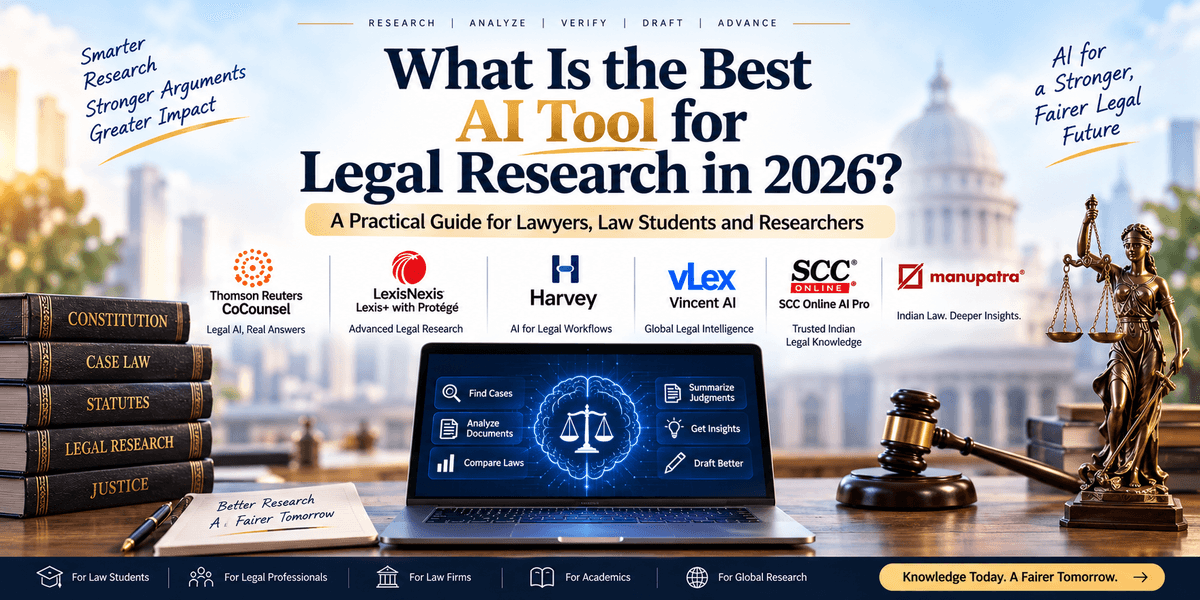
For professional US legal research, specialist platforms such as CoCounsel Legal and Lexis+ with Protégé connect AI-assisted workflows with established legal-content ecosystems.
For Indian legal research, platforms such as SCC Online AI Pro, SCC Online and Manupatra are relevant because Indian legal research requires jurisdiction-specific coverage.
For broader legal workflows, Harvey and Vincent AI by vLex provide AI-assisted research and document workflows across multiple jurisdictions.
General-purpose AI tools such as ChatGPT can also assist with research planning, explanation, source discovery and synthesis. However, a general AI assistant should not automatically be treated as a substitute for an authoritative legal database.
The central principle is simple:
AI can assist legal research, but the original legal authority remains the source that must be verified.
This guide compares major AI-powered legal research tools, explains their different use cases, discusses Indian and US legal research separately, and provides a practical framework for choosing an AI legal research platform.
Quick Answer: What Is the Best AI Tool for Legal Research?
There is no universal best AI tool for legal research.
The more useful question is:
Which AI legal research tool provides the authoritative sources, jurisdictional coverage, citation traceability and workflow capabilities required for my research problem?
For example:
- US professional legal research: CoCounsel Legal and Lexis+ with Protégé provide AI-assisted research within established legal-content ecosystems.
- Indian legal research: SCC Online AI Pro, SCC Online, Manupatra and LexisNexis’s India-specific offering address different aspects of Indian legal research.
- Law-firm and enterprise workflows: Harvey combines AI with research, document and workflow capabilities.
- Cross-jurisdictional legal research: Vincent AI by vLex provides AI-assisted research using vLex legal content, subject to the coverage available under the user’s subscription.
- Research planning and general AI assistance: ChatGPT, Claude and Gemini can help with research planning, explanation, summarisation and synthesis.
- Students and academics: Combining an authoritative legal database with a general AI assistant can be more useful than relying entirely on a single AI system.
The most important distinction is:
An AI-generated answer is not itself a legal authority.
A reliable workflow should allow the researcher to move from an AI-assisted response to the original judgment, statute, regulation, notification or other authoritative source.
What Is an AI Legal Research Tool?
An AI legal research tool combines artificial intelligence with legal information, search technology, document analysis or professional legal workflows.
Traditional legal research commonly requires a researcher to:
- formulate a research question;
- identify relevant legal terminology;
- search legal databases;
- locate cases and statutes;
- read judgments;
- identify legal principles;
- compare authorities;
- check subsequent treatment;
- determine whether the law has changed; and
- prepare the final legal analysis.
AI can assist with several of these steps.
Instead of beginning with a complicated Boolean search, a researcher may describe a legal problem in ordinary language.
Depending on the platform and available sources, an AI system may help identify:
- legal issues;
- potentially relevant authorities;
- statutory provisions;
- factual patterns;
- related legal concepts;
- arguments and counterarguments;
- potentially relevant documents;
- research gaps; and
- questions requiring further investigation.
However, the quality of the final legal research still depends on the underlying sources, the scope of the database and human verification.
How We Compared AI Legal Research Tools
This comparison uses six practical factors rather than attempting to declare a universal winner.
1. Jurisdictional coverage
A tool that works well for US case law may not provide the same depth for Indian law.
2. Primary and secondary sources
We consider whether a platform provides access to cases, statutes, regulations and other legal materials, as well as secondary sources where applicable.
3. Citation traceability and verification
Legal research requires more than a plausible-looking answer. Researchers need to identify and verify the underlying authority.
4. Research and document-analysis capabilities
Some platforms focus heavily on legal research, while others combine research with document review, drafting, contract analysis and workflow automation.
5. Privacy and data governance
Legal professionals must consider confidentiality, data processing, retention, security and organisational policies before uploading sensitive material.
6. Suitability for different users
The needs of a law student, legal academic, solo practitioner and multinational law firm are not identical.
Because these platforms serve different jurisdictions and workflows, the comparison below is functional rather than a universal ranking.
What Are the Top AI Tools for Legal Research in 2026?
The current legal-AI market is better understood through different categories rather than a simple #1-to-#10 ranking.
CoCounsel Legal
Primary use cases: Legal research, drafting, document analysis, litigation support and professional legal workflows.
CoCounsel Legal is Thomson Reuters’ legal AI platform. Its current ecosystem connects AI-assisted legal work with Westlaw, Practical Law and organisational knowledge.
Current capabilities include:
- legal research;
- Deep Research;
- document analysis;
- drafting;
- legal-content retrieval;
- linked citations;
- organisation-specific knowledge; and
- matter-oriented workflows.
Thomson Reuters describes CoCounsel’s Deep Research as producing detailed, cited research grounded in Westlaw and Practical Law.
For researchers already working within the Thomson Reuters ecosystem, the connection between AI assistance and established legal content is an important part of the platform’s design.
CoCounsel also includes document-analysis capabilities. Thomson Reuters describes its Tabular Analysis feature as capable of analysing up to 10,000 documents against 100 questions.
What happened to Casetext?
Casetext should not be treated as a separate current competitor in the same way it was before 2023.
Thomson Reuters completed its acquisition of Casetext in August 2023. CoCounsel became part of Thomson Reuters’ legal-AI portfolio.
Important limitation
CoCounsel’s strengths are closely connected to the Thomson Reuters legal-content ecosystem.
Therefore, users should check the actual jurisdictional coverage and content included in their subscription rather than assuming that the platform provides comprehensive law for every jurisdiction.
Lexis+ with Protege
Primary use cases: Legal research, drafting and legal analysis within the LexisNexis ecosystem.
One important 2026 development is the product name.
Lexis+ AI was renamed Lexis+ with Protege in 2026.
LexisNexis describes Lexis+ with Protege as a legal AI solution for research, drafting and analysis.
The platform combines its AI assistant with LexisNexis legal content and related research capabilities.
Features include:
- natural-language legal research;
- primary legal sources;
- secondary sources;
- Practical Guidance;
- AI-assisted research;
- linked legal citations;
- web information where applicable; and
- Shepard’s citation functionality.
What is Shepard’s?
Shepard’s is LexisNexis’s citation-validation and legal-citation treatment system.
For professional legal research, this distinction is important because finding a citation and determining how later authorities have treated that citation are different research tasks.
Lexis+ with Protege for Indian legal research
LexisNexis also offers Lexis Advance with Protege for India.
The India-specific offering combines AI capabilities with LexisNexis India content and legal research workflows.
For Indian researchers, this demonstrates an important point:
The relevant question is not simply whether a platform has AI. The relevant question is which Indian legal sources are actually available to the user.
Harvey
Primary use cases: Law-firm workflows, corporate legal teams, legal research, document analysis and complex legal work.
Harvey is designed as a broader AI platform for legal and professional services.
Its platform includes capabilities involving:
- AI agents;
- legal research;
- document analysis;
- drafting;
- knowledge sources;
- workflows;
- contract intelligence;
- collaborative workspaces; and
- organisation-specific information.
Harvey’s knowledge-source system is particularly relevant when comparing international legal AI platforms.
Its current knowledge-source documentation lists multiple regional and legal-content sources, including SCC Online for Indian legal content.
This means Harvey can be relevant for organisations conducting research across jurisdictions, but users should always check which sources are available to their particular account.
Privacy and confidentiality
Privacy is particularly important when using AI in legal practice.
Harvey’s current privacy materials describe its handling of customer data and its enterprise security controls. Users should nevertheless review the provider’s current contractual terms, privacy documentation and their own organisation’s policies before uploading confidential or privileged material.
No legal AI platform should be assumed to have identical data-handling practices.
Vincent AI by vLex
Primary use cases: Legal research, litigation preparation, contract review and cross-jurisdictional legal workflows.
Vincent AI is vLex’s legal AI assistant.
The platform is built around vLex’s legal information resources and is designed to assist with legal research and related legal tasks.
Vincent can be particularly relevant when research extends across jurisdictions.
However, the phrase “global legal research” should not be interpreted as meaning that every country, court or legal source is covered equally.
Researchers should check:
- jurisdiction;
- court coverage;
- date range;
- source type;
- language;
- subscription level; and
- current database availability.
Any productivity or performance statistics published by the vendor should also be treated as vendor-reported claims, rather than independent evidence.
SCC Online AI Pro
Primary use cases: Indian legal research, legal analysis and research workflows involving Indian authorities.
SCC Online introduced AI Pro in 2026, combining AI capabilities with the SCC Online legal database.
Its published materials describe natural-language legal queries and source-linked legal responses.
SCC Online describes AI Pro as supporting areas such as:
- legal research;
- legal principles;
- factual analysis;
- advisory work;
- drafting;
- due diligence;
- compliance; and
- litigation preparation.
The platform’s connection to SCC Online’s legal content is particularly relevant for Indian researchers because Indian legal research frequently requires detailed examination of Supreme Court and High Court authorities.
Why SCC Online AI Pro matters for Indian research
Indian researchers may need to work with:
- Supreme Court judgments;
- High Court judgments;
- legislation;
- rules;
- regulations;
- notifications;
- tribunal decisions;
- constitutional provisions; and
- subsequent judicial interpretation.
An AI system grounded in Indian legal content therefore serves a different function from a general-purpose chatbot.
Manupatra
Primary use cases: Indian legal database research and access to Indian legal information.
Manupatra is an established Indian legal information and research platform.
Its public information includes coverage of:
- Supreme Court decisions;
- High Court decisions;
- tribunals and commissions;
- Bare Acts and statutes;
- notifications;
- circulars;
- citation searches;
- Act searches;
- legal searches; and
- research and analytical tools.
Important distinction
Manupatra should not simply be described as an AI legal research platform.
It is more accurately described as an Indian legal database and research platform.
This distinction matters because an authoritative legal database and a generative AI assistant perform different functions.
A strong research workflow may use both.
AI Legal Research Tools Comparison
| Platform | Primary focus | AI assistance | Legal research | Citation/source verification | Indian-law relevance | Primary use cases |
|---|---|---|---|---|---|---|
| CoCounsel Legal | Legal research, drafting and analysis | Yes | Yes | Linked citations to Westlaw/Practical Law sources | Depends on available content | Professional legal teams |
| Lexis+ with Protégé | Research, drafting and analysis | Yes | Yes | Shepard’s and linked legal citations | India-specific offering available | Legal professionals |
| Harvey | Legal workflows, research and document analysis | Yes | Yes | Source-grounded workflows | SCC Online content available | Firms and legal departments |
| Vincent AI | Global legal research and workflows | Yes | Yes | Source-based research | Depends on coverage | Cross-jurisdictional work |
| SCC Online AI Pro | Indian legal research | Yes | Yes | Source-linked legal material | Strong Indian relevance | Indian legal professionals and researchers |
| Manupatra | Indian legal database and research | Research tools | Yes | Citation/search functionality | Strong Indian relevance | Indian legal research |
| ChatGPT | General research and reasoning | Yes | Assistance | Depends on sources and research mode | Useful as an assistant | Students, academics and researchers |
| Claude | General AI and research workflows | Yes | Assistance | Depends on connected sources/tools | Depends on source access | Research and drafting assistance |
| Gemini | General AI, search and research | Yes | Assistance | Depends on source/workflow | Useful for general research | Students and researchers |
This table is a functional comparison, not a ranking. Features, pricing, source coverage and jurisdictional availability can change. Users should confirm the current plan and database coverage before subscribing.
Which AI-Powered Legal Research Tool Is Best for Indian Law?
For Indian legal research, jurisdiction should be one of the first filters.
A researcher may need access to:
- Supreme Court judgments;
- High Court decisions;
- Indian statutes;
- rules and regulations;
- notifications;
- constitutional materials;
- tribunal decisions;
- amendments; and
- subsequent judicial treatment.
Relevant platforms include:
- SCC Online AI Pro;
- SCC Online;
- Manupatra;
- Lexis Advance with Protégé; and
- Harvey, where SCC Online content is available through the relevant knowledge source.
The important question is not simply:
“Which AI model is smartest?”
Instead ask:
“Which platform gives me the Indian legal authorities I actually need, and can I verify the underlying sources?”
For example, the official India Code portal provides access to Acts and other legislative materials, including sections, rules, regulations, notifications, orders, ordinances, statutes and circulars.
For judgments, the Supreme Court’s official search system allows searches using keywords, phrases, Boolean operators and neutral citations.
These official resources can form part of the verification layer of an AI-assisted research workflow.
What Is the Best AI Tool for US Legal Research?
US legal research requires access to US-specific legal authorities and databases.
CoCounsel Legal currently connects AI-assisted workflows with Westlaw and Practical Law.
Lexis+ with Protégé connects AI-assisted research with LexisNexis legal content and Shepard’s citation functionality.
For US research, users should compare:
- federal case-law coverage;
- state case-law coverage;
- statutes;
- regulations;
- secondary sources;
- citation treatment;
- currentness;
- document analysis;
- drafting capabilities;
- integration; and
- organisational security requirements.
The appropriate platform therefore depends on the specific research environment rather than the AI model alone.
Which AI Legal Research Tools Are Useful for Law Firms?
Law firms often have broader requirements than individual researchers.
A firm may need:
- legal research;
- document review;
- drafting;
- contract analysis;
- matter organisation;
- knowledge management;
- workflow automation;
- collaboration;
- enterprise security;
- administrative controls; and
- integration with existing systems.
Platforms such as CoCounsel Legal, Lexis+ with Protégé and Harvey address different combinations of these requirements.
Before adopting an AI platform, a firm should conduct its own evaluation covering:
- source coverage;
- accuracy;
- citation traceability;
- confidentiality;
- data governance;
- administrator controls;
- integration;
- user permissions;
- auditability; and
- total cost.
What Is the Best AI Legal Research Tool for Law Students?
Law students usually have different requirements from large law firms.
Students may primarily need help with:
- understanding legal concepts;
- finding relevant cases;
- identifying statutory provisions;
- preparing research questions;
- summarising judgments;
- comparing cases;
- preparing notes;
- developing assignments; and
- learning legal research methods.
A general AI assistant can be useful for these tasks.
However, students should develop the habit of verifying every important legal authority.
A practical student workflow is:
AI assistance → identify authority → open original source → read authority → verify citation → prepare notes → write answer.
This is particularly important when preparing:
- research papers;
- dissertations;
- moot court submissions;
- case comments;
- seminar papers;
- assignments; and
- examination answers.
What Is the Best Free AI Tool for Legal Research?
There is no single free AI tool that should automatically be treated as a complete free legal research database.
Free or broadly accessible general AI tools can be useful for:
- research planning;
- brainstorming search terms;
- explaining legal concepts;
- summarising user-provided documents;
- creating research checklists;
- organising verified material; and
- developing research questions.
However, free AI assistance is not the same as free access to a comprehensive professional legal database.
For Indian legal research, researchers can combine AI assistance with authoritative public resources such as:
- India Code;
- official Supreme Court resources;
- official High Court resources; and
- other relevant government or institutional sources.
The availability of subscription databases and AI features varies by platform.
Where Can I Compare AI Legal Research Tools?
When comparing AI legal research platforms, do not compare only the chatbot interface.
Compare the underlying research environment.
A useful comparison should examine:
| Factor | Question to ask |
|---|---|
| Jurisdiction | Does it cover the jurisdiction I research? |
| Primary law | Can I access the underlying cases and legislation? |
| Secondary sources | What commentary or secondary material is included? |
| Citation verification | Can I trace and verify citations? |
| Currentness | How current is the legal content? |
| Research | Can it handle complex legal questions? |
| Documents | Can it analyse large document collections? |
| Privacy | How is customer data handled? |
| Integration | Does it fit my existing workflow? |
| Pricing | What does my actual plan include? |
| Training | Can users learn how to use the tool effectively? |
| Human review | Can the workflow preserve meaningful human verification? |
This is more useful than relying on a simple online “best AI legal research tool” list.
How Much Do AI Legal Research Tools Cost?
Pricing varies considerably.
Professional legal AI platforms may use:
- subscription pricing;
- organisation-level licensing;
- quote-based pricing;
- jurisdiction-specific pricing;
- feature-based plans; or
- packages that combine AI with legal databases and research products.
Pricing can also depend on:
- number of users;
- organisation size;
- jurisdiction;
- database content;
- AI features;
- document-analysis limits;
- integrations; and
- enterprise requirements.
For this reason, it is safer not to publish a fixed price unless the provider currently publishes that price for the exact plan being discussed.
What should you compare instead?
When evaluating cost, calculate:
Total cost = subscription + required database access + additional features + user licences + implementation/training costs
A free trial should also not be confused with permanent free access.
Can ChatGPT Be Used for Legal Research?
Yes.
ChatGPT can assist with legal research planning, source discovery, explanation, synthesis and structured analysis.
Its current Search and Deep Research capabilities can retrieve and cite web sources. OpenAI also specifically notes that Search does not replace specialised databases.
Deep Research is designed for multi-step research involving gathering, evaluating and synthesising information from multiple sources.
This makes general AI useful as a research assistant.
However:
ChatGPT should not automatically be treated as the final authority on a legal proposition.
A safer workflow is:
Ask AI → identify sources → open original source → verify proposition → cite original source.
For professional legal work, the final authority should come from the applicable legal source.
Can AI Find and Analyse Case Law?
Yes, but there is an important distinction.
Finding a potentially relevant case is not the same as establishing that the case supports your proposition.
An AI system may identify a judgment that appears relevant.
The researcher should then check:
- case name;
- court;
- date;
- citation;
- relevant paragraph;
- factual context;
- legal issue;
- ratio or holding;
- subsequent treatment;
- whether the decision has been overruled;
- whether it has been distinguished; and
- whether the authority remains applicable.
This is particularly important because generative AI systems can produce incorrect or hallucinated legal citations.
Can AI Summarise Court Judgments?
Yes.
AI can help create an initial summary of a lengthy judgment covering:
- facts;
- issues;
- arguments;
- statutory provisions;
- reasoning;
- decision; and
- legal principles.
However, a summary is not a substitute for reading the judgment when the legal proposition is important.
The Supreme Court of India itself provides landmark judgment summaries but expressly states that its summaries do not form part of the Court’s decision or reasons and are not for use in legal proceedings.
The principle is therefore straightforward:
A summary can help you understand an authority; the judgment remains the authority.
Can AI Replace Traditional Legal Research?
AI can change the research workflow, but it does not remove the need for legal research and legal judgment.
Traditional research remains important for:
- verifying authorities;
- interpreting legislation;
- analysing precedent;
- distinguishing cases;
- checking amendments;
- identifying conflicting decisions;
- determining jurisdiction;
- understanding factual context; and
- assessing the legal significance of an authority.
AI is better understood as an augmentation layer over legal research.
Can AI Be Trusted for Legal Research?
AI can be highly useful, but an answer should not be trusted merely because it sounds confident or authoritative.
This issue became particularly important in India in 2026.
Pooja Ramesh Singh v. Jammu and Kashmir Bank Ltd.
In Pooja Ramesh Singh v. Jammu and Kashmir Bank Ltd., 2026 INSC 668, decided on 2 July 2026, the Supreme Court of India considered the consequences of reliance on AI-generated fake and hallucinated case law.
The Supreme Court’s published summary states that six AI-generated citations relied upon by the tribunals were later found to be either wholly non-existent or attributed with non-existent paragraphs.
The Court considered whether the NCLT and NCLAT decisions relying on that material could be sustained.
This case demonstrates why citation verification is not merely a technical recommendation.
The practical lesson
Never cite a case merely because an AI system provides the citation.
Verify:
- the case exists;
- the citation is correct;
- the court is correct;
- the relevant paragraph exists;
- the judgment actually supports the proposition;
- subsequent decisions have been checked; and
- the current legal position has been established.
How Can AI Hallucinate Legal Citations?
A language model can generate text that appears authoritative even when:
- a case does not exist;
- a citation is incorrect;
- a paragraph number is fabricated;
- the case exists but does not support the proposition;
- an old statutory provision has changed;
- the judgment is misunderstood;
- the wrong jurisdiction is used; or
- multiple authorities are incorrectly combined.
This is why citation verification is a core part of AI-assisted legal research.
The Safe AI Legal Research Workflow
Whether you are a lawyer, professor, researcher or student, the following workflow can reduce the risk of relying on unverified AI output.
Step 1: Define the research question
Write the precise legal issue.
Avoid beginning with an unnecessarily broad prompt.
Instead of:
“Tell me everything about criminal intimidation.”
Try:
“What is the current judicial interpretation of the essential elements of criminal intimidation under the applicable Indian law, and which recent Supreme Court or High Court decisions discuss those elements?”
Step 2: Break the issue into sub-questions
Identify:
- statutory issues;
- factual issues;
- procedural issues;
- precedent issues;
- jurisdictional questions; and
- currentness questions.
Step 3: Use AI for research planning
AI can help identify:
- legal terminology;
- alternative search terms;
- related concepts;
- possible research questions;
- potential lines of inquiry.
Treat these as research leads rather than verified legal conclusions.
Step 4: Search authoritative sources
Use appropriate legal databases and official sources.
For Indian legislation, India Code is an important official source.
For Supreme Court judgments, use the official Supreme Court/eCommittee search resources and appropriate authorised databases.
Step 5: Identify primary authorities
Locate the actual:
- judgment;
- Act;
- section;
- regulation;
- notification;
- rule; or
- official order.
Step 6: Read the authority
Do not rely only on an AI-generated summary.
Read the relevant portions of the original authority.
Step 7: Verify current legal status
Check for:
- amendments;
- subsequent judgments;
- overruling;
- distinguishing decisions;
- appeals;
- changes in statutory law; and
- current regulatory requirements.
Step 8: Use AI for organisation
Once the sources have been verified, AI can help turn them into:
- research notes;
- case tables;
- chronologies;
- issue matrices;
- comparative tables;
- summaries; and
- structured drafts.
Step 9: Draft
Prepare the legal analysis using verified authorities.
Step 10: Conduct a citation audit
Check every citation against the original source.
Ask:
- Does the case exist?
- Is the citation correct?
- Does the paragraph exist?
- Does the authority support the proposition?
- Is the authority current?
- Is the jurisdiction correct?
Step 11: Human review
The final legal analysis should remain under meaningful human control.
How to Choose an AI Legal Research Tool
Before subscribing to AI legal research software, ask these questions.
1. What jurisdiction do I need?
Indian law, US law, UK law and other jurisdictions require different source coverage.
2. Does it provide primary sources?
An AI-generated answer is not equivalent to access to primary authority.
3. How extensive is its case-law database?
Check the actual courts and jurisdictions covered.
4. Does it cover legislation?
Check whether statutes, regulations and subordinate legislation are included.
5. Can I verify citations?
Citation traceability should be a major consideration.
6. How current is the legal content?
Legal research requires current law.
7. Does it support natural-language research?
Natural-language search can make complex research questions easier to formulate.
8. Can it analyse documents?
This matters when working with contracts, pleadings, judgments or large document collections.
9. How does it handle confidential information?
Review:
- privacy policies;
- data-processing terms;
- retention policies;
- security controls; and
- your organisation’s own confidentiality requirements.
10. Does it integrate with my workflow?
Consider:
- document management;
- word-processing tools;
- collaboration;
- matter management; and
- other systems used by your organisation.
11. What does it actually cost?
Compare the plan you can actually purchase, rather than relying on general online estimates.
12. Does it fit my role?
A:
- law student;
- professor;
- academic researcher;
- solo practitioner;
- law firm;
- corporate legal department; and
- government researcher
may require different capabilities.
AI Legal Research for Indian Law: A Practical Example
Suppose a researcher wants to study a question involving a provision of the Bharatiya Nyaya Sanhita, 2023.
A strong workflow could look like this:
Research question
↓
Identify the relevant BNS provision
↓
Check the current statutory text
↓
Search Supreme Court and High Court judgments
↓
Identify relevant judicial interpretations
↓
Use AI to organise and compare verified authorities
↓
Open and read the original judgments
↓
Check subsequent decisions
↓
Check amendments and current legislation
↓
Draft the legal analysis
↓
Verify every citation
This is safer than simply asking a general AI chatbot:
“Give me all the cases on this section.”
and copying the resulting citations.
AI Legal Research: Privacy and Confidentiality
Privacy is especially important when using AI for legal work.
Before uploading client or confidential documents, consider:
- Is the provider acting as a processor?
- Is customer data used to train models?
- How long is information retained?
- Who can access it?
- Where is data processed?
- Are administrator controls available?
- Are audit logs available?
- What contractual protections exist?
- Does the organisation permit the use of the particular AI service?
For example, providers may publish specific statements about customer-data handling, security and model training.
However, a statement made by one provider should not be assumed to apply to another provider.
Always check the provider’s current terms and your organisation’s confidentiality requirements before uploading sensitive legal material.
AI Legal Research vs Traditional Legal Research
| Traditional legal research | AI-assisted legal research |
|---|---|
| Keyword searching | Natural-language queries |
| Manual document review | AI-assisted document analysis |
| Manual summarisation | AI-generated summaries |
| Manual comparison | AI-assisted comparison |
| Research notes | AI-assisted organisation |
| Human legal judgment | Human legal judgment |
| Authority verification | Authority verification remains essential |
| Manual research planning | AI-assisted research planning |
AI can change how researchers work through information.
It does not change the need to determine whether the information is legally authoritative.
What AI Legal Research Cannot Reliably Decide for You
AI should not independently make professional legal decisions such as:
- whether a case is binding in a particular jurisdiction;
- whether a judgment remains good law;
- whether a statutory provision applies to a specific client;
- whether privileged information can be disclosed;
- whether a particular litigation strategy should be adopted;
- whether a legal opinion is professionally sufficient; or
- what legal advice should ultimately be given to a client.
These questions require legal expertise, source verification and contextual judgment.
AI Legal Research for Academics and Legal Researchers
Legal academics can use AI at several stages of research.
For example, AI can assist with:
Research question development
AI can help convert a broad topic into specific research questions.
Literature mapping
AI can help organise themes and identify areas requiring further investigation.
Case comparison
Verified cases can be placed into structured comparison tables.
Judgment summarisation
Long judgments can be initially organised into facts, issues, arguments, reasoning and decision.
Research organisation
AI can help create:
- case matrices;
- chronology tables;
- issue lists;
- literature maps;
- research outlines; and
- preliminary drafts.
However, academic researchers should distinguish between:
AI-generated research assistance and verified scholarly evidence.
Primary authorities and reliable academic sources should remain the foundation of the final research.
AI Legal Research for Legal Writing
AI can also assist with legal writing after the research has been verified.
For example, a researcher can provide verified material and ask AI to:
- organise the argument;
- improve structure;
- simplify language;
- create headings;
- compare authorities;
- identify missing counterarguments;
- prepare a case table; or
- check consistency.
However, AI should not be allowed to silently introduce unsupported authorities or propositions.
A useful rule is:
Research first. Verify second. Draft with AI third. Audit citations last.
Frequently Asked Questions
What is the best AI tool for legal research?
There is no universal best tool.
CoCounsel Legal, Lexis+ with Protege, Harvey, Vincent AI and SCC Online AI Pro serve different jurisdictions and workflows. The appropriate choice depends primarily on the legal sources, jurisdiction and workflow requirements of the researcher.
What is the best free AI tool for legal research?
Free general AI tools can assist with research planning, explanation, summarisation and organisation.
However, free AI assistance should not be confused with free access to a comprehensive professional legal database.
For Indian legal research, researchers can combine AI assistance with authoritative public resources such as India Code and official court resources.
Can ChatGPT do legal research?
Yes.
ChatGPT can assist with research planning, source discovery, synthesis and structured analysis. Its Search and Deep Research capabilities can retrieve and cite web sources.
However, important legal authorities should still be opened and independently verified.
What AI tools do lawyers use?
Legal professionals may use specialist platforms such as CoCounsel Legal, Lexis+ with Protege, Harvey, Vincent AI and SCC Online AI Pro, as well as general-purpose AI systems.
Actual use depends on:
jurisdiction;
firm policy;
subscription;
confidentiality requirements;
source coverage; and
the particular task.
Which AI is useful for case-law research?
The important question is not simply which AI model is most capable.
The researcher should ask:
Does the platform provide authoritative case-law coverage for the relevant jurisdiction, and can I verify the underlying authority?
Can AI find relevant court judgments?
Yes.
AI can help identify potentially relevant judgments, but researchers should verify:
the actual judgment;
citation;
court;
date;
relevant reasoning;
factual context; and
subsequent treatment.
Is AI reliable for legal research?
AI can be useful, but it should not be treated as automatically reliable.
AI systems can generate incorrect legal propositions and hallucinated citations.
Important legal claims should therefore be verified against authoritative sources.
Can AI generate fake legal citations?
Yes.
This is a documented risk.
The Supreme Court of India addressed reliance on AI-generated fake and hallucinated case law in Pooja Ramesh Singh v. Jammu and Kashmir Bank Ltd., 2026 INSC 668, decided on 2 July 2026.
Which AI tool is useful for Indian legal research?
Researchers should examine platforms with actual Indian legal content.
Relevant options include:
SCC Online AI Pro;
SCC Online;
Manupatra;
Lexis Advance with Protégé; and
Harvey where SCC Online content is available through its knowledge-source system.
The appropriate choice depends on the specific research requirement.
Can law students use AI for legal research?
Yes.
Students can use AI to understand concepts, develop research questions, organise material and analyse documents.
They should nevertheless read and verify the underlying legislation and judgments.
Is AI legal research a replacement for legal databases?
A general-purpose AI assistant should not be treated as a replacement for a comprehensive legal database.
Some specialist legal AI platforms combine AI with established legal databases, but the source coverage and functionality depend on the platform and subscription.
Where can I compare AI legal research platforms?
jurisdictional coverage;
primary-source access;
case-law coverage;
legislation;
citation verification;
currentness;
document analysis;
privacy;
workflow integration; and
actual subscription cost.
Avoid choosing solely on the basis of an AI model’s general reputation.
Final Takeaway: Which AI Legal Research Tool Should You Choose?
The question:
“What is the best AI tool for legal research?”
does not have one answer for every researcher.
A better question is:
“Which AI legal research tool has the authoritative sources, jurisdictional coverage and workflow capabilities that match my research problem?”
For Indian legal research
Examine:
- SCC Online AI Pro;
- SCC Online;
- Manupatra;
- Lexis Advance with Protégé; and
- other platforms providing the specific Indian authorities you need.
Also use official sources such as India Code and official court resources for primary-source verification.
For US professional legal research
Consider the source coverage and workflows available through platforms such as:
- CoCounsel Legal; and
- Lexis+ with Protégé.
The important factors include primary-law coverage, citation treatment, currentness and workflow integration.
For law-firm and enterprise workflows
Platforms such as Harvey provide broader combinations of:
- research;
- document analysis;
- drafting;
- knowledge sources;
- workflows; and
- enterprise controls.
For research planning and general AI assistance
Tools such as ChatGPT can assist with:
- research planning;
- source discovery;
- explanation;
- summarisation;
- comparison; and
- synthesis.
But important legal propositions should still be verified against the underlying authorities.
The Most Important Principle
Regardless of which AI legal research tool you use:
AI can accelerate legal research. It cannot remove the responsibility to verify the law.
A reliable workflow is:
AI assistance → authoritative source → original judgment/statute → verification → legal analysis → citation audit → human review
That approach allows AI to function as a research accelerator while keeping legal authority and human judgment at the centre of the research process.
About This Article
Research focus: AI legal research tools, legal technology, Indian legal research, US legal research and AI-assisted legal workflows.
Comparison method: Platforms were examined based on jurisdictional coverage, legal-source access, citation traceability, research capabilities, document analysis, privacy considerations and suitability for different users.
Last reviewed: September 2026
explore more
- ✔ Law Study Material
- ✔ Practical Legal Guides
- ✔ Legal writing
- ✔ Artificial Intelligence
- ✔ Best Tools & Resources
- ✔ Career Opportunities
- ✔ Best Books
- ✔ Professional Writing Services
sources
https://legal.thomsonreuters.com/en/products/cocounsel-legal
LexisNexis