Classification of Jurisprudence
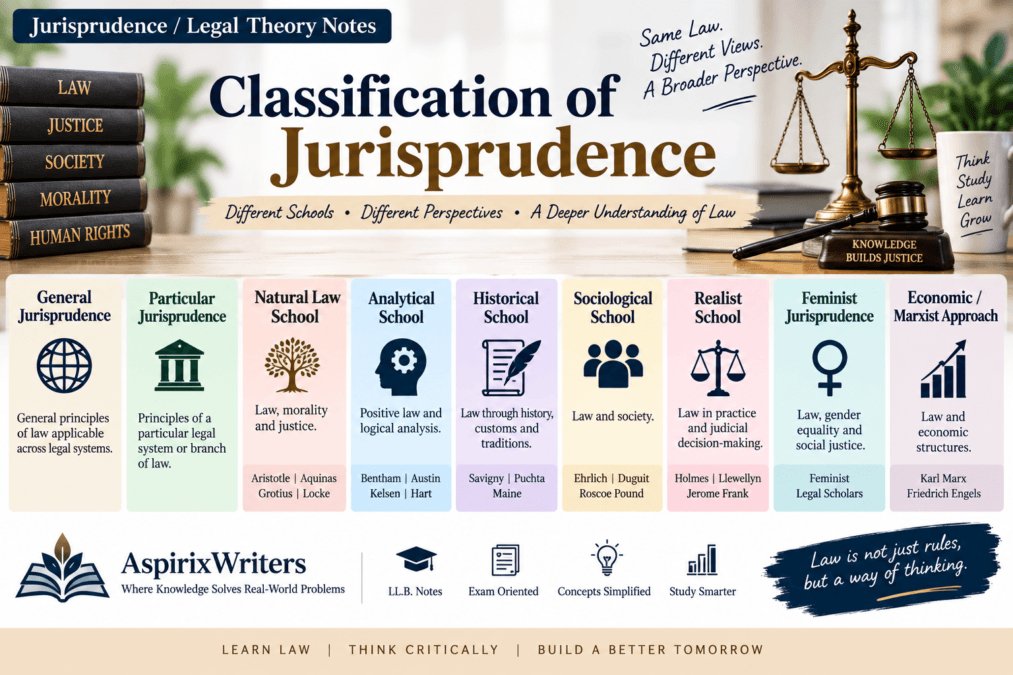
Classification of Jurisprudence means arranging the study of law into different branches, approaches or schools according to their subject matter, method and understanding of law. It helps students understand the different ways in which jurists have studied the nature, purpose and functioning of law.
For examination purposes, it is useful to understand General and Particular Jurisprudence separately from the major schools of jurisprudence.
Don’t Miss New Law Opportunities!
Join our WhatsApp community for verified updates on Law Jobs, Internships, Competitions, Scholarships, LLB Notes & more.
1. General Jurisprudence
General Jurisprudence deals with general principles and fundamental concepts that are common to different legal systems.
It studies questions such as:
- What is law?
- What is the nature of law?
- What are rights and duties?
- What is legal liability?
- What is justice?
- What is the relationship between law and morality?
Example: The concept of legal rights can be studied as a general jurisprudential concept irrespective of a particular country’s legal system.
2. Particular Jurisprudence
Particular Jurisprudence deals with the principles and concepts of a particular legal system or a particular branch of law.
It focuses on the legal principles applicable within a specific jurisdiction.
Example: The study of specific principles of Indian law may be considered within the context of a particular legal system.
General vs Particular Jurisprudence
| General Jurisprudence | Particular Jurisprudence |
| Deals with general principles of law | Deals with a particular legal system |
| Broader in approach | More specific in approach |
| May be applicable across legal systems | Closely connected with a particular jurisdiction |
| Focuses on fundamental legal concepts | Focuses on specific legal rules and principles |
Major Schools and Approaches of Jurisprudence
The development of jurisprudence has produced several important schools of thought. Different universities may include different schools in their syllabus. The University of Rajasthan’s LL.B. syllabus, for example, includes Natural Law, Analytical, Historical, Sociological, American Realism and Feminism. (University of Rajasthan)
3. Natural Law School
The Natural Law School considers law in relation to reason, morality, justice and principles believed to be inherent in human nature.
Key idea:
Law should be connected with reason, morality and justice.
Important thinkers include:
- Aristotle
- Cicero
- St. Augustine
- St. Thomas Aquinas
- Grotius
- John Locke
- Rousseau
4. Analytical or Positivist School
The Analytical School studies law as it exists, particularly positive law created or recognized by legal authority.
Important thinkers include:
- Jeremy Bentham
- John Austin
- Hans Kelsen
- H.L.A. Hart
Key idea:
The school emphasizes the study of positive law and the structure, sources and validity of legal rules.
Exam memory:
Austin → Command Theory
Kelsen → Pure Theory of Law
Hart → Primary and Secondary Rules
The University of Rajasthan’s current syllabus specifically includes Austin, Bentham, Hart and Kelsen under the Analytical School. (University of Rajasthan)
5. Historical School
The Historical School explains law as something that develops gradually from the history, traditions, customs and social life of people.
Important jurists include:
- Friedrich Carl von Savigny
- Georg Friedrich Puchta
- Sir Henry Maine
Key idea:
Law develops with society and its historical traditions.
Exam memory:
Savigny → Volksgeist (Spirit of the People)
Maine → Status to Contract
6. Sociological School
The Sociological School studies law in relation to society and social needs.
Important jurists include:
- Eugen Ehrlich
- Léon Duguit
- Roscoe Pound
Key idea:
Law should be studied as a social institution and in relation to its effects on society.
Roscoe Pound is particularly associated with the idea of social engineering.
7. American Realist School
The Realist School focuses on the practical operation of law, particularly what courts and judges actually do in deciding cases.
Important American realists include:
- Oliver Wendell Holmes Jr.
- Karl Llewellyn
- Jerome Frank
Key idea:
Law should be understood through its practical operation and judicial decision-making.
8. Feminist Jurisprudence
Feminist Jurisprudence critically examines how law affects women and how traditional legal concepts may reflect gender-based inequalities.
It studies issues such as:
- Gender equality
- Discrimination
- Women’s rights
- Equality before law
- Gender and legal institutions
The University of Rajasthan’s current LL.B. syllabus expressly includes Feminism among the schools of jurisprudence. (University of Rajasthan)
9. Economic / Marxist Approach
The Economic or Marxist approach examines law in relation to economic structures, property, class relations and distribution of resources.
Important thinkers include:
- Karl Marx
- Friedrich Engels
Key idea:
Law can be understood in relation to economic conditions and social class structures.
Quick Revision Table
| School / Classification | Main Focus | Important Jurists |
| General Jurisprudence | General principles of law | Various jurists |
| Particular Jurisprudence | Particular legal system | Various jurists |
| Natural Law | Law, reason, morality and justice | Aquinas, Grotius, Locke |
| Analytical | Positive law and legal rules | Austin, Bentham, Kelsen, Hart |
| Historical | History, customs and traditions | Savigny, Puchta, Maine |
| Sociological | Law and society | Ehrlich, Duguit, Pound |
| American Realism | Practical operation of law | Holmes, Llewellyn, Frank |
| Feminist Jurisprudence | Law and gender equality | Feminist legal scholars |
| Economic/Marxist | Law and economic/class structures | Marx, Engels |
Easy Memory Trick
For the major schools:
N – A – H – S – R – F
- N → Natural Law
- A → Analytical
- H → Historical
- S → Sociological
- R → Realist
- F → Feminist
Add E when your university syllabus includes the Economic/Marxist Approach.
Why is the Classification of Jurisprudence Important?
Understanding classification helps students:
- Identify different approaches to law.
- Understand the development of legal thought.
- Compare different jurists and schools.
- Understand the relationship between law, society, morality and justice.
- Write structured answers in jurisprudence examinations.
Important Exam Questions
Short Questions
- What is General Jurisprudence?
- What is Particular Jurisprudence?
- What is Natural Law?
- What is Analytical Jurisprudence?
- What is Historical Jurisprudence?
- What is Sociological Jurisprudence?
- What is Legal Realism?
- What is Feminist Jurisprudence?
Long Questions
- Explain the classification of Jurisprudence.
- Distinguish between General and Particular Jurisprudence.
- Explain the major schools of Jurisprudence.
- Discuss the Natural, Analytical, Historical and Sociological Schools of Jurisprudence.
- Explain the contribution of the Realist School to modern jurisprudence.
- Discuss Feminist Jurisprudence as a modern approach to legal theory.
Key Takeaway
Classification of Jurisprudence helps us understand law from different perspectives. General and Particular Jurisprudence provide a broad way of organizing the subject, while schools such as Natural Law, Analytical, Historical, Sociological, Realist and Feminist Jurisprudence provide different approaches to understanding law.
Exam Tip: Do not simply memorize the names of schools. Remember the central idea + important jurists associated with each school.
Further Reading
This topic should be studied along with:
- Meaning and Definition of Jurisprudence
- Nature of Jurisprudence
- Scope of Jurisprudence
- Natural Law School
- Analytical School
- Historical School
- Sociological School
- Realist School
- Feminist Jurisprudence
Prepared for LL.B. and B.A. LL.B. students by AspirixWriters – Where Knowledge Solves Real-World Problems.
Don’t Miss New Law Opportunities!
Join our WhatsApp community for verified updates on Law Jobs, Internships, Competitions, Scholarships, LLB Notes & more.
Classmate Pulse Spiral Notebook ✏️ Need a Spiral Notebook for Everyday Writing? A spiral notebook…

Latest Scholarships & Fellowships 2026–27: Open Opportunities for Upcoming call
Latest Scholarships & Research Fellowships 2026–27 Last Verified: 30 September 2026 Students, researchers, PhD scholars…
Writing & Research Resources: Useful Books, Tools & Essentials for Writers and Researchers
Whether you are an author, content writer, law student, academic researcher, PhD scholar, teacher, or…
Explore