
Cluster Post 6 | Module 4: Data Analysis and Presenting Results
From Concept to Submission Series | 2026
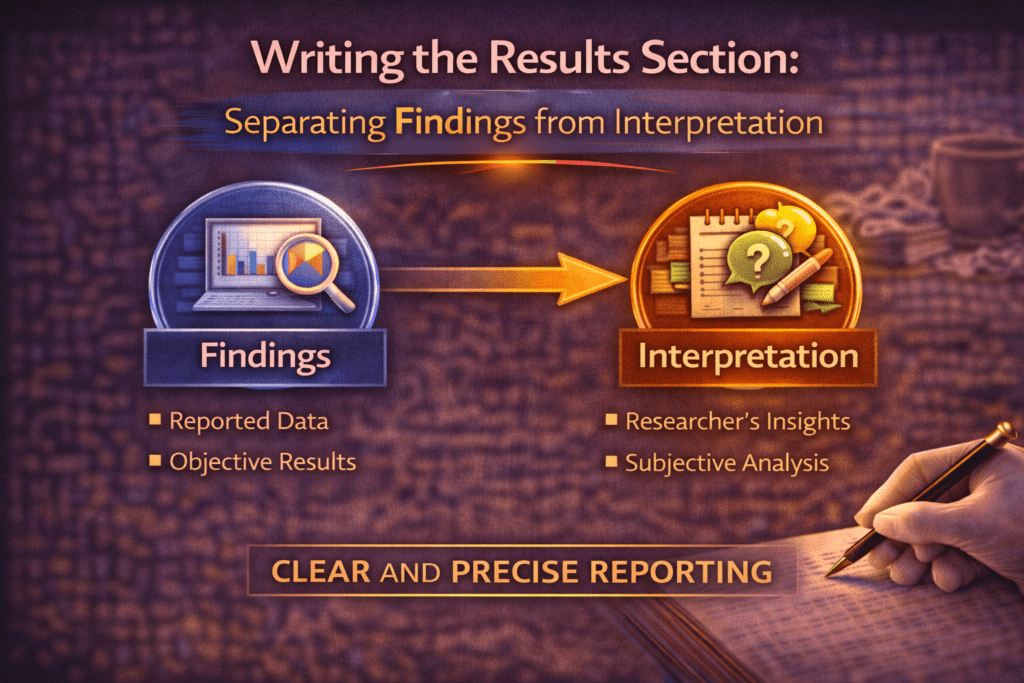
Writing the Results Section: Separating Findings from Interpretation
The module overview explains the results-discussion distinction. This post goes deeper: exactly where the boundary sits and how to identify when you have crossed it, how to organise results around research questions, the complete reporting requirements for quantitative and qualitative results, and how to write the bridging text between results and discussion that reviewers consistently say is missing.
The Results-Discussion Distinction: A Precise Account
The distinction between results and discussion is the most frequently violated structural rule in academic writing. It is also the one most often explained in vague terms — ‘results report, discussion interprets’ — that do not give writers enough to work with.
A more precise account: the results section answers the question ‘what did the data show?’ The discussion section answers ‘what does that mean?’ The boundary is crossed whenever you explain why a result occurred, connect it to prior literature, draw implications for practice or policy, speculate about mechanisms, or make recommendations. All of that belongs in the discussion.
The practical test: for every sentence in your results section, ask whether it would still be true even if you had never read any prior literature on the topic. Results are facts about your data. They should be reportable by someone who has only your dataset and no theoretical framework. Interpretation requires theory, context, and the literature — and that is what discussion is for.
| Results section — belongs here | Discussion section — belongs here |
| Participants in the mentoring condition scored significantly higher, t(438) = 7.03, p < .001, d = 0.67 | This effect size (d = 0.67) is larger than the small effects typically found in brief mentoring interventions, suggesting that peer rather than professional mentoring may have particular advantages in this context |
| Three themes emerged: institutional navigation, emotional support, and identity affirmation | The institutional navigation theme extends Yosso’s (2005) community cultural wealth framework by showing how peer relationships transfer navigational capital in contexts where formal institutional support is absent |
| Interview participants from government colleges described mentors as navigational guides more frequently than those from aided colleges (22/26 vs. 9/24) | The between-college difference likely reflects the lower provision of formal student support services in government colleges, consistent with the resource disparities documented by Chandra and Singh (2023) |
Organising Results Around Research Questions
The most reliable organisational structure for a results section is one subsection per research question. This structure ensures that every result connects explicitly to something the study was designed to find out, and that readers can easily locate the findings relevant to each question.
Open each subsection by restating the research question: this reminds the reader what was being asked and signals that you are about to answer it. Present the findings for that question, using tables, figures, and text as appropriate. End with a brief statement that directly answers the question — not an interpretation, but a factual summary of what the data showed.
Subsection opening and close: The first research question asked whether peer mentoring participation was associated with first-year retention rates. [Results presented here: tables, statistics, or themes] In summary, peer mentoring participation was significantly associated with first-year retention: students who participated had a retention rate of 87%, compared with 74% for non-participants (p < .001). This finding addresses the first research question affirmatively.
The closing sentence does three things: states the direction of the finding, provides the key statistic, and explicitly links back to the research question. This is not discussion — it is factual summary. The why and the implications come later.
Quantitative Results: What Must Be in the Text
The results section text should not repeat every number that appears in your tables — that wastes space and readers’ attention. Instead, the text should direct readers to the tables and highlight the most important findings. The tables supply the detail; the text supplies the narrative.
What the text must do
- Reference every table and figure explicitly: ‘As shown in Table 2…’ or ‘Figure 1 displays…’ Never insert a table without referring to it in the text. Unreferenced tables are invisible to many readers.
- Identify the key finding for each analysis: State the direction and significance of the primary result. Do not make readers hunt through a table for the finding that matters.
- Report effect sizes alongside significance: A significant result without an effect size is incomplete reporting. State both: ‘The difference was statistically significant (p < .001) and of medium magnitude (d = 0.54).’
- Note unexpected or null results: Non-significant results are results. ‘The hypothesised relationship between mentor gender match and belonging scores was not supported, r(440) = .04, p = .41’ is a finding, not an absence of findings.
The precision-readability balance
Results sections can become impenetrable if every sentence carries a full statistical citation. The standard practice is to report complete statistics at the first mention of each test result, and then refer to numbers more sparingly in subsequent sentences that elaborate on the same finding.
First mention (full reporting): Students who received weekly mentoring (M = 3.91, SD = 0.84) scored significantly higher on social belonging than those with monthly contact (M = 3.41, SD = 0.93), t(287) = 4.87, p < .001, d = 0.56. Subsequent elaboration (reference to the finding): This half-standard-deviation difference is the largest effect observed across all pairwise comparisons and suggests that contact frequency matters more than contact occurrence alone.
Qualitative Results: What Must Be in the Text
The text of a qualitative results section should do three things for each theme: state the theme’s scope (who it applies to and how widely), provide integrated evidence (as covered in Cluster Post 5), and make the analytical contribution explicit.
The analytical contribution is what many qualitative results sections miss. A theme section that describes what participants said — even with well-integrated quotes — has not completed the analytical work if it does not state what the description means for the research question. This is not the same as interpretation for the discussion section — it is the within-results analytical synthesis that explains why this theme is a finding rather than a description.
Description only (incomplete): Participants described peer mentors as helping them understand college processes. As P12 noted, ‘There is a whole system and if you do not know it you just do not get what you need.’ This was common across interviews with first-generation students. Analytical synthesis added (complete): Participants described peer mentors as helping them understand college processes. As P12 noted, ‘There is a whole system and if you do not know it you just do not get what you need.’ This pattern, present in twenty-two of twenty-six interviews and concentrated among first-generation students, suggests that the primary function of peer mentoring in this setting is navigational rather than academic: mentors serve as institutional insiders who transfer procedural knowledge that cannot be acquired through formal channels. This finding addresses the second research question directly — the mechanism connecting peer mentoring to retention in this context is access to hidden institutional knowledge, not direct academic support.
The final sentence of the second version connects the theme to the research question and names the mechanism. This is what transforms a description into a finding.
The Bridge Between Results and Discussion
One of the most common structural weaknesses reviewers identify is the abrupt transition between results and discussion. Results end; discussion begins with a different tone and concerns, often without explicit connection to what was just presented. The reader must do the connecting work themselves.
A brief bridging passage at the end of the results section — two to three sentences — does this connecting work explicitly. It does not interpret (that belongs in the discussion), but it summarises the pattern of findings and signals what the discussion will address.
Bridging passage example: Across both quantitative and qualitative phases, a consistent pattern emerged: peer mentoring was associated with improved retention outcomes, and this association was strongest for first-generation students in government colleges. The quantitative phase established the existence and magnitude of the association; the qualitative phase revealed the mechanism — institutional navigation — through which mentoring appears to produce its effects. The following discussion explores these findings in the context of existing literature and considers their implications for college support programme design.
This passage does not interpret — it summarises and orients. It tells the reader what was found, characterises the relationship between the two phases of the study, and announces what the discussion will do. The actual interpretation, connection to literature, and implications come in the discussion.
A Results Section Self-Audit
Before submitting any paper or thesis chapter, apply the following checks to your results section:
- Every table and figure is referenced in the text. If not: add the reference.
- Every result includes an effect size. If not: calculate and report it.
- No sentence in the results section references prior literature. If there is one: move it to the discussion.
- No sentence explains why a result occurred. If there is one: move it to the discussion.
- No sentence makes a recommendation or draws a policy implication. If there is one: move it to the discussion.
- Every research question is answered, including those with null results. If a question is unanswered: address it, even if the answer is non-significant.
- The results section ends with a bridging passage. If not: add one.
🔱 For Law Students
In legal research, the results-discussion boundary takes a specific form depending on the type of research. For doctrinal research, it maps roughly onto the distinction between what the cases say and what they mean.
Doctrinal results: what the cases say
The findings section of a doctrinal study presents what the research revealed about the legal materials — the patterns in judicial reasoning, the doctrinal categories that emerge from the cases, the tensions or contradictions within the body of law. This is the equivalent of the qualitative results section: it presents themes from the text without yet interpreting their significance for the legal argument.
The temptation to interpret too early is particularly strong in doctrinal work because the analysis and the argument feel continuous. A researcher who has just identified that courts consistently apply a test in ways inconsistent with its stated rationale will naturally want to say why this matters and what should change. That is the argument — and it belongs in the discussion, not the findings section. The findings section states: courts apply the test this way, and here is the evidence. The discussion section states: this application is inconsistent with the rationale, and here is why that matters and what should be done about it.
Empirical legal results: reporting without advocacy
The results section of an empirical legal study must be scrupulously factual, even when the findings are concerning or suggest systemic injustice. A results section that reports that 73% of bail applications from Dalit defendants were refused compared with 48% from upper-caste defendants must state this as a finding without immediately moving to conclusions about discrimination, systemic bias, or required reform. Those conclusions belong in the discussion, after the alternative explanations have been considered and the limitations acknowledged.
This discipline is not about avoiding advocacy — it is about maintaining the credibility of the advocacy. An argument built on clearly presented and objectively reported findings is more persuasive to a sceptical reader than one in which results and interpretation are mixed from the beginning. Present the evidence first, interpret it second, argue from it third.
References
- American Psychological Association. (2020). Publication Manual of the APA (7th ed.).
- Field, A. (2024). Discovering Statistics Using IBM SPSS Statistics (6th ed.). Sage.
- Braun, V., & Clarke, V. (2022). Thematic Analysis: A Practical Guide. Sage.
- Creswell, J. W., & Creswell, J. D. (2022). Research Design: Qualitative, Quantitative, and Mixed Methods Approaches (6th ed.). Sage.
- Nicol, A. A. M., & Pexman, P. M. (2019). Displaying Your Findings: A Practical Guide for Creating Figures, Posters, and Presentations (7th ed.). APA.
End of Module 4 Cluster Posts — all 6 complete.

Academic Writing Mastery: The Complete 2026 Guide to Research Papers & Thesis Writing
Academic Writing Mastery Your research deserves to be read. This complete guide transforms your ideas…

The Final Week: Preparing a Submission-Ready Document
Cluster Post 5 | Module 5: Organising Chapters, Maintaining Academic Tone, and Preparing Submission-Ready Documents…
Formatting Thesis for Institutional Submission
Cluster Post 4 | Module 5: Thesis Writing and Submission From Concept to Submission Series …

Academic Tone: From Principles to Practice
Cluster Post 3 | Module 5: Organising Chapters, Maintaining Academic Tone, and Preparing Submission-Ready Documents…
Writing the Thesis Abstract and Introduction
Cluster Post 2 | Module 5: Thesis Writing and Submission From Concept to Submission Series …
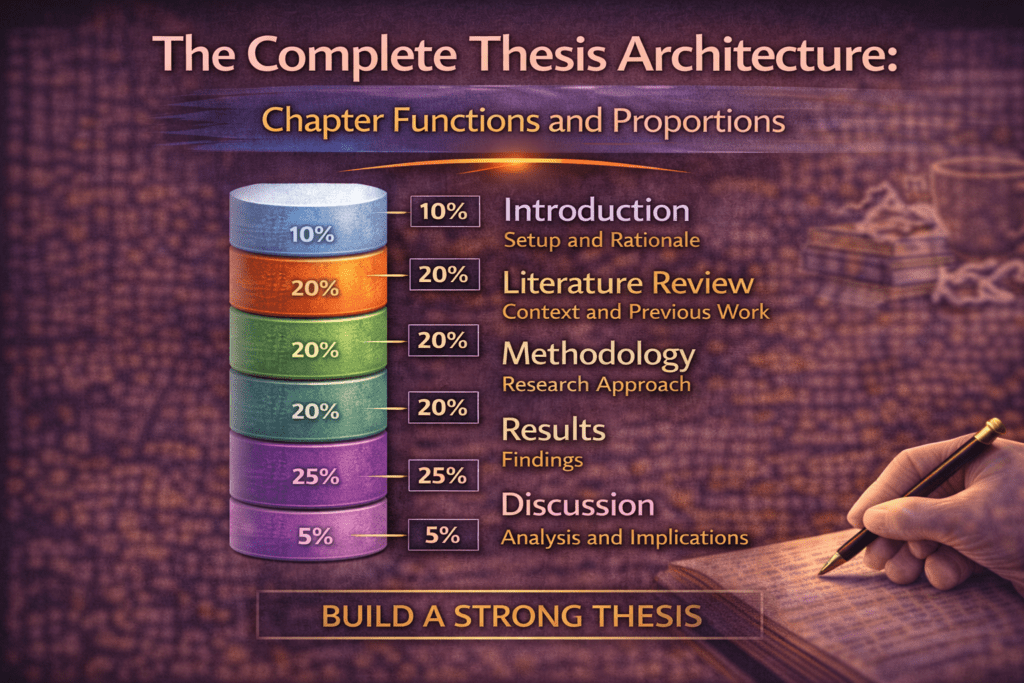
The Complete Thesis Architecture: Chapter Functions and Proportions
Cluster Post 1 | Module 5: Organising Chapters, Maintaining Academic Tone, and Preparing Submission-Ready Documents…

Organization and Academic Tone: Complete Guide to Professional Scholarly Writing (2026)
Why Organization and Academic Tone Matter More Than You Think Here’s what thesis examiners notice…
Writing the Results Section: Separating Findings from Interpretation
Cluster Post 6 | Module 4: Data Analysis and Presenting Results From Concept to Submission…
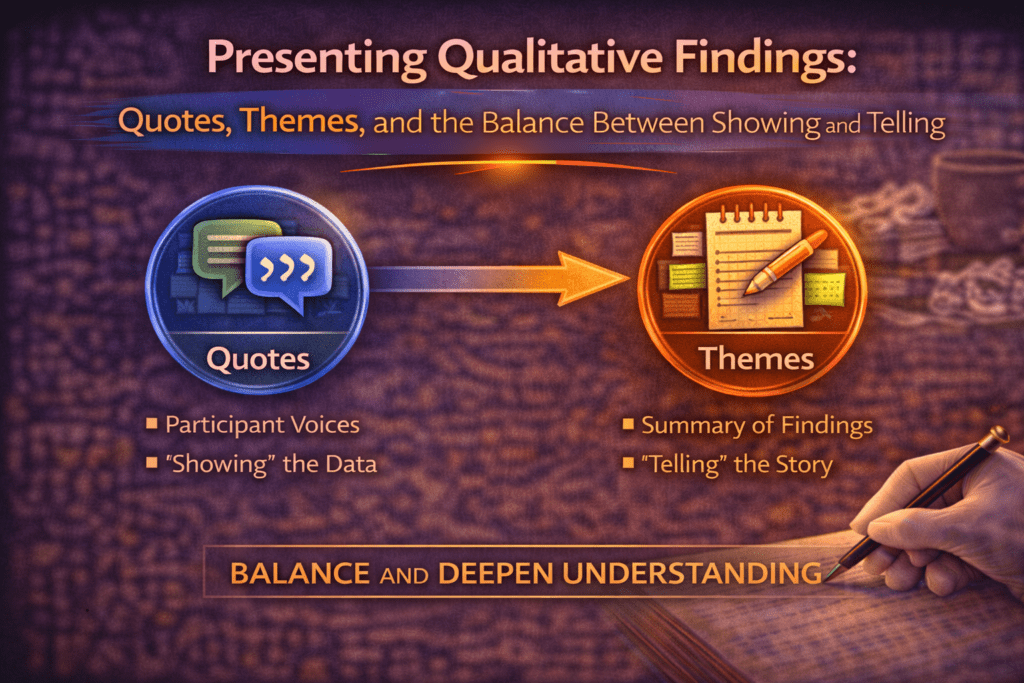
Presenting Qualitative Findings: Quotes, Themes, and the Balance Between Showing and Telling
Cluster Post 5 | Module 4: Data Analysis and Presenting Results From Concept to Submission…
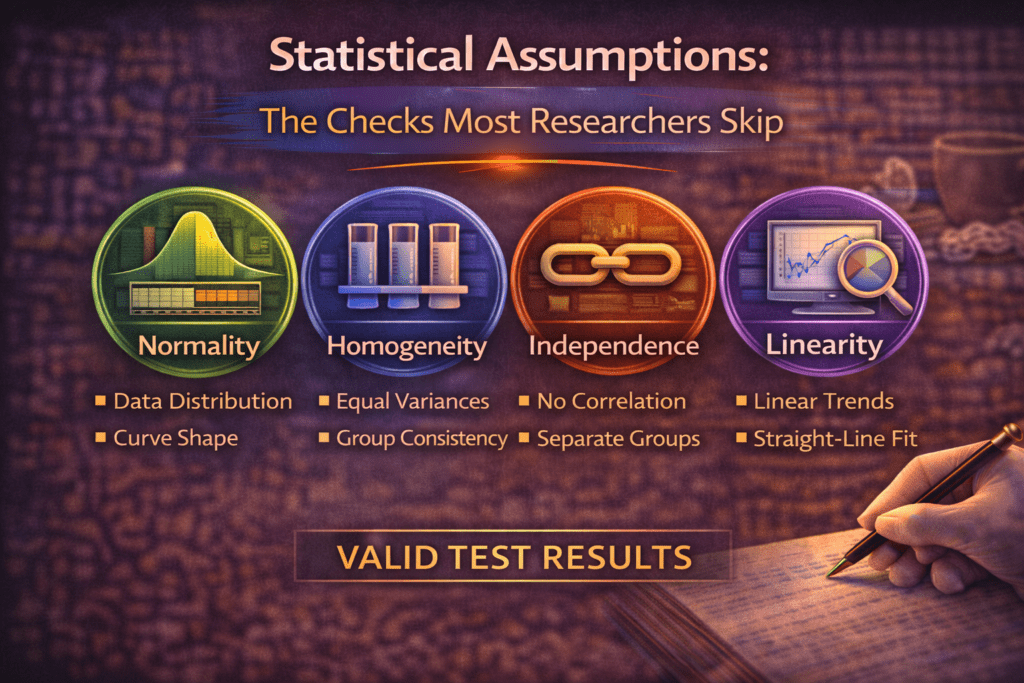
Statistical Assumptions: The Checks Most Researchers Skip
Cluster Post 4 | Module 4: Data Analysis and Presenting Results From Concept to Submission…
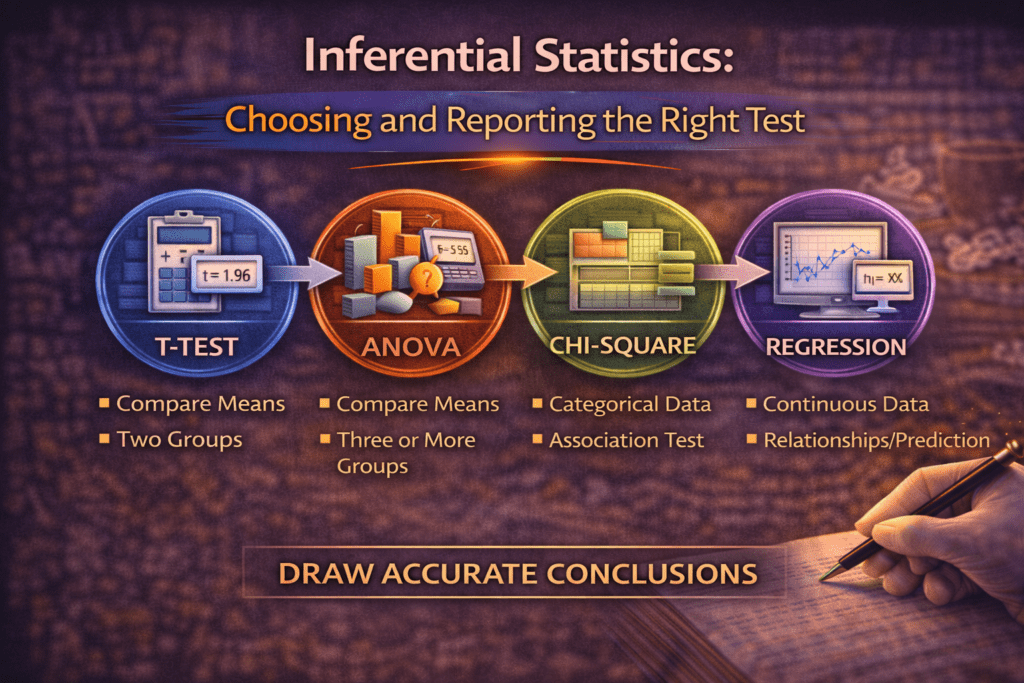
Inferential Statistics: Choosing and Reporting the Right Test
Cluster Post 3 | Module 4: Data Analysis and Presenting Results From Concept to Submission…
Descriptive Statistics: What to Report and How to Read Them
Cluster Post 2 | Module 4: Data Analysis and Presenting Results From Concept to Submission…

Preparing Your Data: The Work That Determines Analysis Quality
Cluster Post 1 | Module 4: Data Analysis and Presenting Results From Concept to Submission…
Data Analysis and Results Presentation: Complete Guide for Quantitative, Qualitative & Legal Research (2026)
Data Analysis and Results Presentation: Why Data Analysis Determines Research Credibility Here’s what separates published…
Research Ethics in Practice: What Ethics Forms Don’t Tell You
Cluster Post 7 | Module 3: Research Methodologies From Concept to Submission Series | 2026…
Sampling: Choosing Who to Study and How Many
Cluster Post 6 | Module 3: Research Methodologies From Concept to Submission Series | 2026…
Mixed Methods Research: When and How to Combine Approaches
Cluster Post 5 | Module 3: Research Methodologies From Concept to Submission Series | 2026…
Qualitative Data Collection and Analysis: Interviews, Coding, and Trustworthiness
Cluster Post 4 | Module 3: Research Methodologies From Concept to Submission Series | 2026…
Qualitative Research Design: Choosing the Right Approach
Cluster Post 3 | Module 3: Research Methodologies From Concept to Submission Series | 2026…
Quantitative Research Design: From Hypothesis to Valid Results
Cluster Post 2 | Module 3: Research Methodologies From Concept to Submission Series | 2026…

Research Paradigms: Why Your Philosophical Stance Shapes Everything
Cluster Post 1 | Module 3: Research Methodologies From Concept to Submission Series | 2026 ←…
Research Methodologies: Complete Guide to Quantitative, Qualitative, Mixed Methods & Legal Research (2026)
Why Methodology Determines Research Quality Here’s what thesis examiners focus on first: your methodology section…
Reference Management: Zotero and Mendeley from Setup to Submission
Cluster Post 5 | Module 2: The Academic Writing Process From Concept to Submission Series …
Citation Styles Explained: APA, MLA, Chicago, IEEE, and Bluebook
Cluster Post 4 | Module 2: The Academic Writing Process From Concept to Submission Series …

The Revision Process: How to Turn a Draft Into a Submission
Cluster Post 3 | Module 2: The Academic Writing Process From Concept to Submission Series …

How to Write Clear Engaging Academic Prose
Cluster Post 2 | Module 2: The Academic Writing Process From Concept to Submission Series …
How to Start Writing — and Keep Going
Cluster Post 1 | Module 2: The Academic Writing Process From Concept to Submission Series …

The Academic Writing Process: Complete Guide from First Draft to Submission (2026)
From Concept to Submission: A Complete Guide to Research Paper and Thesis Writing Module 2,…

10 Structural Mistakes That Get Research Papers Rejected — And How to Fix Every One
Cluster Post 7 | Module 1: Understanding the Structure of Research Papers and Theses From…
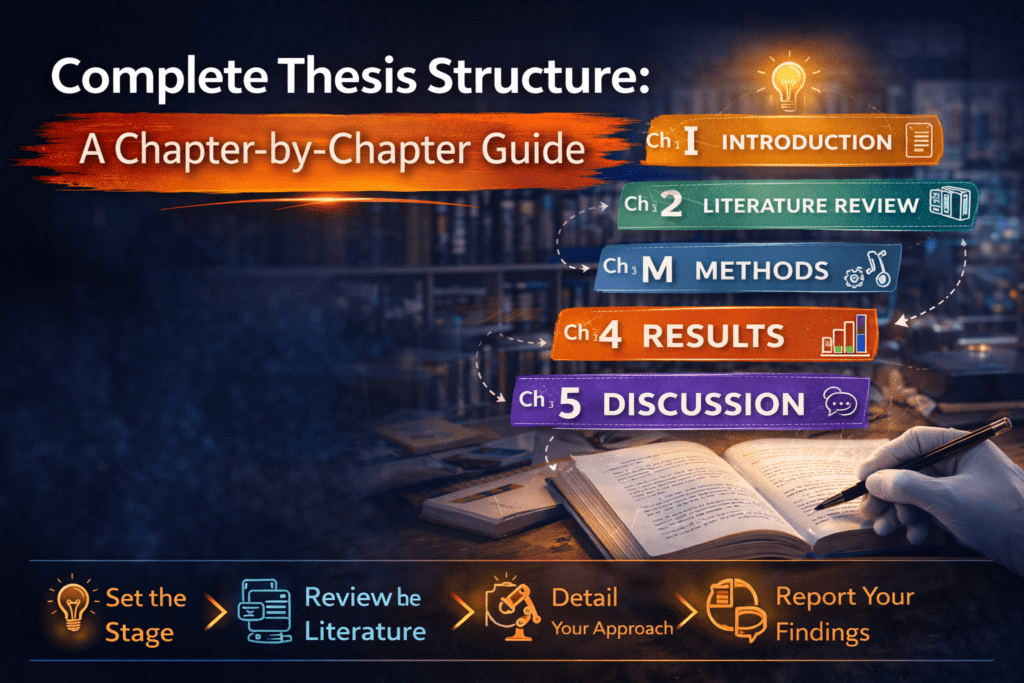
Complete Thesis Structure: A Chapter-by-Chapter Guide
Cluster Post 6 | Module 1: Understanding the Structure of Research Papers and Theses From…