Last Updated: March 26, 2026
(Module 5) Complete Guide Organization and Academic Tone
Academic Writing Mastery: The Complete 2026 Guide To Research Papers, Thesis & Dissertation Writing
Why Organization and Academic Tone Matter More Than You Think
Here’s what thesis examiners notice immediately: how your work is organized and whether you sound like a serious scholar. Before they evaluate your findings, they assess whether you write like a professional researcher.
Keywords: academic writing tone, scholarly writing style, thesis organization, chapter structure, professional writing, academic voice, legal writing conventions, formal writing style, paragraph organization
Think about it: disorganized chapters frustrate readers. Inconsistent tone undermines credibility. Even brilliant research loses impact when poorly presented.
This comprehensive guide teaches you how to organize and write professionally:
Chapter organization strategies
Paragraph structure for clarity
Academic tone (authoritative without pompous)
Transitions and flow
Headings and subheadings
Legal writing conventions (for law students)
Common tone mistakes to avoid
Whether you’re organizing an 80,000-word thesis or polishing a 8,000-word article, mastering organization and tone elevates your work from amateur to professional.
Understanding Academic Tone
What Is Academic Tone?
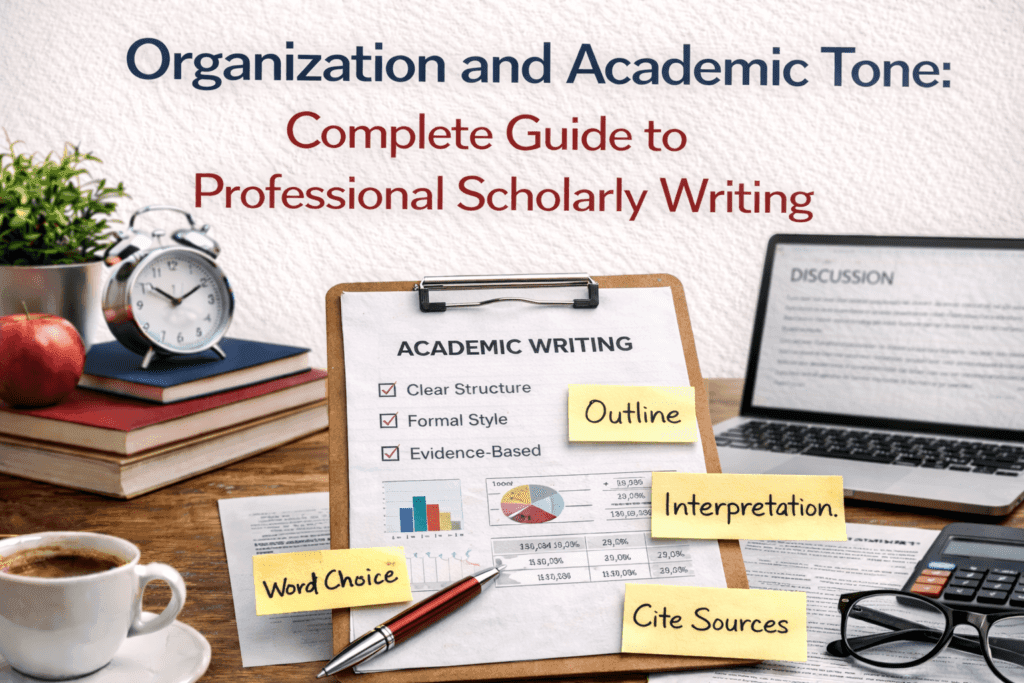
Academic tone = formal, objective, evidence-based, cautious yet confident.
Not:
- Conversational/casual (“basically,” “you guys,” “tons of”)
- Emotional/personal (“I feel,” “it’s obvious,” “everyone knows”)
- Absolute/dogmatic (“proves,” “always,” “never”)
- Vague (“things,” “stuff,” “a lot”)
Instead:
- Formal but readable
- Objective with evidence
- Qualified appropriately (“suggests,” “indicates,” “may”)
- Precise and specific
Striking the Right Balance
Too informal:
“The data shows students totally struggle with math. Obviously, teachers need to step up their game.”
Too pompous:
“The quantitative metrics conclusively demonstrate a substantial pedagogical deficiency necessitating immediate ameliorative interventions vis-à-vis instructional methodologies.”
Just right:
“The data indicate that students experience significant difficulties with mathematics. These findings suggest that enhanced teacher training may improve student outcomes.”
Chapter Organization Strategies
Thesis-Level Organization
Standard social science thesis:
Chapter 1: Introduction (10-15%)
- Context and background
- Problem statement
- Research questions
- Significance
- Thesis structure overview
Chapter 2: Literature Review (20-25%)
- Thematic organization (NOT author-by-author)
- Synthesis of existing research
- Identification of gaps
- Theoretical framework
Chapter 3: Methodology (15-20%)
- Research design
- Participants/sample
- Data collection procedures
- Analysis methods
- Ethical considerations
Chapter 4: Results/Findings (20-25%)
- Organized by research question or theme
- Quantitative results
- Qualitative findings
- Integrated if mixed methods
Chapter 5: Discussion (20-25%)
- Interpretation of findings
- Relation to literature
- Implications
- Limitations
- Recommendations
Chapter 6: Conclusion (5-10%)
- Summary of key findings
- Contributions to knowledge
- Practical implications
- Future research directions
Chapter-Level Organization
Each chapter should have:
Opening paragraph: Preview chapter content and purpose
“This chapter presents the study’s findings, organized around three research questions. First, quantitative results examine retention rates across intervention and control groups. Second, qualitative findings explore student experiences of peer mentoring. Finally, integrated analysis synthesizes quantitative and qualitative data.”
Clear sections with headings
Concluding paragraph: Summarize chapter and transition to next
“This chapter established the methodological approach guiding this research. The next chapter presents findings from applying these methods across three colleges in Rajasthan.”
Paragraph-Level Organization
The Perfect Paragraph Structure
Every paragraph should:
1. Start with topic sentence
- States main idea
- Signals what paragraph is about
2. Develop the idea
- Evidence, examples, explanation
- 3-6 supporting sentences typically
3. Conclude or transition
- Wrap up the point
- Connect to next paragraph
Example Analysis
Weak paragraph:
“Peer mentoring is important. Students like having mentors. Mentors help with homework. They also provide emotional support. This is good for retention. Many students said mentors helped them.”
Problems: No clear topic sentence, choppy sentences, vague claims, no development.
Strong paragraph:
“Peer mentoring emerged as a critical retention factor in this study. Quantitative data showed students with mentors had significantly higher retention intentions (M=4.2) compared to those without mentors (M=3.6), t (448) =7.3, p<.001. Qualitative interviews revealed specific mechanisms through which mentoring operated. As one participant explained, ‘My mentor helped me navigate campus, understand assignments, and deal with homesickness—I wouldn’t have made it through first semester without her’ (P14, female, Arts). This combination of academic and emotional support appeared particularly crucial during transition periods, suggesting that peer mentoring addresses multiple retention barriers simultaneously.”
Why it works: Clear topic sentence, evidence from both quantitative and qualitative data, specific example, synthesized interpretation.
Creating Flow and Transitions
Why Flow Matters
Readers shouldn’t have to work to follow your argument. Each paragraph should flow naturally to the next.
Transition Strategies
1. Transitional words and phrases
To add information:
- Furthermore, Moreover, Additionally, In addition
To show contrast:
- However, Nevertheless, Conversely, In contrast, On the other hand
To show cause/effect:
- Therefore, Thus, Consequently, As a result
To show sequence:
- First, Second, Finally, Subsequently, Next
To show comparison:
- Similarly, Likewise, In the same way
2. Transitional sentences
Bridge between paragraphs by referring back and forward:
“While quantitative data established the correlation between peer support and retention, qualitative findings illuminate why this relationship exists.”
3. Consistent logical progression
General to specific:
General principle → Supporting evidence → Specific examples
Problem to solution:
Problem identified → Evidence of problem → Proposed solution → Evidence for solution
Compare and contrast:
Similarity discussed → Difference highlighted → Implications analyzed
Using Headings Effectively
Heading Hierarchy
Level 1 (Chapter titles): Centered, Bold, Title Case
CHAPTER 3: RESEARCH METHODOLOGY
Level 2 (Main sections): Left-aligned, Bold, Title Case
Research Design
Level 3 (Subsections): Left-aligned, Bold, Sentence case
Participant recruitment
Level 4 (If needed): Indented, Bold, Sentence case, ending with period.
Inclusion criteria. Text continues…
Writing Good Headings
Characteristics of effective headings:
- Descriptive (tells what section covers)
- Parallel structure (same grammatical form)
- Concise but clear
- Not too many levels (3 max for most work)
Weak headings:
Results
What I Found
Stuff About Teachers
Strong headings:
Quantitative Results: Retention Rates by Condition
Student Perceptions of Peer Mentoring
Teacher Training Implementation Challenges
Academic Writing Style Guidelines
Voice and Person
Sciences and social sciences: Use first person sparingly
Acceptable:
“We conducted interviews…” (when describing what you did)
“I argue that…” (when presenting your interpretation)
Avoid:
“I think…” (sounds uncertain)
“I feel…” (sounds emotional)
“In my opinion…” (all interpretation is your opinion—stating it is redundant)
Third person alternatives:
“This study examines…”
“The findings suggest…”
“The evidence indicates…”
Passive voice sometimes appropriate:
“Participants were randomly assigned to conditions” (focus on participants, not researcher)
Verb Tense Conventions
Introduction: Present and past
- Present for general facts: “Retention is a critical challenge”
- Past for previous research: “Smith (2020) found that…”
Literature Review: Past and present perfect
- Past for specific studies: “Johnson (2019) examined…”
- Present perfect for field overall: “Research has shown…”
Methods: Past
- “Participants completed surveys”
- “Data were analyzed using SPSS”
Results: Past
- “Retention rates were higher in the intervention group”
Discussion: Present
- “These findings suggest…”
- “The results indicate…”
Precision and Clarity
Be specific:
Wrong -Vague: “Many students had problems.”
Right – Specific: “Thirty-eight percent of students (n=171) reported academic difficulties.”
Wrong -Vague: “The data shows positive results.”
Right – Specific: “Retention rates increased from 71% to 82%, representing a 15.5% improvement.”
Define terms clearly:
First use: “Students with high self-efficacy—that is, confidence in their ability to succeed academically—showed better outcomes.”
Avoid ambiguous pronouns:
Wrong – “Teachers implemented the program. This improved retention.”
(Does “this” refer to implementation or the program itself?)
Right – “Teachers implemented the program. This implementation improved retention.”
Common Tone Mistakes
Mistake 1: Overconfidence
Wrong – “This proves that peer mentoring causes retention.”
Right – “These findings suggest that peer mentoring is associated with improved retention.”
Why: Research rarely “proves” anything. Be appropriately cautious.
Mistake 2: Excessive Hedging
Wrong – “It might be possible that there could potentially be a relationship that perhaps suggests…”
Right – “The data suggest a relationship between…”
One hedge is enough. Don’t stack them.
Mistake 3: Colloquialisms and Informality
Wrong – “Basically, the kids totally struggled with math.”
Right – “Students experienced significant difficulties with mathematics.”
Avoid:
- Contractions (don’t → do not)
- Slang (kids → children/students)
- Informal intensifiers (really, very, totally)
Mistake 4: Emotional Language
Wrong – “It’s tragic that students drop out.”
Right –“Student attrition represents a significant institutional and social concern.”
Academic writing = objective analysis, not emotional appeals
Mistake 5: Rhetorical Questions
Wrong – “But what can we do about retention?”
Right – “Several strategies may address retention challenges.”
State your points directly, don’t ask questions you’ll answer.
Mistake 6: Absolute Statements
Wrong – “All students need mentoring.”
Wrong – “Peer support always improves outcomes.”
Wrong – “This never works.”
Right – “Most students benefit from mentoring.”
Right – “Peer support typically improves outcomes.”
Right – “This approach rarely succeeds in…”
Rarely are absolutes justified in research.
Writing Accessible Academic Prose
Clarity Doesn’t Mean Simplistic
You can write clearly without “dumbing down” complex ideas.
Complex idea, unclear writing:“The pedagogical intervention’s implementation facilitated ameliorative transformations in participant cohort retention metrics subsequent to longitudinal assessment.”
Complex idea, clear writing:
“After one year, students who received the teaching intervention showed improved retention rates compared to the control group.”
Strategies for Clarity
1. Prefer active voice – Wrong “The survey was administered by researchers.”
Right- “Researchers administered the survey.”
2. Keep sentences reasonably short
- Aim for 15-25 words average
- Mix sentence lengths for rhythm
- Break up 40+ word monsters
3. Use familiar words when possible
Wrong – “Utilize” → Right- “Use”
Wrong – “Commence” → Right- “Begin”
Wrong – “Subsequent to” → Right- “After”
But: Use technical terms when they’re precise
Right – “Quasi-experimental design” (precise term)
Right –“Thematic analysis” (methodological term)
4. Define technical terms first use
“We employed phenomenological reduction—a process of bracketing preconceptions to examine participants’ lived experiences—to analyze interview data.”
Revision for Organization and Tone
Structural Revision Checklist
Chapter level:
- Each chapter has clear purpose
- Logical progression between chapters
- No redundancy across chapters
- Balance (no chapter too short/long)
Section level:
- Headings descriptive and parallel
- Sections organized logically
- Smooth transitions between sections
Paragraph level:
- Each paragraph = one main idea
- Topic sentences clear
- Evidence supports claims
- Flow between paragraphs
Tone Revision Checklist
- Formal but readable
- Objective (evidence-based)
- Appropriately cautious
- Consistent voice throughout
- No colloquialisms
- No emotional language
- Precise and specific
- Technical terms defined
The Read-Aloud Test
Read your work aloud. You’ll catch:
- Awkward phrasing
- Run-on sentences
- Missing transitions
- Repetitive word choice
- Unclear passages
If you stumble reading it, your reader will stumble reading it.
Quick Reference: Strong vs. Weak Writing
Weak Sentence → Strong Sentence
Wrong – “There are many factors that influence retention.”
Right – “Multiple factors influence retention.”
Wrong – “It is important to note that students struggle.”
Right – “Students struggle with…”
Wrong – “In terms of retention, peer support plays a role.”
Right – “Peer support influences retention.”
Wrong – “The fact that students have mentors helps.”
Right – “Mentors help students persist.”
Pompous → Professional
Wrong – “Notwithstanding the aforementioned pedagogical interventions…”
Right – “Despite these teaching interventions…”
Wrong – “Subsequent to the implementation of said program…”
Right – “After implementing the program…”
Wrong – “A plethora of methodological approaches exist…”
Right – “Many methodological approaches exist…”
Legal Research and Writing: Complete Guide for Law Students and Legal Researchers
Conclusion
Organization and tone transform research from amateur to professional. Clear structure helps readers follow complex arguments. Appropriate academic tone builds credibility and authority.
- For all disciplines: Organize logically, write clearly, maintain consistent formal tone, guide readers with transitions and headings.
- For law students: Master legal writing conventions—authoritative tone, citation as authority, thematic organization, IRAC analysis, and respectful but critical engagement with judicial decisions.
For everyone: Good organization and appropriate tone aren’t decorative—they’re fundamental to how your research is received and evaluated.
Master these elements. Your research deserves professional presentation.
Academic Writing Mastery: The Complete 2026 Guide To Research Papers, Thesis & Dissertation Writing
FAQs
Q: What is academic tone in writing?
A: Academic tone is the formal, precise, and evidence-based register used in scholarly writing. It is characterised by: objectivity (claims supported by evidence, not opinion); precision (specific language over vague generalisations); hedging (qualifying claims that are not conclusively established); impersonality (avoiding colloquial language and first person where inappropriate); and formality (no contractions, slang, or informal phrasing). Academic tone varies by discipline — science papers use more passive voice; humanities essays use more authorial voice. The goal is authority through precision, not complexity through jargon.
Q: How do you organise a thesis or dissertation?
A thesis is organised around a research argument, not a topic. Each chapter has a specific function in advancing the overall argument: Introduction establishes the problem and research questions; Literature Review maps the scholarly context; Methodology justifies the research design; Results/Findings presents data; Discussion interprets findings and connects to literature; Conclusion synthesises the contribution. Chapter order reflects the logic of the research process. Every chapter must connect to the thesis’s central argument — chapters that stand alone as essays break the architecture.
Q: What makes professional scholarly writing different from general academic writing?
Professional scholarly writing goes beyond grammatical correctness. It requires: a clear argumentative structure where every section advances a claim; precision in terminology (using the exact term the field uses, not a synonym); appropriate hedging (not overclaiming or underclaiming); explicit signposting (guiding the reader through the argument structure); and a voice that is authoritative without being assertive. The difference between adequate academic writing and professional scholarly writing is the degree to which the writing itself contributes to the argument rather than merely containing it.
Q: How do you develop an academic writing style?
Academic writing style is developed through reading and deliberate practice. Read papers in your target journal to absorb the register your field uses. Write regularly — daily if possible. Get feedback from supervisors and peers before submission. After each piece of feedback, identify the pattern: is the problem structure, argument, or sentence clarity? Address the pattern, not just the specific comment. Revise published papers you admire by rewriting a section in your own words, then comparing your version to the original.
Q: What are the most common academic writing mistakes researchers make?
The most common mistakes are: vague gap statements that do not identify a specific unresolved question; literature reviews that describe sources rather than synthesising them into an argument; methodology sections that describe procedures without justifying the design; results sections that interpret instead of report; discussions that repeat results rather than advancing analysis; and conclusions that introduce new material. These are structural problems, not grammatical ones — they require reorganisation, not proofreading.
References
- Sword, H. (2012). Stylish Academic Writing. Harvard University Press.
- Booth, W. C., et al. (2024). The Craft of Research (5th ed.). University of Chicago Press.
- Garner, B. A. (2013). Legal Writing in Plain English (2nd ed.). University of Chicago Press.
- Turabian, K. L. (2018). A Manual for Writers of Research Papers, Theses, and Dissertations (9th ed.). University of Chicago Press.
Author
Dr. Rekha Khandelwal, a legal scholar and academic writing expert, is the founder of AspirixWriters. She has extensive experience in guiding students and researchers in writing research papers, theses, and dissertations with clarity and originality. Her work focuses on ethical AI-assisted writing, structured research, and making academic writing simple and effective for learners worldwide.
Author Profile Dr. Rekha Khandelwal | Academic Writer, Legal Technical Writer, AI Expert & Author | AspirixWriters
Part of: Complete Research Writing Guide Series
- The Complete Thesis Architecture: Chapter Functions and Proportions
- Writing the Thesis Abstract and Introduction
- Academic Tone: From Principles to Practice
- Formatting Thesis and Dissertation for Institutional Submission
- The Final Week: Preparing a Submission-Ready Document
- Writing the PhD Synopsis & Master’s Dissertation: India’s Most Underestimated Document
Next in Series:
- Complete Guide: Peer Review and Publication: Complete Guide from Submission to Acceptance (2026) (Module 6)
- Complete Guide: AI Tools in Academic Research: Opportunities, Ethics, and Best Practices (2026) (Module 7)
- Complete Guide: Grant Writing and Research Funding: Complete Guide to Finding Money for Your Research (2026) (Module 8)
- Complete Guide: Academic Career Development: Complete Guide to Building Your Professional Life in Research (2026) (Module 9)
- Complete Guide: Research Ethics and the IRB Process: Complete Guide to Doing Research Responsibly (2026) (Module 10)
No post found!