
Last Updated: April 19, 2026
Mixed Methods Research
Module 3: Research Methodologies
From Concept to Submission Series | 2026
Academic Writing Mastery: The Complete 2026 Guide To Research Papers, Thesis & Dissertation Writing
Module 1 (Complete Guide)- The Complete Guide To Research Paper Structure: IMRAD Format, Thesis Organization & Academic Writing (2026)
Module 2 (Complete Guide) –The Academic Writing Process: Complete Guide from First Draft to Submission (2026)
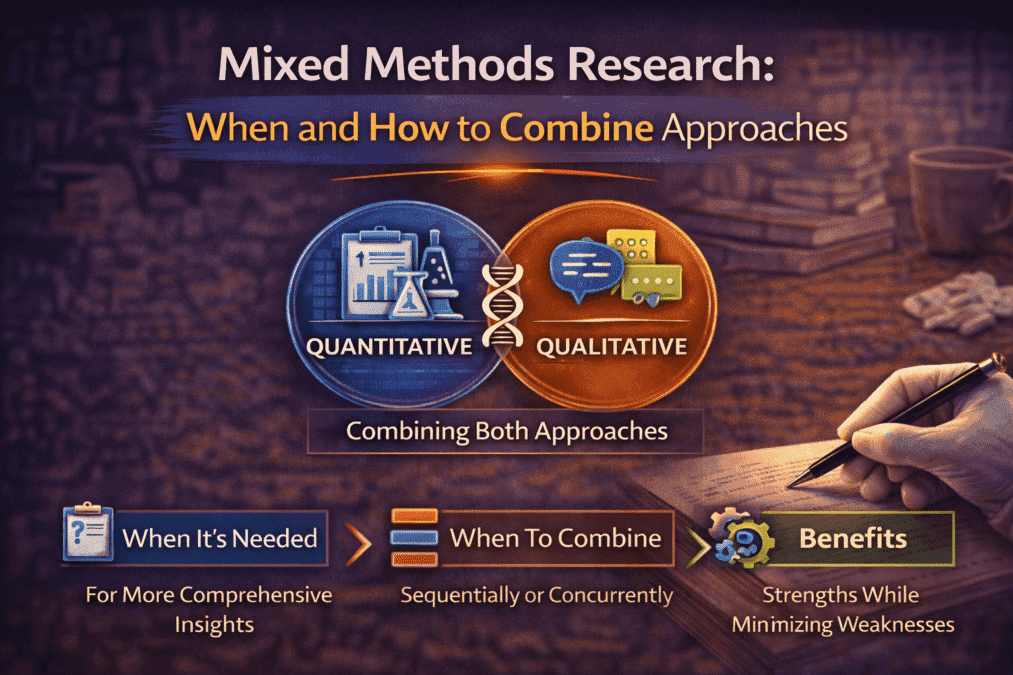
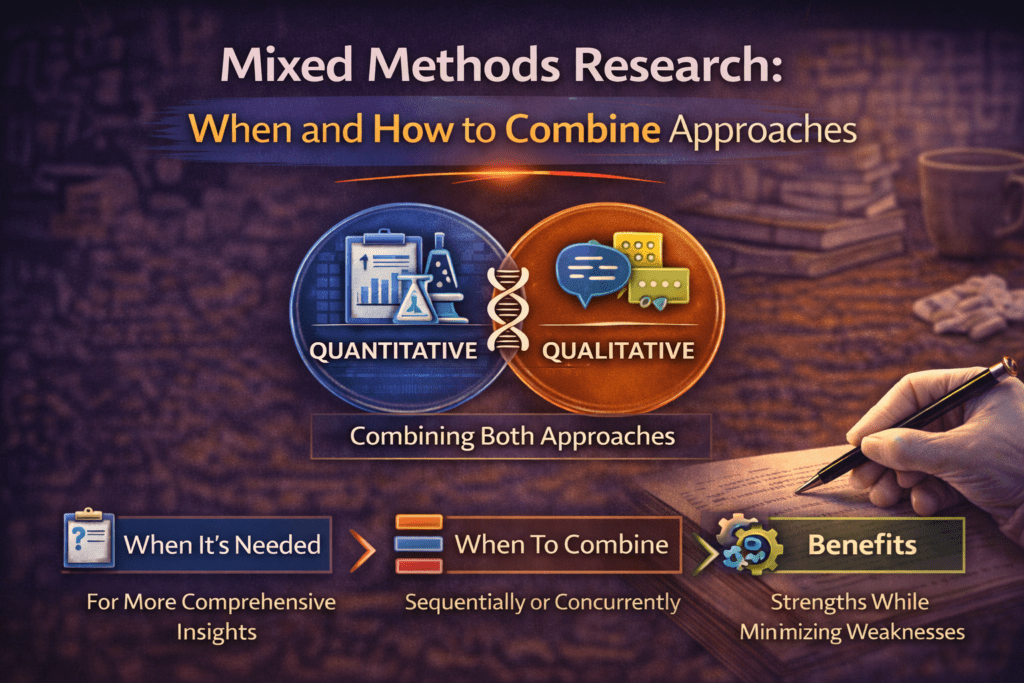
Mixed Methods Research: When and How to Combine Approaches
The module overview named the four mixed methods designs. This post goes deeper: a decision guide for when mixed methods is genuinely warranted versus when it is unnecessary complexity, what each design actually requires to execute well, the integration problem that causes most mixed methods studies to fail their own promise, and how to write the mixed methods rationale that examiners find convincing.
When Mixed Methods Is — and Is Not — Warranted
Mixed methods research carries a significant cost: you need expertise in both quantitative and qualitative methods, you collect and analyse two datasets, and you must integrate findings that may point in different directions. This cost is only justified when the research question genuinely requires both approaches — when neither quantitative nor qualitative methods alone can answer what you need to know.
Mixed methods is warranted when: your research question has two irreducibly different components — one requiring measurement and one requiring interpretation; when quantitative findings need explanation that only qualitative data can provide; when qualitative findings need testing at scale that only quantitative data can provide; or when you are developing an instrument and need qualitative data to generate the items before quantitative data can validate them.
Mixed methods is not warranted when: adding a second method would simply generate more data about the same question without adding a different type of answer; when you are adding qualitative data to make a quantitative study look richer without genuinely integrating the findings; or when your timeline and expertise do not allow both methods to be executed rigorously. A weak qualitative component added to a quantitative study does not strengthen it — it introduces new sources of error and undermines the overall credibility of the work.
Warranted: “Does peer mentoring improve retention outcomes, and if so, what mechanism explains this effect?” — The first question requires quantitative measurement; the second requires qualitative investigation of process and meaning. Neither can answer the other’s question. Not warranted: “What factors predict student retention, and what do students say about their college experience?” — These are two separate questions that happen to involve the same participants. Combining them in one study does not constitute integration; it is two studies stapled together.
The Three Core Designs: What Each Actually Requires
Convergent design: collecting both simultaneously
In a convergent design, quantitative and qualitative data are collected at roughly the same time, analysed separately using the methods appropriate to each, and then the findings from both strands are compared or merged in a joint analysis.
What convergent design is for: validating or corroborating findings — checking whether quantitative patterns are confirmed by qualitative accounts, or whether qualitative themes are reflected in survey distributions. It is also useful when you want to compare the perspective of a large sample (quantitative) with the depth of a smaller group’s experience (qualitative).
What it requires: the two strands must be designed to address the same phenomenon from different angles, so that their findings can be meaningfully compared. If the survey measures retention intention and the interviews explore general college experience, there is nothing to converge. The convergence must be designed in, not discovered after the fact.
Well-designed convergent study: A survey of 450 students measures peer support frequency, social belonging, and first-year retention intention using validated scales. Simultaneously, thirty interviews explore how students experience peer relationships and what meaning they assign to them. The joint analysis asks: do students who score high on the social belonging scale also describe qualitatively rich peer relationships? Do students who report low belonging describe isolation experiences that the scale captures? Convergence or divergence between the strands becomes the analytical finding.
Explanatory sequential design: quantitative first, then qualitative
In an explanatory sequential design, quantitative data is collected and analysed first. The qualitative phase is then designed specifically to explain, elaborate, or investigate aspects of the quantitative findings that the numbers alone cannot account for.
What explanatory sequential design is for: this is the most widely used mixed methods design in social science research, and for good reason. Quantitative analysis identifies patterns, relationships, or anomalies; qualitative investigation explains them. The power of the design comes from the fact that the qualitative phase is directly responsive to the quantitative findings — it is not a general exploration of the topic but a targeted investigation of specific puzzles the quantitative data raised.
What it requires: the qualitative phase must be designed after the quantitative analysis is complete, not in advance. The sampling for the qualitative phase is often purposive based on quantitative characteristics — for example, selecting interview participants who showed strong or weak effects in the survey, or who fell into particular subgroups the quantitative analysis identified as interesting.
Design sequence: 1. Survey of 450 students → regression analysis identifies peer mentoring frequency as significant predictor of retention (β = .34) but college type (government vs. aided) as an unexpected moderator. 2. Qualitative phase: purposive selection of twelve students — six from government colleges and six from aided colleges — to investigate through interviews why the mentoring effect differs by college type. 3. Integration: quantitative finding (the moderation effect) explains why the qualitative sample was selected; qualitative findings (government college students describe mentors as institutional navigators; aided college students describe mentors primarily as social companions) explain the moderation pattern.
Exploratory sequential design: qualitative first, then quantitative
In an exploratory sequential design, qualitative data is collected and analysed first, and the findings are used to inform the development or selection of quantitative instruments that are then administered to a larger sample.
What exploratory sequential design is for: researching phenomena where no validated instruments exist, where the constructs relevant to a specific cultural or institutional context need to be identified before they can be measured, or where a theory needs to be developed qualitatively before it can be tested quantitatively.
What it requires: the qualitative findings must actually shape the quantitative instrument in visible and traceable ways. If you conduct interviews, identify themes, and then use a pre-existing validated scale anyway, you have not executed an exploratory sequential design — you have done a qualitative study followed by a quantitative study that was not informed by it.
Design sequence: 1. Twenty interviews with peer mentors and mentees → thematic analysis identifies five dimensions of mentoring quality not captured in existing instruments (navigational support, institutional knowledge transfer, emotional availability, academic coaching, social network brokerage).
2. Item generation: ten survey items developed for each dimension, based on language and concepts from interview data. Items pilot-tested with thirty students. Factor analysis confirms five-factor structure.
3. Survey phase: validated instrument administered to 400 students across six colleges. Regression analysis tests relationships between each mentoring quality dimension and retention outcomes.
4. Integration: qualitative findings explain what the survey measures and why those dimensions were selected; quantitative findings test whether qualitatively identified dimensions predict outcomes at scale.
The Integration Problem — and How to Solve It
Integration is what distinguishes genuine mixed methods research from two studies published together. The module acknowledges that integration is where many mixed methods studies fall short. This section explains specifically what integration means, what prevents it, and how to achieve it.
Integration means that the findings from both strands are brought into direct conversation — that you show how quantitative and qualitative findings relate to each other, what each illuminates that the other cannot, and what the combined picture reveals that neither strand reveals alone. This requires active analytical work in the discussion and findings sections, not just parallel presentation of results from each strand followed by a brief concluding paragraph noting that they are consistent.
The three integration failures
- Parallel presentation: Reporting quantitative findings in full, then qualitative findings in full, with no joint analysis. The reader is left to make the connections. This is not integration.
- Superficial convergence: Noting that qualitative themes are “consistent with” quantitative patterns without specifying which themes correspond to which patterns and why the consistency is meaningful.
- Divergence ignored: When quantitative and qualitative findings point in different directions — which happens regularly in real research — treating the divergence as a problem to be explained away rather than as an analytically productive finding.
What genuine integration looks like
Integration happens in the discussion section through what Fetters, Curry, and Creswell call the joint display — a visual or narrative structure that places quantitative and qualitative findings side by side so that their relationships become visible. The joint display forces you to specify which qualitative finding corresponds to which quantitative pattern, and it immediately reveals whether you actually have integration or only parallel reporting.
Joint display example (narrative form): “The quantitative finding that mentoring frequency predicts retention most strongly in the first semester (β = .42, p < .001) but not the second (β = .08, p = .31) is directly explained by the qualitative data. Interviews revealed that first-semester mentoring focuses predominantly on institutional navigation — finding resources, understanding processes, building a sense of belonging. By second semester, most students described having developed independent institutional knowledge. The temporal attenuation of the mentoring effect is not, therefore, evidence that mentoring becomes less effective — it is evidence that it successfully transfers the knowledge that made it necessary.
This interpretation, which the quantitative data alone could not produce, substantially changes the implication for programme design: front-loading mentoring intensity in the first eight weeks may be more efficient than maintaining uniform contact across the year.”
This paragraph does something that neither quantitative nor qualitative data alone could do: it explains a temporal pattern using experiential data and draws a design implication that the explanation makes possible. That is what integration means.
Writing the Mixed Methods Rationale
The most important sentence in your mixed methods methodology chapter is the rationale — the explicit statement of why both approaches are needed. Without a clear rationale, examiners have no way to evaluate whether the design is appropriate or whether both components are genuinely integrated.
Weak rationale: “This study uses a mixed methods approach to provide a more comprehensive understanding of peer mentoring and student retention.” Strong rationale: “A mixed methods design is required because the research questions operate at two levels that cannot be addressed by a single approach. The first question — whether peer mentoring frequency predicts retention outcomes — requires quantitative measurement across a sample large enough for statistical inference. The second question — what mechanism explains this relationship — requires qualitative investigation of process and meaning that survey instruments cannot capture. Neither question can be answered by the method appropriate to the other, and neither finding is interpretable without the other. An explanatory sequential design was selected because the qualitative phase must be responsive to specific patterns identified in the quantitative data, requiring quantitative analysis to be completed first.”
The strong rationale does four things: states each research question, names the approach required for each, explains why neither approach can answer both questions, and justifies the specific sequential or concurrent design chosen. Four things, one paragraph.
FAQs
Q: What is mixed methods research?
Mixed methods research combines quantitative and qualitative data collection and analysis within a single study to answer a research question more completely than either approach alone. The rationale for mixing must be explicit: you combine because each strand addresses a different aspect of the question, one strand explains the other, or qualitative findings help interpret quantitative results. Mixed methods is not adding qualitative questions to a survey — it requires integrating both strands in the research design, analysis, and interpretation.
Q: What are the main mixed methods research designs?
The three main designs are: convergent parallel (quantitative and qualitative data collected simultaneously, analysed separately, then merged for comparison); sequential explanatory (quantitative data collected first, qualitative data then collected to explain the quantitative results); and sequential exploratory (qualitative data collected first to develop a framework or instrument, then tested quantitatively). Choose the design based on the purpose of mixing: explanation, triangulation, exploration, or instrument development.
Q: When should you use mixed methods research?
Use mixed methods when: quantitative findings need qualitative explanation (why did Group A score higher?); qualitative findings need quantitative validation (how prevalent is this theme?); the research question has both numeric and contextual dimensions; you are developing and testing a new measurement instrument; or triangulation across methods is needed to strengthen confidence in findings. Do not use mixed methods simply to appear more rigorous — adding a second method without a clear rationale for mixing adds complexity without benefit.
Q: How do you integrate qualitative and quantitative findings in mixed methods research?
Integration — the actual mixing of findings — must happen at one of three points: design (one strand informs the design of the other); analysis (data is merged or transformed for joint analysis); or interpretation (findings are brought together in the discussion). The most common integration point is interpretation. Present quantitative findings, present qualitative findings, then discuss how they converge, diverge, or complement each other. Divergence is valuable — explain why the two strands produced different pictures of the same phenomenon.
Q: What is the difference between triangulation and mixed methods?
Triangulation is one purpose of mixed methods — using multiple methods to cross-check findings and increase confidence. But mixed methods serves other purposes too: explanation (qualitative explains quantitative results), exploration (qualitative informs instrument development), and sampling (qualitative informs who to survey). Triangulation assumes both strands should produce convergent findings. Mixed methods accepts divergence as analytically informative. Not all mixed methods research is triangulation; not all triangulation uses qualitative and quantitative methods.
Author
Dr. Rekha Khandelwal, a legal scholar and academic writing expert, is the founder of AspirixWriters. She has extensive experience in guiding students and researchers in writing research papers, theses, and dissertations with clarity and originality. Her work focuses on ethical AI-assisted writing, structured research, and making academic writing simple and effective for learners worldwide.
Author Profile Dr. Rekha Khandelwal | Academic Writer, Legal Technical Writer, AI Expert & Author | AspirixWriters
References
- Tashakkori, A., Johnson, R. B., & Teddlie, C. (2021). Foundations of Mixed Methods Research (2nd ed.). Sage.
- Fetters, M. D., Curry, L. A., & Creswell, J. W. (2013). Achieving integration in mixed methods designs. Health Services Research, 48(6 Pt 2), 2134–2156.
- Braun, V., & Clarke, V. (2022). Thematic Analysis: A Practical Guide. Sage.
- Protection of Children from Sexual Offences Act, 2012 (India). Ministry of Women and Child Development.
Next — Sampling: Choosing Who To Study And How Many
Next in Series
- Complete Guide: Data Analysis and Results Presentation: Complete Guide for Quantitative, Qualitative & Legal Research (2026) (Module 4)
- Complete Guide: Organization and Academic Tone: Complete Guide to Professional Scholarly Writing (2026) (Module 5)
- Complete Guide: Peer Review and Publication: Complete Guide from Submission to Acceptance (2026) (Module 6)
- Complete Guide: AI Tools in Academic Research: Opportunities, Ethics, and Best Practices (2026) (Module 7)
- Complete Guide: Grant Writing and Research Funding: Complete Guide to Finding Money for Your Research (2026) (Module 8)
- Complete Guide: Academic Career Development: Complete Guide to Building Your Professional Life in Research (2026) (Module 9)
- Complete Guide: Research Ethics and the IRB Process: Complete Guide to Doing Research Responsibly (2026) (Module 10)
No post found!