Last Updated: March 20, 2026
Cluster Post 5 | Module 4: Data Analysis and Presenting Results
From Concept to Submission Series | 2026
Academic Writing Mastery: The Complete 2026 Guide To Research Papers, Thesis & Dissertation Writing
Presenting Qualitative Findings: Quotes, Themes, and the Balance Between Showing and Telling
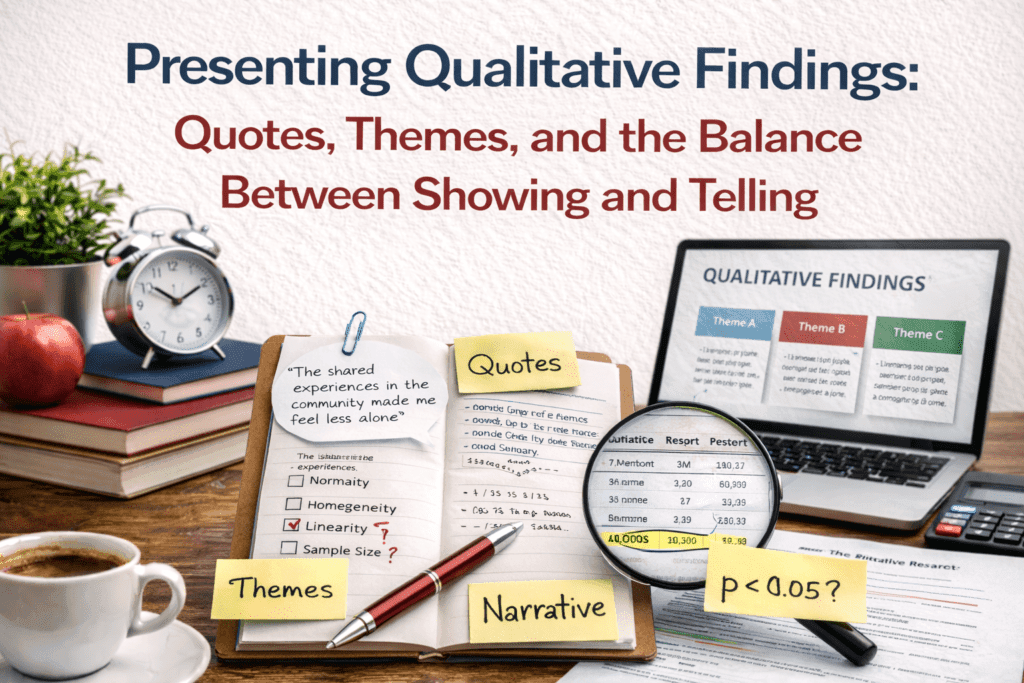
The module overview covers quote selection and theme presentation with brief examples. This post goes deeper: the anatomy of a well-constructed theme section, how to select and integrate quotes so they function as evidence rather than decoration, the five most common presentation failures in qualitative results, and how to write about variation and negative cases without undermining your themes.
The Fundamental Structure: What a Qualitative Results Section Must Do
A qualitative results section has a different job from a quantitative results section. Quantitative results report what the tests found. Qualitative results must do something harder: make visible a pattern that exists across multiple participants’ accounts, while also conveying enough of the texture and specificity of those accounts that the reader trusts the pattern is real and not imposed by the researcher.
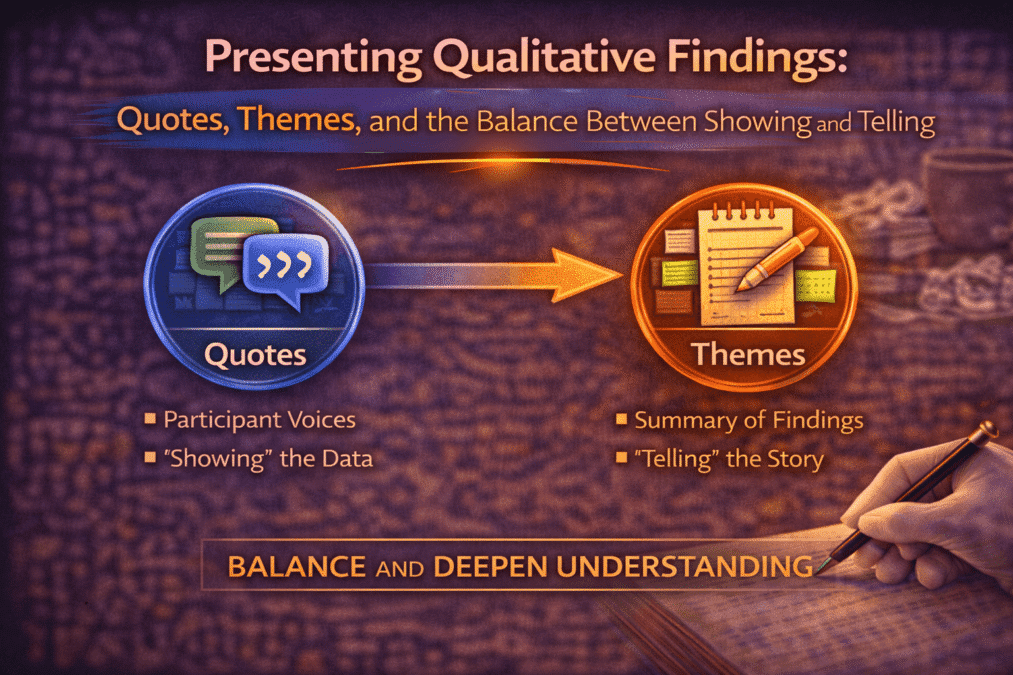
The central challenge is the balance between showing and telling. Too much telling — “participants felt overwhelmed” — is assertion without evidence. The reader has no way to evaluate whether the interpretation is accurate. Too much showing — page after page of quotes with minimal interpretation — buries the analytical contribution in raw data. The reader sees the trees but not the forest.
The standard that satisfies both requirements is: claim, evidence, interpretation. State what the theme claims, show evidence from the data that supports it, explain what the evidence means and how it connects to the research question. Every theme section in a results chapter should cycle through this structure, usually multiple times.
Constructing a Theme Section
Each theme in your results chapter deserves its own subsection. The subsection should do five things, roughly in this order:
- Open with a statement of what the theme claims: Not a descriptive label, but an interpretive statement. Not “Institutional knowledge” but “Students experienced institutional knowledge as a form of social capital that peer mentors could transfer.”
- Establish prevalence: How widely was this theme present? Across all participants, most, some? Be specific: “This pattern was evident in twenty-two of the twenty-six interviews.” This is not quantifying qualitative data — it is being transparent about the scope of the evidence.
- Present the primary evidence: Two or three quotes that exemplify the theme most clearly, each introduced and interpreted.
- Address variation: Were there participants whose experience diverged from the theme? How, and what does that variation mean?
- Conclude with analytical synthesis: What does this theme contribute to answering the research question? What is its relationship to other themes?
Example theme section opening (from a study of peer mentoring): Theme 2: Navigating Hidden Institutional Rules A second theme that emerged consistently across interviews concerned participants encounter with the unwritten rules of government college academic culture. This pattern was evident in twenty-two of twenty-six interviews, with particular intensity among first-generation students. Participants described institutional processes that appeared simple in principle but were complex in practice. As P12, a first-generation student from a rural district, explained: “There is a whole system and if you do not know it, you just do not get what you need. I would have failed my first assignment because I did not know you had to ask a specific person for an extension.” The phrase whole system appeared or was clearly implied in twelve interviews, suggesting participants experienced institutional processes not as individual procedures but as a coherent, opaque structure that needed to be decoded.
Notice what this opening does: it names the theme interpretively (not just “institutional rules” but “navigating hidden institutional rules”), states its prevalence precisely, introduces the first quote with context that tells the reader what to look for in it, and then makes an analytical observation about a linguistic pattern in the data (“whole system”) that supports the interpretation. This is the showing-and-telling balance at work.
Selecting Quotes: The Four Criteria
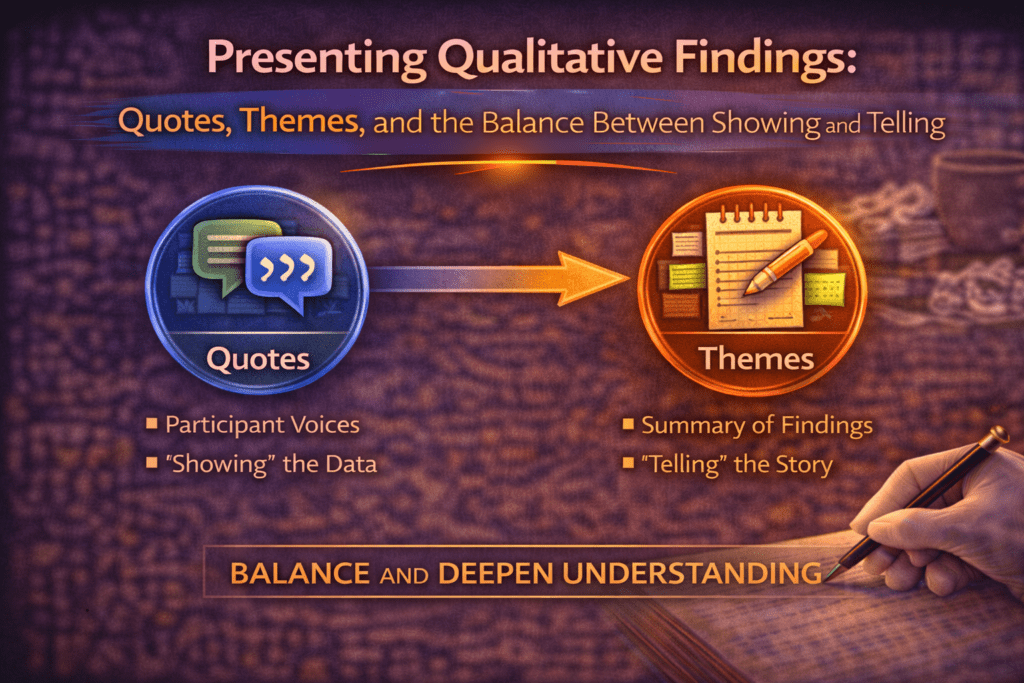
Quotes are your evidence. They function in qualitative results the way statistical results function in quantitative results — they are what you point to when someone asks “how do you know this?” This means quote selection requires the same rigour you would apply to data selection in any other context.
Criterion 1: Representativeness
The quote should represent the pattern, not an unusual exception. If eighteen out of twenty participants described peer mentors as institutional navigators and two described them as social companions, your representative quote for the navigation theme should come from the eighteen, not the two. Selecting an unusual but vivid quote because it is more interesting than the typical ones misrepresents your data.
Criterion 2: Clarity
The quote should be understandable to a reader who was not present at the interview. Quotes heavy with local references, technical terms, or context that requires extensive setup are poor evidence — they require more explanation than they provide. If a quote needs three sentences of context before it makes sense, consider paraphrasing the context and quoting only the most analytically significant phrase.
Criterion 3: Analytical yield
The quote should do analytical work — it should say something that advances the argument rather than merely illustrating a point already made in the text. If your analysis already fully establishes the claim, a quote that simply restates it adds length without adding value. Choose quotes that add something: a nuance, a texture, a formulation that the analytical prose cannot fully capture.
Criterion 4: Economy
One or two strong quotes do the job better than five average ones. Quote overload — using multiple quotes to make the same point — is one of the most common qualitative presentation failures. It gives the impression that the researcher is uncertain of the pattern and is compensating with volume. Select the strongest quote and interpret it fully. If a second quote adds something the first does not, use it. If it repeats the same point with different words, cut it.
Integrating Quotes: Setup and Interpretation
The module distinguishes between quoting with setup and quoting without. This section extends that distinction into a complete integration model.
Every quote needs three components: a frame that tells the reader what to look for, the quote itself, and an interpretation that explains what it means and why it matters. Quotes that appear without frame or interpretation are not functioning as evidence — they are raw material that the reader must do analytical work on, which is your job, not theirs.
Without integration (weak): P7: “My mentor knew everything about how the college worked. She told me things I would never have found out on my own.” With integration (strong): The navigator role was described most vividly by participants who were the first in their families to attend college. P7, whose parents had completed primary school only, described her mentor as someone who possessed institutional capital she had no way to access independently: “My mentor knew everything about how the college worked. She told me things I would never have found out on my own.” The phrase ‘would never have found out on my own’ signals not just gratitude but the recognition of a structural disadvantage that the mentoring relationship mitigated. This was not unique to P7 — variants of the same formulation appeared in fourteen of the seventeen first-generation student interviews.
The integrated version does four things the unintegrated version does not: it positions the quote within the theoretical frame (institutional capital), provides participant context relevant to interpreting the quote, makes an analytical observation about the specific language used (“would never have found out on my own”), and connects the individual quote to the broader pattern across the dataset.
Writing About Variation and Negative Cases
One of the most common failures in qualitative results writing is presenting themes as universal when they are not. If a theme is present in twenty-two of twenty-six interviews, four participants’ data is not fitting the theme — and pretending otherwise misrepresents your data and undermines the credibility of the analysis.
Variation is not a problem to be managed — it is data to be reported and interpreted. Participants whose experience diverges from the dominant theme may represent a genuine subgroup, or they may reveal the boundary conditions of the theme — the conditions under which it applies and those under which it does not.
Addressing variation: “Four participants did not describe peer mentoring in navigational terms. Three of these were continuing-generation students whose family familiarity with higher education may have reduced their dependence on institutional knowledge transfer. The fourth — a first-generation student who described her mentor as unhelpful and disengaged — suggests that the navigational function depends on mentor quality and investment as well as student need. The theme of navigating hidden institutional rules therefore characterises the experience of most participants, particularly first-generation students, but is not universal and is contingent on mentor engagement.”
This paragraph acknowledges variation, offers interpretation of why variation exists, and restates the theme’s scope more precisely. The theme is not weakened — it is made more accurate and more analytically credible.
The Five Most Common Qualitative Presentation Failures
- Quote-only sections: Pages of quotes presented without interpretation. The reader sees the data but not the analysis. Every quote must be introduced, and every quote must be followed by interpretation.
- Assertion without evidence: Claims about themes not supported by data. “Participants felt overwhelmed” with no quotes to support it. In qualitative results, every claim must be evidenced.
- Cherry-picked quotes: Selecting the most vivid or extreme quote regardless of whether it represents the typical experience. If the most dramatic quote comes from one participant and eighteen others describe something more moderate, the dramatic quote is not representative evidence.
- No variation or negative cases: Presenting themes as universal when they are not. This is both methodologically inaccurate and analytically naïve — real social phenomena almost always have exceptions and boundary conditions.
- Descriptive rather than interpretive themes: Theme names like “Participants discussed stress” or “Responses about time management” describe topic areas, not analytical claims. A theme name should state what the analysis found, not what participants talked about.
For Law Students
Presenting qualitative legal findings — from interviews, observations, or document analysis — follows the same principles as social science qualitative presentation, with two considerations specific to legal scholarship.
Quoting legal professionals: precision and attribution
When presenting quotes from interviews with judges, advocates, or legal officers, precision in attribution matters more than in many social science contexts. Legal professionals speak with institutional authority; what a judge says about sentencing practice carries different weight than what a student says about study habits. Attribution should specify role and court level (“a Sessions Court judge with fifteen years on the bench”) without identifying the individual — this provides the context readers need to evaluate the authority of the statement while protecting anonymity.
Do not paraphrase where a direct quote is available and appropriate. In legal interview research, participants often use precise technical language that carries specific legal meaning. Paraphrasing a judge’s description of proportionality analysis risks losing the exact formulation that makes the quote analytically significant. Quote directly and interpret the specific legal language used.
Document analysis as qualitative data: presenting textual evidence
When the qualitative data is legal documents — judgments, policy documents, legislative materials, legal aid records — presenting findings follows the same claim-evidence-interpretation structure, but the evidence is documentary rather than interview-based. Quote the specific passage from the document, provide sufficient context for the reader to understand it, and interpret its significance for the doctrinal or empirical argument.
For doctrinal analysis, the equivalent of quote overload is case overload — citing seven cases to establish a proposition that one or two would establish equally well. Select the cases that are most authoritative, most precisely on point, and most analytically productive. Citation volume is not a proxy for doctrinal rigour.
FAQs
Q: How do you present qualitative research findings?
Present qualitative findings organised by themes, not by participant or by chronological order of interviews. For each theme: name it with an analytical heading; describe it in analytical prose stating what it means across participants; provide two or three supporting quotes that illustrate the theme; and note variation or sub-themes. The ratio of analytical prose to direct quotes should be approximately 60:40. A results section composed mostly of quotes without analytical commentary has presented data, not findings.
Q: How do you select quotes to include in qualitative research?
Select quotes that best illustrate the theme — not the most dramatic, most articulate, or most extreme. A good quote is specific, concrete, and says something the reader could not infer from your analytical prose alone. Use two or three quotes per theme — not one (insufficient illustration) and not ten (padding). Vary participant characteristics across quoted extracts so the same participant does not dominate the results. Always include a participant identifier (Participant 7, female lawyer, 12 years experience) so the reader can assess whose perspective is represented.
Q: How long should quotes be in qualitative research?
Most quotes should be 1–4 sentences — long enough to convey the participant’s meaning in context, short enough to remain focused. Quotes longer than 6–7 lines require strong justification — they are usually better paraphrased with a short illustrative extract. If you find yourself using many long quotes, you are likely substituting quotation for analysis. Short quotes embedded in analytical prose (‘Participants described feeling ‘completely overwhelmed’ by the process’) are often more effective than long block quotes standing alone.
Q: What is the difference between a theme and a code in qualitative research?
A code is a label applied to a segment of data that describes what is present in that segment. A theme is a pattern of meaning that runs across multiple codes and multiple participants — it captures something important about the data in relation to the research question. Codes are generated during initial analysis; themes are developed from clusters of related codes. Themes must represent a genuine pattern across the dataset, not a topic area. A theme titled ‘challenges’ is a topic. A theme titled ‘institutional barriers undermine participant agency’ is an analytical claim.
Q: How do you handle negative cases in qualitative research?
A negative case is a data point that contradicts or does not fit the emerging theme or pattern. Negative cases should be actively sought during analysis — not avoided. Including negative cases in your findings demonstrates analytical rigour and prevents confirmation bias. When presenting a theme, note variation: ‘While most participants reported X, three participants described Y, which was associated with [contextual factor].’ A qualitative analysis that finds no exceptions or variation is usually a sign that the researcher coded only data that confirmed their expectations.
- Braun, V., & Clarke, V. (2022). Thematic Analysis: A Practical Guide. Sage.
- Saldaña, J. (2021). The Coding Manual for Qualitative Researchers (4th ed.). Sage.
- Miles, M. B., Huberman, A. M., & Saldaña, J. (2024). Qualitative Data Analysis: A Methods Sourcebook (5th ed.). Sage.
- Merriam, S. B., & Tisdell, E. J. (2016). Qualitative Research: A Guide to Design and Implementation (4th ed.). Jossey-Bass.
- Creswell, J. W., & Creswell, J. D. (2022). Research Design: Qualitative, Quantitative, and Mixed Methods Approaches (6th ed.). Sage.
References
Next: Cluster Post 6 — Writing the Results Section: Separating Findings from Interpretation
Module 1 (Pillar Post)- The Complete Guide To Research Paper Structure: IMRAD Format, Thesis Organization & Academic Writing (2026)
Module 2 (Pillar Post) –The Academic Writing Process: Complete Guide from First Draft to Submission (2026)
Module 3 (Pillar Post): Research Methodologies: Complete Guide to Quantitative, Qualitative, Mixed Methods & Legal Research (2026)
- Pillar Post : Organization and Academic Tone: Complete Guide to Professional Scholarly Writing (2026) (Module 5)
- Pillar Post : Peer Review and Publication: Complete Guide from Submission to Acceptance (2026) (Module 6)
- Pillar Post : AI Tools in Academic Research: Opportunities, Ethics, and Best Practices (2026) (Module 7)
- Pillar Post: Grant Writing and Research Funding: Complete Guide to Finding Money for Your Research (2026) (Module 8)
- Pillar Post : Academic Career Development: Complete Guide to Building Your Professional Life in Research (2026) (Module 9)
- Pillar Post : Research Ethics and the IRB Process: Complete Guide to Doing Research Responsibly (2026) (Module 10)
No post found!