

Last Updated: March 13, 2026
Cluster Post 3 | Module 5: Organising Chapters, Maintaining Academic Tone, and Preparing Submission-Ready Documents
From Concept to Submission Series | 2026
Academic Writing Mastery: The Complete 2026 Guide To Research Papers, Thesis & Dissertation Writing
Academic Tone: From Principles to Practice
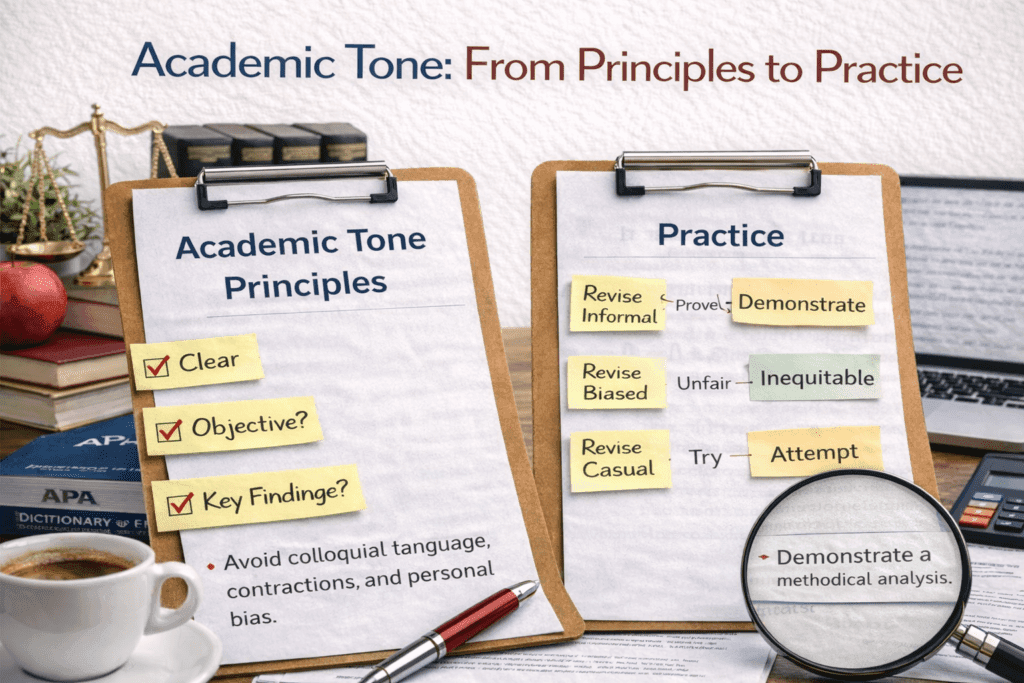
The module overview gives principles for academic tone with brief examples. This post goes deeper: twenty worked transformations from informal to formal, the hedging system that prevents overclaiming, objectivity in practice as a distinct skill from formality, and the first-person question resolved with discipline-specific guidance for Indian researchers.
What Academic Tone Is Actually For
Academic tone is not about impressing examiners with elaborate vocabulary, avoiding the word ‘I’, or demonstrating that you have read enough to sound scholarly. It serves a specific communicative function: it signals that claims are proportionate to evidence, that the writer distinguishes what is known from what is inferred, and that the argument is grounded in reasoning rather than feeling.
The core discipline is precision about epistemic status. Academic tone marks clearly whether a claim is established fact, a well-supported finding, a plausible inference, or a speculative suggestion. Informal language tends to present all claims at the same level of confidence. Academic language uses a range of hedging and attribution devices to signal these distinctions — and those signals are not just stylistic; they are epistemically important.
This framing has a practical implication: academic tone is not primarily about word choice at the sentence level. It is about the relationship between claims and evidence at the level of the argument. A thesis written in formal vocabulary but that overclaims — presenting inferences as established facts, correlations as causes, limited findings as generalisable conclusions — has tone problems that word substitution cannot fix.
Formalising Language: Twenty Worked Transformations
The module provides a short list of informal-to-formal substitutions. This post extends it substantially, with the reasoning behind each substitution so you can apply the same logic to other cases.
| Informal | Formal — and why |
| The results were pretty surprising. | The results were unexpected and warrant further investigation. — ‘Pretty’ is a hedge that weakens the claim; ‘unexpected’ is precise and ‘warrants investigation’ adds analytical direction. |
| A lot of students felt stressed. | A substantial proportion of students reported elevated stress levels. — ‘A lot’ is vague; ‘substantial proportion’ signals magnitude without false precision. ‘Felt’ is subjective; ‘reported’ reflects that data came from self-report. |
| The policy is obviously wrong. | The policy lacks empirical support and contradicts established findings in the intervention literature. — ‘Obviously wrong’ is assertion; the formal version gives the grounds for the claim. |
| This shows that mentoring works. | This finding is consistent with the hypothesis that peer mentoring improves retention outcomes. — ‘Works’ overclaims; the formal version is calibrated to what a correlational finding can support. |
| I think privacy is really important. | Privacy constitutes a foundational right in democratic societies, recognised by international human rights instruments and domestic constitutional provisions. |
| The problem is getting worse and worse. | Evidence suggests a progressive deterioration in compliance rates over the study period. |
| Researchers have found out a lot about this. | A substantial body of scholarship has examined this relationship, producing convergent findings on several dimensions. |
| The judge came up with a new test. | The court developed a three-stage proportionality test in this decision. |
| It seems like the law isn’t working. | Available evidence indicates that implementation of the statutory framework has not produced the compliance outcomes the legislation intended. |
| Everyone knows surveillance is invasive. | Surveillance technologies are widely recognised in the academic literature as posing significant risks to informational privacy. |
Hedging: Calibrating Claims to Evidence
Hedging is not weakness — it is precision. A claim made with more confidence than the evidence warrants is not stronger than a hedged claim; it is less accurate. Academic writing uses a systematic range of hedging expressions to signal how strongly evidence supports a claim.
The four hedging levels
| Epistemic level | Language and example |
| Established (no hedge needed) | Use declarative statements for well-established facts and near-universal findings: ‘The Supreme Court established privacy as a fundamental right in Puttaswamy (2017).’ |
| Well-supported (light hedge) | Use for findings supported by multiple strong studies or consistent case law: ‘Evidence suggests that / Research indicates that / Studies consistently show that peer mentoring is associated with improved first-year retention.’ |
| Plausible (moderate hedge) | Use for inferences that go slightly beyond the direct evidence: ‘This pattern may reflect / It is possible that / The data are consistent with the interpretation that…’ |
| Speculative (strong hedge) | Use for suggestions beyond what the evidence directly supports: ‘One possible explanation is / It has been suggested that / Future research might investigate whether…’ |
The most common hedging error is under-hedging: presenting plausible interpretations as established findings. The second most common is over-hedging: using tentative language for claims that are well-established, which gives the impression that the writer is uncertain about things the field agrees on.
Under-hedged (overclaims): ‘Peer mentoring causes improved retention in first-generation students.’ — This is a causal claim. A survey study cannot establish causation. Appropriately hedged: ‘The findings are consistent with the hypothesis that peer mentoring contributes to improved retention outcomes among first-generation students, though the cross-sectional design precludes causal inference.’ Over-hedged (underclaims): ‘It might possibly be the case that privacy is perhaps considered important in some democratic systems.’ — Privacy as a right is well-established; this level of hedging misrepresents the state of knowledge.
Objectivity in Practice
The module describes objective writing as avoiding emotional language. This is accurate but incomplete. Objectivity in academic writing requires four things, not one.
- Present evidence and let conclusions follow: State the evidence, then state what it shows, rather than stating the conclusion and then citing the evidence. The order matters: it signals that the conclusion was reached by following the evidence, not that evidence was selected to support a predetermined conclusion.
- Acknowledge counterevidence: Present evidence that complicates or contradicts your argument, and explain why your conclusion is still defensible despite it. This is not weakness — it is the mark of intellectual honesty that distinguishes scholarship from advocacy.
- Distinguish your claim from the literature: When summarising others’ work, make clear that it is their position, not yours: ‘Smith (2020) argues that…’ rather than ‘It is the case that…’ This is also important when you disagree: ‘While Smith (2020) argues X, the weight of subsequent evidence suggests Y.’
- Avoid loaded language: Words like ‘terrifying’, ‘scandalous’, ‘obviously’, ‘clearly’, and ‘simply’ express the writer’s emotional response rather than a property of the evidence. Replace them with specific claims: not ‘the data are clearly alarming’ but ‘the data show a 40% increase in non-compliance over three years.’
The First-Person Question
The module says academic writing ‘typically avoids first and second person’ and notes that first person is ‘sometimes appropriate.’ This is accurate but leaves the question insufficiently resolved for researchers who need to know when to use it.
The discipline-specific conventions
- Natural sciences and engineering: Strong convention against first person. ‘The experiment was conducted’ rather than ‘I conducted the experiment.’ Passive voice is the standard.
- Social sciences (psychology, economics, political science): APA style permits and in some cases recommends first person, particularly for describing methods and for stating the researcher’s analytical position. ‘I argue that’ is preferable to the distancing ‘it is argued that’ when the argument is your own.
- Humanities (history, literature, philosophy): First person is widely used and expected for interpretive claims. Saying ‘I read this passage as…’ is appropriate and signals that interpretation is at stake.
- Law: Indian legal scholarship has historically used third person (‘the researcher argues’, ‘it is submitted’), following the convention of legal pleadings. This is changing, particularly at NLUs: ‘I argue that’ and ‘I contend that’ are increasingly accepted in doctrinal and socio-legal scholarship. Check your supervisor’s preferences and your target journal’s style.
The practical principle
Use first person when you are describing something only you did or when you are making a claim that is specifically yours. ‘I conducted interviews with thirty participants’ is clearer than ‘interviews were conducted with thirty participants.’ ‘I argue that proportionality is the appropriate review standard’ is more intellectually honest than ‘it may be argued that’ — because the argument is yours and you should own it. Reserve third person or passive for describing procedures and established knowledge, where the actor is genuinely not important or not specific.
Maintaining Tone Across a Long Document
Tone inconsistency across a long thesis is one of the most common — and least commented on — quality issues examiners notice. It typically results from chapters written at different times, sections revised under different levels of stress, and the first chapter being much more carefully written than the last.
- Establish a style reference: Keep the first two pages of a well-written section as a tone reference. When revising later sections, read them against this reference and note where the register drops.
- Audit for contractions: Search for apostrophes (don’t, can’t, it’s, won’t). Every one is a contraction in an academic document and should be expanded.
- Audit for first/second person: Search for ‘you’, ‘your’, and ‘we’ (unless institutional ‘we’ is disciplinary convention). These are common in sections written quickly.
- Audit for emotional adjectives: Search for ‘amazing’, ‘terrible’, ‘wonderful’, ‘shocking’, ‘horrifying’. These almost always need to be replaced with specific claims.
- Audit for informal connectors: ‘Also’, ‘so’, ‘but’ at the start of sentences are informal in academic writing. Replace with ‘Furthermore’, ‘Consequently’, ‘However’.
For Law Students & Legal Researchers
Formality in legal writing vs. academic legal writing
Legal practitioners and academic legal writers face opposite challenges with formality. Legal practitioners are trained in highly formal drafting conventions that carry over into their academic writing, sometimes making it overly impersonal and difficult to read. Academic legal researchers coming from non-legal backgrounds may write in a more accessible register that reads as insufficiently formal for legal scholarship.
The register for academic legal writing sits between legal drafting and general academic prose. It is formal — no contractions, no slang, careful hedging — but it is not the hyper-technical language of pleadings. It uses plain English where legal precision does not require technical terms, and technical terms where they carry specific legal meaning that no plain-English substitute captures.
Hedging in doctrinal arguments
Doctrinal arguments require careful hedging because legal claims are inherently contested. ‘The court held’ is established fact. ‘The court’s reasoning implies’ is interpretation. ‘It is submitted that the better view is’ is argument. ‘This analysis suggests that a future court might adopt’ is speculation. Each level requires different language.
The phrase ‘it is submitted that’ deserves specific attention. It is the standard legal formulation for putting forward an argument, borrowed from oral advocacy. In academic legal writing, it is acceptable and conventional, but use it only for genuine argumentative claims — not for statements of established law, which should be stated without the submission formula.
References
- Sword, H. (2012). Stylish Academic Writing. Harvard University Press.
- American Psychological Association. (2020). Publication Manual of the APA (7th ed.).
- Paltridge, B., & Starfield, S. (2020). Thesis and Dissertation Writing in a Second Language (2nd ed.). Routledge.
- Murray, R., & Moore, S. (2018). The Handbook of Academic Writing: A Fresh Approach (revised ed.). Open University Press.
- Williams, J. M., & Bizup, J. (2017). Style: Lessons in Clarity and Grace (12th ed.). Pearson.
Next: Cluster Post 4 — Formatting Thesis and Dissertation for Institutional Submission
Module 1 (Pillar Post)- The Complete Guide To Research Paper Structure: IMRAD Format, Thesis Organization & Academic Writing (2026)
Module 2 (Pillar Post) –The Academic Writing Process: Complete Guide from First Draft to Submission (2026)
Module 3 (Pillar Post) Research Methodologies: Complete Guide To Quantitative, Qualitative, Mixed Methods & Legal Research (2026)
- (Module 4) Pillar Post : Data Analysis and Results Presentation: Complete Guide for Quantitative, Qualitative & Legal Research (2026)
- (Module 5) Pillar Post : Organization and Academic Tone: Complete Guide to Professional Scholarly Writing (2026)
Next in Series:
- Pillar Post : Peer Review and Publication: Complete Guide from Submission to Acceptance (2026) (Module 6)
- Pillar Post : AI Tools in Academic Research: Opportunities, Ethics, and Best Practices (2026) (Module 7)
- Pillar Post: Grant Writing and Research Funding: Complete Guide to Finding Money for Your Research (2026) (Module 8)
- Pillar Post : Academic Career Development: Complete Guide to Building Your Professional Life in Research (2026) (Module 9)
- Pillar Post : Research Ethics and the IRB Process: Complete Guide to Doing Research Responsibly (2026) (Module 10)
No post found!