Last Updated: March 21, 2026
Cluster Post 4 | Module 7: AI Tools in Academic Research — Opportunities, Ethics, and Best Practices
From Concept to Submission Series | 2026
Academic Writing Mastery: The Complete 2026 Guide To Research Papers, Thesis & Dissertation Writing
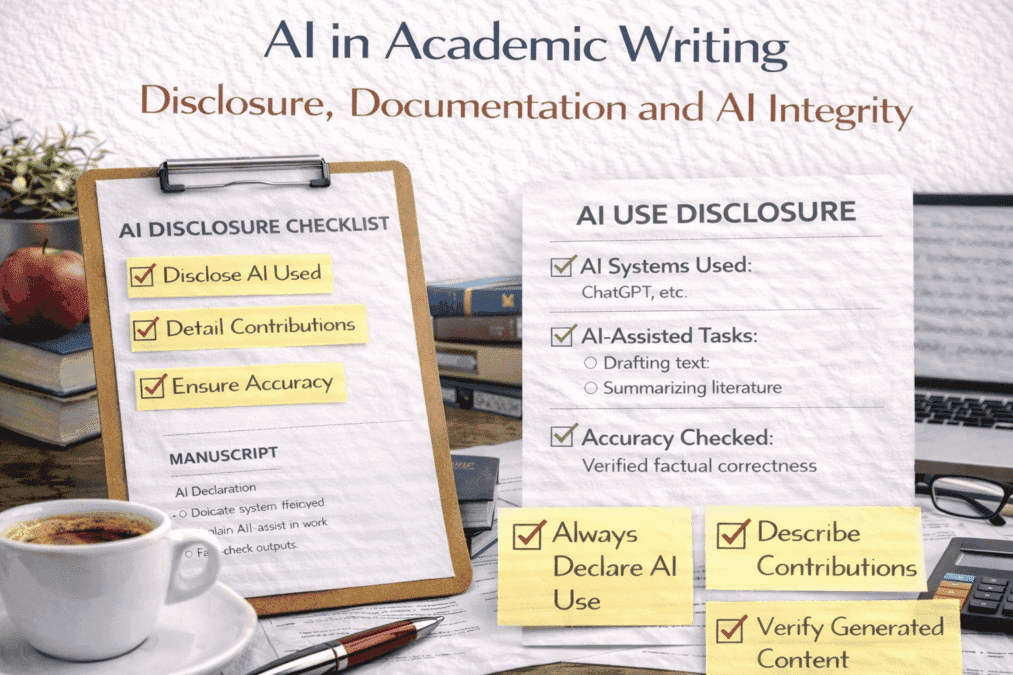
Disclosure Documentation and AI Integrity
The module overview gives disclosure examples. This post goes deeper: complete disclosure templates for thesis, journal article, and conference paper submission, what process documentation to keep and why, how to respond if your work is questioned, and the specific problem of AI detection false positives affecting non-native English speakers.
Why Disclosure Is Not Optional
Some researchers view AI disclosure as a risk — revealing AI use might invite scrutiny, raise questions about originality, or disadvantage them relative to researchers who do not disclose. This calculus is wrong in both directions.
First, the risk of non-disclosure is greater than the risk of disclosure. Supervisors who know a researcher’s writing recognise voice changes. Examiners who ask about methodology details can identify gaps in understanding. AI detection tools, however imperfect, flag documents. And research communities are small — patterns of implausible productivity get noticed. The consequences of discovered non-disclosure are far more serious than the consequences of transparent disclosure.
Second, appropriate AI use is not embarrassing. Using Grammarly, Paperpal, or a coding assistant is analogous to using a writing centre, a statistician consultant, or a research assistant — all of which are disclosed in theses and papers. The purpose of disclosure is transparency about process, not confession of shortcut. Researchers who disclose appropriate AI use are modelling the responsible practices the field is developing.
What to Disclose: The Spectrum
| AI use type | Disclose? Where? |
| Grammar/spell check (Grammarly, Word spelling) | No — this is equivalent to standard word processing |
| Citation formatting software (Zotero, Mendeley) | No — this is standard research tool use |
| AI writing assistance (Grammarly Premium style suggestions, Paperpal) | Yes — in acknowledgements as language/style assistance |
| LLM used to improve clarity of specific passages | Yes — in acknowledgements or methods note |
| LLM used for brainstorming research directions | Yes — brief note in methodology or acknowledgements |
| LLM used to generate code for data analysis | Yes — in methodology section, with explanation of verification |
| Research-specific AI tools (Elicit, Research Rabbit) for literature discovery | Yes — in methodology section |
| LLM used to translate non-English sources | Yes — note where the translation is used |
| AI pre-submission check tools (Thesify, Paperpal) | Yes — brief note in acknowledgements |
Disclosure Templates
Thesis: Acknowledgements section
Minimal disclosure (grammar and writing tools only): ‘During the preparation of this thesis, I used Grammarly Premium and Paperpal to check grammar, spelling, and academic writing style. All content, analysis, arguments, and conclusions are my own. I take full responsibility for the accuracy and integrity of this work.’ Moderate disclosure (writing tools plus literature discovery): ‘During the preparation of this thesis, I used the following AI tools. Elicit and Research Rabbit were used to supplement traditional database searches in identifying relevant literature; all papers included in the thesis were read and evaluated by me. Grammarly Premium and Paperpal were used for grammar and academic writing style checking. All content, analysis, arguments, and conclusions are my own. Full disclosure (multiple tools including coding): ‘During the preparation of this thesis, I used AI tools as follows. Literature discovery: Elicit, Research Rabbit, and Semantic Scholar were used to identify relevant papers beyond traditional database searches; all papers cited were read in full by me. Writing assistance: Grammarly Premium and Paperpal were used for grammar, style, and academic register checking throughout the thesis. Coding assistance: GitHub Copilot was used to help write Python code for the quantitative analysis in Chapter 4; all analyses were designed by me, code was verified manually, and all results were interpreted by me. No AI tools were used to generate content, arguments, or conclusions. I take full responsibility for the accuracy, integrity, and originality of this work.’
Thesis: Methods section (for analysis-related AI use)
‘Data analysis was conducted in Python 3.11. Code for the statistical analyses was written with assistance from GitHub Copilot (version 1.140), which suggested code completions that were reviewed, modified, and verified by the researcher. All analyses were designed by the researcher in accordance with the methodological decisions described above. Results were verified by running each analysis independently and cross-checking outputs against manually calculated values for a randomly selected subset of the data.’
Journal article: Author contribution statement / Methods
‘The authors used Grammarly Premium for grammar and style checking during manuscript preparation. [Author name] used ChatGPT-4 to assist with generating initial Python code for data visualisation; all code was reviewed and modified by the authors before use. No AI tools were used to generate scientific content, interpret results, or draw conclusions. All authors take responsibility for the accuracy and integrity of the work.’
Journal article: Acknowledgements
‘The authors acknowledge the use of AI writing assistance tools (Grammarly, Paperpal) for language editing during manuscript preparation. The scientific content, analysis, and conclusions are the authors’ own.’
Conference paper or presentation
‘AI disclosure: This research used Elicit for supplementary literature discovery and Grammarly for language editing. All analysis, argumentation, and conclusions are the authors’ own work.’
Process Documentation: What to Keep
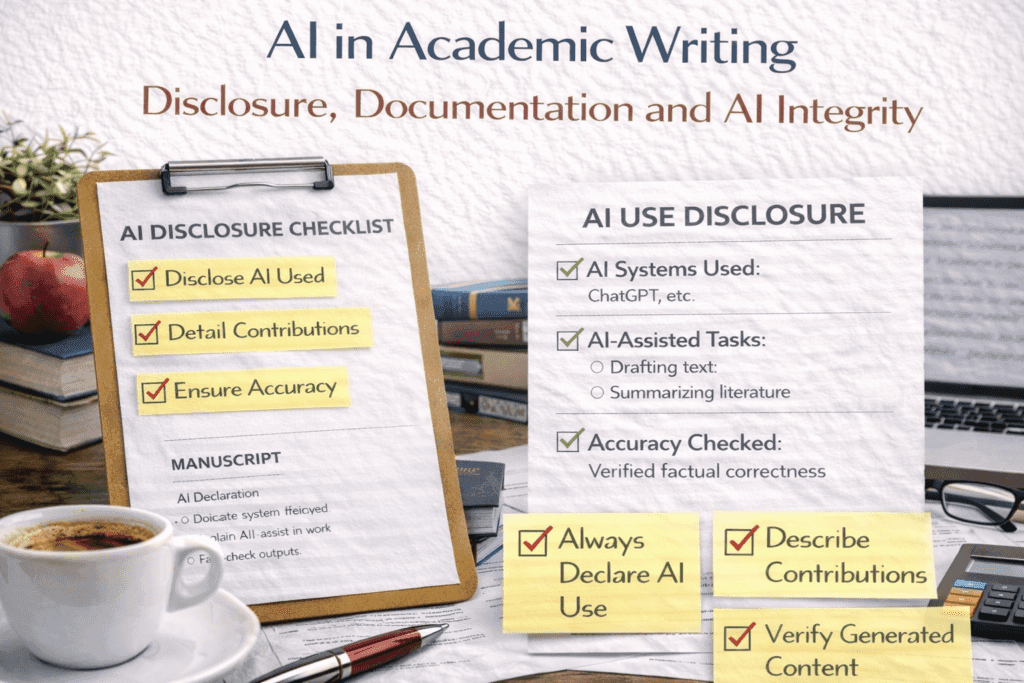
Process documentation is your evidence that the work is yours. If your thesis is questioned — by an examiner, an integrity officer, or a journal editor — the ability to demonstrate your process is your strongest defence. This is not bureaucratic box-ticking; it is self-protection.
Keep the following:
- Dated drafts at key stages: Save a dated version of each chapter draft before and after major revisions. The evolution of a document through multiple clearly-authorial drafts is powerful evidence of genuine authorship.
- AI chat logs where relevant: If you used an AI tool for a specific task — generating code, improving a paragraph, brainstorming counterarguments — screenshot or export the conversation. Most platforms allow conversation export. This shows what the AI produced and what you did with it.
- Research notes and reading logs: Your annotations on papers, your notes from the literature, your interview memos. These document the intellectual engagement that produced the thesis.
- Supervisor correspondence: Emails and meeting notes with your supervisor document the intellectual development of the research over time. Keep these.
- Data files and analysis code: The raw data, the cleaning scripts, the analysis code. For computational research, these are the most direct evidence of what you did.
You do not need to submit this documentation unless asked. Store it somewhere accessible — cloud storage with version history works well — so it is available if needed.
If Your Work Is Questioned
If an examiner, integrity officer, or reviewer questions whether your work is genuinely yours — whether due to AI detection, a sudden change in writing quality, or inability to discuss your work in detail — the following response strategy applies.
- Do not be defensive: Defensiveness is interpreted as guilt. A confident, transparent account of your process is the appropriate response.
- Explain your process in detail: Walk through how you conducted each stage of the research. The ability to describe the process in detail — including the intellectual decisions, the dead ends, the revisions — is the most compelling evidence of genuine authorship.
- Produce documentation: Dated drafts, supervisor emails, reading notes, AI chat logs. A researcher who can produce a progression of drafts and correspondence across two or three years is demonstrating a research process that cannot be faked retroactively.
- Engage substantively with the content: The strongest evidence that a thesis is yours is the ability to discuss its argument, defend its methodology, and engage with challenges at the level of scholarship. Examiners who suspect AI use often test this by asking increasingly specific questions about the research — genuine authors can answer these; AI cannot.
The false positive problem
AI detection tools produce false positives, and non-native English speakers are disproportionately affected. A researcher whose natural writing is clear, grammatically correct, and academically precise may have their work flagged as AI-generated precisely because those are the characteristics the detectors associate with AI. This is a documented problem in the literature.
If your work is flagged by a detection tool and you wrote it yourself: request that the institution follow its process for investigating AI use, which should involve more than a detection tool output. Provide your process documentation. Offer to discuss the work in an oral examination. The detection tool output alone is not evidence of AI use — this is recognised by the International Center for Academic Integrity and by most institutional policies.
Legal Research and Writing: Complete Guide for Law Students and Legal Researchers
FAQs
Q: How do you disclose AI use in a research paper?
Disclose AI use in the acknowledgements or methods section, depending on how it was used. For writing assistance: ‘The authors used [tool name] to improve the clarity of the manuscript. The authors take full responsibility for the content.’ For data analysis assistance: describe in the methods section what tool was used, for what task, and how outputs were verified. Do not use vague statements like ‘AI tools were used in this research’ — specify what tools, what tasks, and what verification was performed. Follow your target journal’s specific AI disclosure format if one is prescribed.
Q: Can AI be listed as an author on a research paper?
Q: Can AI be listed as an author on a research paper?
No — AI cannot be listed as an author on a research paper under the policies of all major publishers (Nature, Elsevier, Springer, Wiley, Taylor & Francis) and under ICMR and ICSSR guidelines. Authorship requires human accountability — the ability to take responsibility for the work, respond to post-publication queries, and stand behind the findings. AI cannot do this. If AI made a substantial contribution to the research, disclose it in the acknowledgements or methods section. Listing AI as an author is grounds for retraction and is treated as research misconduct.
Q: What is an AI use statement in a research paper?
An AI use statement is a declaration in the manuscript describing how AI tools were used in the research or writing process. Required by most major publishers as of 2025–2026. A complete AI use statement includes: the specific tool(s) used (ChatGPT-4, Claude, Grammarly); the tasks it was used for (grammar checking, prose clarity, literature mapping); and a statement that all AI-generated content was reviewed, verified, and the authors take full responsibility. The statement appears in the acknowledgements or as a standalone section depending on the journal’s template.
Q: How do you maintain research integrity when using AI tools?
Maintain research integrity by: using AI only for tasks where its limitations are manageable (writing assistance, grammar, initial outlines — not data analysis or citation generation); verifying every factual claim AI produces against primary sources; disclosing all AI use as required; keeping records of AI interactions that informed your work; ensuring every argument in the final submission is one you can explain and defend; and never using AI to produce content that misrepresents the actual research conducted. Integrity is about whether the research is honestly represented — AI use is not inherently dishonest, but undisclosed substitution is.
Q: What is the difference between AI assistance and AI misconduct in research?
AI assistance is using AI to do things you could do yourself more slowly — improving prose, checking grammar, generating outlines, mapping literature. AI misconduct is using AI to substitute for intellectual work that is central to the research contribution — fabricating or misrepresenting data, generating conclusions from data you have not analysed, producing arguments you cannot explain or defend, creating citations you have not verified. The distinction is: does the AI help you do your research faster and better, or does it do your research for you? The first is assistance; the second is fraud.
Check whether your target journal has specific guidance on AI citation format before submitting. Some journals now require a dedicated AI statement separate from references.
References
- ICAI. (2026). The Fundamental Values of Academic Integrity (5th ed.). ICAI.
- Weber-Wulff et al. (2023). Testing of Detection Tools for AI-Generated Text. International Journal for Educational Integrity, 19(26).
- UGC. (2025). Guidelines for AI Use in Higher Education Research. ugc.gov.in
- Turnitin AI Detection Benchmarks 2026. turnitin.com
Next: Cluster Post 5 — AI Policy Landscape for Indian and Global Researchers
- Module 1 Overview The Complete Guide to Research Paper and Thesis Structure
- Module 2 Overview The Academic Writing Process: Complete Guide from First Draft to Submission (2026)
- Module 3 Overview Research Methodologies: Complete Guide to Quantitative, Qualitative, Mixed Methods & Legal Research (2026)
- Module 4 Overview Data Analysis and Results Presentation: Complete Guide for Quantitative, Qualitative & Legal Research (2026)
- Module 5 Overview Organization and Academic Tone: Complete Guide to Professional Scholarly Writing (2026)
- Module 4 Overview Peer Review and Publication: Complete Guide from Submission to Acceptance (2026)
- Module 7 Overview AI Tools in Academic Research: Opportunities, Ethics, and Best Practices (2026)
Next in Series
- Module 8 Overview Grant Writing and Research Funding: Complete Guide to Finding Money for Your Research (2026)
- Module 9 Overview Academic Career Development: Complete Guide to Building Your Professional Life in Research (2026)
- Module 10 Overview Research Ethics and the IRB Process: Complete Guide to Doing Research Responsibly (2026)
No post found!