Last Updated: March 21, 2026
Cluster Post 2 | Module 9: Academic Career Development
From Concept to Submission Series | 2026
Academic Writing Mastery: The Complete 2026 Guide To Research Papers, Thesis & Dissertation Writing
Conference Strategy
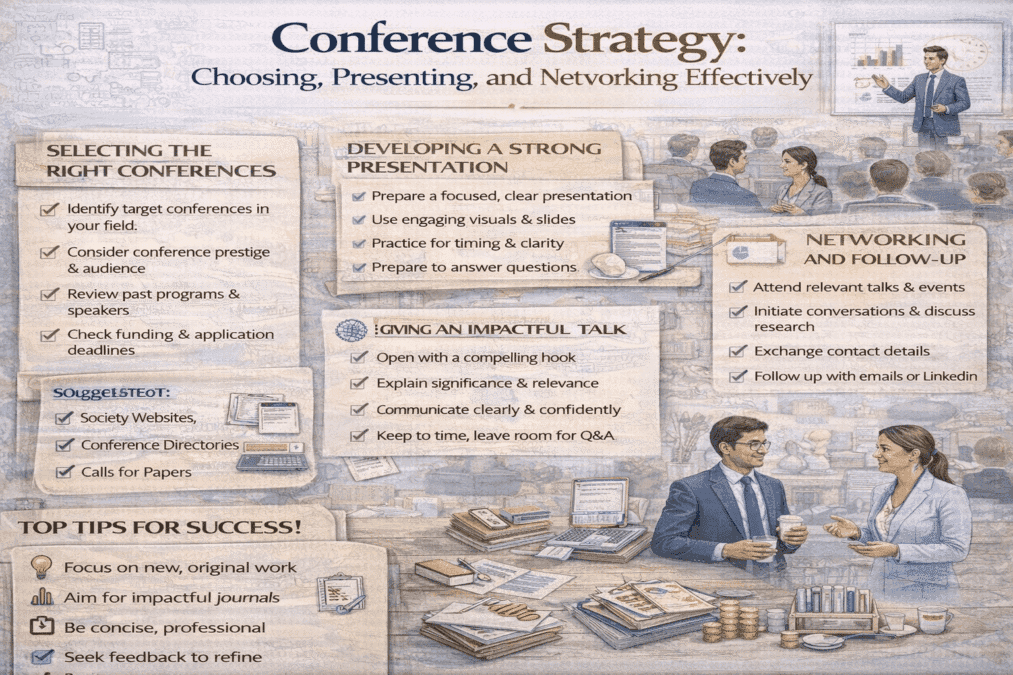
The module overview covers conferences at a general level. This post goes deeper: the strategic logic for which conferences to target at each career stage, the mechanics of a strong paper presentation, the specific networking approaches that build lasting professional relationships rather than a collection of business cards, and how Indian researchers can position themselves effectively at international conferences.
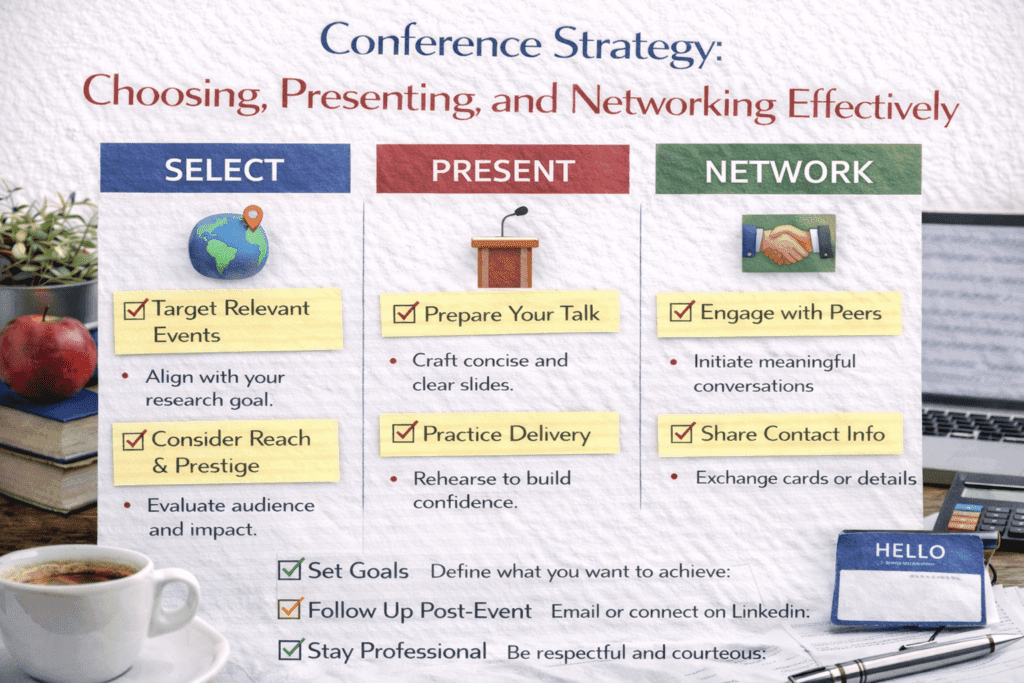
The Strategic Logic of Conference Selection
Not all conference appearances on a CV carry equal weight, and not all conferences serve the same career purpose. Attending every conference indiscriminately is expensive and time-consuming. A strategic approach treats conferences as investments with specific returns.
| Conference type | Primary return and when to prioritise |
| Annual meeting of major disciplinary association (APSA, ASA, ILSA, etc.) | Exposure and visibility. Prioritise once you have work worth presenting publicly — typically second year of PhD onward. Getting onto the programme of a prestigious association annual meeting is a CV credential. |
| Specialised thematic conference (e.g., a conference specifically on constitutional AI governance) | Targeted networking with the specific community most likely to read and cite your work. Prioritise when your research is developed enough to contribute to the conversation, not just observe it. |
| Graduate student conference | Low-stakes practice and peer feedback. Prioritise in the first year of PhD when you need practice without high-stakes consequences. Return to these later only if invited to keynote or organise. |
| International conference abroad | International visibility and the credential of international conference presentation. Prioritise when you have a strong paper and can secure travel funding. One well-chosen international conference appearance per year is sufficient for most PhD students. |
| Regional or national Indian conference | Building domestic academic network and remaining visible in Indian scholarly conversation. Prioritise throughout PhD, not only as a preliminary before ‘real’ conferences — Indian network is important for Indian academic careers. |
The conference selection principle: present at conferences where the audience is the audience for your work. The most useful feedback comes from scholars who work on related questions and can identify gaps, alternative interpretations, or missing literature that genuinely strengthens your research.
The Conference Abstract: Getting Accepted
Conference abstract acceptance is substantially less selective than journal review — most disciplinary conferences accept 50–70% of submitted abstracts. But competitive conferences at major associations can accept as few as 20–30%. The abstract that gets accepted for a competitive conference slot follows the same structure as a journal abstract but with two differences:
- Foreground the question more prominently: conference reviewers assess whether the research question is interesting and timely, not just whether the study is rigorous. The research question should be explicit in the first two sentences.
- Signal the paper’s stage honestly: it is standard to submit abstracts for work in progress — you do not need finished findings. But signal the stage. ‘This paper develops a framework’ is appropriate for theoretical work. ‘Preliminary findings suggest’ is appropriate for empirical work in progress. Submitting as if findings are complete when they are not creates problems when the paper is presented.
Preparing a Strong Paper Presentation
A conference presentation is not a condensed version of your paper. It is a selective argument for your paper’s most important contribution, designed to be understood in real time by an audience that has not read your work.
The twenty-minute presentation structure
- Minutes 1–3: The problem. What is the question, and why does it matter? This must be immediately engaging. An audience that does not understand why the question matters will not follow the argument.
- Minutes 4–7: What we know and what we do not. The essential literature context. Not a comprehensive review — three to four key contributions and the specific gap your research fills.
- Minutes 8–12: What you did. The research design, data, or analytical approach. Enough detail to establish credibility, not enough to lose the audience in method.
- Minutes 13–17: What you found. The main findings or argument. Focus on two to three central points. A conference presentation that tries to present everything in the paper presents nothing effectively.
- Minutes 18–20: What it means. The contribution — what the findings add to the conversation and what questions they open. This should feel like the beginning of a conversation, not the end of one.
Slide design principles
Each slide should do one job. A slide with five bullet points containing full sentences is a reading exercise, not a visual aid. The best conference slides are sparse: a key phrase, a figure, or a single claim that you elaborate in speech.
Slide that is a reading exercise: • Proportionality analysis under Article 21 involves three stages: (1) assessment of the purpose of the state action; (2) assessment of the necessity of the measure; (3) assessment of proportionality stricto sensu between the measure and the purpose pursued. Slide that supports speech: Proportionality: Three Stages 1. Purpose 2. Necessity 3. Balance [Elaborated verbally: ‘The first stage asks whether the state action has a legitimate purpose — this is rarely contested in AI surveillance cases, but stage two, necessity, is where most challenges arise…’)
Preparing for questions
The question period is where you demonstrate intellectual engagement, not just the ability to present prepared material. Three preparation steps: first, identify the three most likely challenging questions (the limitation you know is there, the competing theory you didn’t address, the alternative interpretation of your data) and prepare thoughtful responses. Second, prepare a ‘parking’ response for questions you genuinely cannot answer: ‘That’s a question I haven’t fully worked through — my initial thought is X, but I’d want to think further. Could we continue this conversation after the session?’ Third, note which questioners seem most engaged — these are the people to approach during the coffee break.
Networking at Conferences: What Actually Works
The module’s advice on networking is sound. This section adds the mechanics — the specific approaches that distinguish productive from unproductive networking at academic conferences.
Before the conference
Read the programme. Identify three to five specific people whose work is directly relevant to yours and whose presentations or panels you will attend. Look them up: read a recent paper, note something specific you want to ask about. This preparation makes every introduction more substantive — ‘I read your paper on X and wanted to ask about Y’ is the basis for a real conversation.
The conference introduction
Ineffective: ‘Hi, I’m a PhD student at [university]. What do you work on?’ Effective: ‘Hi, I’m [name] — I’m doing a PhD at [university] on [specific topic]. I attended your panel this morning and your argument about [specific point] connects directly to a problem I’m working through. Would you have five minutes to discuss it?’ The difference: the effective introduction shows you know their work, demonstrates intellectual overlap, and makes a specific, bounded request (five minutes) that is easy to say yes to.
Following up: the within-week email
Within five days of meeting a scholar at a conference, send a brief email. The module gives a template; this post adds: be specific about what you discussed (this proves you were genuinely engaged, not just collecting contacts), offer something of value (a paper of yours that connects to their work, a resource that might be useful), and make no requests. The follow-up email’s only job is to establish the connection — requests for advice, reading, or reference letters come later, once the relationship has a foundation.
For Indian researchers at international conferences
Indian researchers sometimes underestimate their standing at international conferences, particularly in law, development studies, and comparative social science, where Indian scholarship is internationally significant. The assumption that you are a peripheral observer rather than a contributor to the conversation is often wrong — and it shapes how you present yourself.
Specific advice: present your work as contributing to international theoretical conversations, not just documenting Indian cases. ‘My research tests proportionality theory in an AI governance context’ positions you as a contributor to a global conversation. ‘My research looks at Indian courts dealing with AI’ positions you as a regional specialist. Both are accurate, but only one opens the networking conversations you want.
Legal Research and Writing: Complete Guide for Law Students and Legal Researchers
FAQs
Q: How do you choose which academic conferences to attend?
Choose conferences based on: disciplinary fit (does the conference attract the scholars whose work most influences yours?); career stage appropriateness (flagship national conferences for PhD students; international flagship conferences for post-PhD researchers); networking potential (will you meet scholars who could become collaborators, examiners, or referees?); abstract acceptance rates (lower rates signal more competitive and prestigious venues); and return on investment (travel costs versus career benefit). Attend the same two or three conferences consistently rather than spreading thinly across many — building a recognisable presence in one community is more valuable than appearing once at many.
Q: How do you write a conference abstract that gets accepted?
A conference abstract (200–300 words) must clearly state: the research problem; your specific argument or finding (not ‘this paper will explore’ but ‘this paper argues that’); the methodology in one sentence; and the contribution to the field. Conference reviewers assess whether the paper will generate productive scholarly discussion — papers with clear, contestable arguments are preferred over descriptive presentations of work in progress. Read recent conference programmes to understand what kinds of papers get accepted at your target conference before writing your abstract.
Q: How do you network effectively at academic conferences?
Effective conference networking is preparation plus follow-through. Before: identify three to five scholars whose work you know well and whom you want to meet; read their recent papers; prepare one or two specific questions about their work. During: attend their panels; introduce yourself briefly with your research focus; exchange contact details. After: email within one week referencing a specific conversation; connect on academia.edu or ResearchGate; follow up if you submit a paper to a journal they edit. Networking is relationship-building, not transactional — genuine scholarly interest in someone’s work is more memorable than a business card.
Q: How do you present at an academic conference effectively?
Conference presentations are typically 15–20 minutes. Present the argument, not the full paper — conferences reward papers that make one clear, contestable claim with supporting evidence. Use slides sparingly: 8–12 slides maximum, no text walls. Practice to time. End 1–2 minutes early to leave room for your best question-and-answer exchange, which often generates more intellectual engagement than the presentation itself. Respond to critical questions with genuine engagement, not defensiveness — conference Q&A is where scholarly conversations begin.
Q: Which conferences are most important for Indian researchers?
Key conferences for Indian social science researchers: Indian Social Science Congress (ISSC); ICSSR-sponsored national conferences in each discipline; discipline-specific flagship conferences (Indian Economic Association, Indian Political Science Association, Indian Sociological Society). For international visibility: discipline flagship international conferences (ASA, ISA, AERA, Law and Society Association depending on field). For law researchers: National Moot Court competitions build advocacy profile; academic conferences include ILSA, ICON-S, SLSA, and NLU-organised national conferences. Conference attendance history on a CV should show a trajectory from national to international as the career develops.
References
- Day, R. A. (2022). How to Present at International Conferences. Wiley-Blackwell.
- Kelsky, K. (2023). The Professor Is In. Penguin.
Next: Cluster Post 3 — The Academic Job Application Package: Cover Letter, Research Statement, Teaching Statement
- Module 1 The Complete Guide to Research Paper and Thesis Structure
- Module 2 The Academic Writing Process: Complete Guide from First Draft to Submission (2026)
- Module 3 Research Methodologies: Complete Guide to Quantitative, Qualitative, Mixed Methods & Legal Research (2026)
- Module 4 Data Analysis and Results Presentation: Complete Guide for Quantitative, Qualitative & Legal Research (2026)
- Module 5 Organization and Academic Tone: Complete Guide to Professional Scholarly Writing (2026)
- Module 6 Peer Review and Publication: Complete Guide from Submission to Acceptance (2026)
- Module 7 AI Tools in Academic Research: Opportunities, Ethics, and Best Practices (2026)
- Module 8 Grant Writing and Research Funding: Complete Guide to Finding Money for Your Research (2026)
- Module 9Academic Career Development: Complete Guide to Building Your Professional Life in Research (2026)
Next in series
Module 10 Research Ethics and the IRB Process: Complete Guide to Doing Research Responsibly (2026)
No post found!