Last Updated: March 21, 2026
Cluster Post 5 | Module 9: Academic Career Development
From Concept to Submission Series | 2026
Academic Writing Mastery: The Complete 2026 Guide To Research Papers, Thesis & Dissertation Writing
Alternative and Hybrid Careers
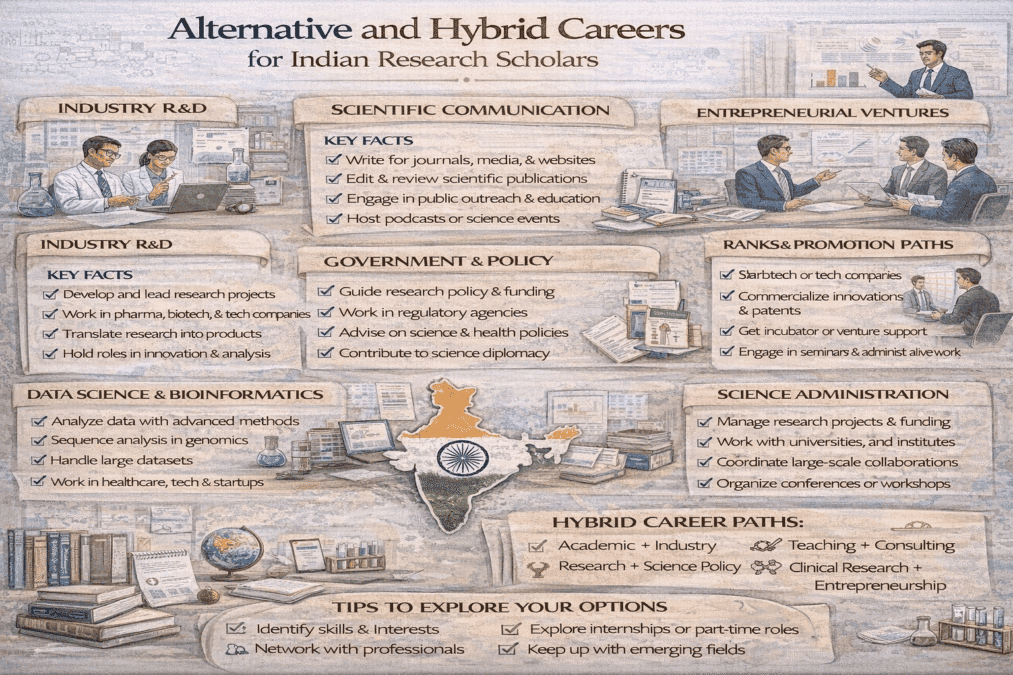
The module overview lists alternative career types. This post goes deeper: the specific roles that are realistic for Indian PhD graduates in law, social science, and STEM, how to position a research degree for non-academic employment, the hybrid academic-practitioner career that is emerging in India, and the skills translation that makes research training valuable outside the university.
Why This Conversation Matters Now
The number of PhD graduates in India has grown substantially over the past decade, while the number of permanent academic positions has not grown proportionately. This is not a temporary mismatch — it reflects a structural change in the relationship between doctoral training and academic employment. Most PhD graduates in India will spend significant portions of their careers outside traditional tenured faculty positions. This is not a failure; it is the new normal, and the careers available to research-trained scholars are genuinely interesting and well-compensated.
The framing shift that matters: many PhD graduates approach non-academic careers as a compromise. The more productive framing is that a PhD provides a specific set of skills — systematic inquiry, synthesis of complex information, rigorous argumentation, quantitative analysis, sustained intellectual project management — that are valuable in multiple sectors. The question is not ‘what can I do given that I could not get an academic job?’ but ‘where do these skills create the most value?’
Policy Research and Think Tanks
India’s policy research ecosystem has expanded significantly in the past decade. Organisations like the Centre for Policy Research (CPR), Observer Research Foundation (ORF), ICRIER, CSDS, and the Takshashila Institution produce policy-relevant research at high standards and employ PhD-trained researchers.
| Organisation type | What they value from PhD graduates |
| Government-linked policy institutes (NITI Aayog, RBI research, ministry research divisions) | Quantitative analytical skills, capacity to synthesise complex evidence, understanding of Indian institutional context, regulatory and legal knowledge for law PhDs |
| Independent policy institutes (CPR, ORF, ICRIER) | Disciplinary depth, publication capacity, international networks, ability to translate research for non-specialist audiences, grant-writing experience |
| International organisation India offices (World Bank, UNDP, UN agencies, Asian Development Bank) | Quantitative methods, familiarity with development economics or public policy literature, report-writing for international audiences, language skills |
| NGO research divisions | Applied research skills, qualitative methods especially, community-based research experience, ability to work across language and cultural contexts |
What distinguishes competitive applicants from the policy research perspective: the ability to write clear, non-academic prose aimed at non-specialists, a track record of engaging with policy questions rather than purely theoretical ones, and demonstrated understanding of the institutional context in which policy is made. If your research has any policy dimensions, developing this dimension during the PhD — through op-eds, policy briefs, or engagement with relevant government consultations — strengthens policy career competitiveness.
Research in the Private Sector: GCCs and Corporate R&D
India’s Global Capability Centre (GCC) ecosystem employs over 1.6 million people in research, analytics, and technology functions as of 2026. For quantitative social scientists, data scientists, and STEM researchers, this sector offers competitive salaries (significantly higher than academic starting salaries) and substantial research responsibility.
For law PhD graduates: GCCs and major corporations have growing legal research and regulatory affairs functions that value the analytical skills of law PhDs — particularly in technology law, intellectual property, data protection compliance (DPDPA implementation is generating significant demand for privacy law expertise), and cross-border regulatory analysis. These roles are not the same as practising law; they are research and analysis roles that require the capacity to analyse complex regulatory environments systematically.
For social science PhD graduates: user research, market research, organisational research, and policy advocacy functions within large companies and consulting firms employ researchers trained in qualitative and quantitative methods. The key translation: reframe ‘interview methodology’ as ‘stakeholder insight generation,’ ‘thematic analysis’ as ‘qualitative synthesis,’ and ‘survey design’ as ‘measurement instrument development.’ The underlying skills are identical; the vocabulary needs to match the sector.
Hybrid Academic-Practitioner Careers
A growing number of Indian academics, particularly in law and public policy, are building careers that combine part-time or adjunct academic positions with practice, consulting, or policy work. This model was once unusual; it is becoming standard.
For law researchers
Many NLUs now accommodate faculty who maintain limited active practice alongside their academic roles. Some NLUs formally permit a specified number of cases or advisory matters per year; others are more flexible. The research-practitioner combination is intellectually valuable — practitioners who maintain research engagement produce more contextually grounded scholarship; researchers who maintain practice exposure bring real-world legal complexity into teaching and writing.
The institutional negotiation: if you are considering a hybrid law career, address this clearly in the hiring conversation rather than after appointment. Some institutions are enthusiastic about faculty who bring practitioner experience; others have strict conflicts of interest policies. Know the institution’s norms before accepting a position.
For social science researchers
Consulting alongside academic work is common in economics, public policy, and development studies. Development consulting firms, international organisations, and government agencies regularly contract academic researchers for evaluation studies, needs assessments, and evidence synthesis. This work is billable at rates that substantially supplement academic salaries, and it keeps research connected to practical questions.
The risk: consulting work expands to fill available time if not managed deliberately. Academics who consult need to ring-fence their research time with the same discipline they would apply to teaching preparation.
Building a Portfolio Career
Some PhD graduates find that a single employer — academic or otherwise — is not the right fit for their interests. A portfolio career combines multiple part-time or contract engagements: adjunct teaching at one or two institutions, a consulting retainer with a policy organisation, advisory board membership with an NGO or startup, and independent research pursued through grants.
The advantages: intellectual diversity, protection against the precarity of any single income source, the ability to pursue research across institutional boundaries, and the flexibility to take up interesting projects as they arise.
The disadvantages: administrative overhead (managing multiple engagements takes time), lack of institutional infrastructure (no research office, library access can require negotiation), difficulty demonstrating the consistent publication record that academic hiring committees want to see, and the psychological challenge of operating without an institutional identity.
Portfolio careers work best for researchers with a clear intellectual identity — a recognisable research focus that makes their work coherent across multiple engagements — and for those who are disciplined self-managers. They require more career intentionality than traditional employment.
The Skills Translation Imperative
The practical barrier to non-academic careers for many PhD graduates is not that their skills are insufficient — it is that they do not know how to translate their skills into language that non-academic employers recognise.
| Academic language | Non-academic translation |
| Conducted 26 semi-structured interviews and performed thematic analysis | Designed and executed qualitative research with 26 senior stakeholders; synthesised findings into actionable insights |
| Developed a proportionality framework for judicial review of AI surveillance | Built an analytical framework for assessing regulatory compliance with constitutional constraints in AI deployment |
| Published three peer-reviewed articles in competitive journals | Three publications with selective acceptance rates demonstrating peer-validated expertise |
| Secured ICSSR doctoral fellowship | Competitive national fellowship for research excellence awarded to fewer than 15% of applicants |
| Supervised three MA thesis students | Mentored three junior researchers through complex research projects from design to completion |
| Presented at international conference | Presented research to international expert audience and engaged scholarly debate |
The underlying activities are identical. The vocabulary shift opens doors to evaluators who do not know what thematic analysis or peer review means but understand stakeholder insight and peer validation.
Legal Research and Writing: Complete Guide for Law Students and Legal Researchers
FAQs
Q: What careers are available for PhD holders outside academia in India?
PhD holders in India have career options beyond academic faculty positions: research positions at think tanks and policy institutes (Observer Research Foundation, CPR, NIPFP, IDS); government research positions (Planning Commission successor bodies, NITI Aayog research roles, Ministry research units); international organisations (UNDP, UNICEF, World Bank, ADB India offices); NGO leadership and research roles; editorial positions at academic publishers and journals; consultancy with government and international development organisations; and corporate research roles in sectors relevant to your discipline. Many of these roles value research skills more than specific disciplinary knowledge.
Q: What is a think tank and how do you get a job at one?
Think tanks are policy research organisations that produce research to inform public debate and policy. In India: Observer Research Foundation (ORF), Centre for Policy Research (CPR), IDFC Institute, Indian Council of World Affairs, and Gateway House are prominent examples. Think tank positions reward: published research with policy relevance; ability to write accessibly for non-specialist audiences (policy briefs, op-eds, blog posts); subject matter expertise in a policy domain; and often, prior engagement with government or international organisations. Entry-level positions (Research Associate, Research Assistant) are competitive — a strong MA or early-PhD record is sufficient.
Q: Can you combine an academic career with policy or consultancy work in India?
Yes — hybrid careers combining academic positions with policy consultancy, government advisory roles, or think tank affiliations are increasingly common in Indian social science. NLU faculty regularly consult for government bodies, law commissions, and international organisations. The key is ensuring that external work enhances rather than conflicts with academic responsibilities. Most Indian universities require disclosure of consultancy work and may require institutional permission. International consultancy for UN bodies or foreign governments may require FCRA considerations if funds flow to India.
Q: How do you transition from academia to the private sector in India?
Transitioning from academia to the private sector requires translating research skills into business language: data analysis becomes market research or business intelligence; qualitative research becomes user research or stakeholder analysis; writing and communication skills apply to corporate communications, policy teams, and consulting. Sectors that actively recruit PhDs include: management consulting (McKinsey, BCG, Bain recruit PhDs); market research; financial services research; government relations; and EdTech. The transition is easier with some industry exposure during the PhD — internships, consulting projects, or part-time industry engagement help bridge the gap.
Q: What is academic entrepreneurship and how does it work in India?
Academic entrepreneurship involves researchers commercialising their research — licensing technology, spinning out companies, or consulting through their university. In India, the National Education Policy 2020 encourages university entrepreneurship, and IITs, IIMs, and some central universities have incubators and technology transfer offices. For social science researchers, entrepreneurship typically takes the form of consultancy firms, research organisations, or EdTech ventures built around research expertise. Most NLUs do not yet have formal entrepreneurship support structures — connections with startup ecosystems in cities like Bengaluru, Delhi, and Hyderabad are typically built through personal networks.
References
- Basalla, S., & Debelius, M. (2015). ‘So What Are You Going to Do with That?’ (3rd ed.). University of Chicago Press.
- Centre for Policy Research. cprindia.org
- Observer Research Foundation. orfonline.org
End of Module 9 Cluster Posts — all 5 complete.
- Module 1 The Complete Guide to Research Paper and Thesis Structure
- Module 2 The Academic Writing Process: Complete Guide from First Draft to Submission (2026)
- Module 3 Research Methodologies: Complete Guide to Quantitative, Qualitative, Mixed Methods & Legal Research (2026)
- Module 4 Data Analysis and Results Presentation: Complete Guide for Quantitative, Qualitative & Legal Research (2026)
- Module 5 Organization and Academic Tone: Complete Guide to Professional Scholarly Writing (2026)
- Module 6 Peer Review and Publication: Complete Guide from Submission to Acceptance (2026)
- Module 7 AI Tools in Academic Research: Opportunities, Ethics, and Best Practices (2026)
- Module 8 Grant Writing and Research Funding: Complete Guide to Finding Money for Your Research (2026)
- Module 9Academic Career Development: Complete Guide to Building Your Professional Life in Research (2026)
Next in series
Module 10 Research Ethics and the IRB Process: Complete Guide to Doing Research Responsibly (2026)
No post found!