Last Updated: April 19, 2026
(Module 10) Complete Guide Research Ethics and the IRB Process
Research Ethics and the IRB Process
Academic Writing Mastery: The Complete 2026 Guide To Research Papers, Thesis & Dissertation Writing
Why Research Ethics Isn’t Bureaucracy—It’s Your Responsibility
Research ethics isn’t paperwork you complete to satisfy a committee. It’s about treating the people who make your research possible with genuine respect, honoring the truth in how you handle data, and ensuring your work helps rather than harms.
History shows what happens when researchers ignore these responsibilities. The Tuskegee Syphilis Study (1932–1972) studied untreated syphilis in Black men without telling them their diagnosis or offering treatment after effective treatments became available. Men died preventable deaths. Nazi medical experiments inflicted horrific suffering on concentration camp prisoners. The Willowbrook Study deliberately infected children with intellectual disabilities with hepatitis.
These atrocities led directly to the ethical frameworks we now use. Modern research ethics regulations aren’t bureaucratic obstacles—they’re the hard-won response to real abuses. Understanding and following them is fundamental to being a good researcher.
This comprehensive guide covers:
- Core ethical principles from the Belmont Report and their practical meaning
- How IRB/Ethics Committees work in India (NEC-BHR, ICMR, IECs) and globally
- Preparing your ethics committee application step by step
- Informed consent: what it means and how to do it properly
- Protecting participant privacy and data security
- Special protections for vulnerable populations
- Research integrity: data handling, authorship, and plagiarism
- Navigating ethical dilemmas when they arise
Core Ethical Principles: The Foundation
Modern research ethics rests on principles from the Belmont Report (1979), which has been adopted worldwide. These aren’t abstract ideals—they have direct, practical implications for every study you design.
Principle 1: Respect for Persons (Autonomy)
People have the right to make their own decisions about whether to participate in your research. Your job is to give them enough information to make a real, informed, voluntary choice.
| In Practice | Special Case: Limited Autonomy |
| Get informed consent before any data collection | Children cannot give legal consent |
| Allow participants to withdraw at any time without penalty | People with cognitive impairments may have limited decision-making capacity |
| Provide information in language participants can understand | Prisoners may face coercive pressures |
| Respect their decisions even when you disagree | Students and employees face power differentials with researcher-supervisors |
These groups with limited autonomy need extra protections—often requiring consent from both the individual AND someone authorized to make decisions for them.
Principle 2: Beneficence (Do Good, Minimize Harm)
Your research should aim to help, not hurt. Before starting any study, conduct an honest risk-benefit analysis:
| Risk-Benefit Analysis: Questions to Ask |
| What are the risks? (physical, psychological, social, economic, legal) |
| How likely are these risks? (rare possibility vs. probable occurrence) |
| How serious would the harm be? (minor discomfort vs. lasting damage) |
| What are the benefits? (to participants, to science, to society) |
| Do benefits genuinely outweigh risks? (be honest, not optimistic) |
If risks clearly outweigh benefits, don’t do the research—or redesign it until the balance shifts.
Principle 3: Justice (Fairness)
The benefits and burdens of research must be distributed fairly. Historically, poor and marginalized communities bore the risks of research while wealthy communities got the benefits.
(Wrong) Injustice: Testing a new drug only in poor communities, then marketing it at prices only wealthy communities can afford.
(Right) Justice: Testing an educational intervention in public schools, then making it freely available to public schools if it works.
Understanding Ethics Committees: What They Are and How They Work
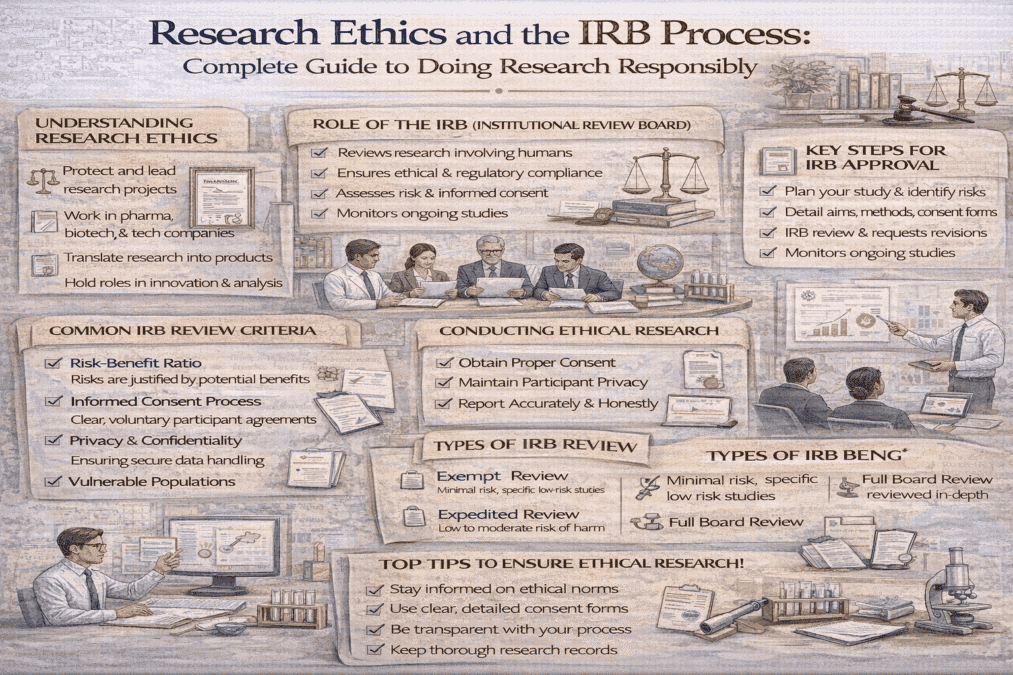
Most research involving humans requires approval from an Institutional Review Board (IRB) in the USA, or an Ethics Committee (EC) in most other countries including India. You cannot start research involving humans until you have this approval. Starting without it is serious misconduct.
The Indian Ethics Review System (2026)
🇮🇳 Key Regulatory Bodies:
| Body | Role and Authority |
| Institutional Ethics Committees (IECs) | Required at all universities and research institutions. Must follow ICMR guidelines. First line of review for all studies. |
| National Ethics Committee for Biomedical & Health Research (NEC-BHR) | Established under ICMR. Oversees national ethics review system. Implements Single Ethics Review for multi-site studies (2026). Maintains IEC registry. |
| Single Ethics Review (2026) | Major improvement: one approval now covers multiple research sites. Dramatically simplifies multi-institutional studies. |
| Digital Personal Data Protection Act (2023) | Indian researchers must comply with data protection law when handling personal information. Legal requirement, not just ethical guidance. |
- NEC-BHR Registration and Resources – All IECs must be registered here.
- ICMR National Ethical Guidelines (2023) – 3rd edition. Required reading for all Indian researchers.
Types of Ethics Review
| Review Type | When It Applies |
| Exempt | Minimal risk + specific categories (anonymous adult surveys on non-sensitive topics). Still requires committee confirmation—you can’t self-exempt. |
| Expedited | No more than minimal risk using established procedures (many interview studies, educational interventions, chart reviews). One or two reviewers, faster than full board. |
| Full Board Review | More than minimal risk OR involves vulnerable populations. Entire committee reviews and discusses. Slower but thorough and required. |
Your Ethics Committee determines review level. You cannot decide yourself what level applies to your research.
What Requires Ethics Review
- Interviews or surveys with identified individuals
- Research with children or vulnerable populations
- Medical interventions, drug trials, or biological specimens
- Research accessing medical records with identifiers
- Psychological experiments
- Research in schools requiring student data
When in doubt, ask your Ethics Committee. It’s always better to submit and have them confirm review isn’t needed than to skip review when it was required.
Preparing Your Ethics Application
Ethics applications seem daunting, but they follow a logical structure. Each section is asking a specific question about your research. Here’s how to answer each one well.
Key Application Sections and How to Nail Them
Project Description
Explain your research purpose, questions, and significance in plain language. Ethics committee members aren’t all experts in your field. Write clearly—avoid jargon, define technical terms.
Risk Assessment: Be Honest, Not Alarmist
Many researchers downplay risks. Don’t. Be honest—this builds trust and helps you plan proper safeguards.
| Risk Type | Examples and Mitigation |
| Psychological/Emotional | Discussing trauma or discrimination may cause distress. Mitigation: inform participants in advance, allow question-skipping, provide referrals to support services. |
| Social | Confidentiality breach could cause embarrassment or damaged relationships. Mitigation: strict data security, pseudonyms, limited access. |
| Economic | Time cost, or employment effects if confidentiality fails. Mitigation: fair compensation, robust data protection. |
| Legal | Disclosure of illegal activity could have consequences. Mitigation: explain mandatory reporting limits upfront in consent. |
Example of honest risk description:
“Participants will discuss their experiences with workplace discrimination. This may cause moderate emotional discomfort—many people find discussing negative experiences somewhat distressing, though some also find it validating. To minimize this risk: (1) participants are informed in advance that topics may be difficult; (2) they control interview pace and can skip questions; (3) referrals to support services are provided; (4) we check in with participants at the interview’s end.”
Describing Procedures
(Incorrect) Weak: “I will interview participants about their experiences.”
(Correct) Strong: “I will conduct one-on-one, semi-structured interviews with 30 teachers at their schools. Interviews last ~60 minutes, are audio-recorded with permission, and cover 10 main questions (interview guide attached). Participants can skip any question. Recordings are transcribed by a confidential professional service, then deleted after verification. Transcripts are stored in password-protected files accessible only to the research team.”
Informed Consent: More Than a Signature
Informed consent is an ongoing process of communication, not a document-signing exercise. The signature is just evidence that the process happened.
What Makes Consent Truly ‘Informed’
| Component | What It Requires |
| Information | Participants understand: what the research is, what they’ll do, how long it takes, what risks and benefits exist, that participation is voluntary, that they can withdraw anytime, how privacy will be protected. |
| Comprehension | Information presented in language participants can understand—appropriate reading level, translated if needed, explained verbally if literacy is an issue. |
| Voluntariness | Participation must be genuinely voluntary—no coercion, no undue influence, no penalties for declining or withdrawing. |
Elements of a Strong Consent Form
| Consent Form Checklist |
| Title: ‘Consent to Participate in Research’ |
| Introduction: Who you are, your institution, why you’re inviting them |
| Purpose: What the research is about in plain language |
| Procedures: What they’ll do, how long, how many times, specific activities |
| Risks: Honest list, likelihood, and how you’ll minimize them |
| Benefits: Direct (often ‘none for individual participants’) + possible societal benefits |
| Confidentiality: How you’ll protect identity, who has data access, storage and retention |
| Limits to confidentiality: Mandatory reporting requirements (child abuse, danger to self or others) |
| Voluntary participation and withdrawal: Can withdraw anytime, no penalty, what happens to their data |
| Contact information: Yours, your advisor’s (if student), Ethics Committee for rights questions |
| Signature lines: Participant name, signature, date + researcher signature and date |
Writing Readable Consent Forms
| Instead of This | Write This |
| “This investigation seeks to elucidate the phenomenological experiences of…” | “This study explores teachers’ experiences with…” |
| “Remuneration will be provided upon completion of all study procedures.” | “You will be paid ₹500 when you finish the survey.” |
| “You will be interviewed by the researcher regarding the aforementioned topics.” | “I will ask you questions about your teaching experiences.” |
| Long sentences with multiple clauses and embedded qualifications throughout | Short sentences. One idea per sentence. Active voice throughout. |
Always: provide a copy for participants to keep. Never: give them the form and immediately ask for a signature—give them time to read it and ask questions.
Special Consent Situations
Children
- Parental/guardian consent is required
- Child assent is also required (child must agree, even though they can’t legally consent)
- Use age-appropriate language for the assent process
- Make it clear: children can say no even if parents said yes
Online Research
- Electronic consent is acceptable—same content as written forms
- Ensure participants can save or print a copy
- Harder to verify comprehension—build in check questions if possible
People Who Can’t Read
- Read consent form aloud
- Check comprehension—ask them to explain back what they understood
- Have a witness present; witness signs confirming the process
Protecting Participant Privacy and Data Security
Confidentiality breaches can seriously harm the people who trusted you with their information. Take this seriously from day one of your research.
Anonymity vs. Confidentiality: Know the Difference
Anonymity: You don’t know who participants are. (Example: anonymous online survey with no name collection.) True anonymity is hard to achieve.
Confidentiality: You know who participants are, but you protect that information. (Example: interviews where you know names but don’t reveal them.) This is what most research achieves.
De-Identifying Your Data
- Assign participant ID codes (P001, P002…) and keep the name-code link in a separate, locked file
- Remove all identifiers from data: names, addresses, phone numbers, specific dates, exact locations
- In publications: use pseudonyms, generalize locations (‘a school in northern India’ vs. school name)
- Ask before using quotes that might identify participants—even with pseudonyms, context can reveal identity
Data Security Requirements
| Physical Data | Digital Data |
| Lock paper materials in cabinets | Password-protect all files containing participant data |
| Store in a secure locked location | Encrypt sensitive data—especially on laptops |
| Never leave materials unattended | Store on secure servers, not personal devices if possible |
| Limit who has access | Don’t email unencrypted participant data |
- Audio/video recordings: Especially sensitive (voices and faces identify people). Delete after transcription if possible. If keeping, encrypt. Never store on personal phones.
Limits to Confidentiality: What Participants Must Know
Some information you cannot keep confidential. Make this explicit in your consent form upfront—never as a surprise.
| Mandatory Reporting Requirements (Include in Consent Form) |
| Child abuse or neglect — you must report this if disclosed or observed |
| Elder abuse — mandatory reporting in many jurisdictions |
| Credible danger to self (suicide risk) — varies by jurisdiction |
| Credible danger to others — varies by jurisdiction |
| Court orders to release data / subpoenas — legal requirement |
| NOTE: Inform participants of these limits BEFORE they share anything, not after. |
Data Sharing and Retention
- How long to keep data: Check your institution’s policy (often 3–7 years after publication). Some funders require longer.
- Open data sharing: Encouraged in open science but only de-identified data. Get participant consent to share if there’s any chance of sharing.
- India data law: Digital Personal Data Protection Act (2023) creates legal obligations around personal data handling.
Vulnerable Populations: Extra Protections Required
Some groups are especially vulnerable in research contexts and need additional safeguards. These aren’t suggestions—they’re requirements.
| Population | Why Vulnerable + Extra Protections |
| Children | Can’t give legal consent, may not understand, may feel pressured. REQUIRES: parental consent + child assent, age-appropriate communication, minimal risk standard applies. |
| Prisoners | Loss of freedom, institutional coercion, unequal power. REQUIRES: special IRB review with prisoner representative, participation must not influence parole, benefits must not be coercive. |
| Pregnant women | Risk extends to fetus. REQUIRES: minimal risk to fetus, research must relate to pregnancy or woman’s health. |
| People with cognitive impairments | May have limited decision-making capacity. REQUIRES: capacity assessment, guardian consent + participant assent, ongoing monitoring of voluntariness. |
| Students and employees | Power differential with professor/supervisor creates coercive pressure. REQUIRES: true voluntary participation, do not penalize non-participation, ideally don’t recruit your own students/employees. |
Research Integrity: Honesty in Data, Attribution, and Authorship
Research ethics isn’t only about protecting participants. It’s also about honesty in how you conduct and report your research.
Data Fabrication and Falsification
These are the most serious forms of research misconduct:
| What It Is | Why It Matters |
| Fabrication: Making up data that doesn’t exist | Others build on your false findings, wasting their time and resources |
| Falsification: Manipulating data dishonestly (changing values, deleting inconvenient points) | Undermines public trust in science as a whole |
| p-hacking: Running analyses repeatedly until p<.05, then reporting only those | Can cause real-world harm when false findings influence policy or practice |
| Selective reporting: Only publishing findings that support your hypothesis | Career-ending if discovered, even years later |
| Data Integrity: What to Do Instead |
| Preregister studies when possible: State hypotheses and analysis plan in advance at OSF or similar |
| Report all findings, including unexpected or null results |
| Document all analytic decisions and changes to analysis plans |
| Keep raw data throughout the project and beyond publication |
| Be transparent about limitations honestly, not defensively |
Plagiarism and Proper Attribution
| What Counts as Plagiarism | What Proper Attribution Looks Like |
| Using others’ words without quotation marks and citation | Cite all sources, even when paraphrasing |
| Using others’ ideas without attribution | Put direct quotes in quotation marks with page numbers |
| Self-plagiarism: reusing your own published work without acknowledgment | Cite your own previous work when building on it |
| Presenting others’ data as your own | Acknowledge all data sources and collaborators |
Authorship Ethics
Who deserves to be an author? The three requirements for authorship are: substantial intellectual contribution to conception/design OR data collection/analysis OR writing AND involvement in drafting or critical revision AND approval of the final version.
NOT sufficient for authorship (acknowledge instead
Incorrect – Providing funding
Incorrect – General supervision of the research group
Incorrect – Providing materials, equipment, or lab space
Incorrect – Data collection without intellectual contribution
Critical rule: Discuss authorship at the beginning of collaborative projects, not at the end. Agree on order, roles, and decision-making in writing (email is fine). Update as contributions evolve.
Handling Ethical Dilemmas During Your Research
Even with perfect planning, ethical challenges arise in the field. Knowing what to do before they happen is essential.
| Dilemma | What to Do |
| Participant discloses something requiring mandatory reporting | Follow the law. You must report. Explain to participant why, support them through the process. This is why you disclosed limits upfront in your consent form. |
| You observe something unethical or illegal during research | Depends on severity. Consult your Ethics Committee immediately for guidance. Balance participant protection with public safety. |
| Participants are harmed unexpectedly | Stop the research immediately. Report to Ethics Committee. Provide appropriate care and referrals. Revise procedures before continuing. |
| You discover your research design is flawed mid-study | Be honest. Report to Ethics Committee if the flaw affects risk/benefit analysis. Consider whether to continue. Acknowledge limitations when publishing. |
Rule for all dilemmas: Don’t handle them alone. Consult your Ethics Committee, your advisor, or your institution’s ethics consultants. It’s better to ask before acting than to apologize after.
Writing About Ethics in Your Thesis and Papers
Your thesis and published papers must document your ethical practices. Incomplete documentation can lead to rejection.
What to Include in Your Methods Section
“This study was approved by the University of Delhi Ethics Committee (EC/2023/45, approved March 15, 2023). All participants provided written informed consent after receiving detailed information about the study. Participants were informed they could withdraw at any time without penalty. To protect confidentiality, all participants were assigned pseudonyms, and identifying information was removed from all transcripts and materials. Data is stored in password-protected files accessible only to the research team. Participants received ₹500 compensation for their time.”
This covers: the approval, the consent process, the right to withdraw, the confidentiality protections, data security, and compensation. All elements reviewers and journal editors look for.
When Ethics Deserve Their Own Discussion
If your research involves complex ethical issues—highly vulnerable populations, sensitive topics, innovative methods—dedicate space to discussing:
- Challenges you faced and how you addressed them
- Trade-offs you made and why
- Lessons learned that future researchers in this area should know
- Implications for how this type of research should be conducted going forward
Law student or legal researcher? → Legal Research and Writing: Complete Guide FOR LAW STUDENTS: Research Ethics in Legal Research
Key Takeaways from Module 10
Research ethics isn’t about checking boxes or satisfying committees. It’s about respecting the people who make your research possible and honoring truth in how you conduct and report your work.
| What to Remember |
| Core principles: Respect for persons (autonomy), Beneficence (do good, minimize harm), Justice (fairness in who bears burdens and benefits) guide everything. |
| Ethics approval is mandatory: Never start human subjects research without approval from your IEC/IRB. Starting without approval is serious misconduct. |
| Informed consent is a process: More than a signature—an ongoing communication. Participants must understand, comprehend, and choose freely. |
| Confidentiality requires active protection: Anonymize data, secure files, limit access, and know the limits of confidentiality upfront. |
| Vulnerable populations need more protection: Children, prisoners, students, people with cognitive impairments—each group has specific requirements. |
| Data integrity matters: Never fabricate, falsify, or selectively report. Preregister when possible. Report all findings including null results. |
| Document ethics in your writing: Include approval number, consent process, confidentiality protections in every methods section. |
| Dilemmas will arise: Don’t handle them alone. Consult your Ethics Committee, advisor, or ethics consultants. |
Research ethics is not what stops you from doing research—it’s what makes your research worth doing.
FAQs
Q: What is research ethics and why does it matter?
Research ethics is the set of principles and practices that ensure research is conducted with integrity, respect for participants, and responsibility to society. It matters because research involves people who trust researchers with their time, data, and sometimes their wellbeing. Unethical research causes direct harm to participants, damages public trust in science, and produces findings that cannot be used. In India, the ICMR National Ethical Guidelines and ICSSR Ethical Guidelines for Social Science Research provide the regulatory framework. Ethics is not a bureaucratic obstacle — it is the foundation that makes research trustworthy.
Q: What is an IRB and do Indian researchers need one?
IRB stands for Institutional Review Board — the US term for an ethics committee. In India, the equivalent is the Institutional Ethics Committee (IEC) for health and biomedical research (governed by ICMR) and the institutional research ethics committee for social science research (governed by ICSSR guidelines). Most NLUs and Indian universities have ethics committees or are developing them. Any research involving human participants, personal data, or sensitive topics requires ethics committee approval before data collection begins. ‘IRB’ and ‘ethics committee’ are used interchangeably in international research contexts.
Q: What research requires ethics approval in India?
Research requiring ethics approval in India includes: any study involving human participants (interviews, surveys, observation, experiments); research collecting personal data about identifiable individuals; research with vulnerable populations (children, prisoners, patients, marginalised communities); research involving sensitive topics (health, trauma, crime, sexuality, religion); and clinical trials and biomedical research (mandatory ICMR ethics review). Doctrinal legal research and secondary analysis of fully anonymised public datasets generally do not require ethics approval. When in doubt, consult your institutional ethics committee — proceeding without required approval can make research unpublishable.
Q: How long does ethics approval take in India?
Ethics committee review timelines in India vary significantly: NLU and university social science committees: 4–8 weeks for straightforward proposals; longer for complex or sensitive designs. ICMR-registered IECs for health research: 4–12 weeks depending on committee meeting schedule. DCGI (Drug Controller General of India) for clinical trials: longer review timelines. Build ethics approval time into your research plan — start the ethics application at least 3 months before you intend to begin data collection. Ethics committees typically meet monthly; missing a meeting deadline adds a full month to your timeline.
Q: What is the DPDPA 2023 and how does it affect researchers in India?
The Digital Personal Data Protection Act, 2023 (DPDPA) is India’s primary data protection legislation. It creates obligations for any researcher who collects, stores, or processes personal data — defined as any data about an identifiable individual. Key research implications: collecting interview data, survey responses, or court records containing personal information requires a lawful basis (consent is the clearest option); data must be stored securely; only necessary data should be collected (data minimisation); and data should be deleted when no longer needed. Ethics applications for research involving personal data should explicitly address DPDPA compliance.
Selected References for Further Reading
Research Ethics Foundations
- National Commission for the Protection of Human Subjects (1979). The Belmont Report. HHS.
- Beauchamp & Childress (2019). Principles of Biomedical Ethics (8th ed.). Oxford UP.
Indian Ethics Framework
- ICMR National Ethical Guidelines for Biomedical and Health Research (3rd ed., 2023)
- NEC-BHR Single Ethics Review System for Multi-Site Studies (2026)
- Ministry of Electronics and IT – Digital Personal Data Protection Act (2023)
Informed Consent
- Grady, C. (2015). Enduring and Emerging Challenges of Informed Consent. NEJM, 372(9), 855–862.
- Faden & Beauchamp (1986). A History and Theory of Informed Consent. Oxford UP.
Data Security and Privacy
- UK Data Service – Research Data Management (2023)
- European Commission – General Data Protection Regulation (GDPR, 2018)
Research Integrity
- National Academies of Sciences (2017). Fostering Integrity in Research. National Academies Press.
- Office of Research Integrity – Introduction to the Responsible Conduct of Research (2024)
Online and International Research Ethics
- British Psychological Society – Ethics Guidelines for Internet-Mediated Research (2021)
- Association of Internet Researchers – Internet Research: Ethical Guidelines 3.0 (2019)
- CIOMS – International Ethical Guidelines for Health-Related Research Involving Humans (2016)
Author
Dr. Rekha Khandelwal, a legal scholar and academic writing expert, is the founder of AspirixWriters. She has extensive experience in guiding students and researchers in writing research papers, theses, and dissertations with clarity and originality. Her work focuses on ethical AI-assisted writing, structured research, and making academic writing simple and effective for learners worldwide.
Author Profile Dr. Rekha Khandelwal | Academic Writer, Legal Technical Writer, AI Expert & Author | AspirixWriters
- The Ethics Committee Application: Writing a Submission That Gets Approved
- Informed Consent in Practice: Designing Forms and Processes That Actually Protect Participants
- Privacy Data Security and Confidentiality: What Researchers Get Wrong
- Ethical Research with Vulnerable Populations: Power, Protection, and Genuine Respect
- Research Integrity: Data Handling Authorship Ethics and the Indian Regulatory Framework
- Module 1 The Complete Guide to Research Paper and Thesis Structure
- Module 2 The Academic Writing Process: Complete Guide from First Draft to Submission (2026)
- Module 3 Research Methodologies: Complete Guide to Quantitative, Qualitative, Mixed Methods & Legal Research (2026)
- Module 4 Data Analysis and Results Presentation: Complete Guide for Quantitative, Qualitative & Legal Research (2026)
- Module 5 Organization and Academic Tone: Complete Guide to Professional Scholarly Writing (2026)
- Module 6 Peer Review and Publication: Complete Guide from Submission to Acceptance (2026)
- Module 7 AI Tools in Academic Research: Opportunities, Ethics, and Best Practices (2026)
- Module 8 Grant Writing and Research Funding: Complete Guide to Finding Money for Your Research (2026)
- Module 9Academic Career Development: Complete Guide to Building Your Professional Life in Research (2026)
- Module 10 Research Ethics and the IRB Process: Complete Guide to Doing Research Responsibly (2026)
No post found!