Last Updated: March 21, 2026
Cluster Post 2 | Module 10: Research Ethics and the IRB Process
From Concept to Submission Series | 2026
Academic Writing Mastery: The Complete 2026 Guide To Research Papers, Thesis & Dissertation Writing
Informed Consent in Practice
The module overview describes consent form elements and process. This post goes deeper: the difference between consent that protects researchers and consent that protects participants, the specific language failures that make forms unreadable, how to handle consent in difficult contexts (low literacy, sensitive topics, online research, community settings), and the consent process as an ongoing relationship rather than a one-time signature.
Researcher Protection vs. Participant Protection
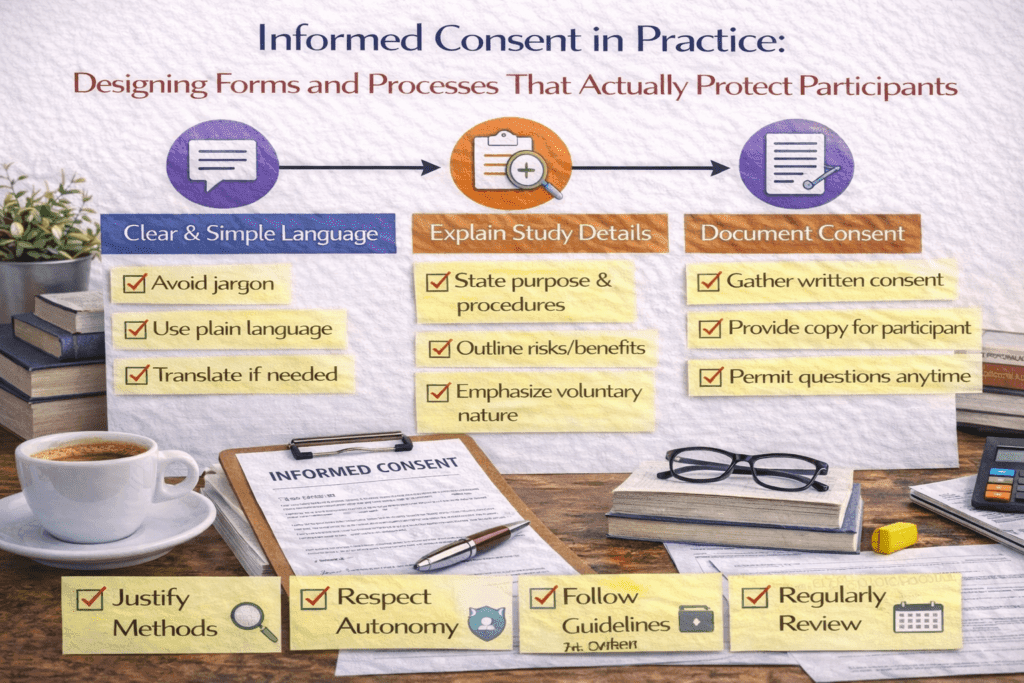
Most consent forms are designed primarily to protect the researcher and institution from liability — not to actually ensure participants understand what they are agreeing to. This is why most consent forms are written in dense legal language that many participants cannot read or understand. A form that participants sign without understanding does not constitute informed consent — it constitutes a signature.
The test for genuine informed consent: if a participant were asked three days after signing your consent form to explain what the research is about, what will happen to them, and what they can do if they want to stop, could they answer these questions accurately? If the answer is no, your consent process has not succeeded — regardless of whether they signed the form.
Designing consent for participant protection means writing the form in the participant’s actual language register (not academic register), confirming comprehension verbally before obtaining the signature, and treating the form as a communication tool rather than a legal document.
The Language Failures That Make Forms Unreadable
The module gives good before/after examples. This section goes deeper on the specific failure modes:
Passive constructions that obscure who does what
Opaque: ‘Data will be collected, processed, and analysed by the research team.’ Clear: ‘I will record our conversation, type up the recording, and analyse what you said as part of my research.’
Institutional language that sounds threatening
Intimidating: ‘By signing below, you acknowledge that you have read, understood, and voluntarily agree to the terms set forth in this consent document and that you waive any rights to legal recourse…’ Human: ‘Please read this and sign at the bottom to show that you agree to take part. Signing does not affect any of your legal rights.’
Abstract risk descriptions that mean nothing
Abstract: ‘Participation in this study may carry psychological risks.’ Concrete: ‘Some questions ask about difficult experiences at work. You might feel uncomfortable answering some of them. You can skip any question or stop the interview at any time.’
Jargon that excludes
Jargon: ‘This study uses a phenomenological approach to explore lived experiences of…’ Plain: ‘This study explores how [teachers / students / workers] describe their experiences of [topic] in their own words.’
The reading level target for consent forms is approximately Grade 8 (roughly equivalent to a 14-year-old’s reading level in most contexts). Most software can calculate reading level — the Flesch-Kincaid grade level tool in Microsoft Word is adequate. If your form scores above Grade 10, revise it.
The Consent Process: Before, During, After
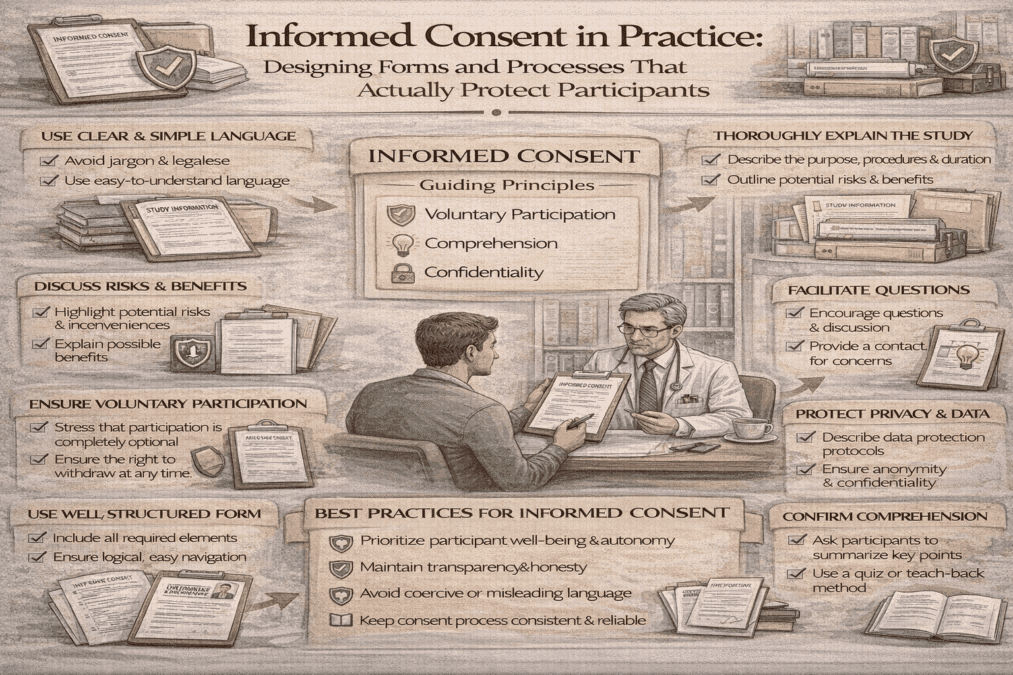
A consent form is not the consent process — it is a document that records the outcome of a process. The process has three stages, each with specific responsibilities.
Before: preparation and anticipation
Participants should receive the consent form (or a plain-language participant information sheet) before the research interaction — not at the moment you are sitting across from them about to start. Handing someone a five-page form and asking them to sign immediately creates social pressure that compromises voluntariness. For interview research, send the form by email at least three days before the interview. For in-person group recruitment, provide a take-home information sheet and follow up the next session.
During: the consent conversation
The moment of signing is a conversation, not a transaction. The researcher should:
- Ask the participant if they read the form and whether they have questions.
- Verbally summarise the three most important things to understand: what the research involves, that participation is voluntary, and how their privacy will be protected.
- Explicitly say ‘you can stop at any point during our conversation — just let me know’ — not just write it in the form.
- Check for comprehension: ‘Can I just confirm what you understand about how I will keep your information private?’ A participant who cannot summarise the confidentiality arrangement has not understood it, regardless of their signature.
After: ongoing consent
Consent is not once-only. For longitudinal research, consent should be re-confirmed at each data collection point — not because the original form is invalid, but because participants’ situations change and their willingness to continue should be affirmed. For research that extends over months or years, an annual re-confirmation that the participant is still comfortable with their data being used is good practice.
If a participant withdraws consent after data has been collected, the default is to exclude their data from analysis unless your consent form explicitly described a point-of-no-return for data already incorporated into aggregate analysis. Be precise in the consent form about what ‘withdrawal’ means for data already collected: ‘If you withdraw before [date], all your data will be deleted. After this date, your de-identified responses may already be incorporated into the analysis and cannot be individually removed, but no further data will be collected from you.’
Consent in Difficult Contexts
Low literacy contexts
When participants may not be able to read the consent form, the process must be adapted — not abandoned. ICMR guidelines permit oral consent procedures with a witness present. The researcher reads the form aloud, confirms comprehension (ask the participant to summarise key points in their own words), and a literate witness who is not connected to the research signs to confirm the process was followed. The researcher also documents the oral consent process in their research notes.
Do not use a written consent form with a participant who cannot read it and expect that their signature constitutes informed consent. If the participant does not understand what they are signing, the form provides no genuine protection to them and does not actually constitute consent.
Sensitive topic research
Research on trauma, mental health, stigmatised identities, illegal activity, or significant personal hardship requires additional consent considerations. The consent form should: name the sensitive topics explicitly so participants know what they are agreeing to discuss; explain that they can skip any question without explanation; and provide concrete support resources (not just ‘help is available if needed’ — list specific organisations, phone numbers, or websites relevant to the population and topic).
The support resource provision is genuinely important, not just formal compliance. A researcher who interviews domestic violence survivors and provides no support information has failed their participants ethically — regardless of whether the ethics committee required this.
Online research
For online surveys and studies, electronic consent is standard. The consent form should appear before any research questions, and participants should not be able to proceed without clicking an explicit ‘I consent to participate’ button (not just beginning the survey). The consent page should allow participants to save or print a copy. For research collecting sensitive data online, the consent form should describe data security measures relevant to the digital context — including what happens to data if the platform is compromised.
Community and village settings in India
Research in rural Indian communities, particularly with marginalised communities, raises specific consent challenges. Community leaders or village heads (sarpanch, ward leaders) may expect to be consulted about or grant permission for research in their community — but community-level permission does not substitute for individual consent. Explain this distinction clearly to community leaders when seeking access: you are asking for access to approach community members, not permission on their behalf. Individual consent must still be obtained from each participant.
The dual consent requirement: community-level access + individual participant consent. Neither substitutes for the other.
Legal Research and Writing: Complete Guide for Law Students and Legal Researchers
FAQs
Q: What is informed consent in research?
Informed consent is the process by which a participant voluntarily agrees to take part in research after receiving and understanding complete information about what participation involves. It requires: disclosure (full information about purpose, procedures, risks, benefits, and rights); comprehension (information in a language and format the participant understands); voluntariness (no coercion or undue inducement); and capacity (the participant has the ability to make the decision). Consent is an ongoing process, not a form — participants can withdraw at any time without consequences. The consent form documents the process but does not replace the verbal explanation.
Q: What must a research consent form include?
A research consent form must include: the study title and researcher contact details; the purpose of the research in plain language; what participation involves (what will be asked, how long it takes); any risks or discomforts; any direct or indirect benefits; how confidentiality will be maintained; a statement that participation is voluntary and can be stopped at any time without penalty; how data will be stored and used; whether findings will be shared and in what form; contact details for the ethics committee; and a signature or verbal confirmation space. Keep the language at approximately Class 8 reading level — do not use academic or technical terminology.
Q: When is written consent not required in research?
Written consent may not be required when: the research involves anonymous surveys where signing a form would be the only identifying information collected; participants are in sensitive situations where a paper trail creates risk (undocumented migrants, people with stigmatised conditions); the research is observational in a public setting with no individual identification; or the ethics committee has waived written consent and approved oral consent with documentation. Waiver of written consent does not mean consent itself is waived — the process of informing and obtaining voluntary agreement must still occur and must be documented.
Q: How do you obtain consent from vulnerable research participants?
Obtaining consent from vulnerable participants requires additional care: for children under 18, obtain written consent from a parent or guardian plus the child’s own assent (verbal agreement appropriate to their age); for people with cognitive impairments, assess capacity individually and involve a legally authorised representative; for prisoners, ensure the consent environment minimises coercion — explain clearly that participation has no effect on their legal situation; for participants in dependent relationships (students, employees, patients), take specific steps to ensure voluntariness is genuine and non-participation has no consequences. Ethics committees review consent procedures for vulnerable populations with particular care.
Q: What is the difference between anonymity and confidentiality in research?
Anonymity means the researcher does not know who the participants are — names and identifiers are never collected. It is achievable in anonymous surveys but not in interview-based research where the researcher knows participants personally. Confidentiality means the researcher knows who participants are but commits to not disclosing their identity in publications or to others. Most qualitative research offers confidentiality, not anonymity. Be precise in your consent form — promising anonymity when you offer confidentiality is misleading. Explain specifically how confidentiality will be maintained: pseudonyms, removal of identifying details, secure data storage.
References
- ICMR National Ethical Guidelines (3rd ed., 2023). icmr.gov.in
- Grady, C. (2015). Enduring and Emerging Challenges of Informed Consent. NEJM, 372(9).
- Faden, R. R., & Beauchamp, T. L. (1986). A History and Theory of Informed Consent. Oxford UP.
Next: Cluster Post 3 — Privacy Data Security and Confidentiality: What Researchers Get Wrong
- Module 1 The Complete Guide to Research Paper and Thesis Structure
- Module 2 The Academic Writing Process: Complete Guide from First Draft to Submission (2026)
- Module 3 Research Methodologies: Complete Guide to Quantitative, Qualitative, Mixed Methods & Legal Research (2026)
- Module 4 Data Analysis and Results Presentation: Complete Guide for Quantitative, Qualitative & Legal Research (2026)
- Module 5 Organization and Academic Tone: Complete Guide to Professional Scholarly Writing (2026)
- Module 6 Peer Review and Publication: Complete Guide from Submission to Acceptance (2026)
- Module 7 AI Tools in Academic Research: Opportunities, Ethics, and Best Practices (2026)
- Module 8 Grant Writing and Research Funding: Complete Guide to Finding Money for Your Research (2026)
- Module 9Academic Career Development: Complete Guide to Building Your Professional Life in Research (2026)
- Module 10 Research Ethics and the IRB Process: Complete Guide to Doing Research Responsibly (2026)
No post found!