Last Updated: March 21, 2026
Cluster Post 5 | Module 10: Research Ethics and the IRB Process
From Concept to Submission Series | 2026
Academic Writing Mastery: The Complete 2026 Guide To Research Papers, Thesis & Dissertation Writing
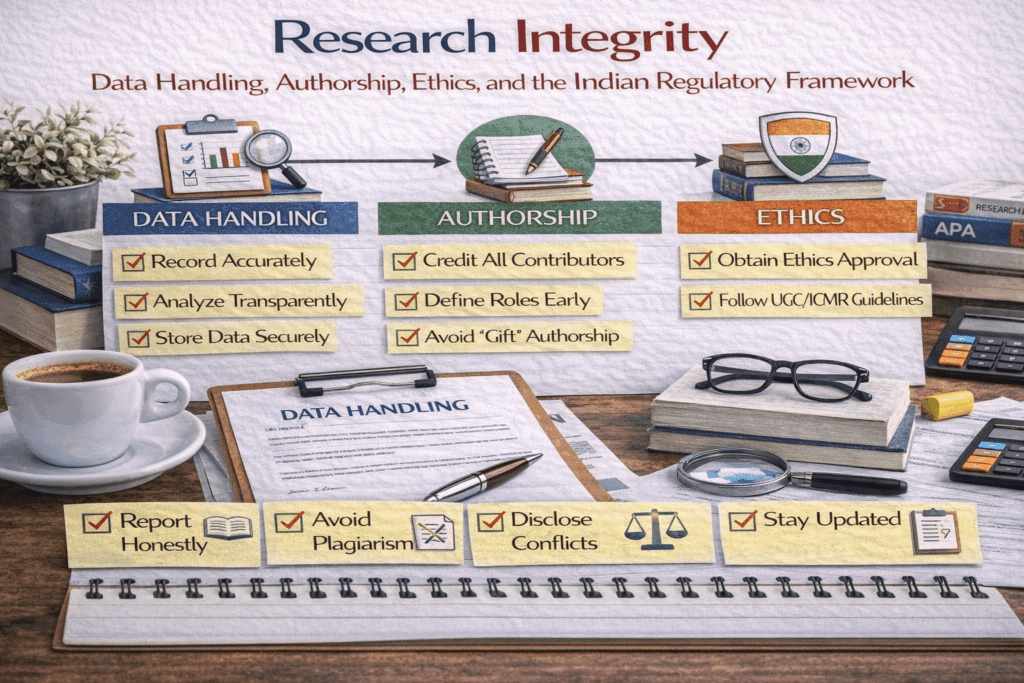
Research Integrity: Data Handling, Authorship Ethics, and the Indian Regulatory Framework
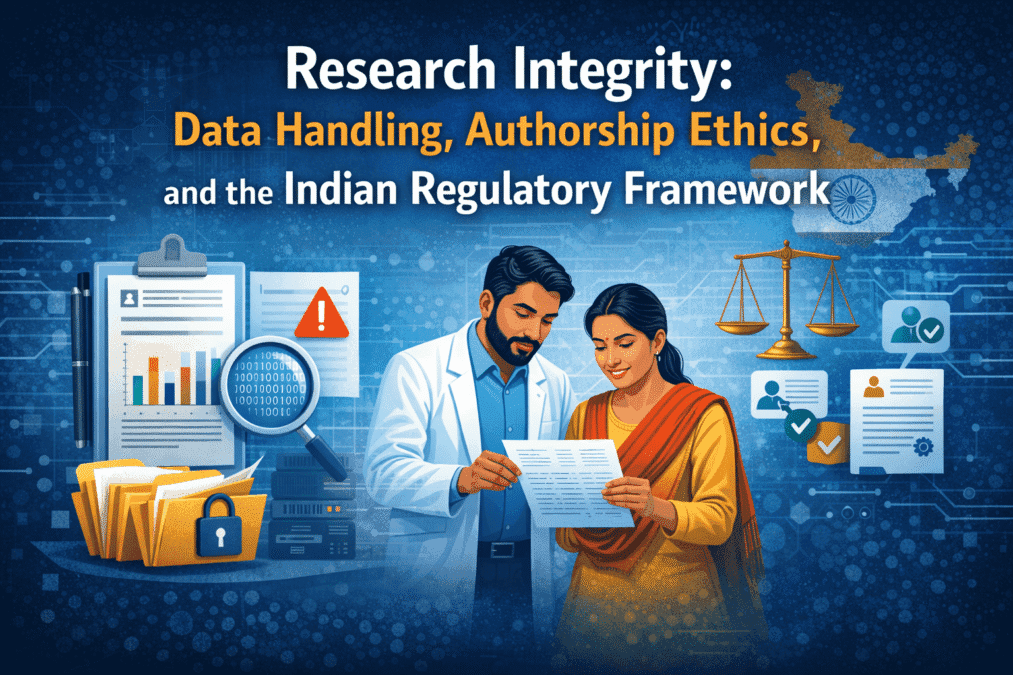
The module overview covers research integrity principles. This post goes deeper: the specific misconduct patterns that most commonly derail research careers, the practical systems for maintaining data integrity, authorship disputes and how to prevent them, and India’s research misconduct regulatory landscape including UGC regulations and institutional procedures.
Research Misconduct: What It Is and What It Is Not
Research misconduct has a formal definition in most national research regulatory frameworks. In India, the UGC (Promotion of Academic Integrity and Prevention of Plagiarism in Higher Educational Institutions) Regulations 2018, and ICMR guidelines for research involving human participants, provide the governing framework.
The three categories of formal research misconduct are fabrication, falsification, and plagiarism (FFP). These are distinct from poor research practice — using inadequate methodology, reaching wrong conclusions, making honest errors in analysis — which are scientific problems but not misconduct. The distinction matters because misconduct carries formal regulatory and career consequences, while poor practice calls for correction.
| Category | What it is and what it is not |
| Fabrication | Making up data, results, or findings that were not actually collected or produced. Not the same as: estimating missing data with disclosed methods, reporting model predictions as distinct from empirical findings, or noting expected results pending data collection. |
| Falsification | Manipulating data, images, or findings dishonestly — changing values, selectively deleting data points without justification, removing outliers without disclosed criteria, or altering images to misrepresent findings. Not the same as: pre-specified outlier exclusion criteria, disclosed data transformations, or legitimate image processing. |
| Plagiarism | Using others’ work, ideas, or words without attribution. Includes self-plagiarism (reusing substantial portions of previously published own work without disclosure). Not the same as: properly cited use of others’ work, building on prior literature, or using standard disciplinary language. |
Questionable research practices (QRPs) — such as running multiple analyses and reporting only the significant ones (p-hacking), collecting data until you get significant results, or changing hypotheses after seeing the data — are not formal misconduct but are scientifically problematic. They inflate the false positive rate in published research and undermine reproducibility. These practices are increasingly recognised as integrity problems even when they do not meet the threshold of formal misconduct.
Data Management Systems That Protect Integrity
The most effective protection against integrity questions is a rigorous, documented data management system. If you are ever asked to demonstrate that your data is genuine and that your analysis was conducted as described, the ability to produce a documented data trail is your evidence.
The research data folder structure
Organise all research data with a version-controlled folder structure from the beginning of the project:
Project folder structure: /Raw_Data — original, unmodified data files (interview recordings, survey exports, original documents). Never edit these files directly. /Processed_Data — cleaned and transformed data files, with a dated cleaning log describing every change made and why. /Analysis — analysis code or protocols, with output files dated. /Documentation — ethics approval, consent forms, participant log (de-identified), field notes. /Outputs — draft and final manuscripts, presentations, figures. Keep raw data files read-only. Every modification is made to a copy in Processed_Data with documentation of what changed. If your analysis is ever questioned, you can trace every step from raw data to reported findings.
Pre-registration
Pre-registration is the practice of documenting your hypotheses, research design, and analysis plan in a public registry before data collection begins. Pre-registration does not prevent exploratory analysis — it distinguishes confirmatory from exploratory analysis in your reporting. A pre-registered study reports its pre-specified analysis with full integrity; it can also report exploratory findings clearly labelled as exploratory.
The Open Science Framework (OSF) provides free pre-registration for any research design, including qualitative research. ICMR-registered clinical trials must register with the Clinical Trials Registry of India (CTRI). For empirical social science and education research, OSF pre-registration is increasingly recognised by journals as a mark of methodological rigour.
Authorship: Prevention Is Better Than Resolution
Authorship disputes are one of the most damaging and most preventable problems in academic research. The module correctly describes who deserves authorship and who should be acknowledged instead. This section focuses on prevention — the specific conversations to have, and when, to prevent disputes from arising.
The authorship conversation: when and what
Have the authorship conversation at the beginning of any collaborative project, not at the end. When research relationships are new and everyone is enthusiastic, authorship discussions are easy. When a paper is nearly finished and contributions have turned out to be unequal, they are often contentious.
The beginning-of-project authorship conversation covers: Who will be authors? List tentative names based on expected contributions. In what order? For multi-author papers, agree on the ordering principle: is it contribution-based (most to least), alphabetical, or role-based (PI first or last)? Different disciplines use different conventions — know yours. What contribution does each author need to make to maintain authorship? Be specific: ‘drafting two chapters and contributing to analysis’ rather than ‘being involved in the project.’ What happens if contributions change? Agree that authorship can be revisited if the work turns out differently from expected, and that you will revisit it before submission. Document this conversation. An email summary sent to all collaborators is sufficient.
Honorary and ghost authorship
Honorary authorship — listing a senior researcher as an author because of their status, institutional affiliation, or funding contribution, when they have not made a substantive intellectual contribution — is widespread in Indian academic culture in some fields and is considered misconduct by international research integrity standards. It inflates the listed person’s publication record, dilutes the credit of those who did the work, and misrepresents the research to readers.
Ghost authorship — failing to list a person who made substantial intellectual contributions — is the opposite problem and equally problematic. If a research assistant, consultant, or junior colleague made substantial contributions to the intellectual content of a paper, they should be listed as an author, not just acknowledged.
If a senior colleague asks to be added as an author on work they did not contribute to, the response is: ‘I want to make sure our authorship is consistent with the journal’s author contribution statement requirements — could we discuss what specific contribution you would be listed for?’ Most reputable journals now require an explicit author contribution statement. This provides a legitimate basis for declining inappropriate authorship requests.
India’s Research Integrity Regulatory Landscape
UGC Regulations 2018 on academic integrity
The UGC (Promotion of Academic Integrity and Prevention of Plagiarism in Higher Educational Institutions) Regulations 2018 apply to all higher education institutions receiving UGC funding. They require institutions to use plagiarism detection software, establish institutional procedures for handling plagiarism complaints, and specify consequences at different levels of similarity.
The 40% similarity threshold in UGC Regulations is widely misunderstood. A 40% similarity score in Turnitin or iThenticate does not mean 40% of the work is plagiarised — similarity scores include all matched text including properly cited quotations. The threshold is a trigger for investigation, not a finding of misconduct. What matters is whether the similar text is properly attributed.
ICMR guidelines and research misconduct in health research
For biomedical and health research, the ICMR National Ethical Guidelines provide the primary misconduct framework. The ICMR requires: data retention for a minimum period (typically 5–10 years for clinical research), reporting of adverse events to the IEC, protocol adherence throughout the study, and accurate reporting of all findings including negative results.
Institutional procedures
Every UGC-recognised institution must have an institutional-level mechanism for receiving and investigating integrity complaints. In practice, these procedures vary enormously in quality and independence. If you face a misconduct allegation or need to report suspected misconduct, document everything: your data trail, communications, and contemporaneous records of your research process. The documentation system described above is your protection.
Legal Research and Writing: Complete Guide for Law Students and Legal Researchers
FAQs
Q: What is research integrity and what does it require?
Research integrity is the commitment to honesty and rigour in all aspects of research: the design must be sound; data must be collected and recorded accurately; analysis must be conducted and reported faithfully; findings must not be selectively reported; authorship must reflect genuine contribution; and any conflicts of interest must be disclosed. The UGC Regulations on Academic Integrity (2023) and the ICSSR/ICMR guidelines govern research integrity in India. Integrity is not just about avoiding fraud — it includes the less dramatic failures of inadequate data management, undisclosed conflicts, and honorary authorship.
Q: What is plagiarism in academic research and what are the consequences?
Plagiarism is presenting others’ words, ideas, or data as your own without appropriate attribution. Types include: verbatim copying without quotation marks and citation; paraphrasing without citation; presenting others’ ideas as original insights; self-plagiarism (reusing your own previously published text without disclosure); and data plagiarism (using others’ data without credit). Consequences in India: UGC regulations empower universities to revoke degrees for plagiarism in theses; journals retract papers and notify institutions; career consequences range from formal warnings to termination. Shodhgandhi anti-plagiarism screening applies to all Indian PhD theses.
Q: What are the authorship criteria for research papers?
Authorship requires: substantial contribution to conception, design, data collection, or analysis; drafting or critically revising the manuscript; final approval of the version for publication; and accountability for all aspects of the work. All four criteria must be met — meeting one or two does not qualify someone as an author. Those who contributed but do not meet all criteria should be acknowledged. Honorary authorship (listing someone who did not contribute), ghost authorship (not listing someone who did), and coercive authorship (pressure to list a supervisor who did not contribute) are all integrity violations. ICMR and ICSSR guidelines adopt the ICMJE authorship criteria.
Q: What is data fabrication and data falsification in research?
Data fabrication is inventing data that was never collected — recording measurements, survey responses, or interview content that does not exist. Data falsification is manipulating real data to change the result — selectively excluding inconvenient data points, altering images, or adjusting values. Both are the most serious research integrity violations and constitute research fraud. Consequences include: retraction of published papers; institutional investigation and termination; notification of funding bodies; and in some jurisdictions, legal consequences. The best protection is rigorous data management: pre-registered protocols, raw data preservation, and transparent reporting of all data collected.
Q: What is a conflict of interest in research and how do you disclose it?
A conflict of interest exists when a researcher has financial, personal, or professional interests that could influence their research decisions — funding from a company whose product is being studied; a personal relationship with a key participant; or professional rivalry with a researcher whose work you are evaluating. Conflicts of interest do not automatically invalidate research — they must be disclosed so readers can assess potential bias. Disclose in the journal submission cover letter, in the manuscript’s declaration section, and in any grant application. Most journals require a conflict of interest statement regardless of whether a conflict exists — ‘none declared’ is a valid statement.
References
- UGC (Promotion of Academic Integrity and Prevention of Plagiarism) Regulations 2018. ugc.gov.in
- National Academies of Sciences. (2017). Fostering Integrity in Research. NAP.
- Open Science Framework — pre-registration. osf.io
- ICMR National Ethical Guidelines (3rd ed., 2023). icmr.gov.in
End of Module 10 Cluster Posts — all 5 complete.
- Module 1 The Complete Guide to Research Paper and Thesis Structure
- Module 2 The Academic Writing Process: Complete Guide from First Draft to Submission (2026)
- Module 3 Research Methodologies: Complete Guide to Quantitative, Qualitative, Mixed Methods & Legal Research (2026)
- Module 4 Data Analysis and Results Presentation: Complete Guide for Quantitative, Qualitative & Legal Research (2026)
- Module 5 Organization and Academic Tone: Complete Guide to Professional Scholarly Writing (2026)
- Module 6 Peer Review and Publication: Complete Guide from Submission to Acceptance (2026)
- Module 7 AI Tools in Academic Research: Opportunities, Ethics, and Best Practices (2026)
- Module 8 Grant Writing and Research Funding: Complete Guide to Finding Money for Your Research (2026)
- Module 9Academic Career Development: Complete Guide to Building Your Professional Life in Research (2026)
- Module 10 Research Ethics and the IRB Process: Complete Guide to Doing Research Responsibly (2026)
No post found!