
Subject: Constitutional Law | Module: Citizenship |
1. Introduction
Before anyone can claim a Fundamental Right reserved for “citizens,” or vote, or hold public office, one threshold question has to be answered: is this person a citizen of India? Part II of the Constitution — Articles 5 to 11 — answers this only for the specific moment the Constitution came into force (26 January 1950). Everything about acquiring or losing citizenship afterward is left to Parliament under Article 11, which Parliament has exercised through the Citizenship Act, 1955. This note covers both layers: the constitutional starting-point rules and the statutory framework built on top of them.
2. Legal Framework
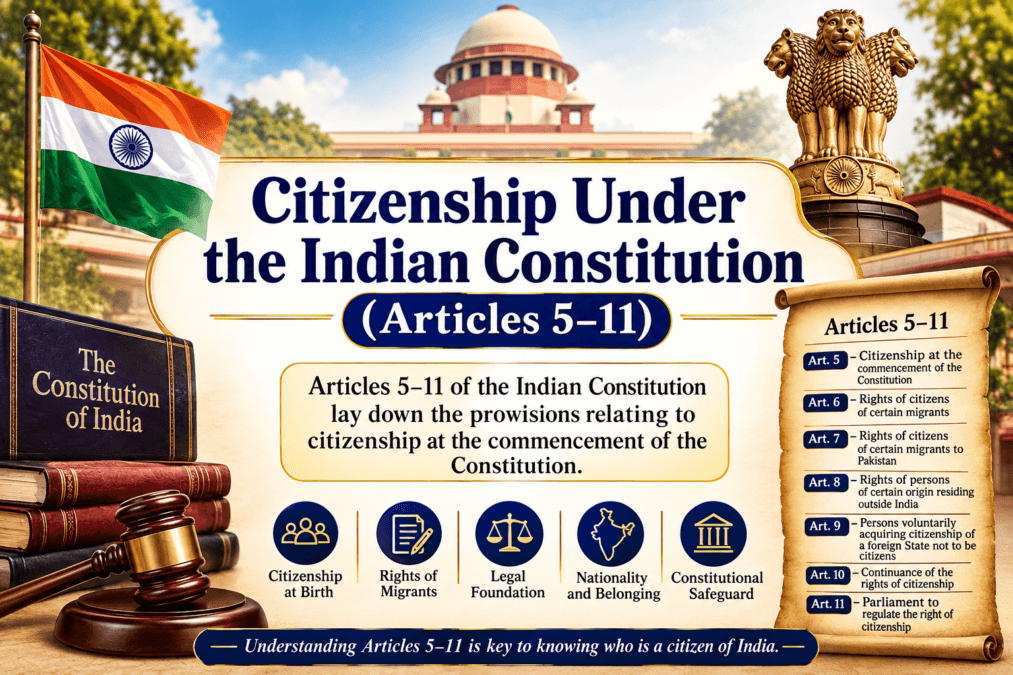
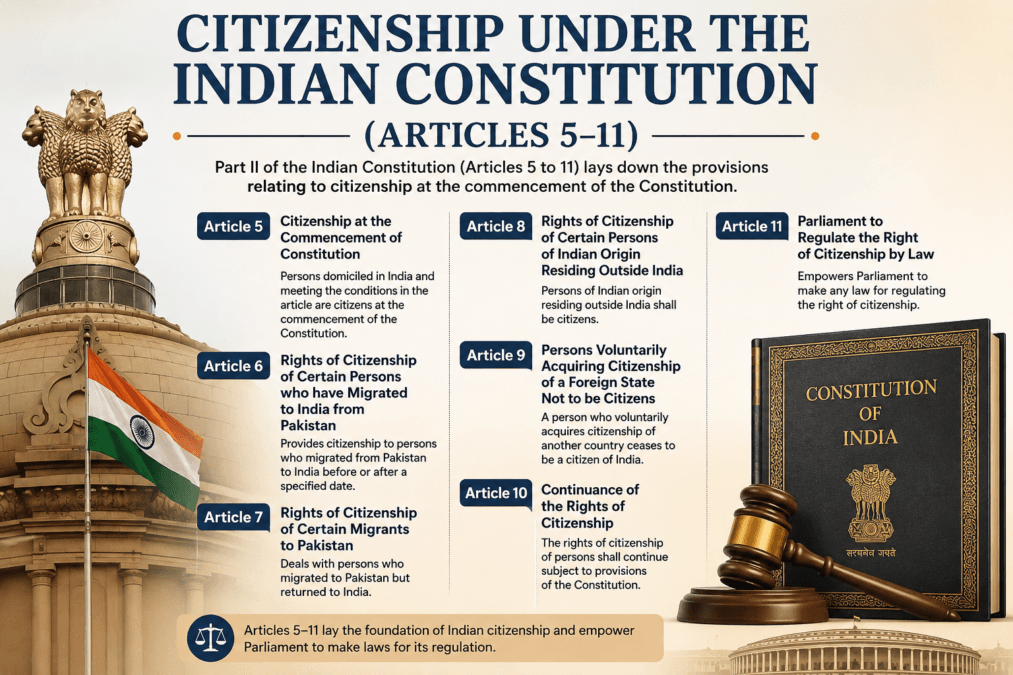
Constitutional Provisions (Part II) – Citizenship Under the Indian Constitution
| Article | What It Does |
|---|---|
| Article 5 | Defines who became a citizen of India at the commencement of the Constitution |
| Article 6 | Citizenship rights for persons who migrated to India from Pakistan |
| Article 7 | Citizenship rights for persons who migrated from India to Pakistan and later returned |
| Article 8 | Citizenship for persons of Indian origin residing outside India |
| Article 9 | A person who voluntarily acquires the citizenship of a foreign country is not, and shall not be, a citizen of India |
| Article 10 | Continuance of citizenship rights, subject to any law Parliament makes |
| Article 11 | Parliament’s power to make any provision regarding acquisition, termination and all matters of citizenship, overriding the earlier Articles |
Statutory Framework
- The Citizenship Act, 1955 — the primary statute Parliament enacted under Article 11, laying down modes of acquiring and losing citizenship after 1950.
- The Citizenship (Amendment) Act, 2019 (CAA) — the most significant recent amendment .
- The Citizenship Rules, 2009 — subordinate legislation.
3. Meaning — Articles 5 to 11
Article 5 — Citizenship at the Commencement of the Constitution
This is a one-time snapshot rule, not an ongoing one. A person became a citizen of India on 26 January 1950 if they were domiciled in India on that date, and additionally satisfied at least one of: (a) they were born in India; or (b) either of their parents was born in India; or (c) they had been ordinarily resident in India for not less than five years immediately before that date.
Article 6 — Migrants to India from Pakistan
This deals with people who crossed over from Pakistan during Partition. The key date is 19 July 1948:
- Migrated before 19 July 1948: Deemed a citizen if they (or a parent/grandparent) were born in undivided India (as defined under the Government of India Act, 1935), and they had been ordinarily resident in India since migrating.
- Migrated on or after 19 July 1948: The same birth/descent condition applies, but they additionally had to have registered as a citizen with a government-appointed officer before the Constitution commenced, after being resident in India for at least six months preceding that application.
Article 7 — Migrants from India to Pakistan (and back)
As a general rule, a person who migrated from India to Pakistan after 1 March 1947 is not treated as an Indian citizen — even if they would otherwise qualify under Article 5 or 6. However, a proviso carves out an exception: if such a person later returned to India under a permit for resettlement or permanent return, they are treated in the same way as a person covered by Article 6.
Article 8 — Persons of Indian Origin Residing Outside India
Covers people (or their parents/grandparents) born in undivided India who are ordinarily residing in a foreign country. Such a person can become a citizen of India by getting registered as a citizen by the diplomatic or consular representative of India in that country, on an application made in the prescribed form.
Article 9 — Voluntary Acquisition of Foreign Citizenship
If a person voluntarily acquires the citizenship of another country, they automatically cease to be a citizen of India — no separate government order is needed to formally “cancel” it. The word “voluntarily” matters a great deal here: foreign citizenship imposed automatically by operation of a foreign law, without the person actually choosing it, is treated differently, and disputes about whether an acquisition was truly voluntary have generated significant case law (see Izhar Ahmad Khan, below).
Article 10 — Continuance of Citizenship Rights
Whatever citizenship rights a person acquired under Articles 5 to 8 continue, unless and until Parliament makes a law to the contrary. This Article is really just a bridge — it keeps citizenship stable while handing full future control to Parliament under Article 11.
Article 11 — Parliament’s Power to Regulate Citizenship by Law
This is the most consequential Article in Part II for practical purposes. It gives Parliament full power to make any provision with respect to the acquisition and termination of citizenship, and all other matters relating to citizenship — and this power is wide enough to override Articles 5 to 10 themselves. This is precisely why the Constitution’s own citizenship rules only ever describe the position as of 1950 — everything about how citizenship is acquired or lost today flows not from the Constitution directly, but from the Citizenship Act, 1955, enacted by Parliament under this very Article 11 (and amended several times since — 1986, 2003, 2005, 2015, and 2019).
Putting It Together
Articles 5–8 answer “who was a citizen at the moment the Constitution began?” — covering the ordinary case (Article 5) and the special Partition-era migration scenarios (Articles 6–8). Article 9 answers “how does citizenship end?” (voluntary foreign acquisition). Article 10 says “that status holds firm” — and Article 11 hands Parliament the pen to write every rule that applies from 1950 onward.
4. Core Principles
1. Single Citizenship Doctrine. India recognises one citizenship for the whole country — there is no separate “State citizenship” the way some federations allow. This ties directly back to the “Single Citizenship” feature discussed in the Salient Features note.
2. Non-Dual Citizenship (Article 9). India does not permit dual citizenship. Voluntarily acquiring a foreign country’s citizenship automatically ends Indian citizenship — no separate government order is needed to “cancel” it, though disputes about whether acquisition was genuinely voluntary are decided under the Citizenship Act.
3. Parliament’s Plenary Power (Article 11). Article 11 is deliberately broad — it lets Parliament override Articles 5 to 10 through ordinary legislation. This is why every major change to how citizenship works in practice — descent-based citizenship (1986), stricter rules against illegal migrants (2003), and the CAA (2019) — has come through amendments to the Citizenship Act, not constitutional amendments.
4. Modes recognised under the Citizenship Act, 1955 (post-1950 acquisition): by birth, by descent (jus sanguinis, introduced by the 1986 Amendment), by registration, by naturalisation, and by incorporation of territory.
5. Important Case Law
(a) Izhar Ahmad Khan v. Union of India, 1962 AIR 1052 — Landmark
- Facts: The petitioners’ Indian citizenship was terminated by the Central Government under Section 9(2) of the Citizenship Act, 1955, relying on Rule 3 of Schedule III of the Citizenship Rules, 1956 — which treated obtaining a Pakistani passport as conclusive proof of having voluntarily acquired Pakistani citizenship.
- Holding: The Supreme Court held that Rule 3 was not a mere rule of evidence but effectively a rule of substantive law, going beyond what subordinate rule-making could validly do, and struck it down as ultra vires. At the same time, the Court affirmed that Parliament has full legislative competence under Article 11 to lay down the conditions on which citizenship is terminated.
- Significance: A foundational case on Article 9/Article 11 and on how “voluntary acquisition” of foreign citizenship is determined — frequently cited in later citizenship disputes.
(b) In Re: Section 6A of the Citizenship Act, 1955, 2024 INSC 789 (decided 17 October 2024) — Landmark, Must Know (Contemporary)
- Facts: Section 6A of the Citizenship Act (inserted pursuant to the Assam Accord) grants a special citizenship pathway to migrants who entered Assam from Bangladesh before 25 March 1971. Petitioners argued this provision was inconsistent with Articles 6 and 7 of the Constitution and unfairly altered Assam’s demographics.
- Holding: A 5-judge Constitution Bench, by a 4:1 majority, upheld the constitutional validity of Section 6A. The majority (led by then-CJI D.Y. Chandrachud, with Justice Surya Kant writing separately) held that Article 6 does not prohibit Parliament, acting under Article 11, from granting citizenship on a different cut-off date than the one fixed in Article 6 itself (19 July 1948) — Section 6A simply exercises Parliament’s independent power over persons Article 6 did not cover. Justice J.B. Pardiwala dissented.
- Significance: The most important recent judicial clarification of how Articles 6, 7 and 11 interact, and a direct, current application of the “Parliament’s plenary power” principle above.
6. Development of Law
1950: Articles 5–11 provide the constitutional starting framework, dealing primarily with partition-era migration.
1955: Parliament enacts the Citizenship Act under Article 11, establishing the ongoing statutory regime.
1986, 2003, 2005, 2015, 2019: Major amendments to the Citizenship Act — most significantly, the 1986 Amendment introducing descent-based (jus sanguinis) citizenship, the 2003 Amendment tightening provisions on illegal migrants, and the 2019 Amendment (CAA).
2019 — Citizenship (Amendment) Act: Provides an accelerated path to Indian citizenship for Hindu, Sikh, Buddhist, Jain, Parsi and Christian migrants from Afghanistan, Bangladesh and Pakistan who entered India on or before 31 December 2014 — notably excluding Muslim migrants from this fast-track route. This triggered nationwide protests and litigation.
2024 (October): Supreme Court upholds Section 6A of the Citizenship Act (Assam Accord provision) in In Re: Section 6A, clarifying Parliament’s power under Article 11.
2024 (March): The Citizenship (Amendment) Rules, 2024 were notified, operationalising the CAA more than four years after it was passed.
Current Position (verified, 2026): Around 200 petitions challenging the CAA’s constitutionality — primarily on the ground that it discriminates on religious grounds and violates Articles 14 and 21 — remain pending before the Supreme Court. The Court has not granted a stay on the CAA at any point since 2019. As of May 2026, a bench led by the Chief Justice of India has begun scheduling the matter for final hearing. Students should treat CAA’s constitutional validity as a live, developing issue, not settled law, and check for the latest status before an exam or publication.
7. Exceptions and Important Notes
- Article 6’s cut-off date is 19 July 1948 (not 1949) — persons who migrated from Pakistan before this date needed only ordinary residence since migration; those who migrated on or after this date needed to register with the Government before the Constitution commenced.
- Article 9 applies only to voluntary acquisition of foreign citizenship — citizenship imposed automatically by operation of a foreign law (without a personal choice to acquire it) does not necessarily trigger loss of Indian citizenship, a distinction courts examine case by case.
- India does not recognise dual citizenship — the Overseas Citizen of India (OCI) card is not citizenship; it is a long-term visa-like status with limited rights (no voting, no holding constitutional office).
8. Practical Examples
- A person born in undivided India in 1949, domiciled in India on 26 January 1950 — becomes a citizen automatically under Article 5.
- A person who migrated from Pakistan to India before 19 July 1948, whose parent or grandparent was born in India, and who has lived in India continuously since migrating — is deemed a citizen under Article 6.
- An Indian citizen who applies for and is granted US citizenship loses Indian citizenship automatically under Article 9 — no separate cancellation order is needed, though the Government may formally record the fact.
9. Important Distinctions
| Concept | Distinction |
|---|---|
| Citizenship vs. Domicile | Citizenship = legal/political membership of the State; domicile = the country/place a person treats as their permanent home |
| Citizen vs. Alien | Citizens enjoy the full range of constitutional rights (including Articles 15, 16, 19, 326); aliens/foreign nationals enjoy only a narrower set (e.g., Articles 14 and 21 apply to “any person,” not just citizens) |
| Article 5 vs. Article 11 | Article 5 = the one-time rule fixing citizenship at commencement; Article 11 = Parliament’s ongoing power to legislate on citizenship after commencement |
| Citizenship vs. OCI status | Citizenship carries full constitutional rights; OCI is a facilitation status, not citizenship, and does not carry voting or office-holding rights |
10. Current Legal Position
- Settled: Articles 5–11 govern citizenship as it stood at the Constitution’s commencement; the Citizenship Act, 1955 (as amended) governs acquisition/loss thereafter; India follows single, non-dual citizenship; Parliament holds exclusive power under Article 11 (most recently reaffirmed in the 2024 Section 6A judgment).
- Developing/Pending: The constitutional validity of the CAA, 2019, remains sub judice before the Supreme Court, with final hearings being scheduled as of mid-2026.
11. Exam Focus
- Text and effect of Articles 5 to 11 (know what each one covers, not just the numbers).
- The Article 6 cut-off date (19 July 1948) and the two categories of migrants it creates.
- Article 9 — voluntary acquisition of foreign citizenship and Izhar Ahmad Khan.
- Article 11 as the source of Parliament’s continuing power — and the 2024 Section 6A judgment as its most recent application.
- Modes of acquiring citizenship under the Citizenship Act, 1955 (birth, descent, registration, naturalisation, incorporation of territory).
- Key features and current status of the CAA, 2019.
12. Ten-Point Quick Revision
- Article 5 = one-time rule for citizenship at commencement (26 Jan 1950).
- Article 6 = migrants from Pakistan; cut-off date 19 July 1948.
- Article 7 = migrants who left for Pakistan and later returned.
- Article 8 = persons of Indian origin residing outside India.
- Article 9 = voluntary acquisition of foreign citizenship ends Indian citizenship.
- Article 10 = citizenship continues, subject to any law Parliament makes.
- Article 11 = Parliament’s plenary power to legislate on citizenship — source of the Citizenship Act, 1955.
- India = single, non-dual citizenship; OCI is not citizenship.
- Izhar Ahmad Khan (1962) — struck down a rigid “passport = conclusive proof” rule as beyond subordinate rule-making power, while affirming Parliament’s Article 11 competence.
- CAA, 2019 — fast-tracks citizenship for six named non-Muslim communities from three countries (cut-off 31 Dec 2014); constitutionality still pending before the Supreme Court as of 2026.
13. Practice Questions
- Distinguish between Article 6 and Article 7 of the Constitution.
- What is the significance of Article 9 in relation to dual citizenship?
- Discuss Parliament’s power under Article 11, with reference to the Supreme Court’s 2024 ruling on Section 6A of the Citizenship Act.
must read
- Introduction to the Constitution of India
- Preamble to the Constitution
- Salient Features of the Constitution
Related Cases: Izhar Ahmad Khan v. Union of India (1962) · In Re: Section 6A of the Citizenship Act, 1955 (2024)
Related Law Success Series: For previous-year question bank on Constitution read AspirixWriters
Classmate Pulse Spiral Notebook ✏️ Need a Spiral Notebook for Everyday Writing? A spiral notebook…

Latest Scholarships & Fellowships 2026–27: Open Opportunities for Upcoming call
Latest Scholarships & Research Fellowships 2026–27 Last Verified: 30 September 2026 Students, researchers, PhD scholars…
Writing & Research Resources: Useful Books, Tools & Essentials for Writers and Researchers
Whether you are an author, content writer, law student, academic researcher, PhD scholar, teacher, or…