
Is It “Law of Tort” or “Law of Torts”? – the foundation of tortious liability
Law of Torts — Meaning and Definition of Tort LLB Notes
The expressions “Law of Tort” and “Law of Torts” reflect an important jurisprudential debate about the foundation of tortious liability.
The question is not merely whether the word should be singular or plural. It asks a deeper question:
Is tortious liability based on one broad and general principle, or does liability arise only when a wrongful act falls within a specific recognised tort?
Two major approaches are traditionally discussed:
- Winfield’s Theory — “Law of Tort”
- Salmond’s Theory — “Law of Torts”
Salmond’s approach is commonly explained through the Pigeon-Hole Theory.
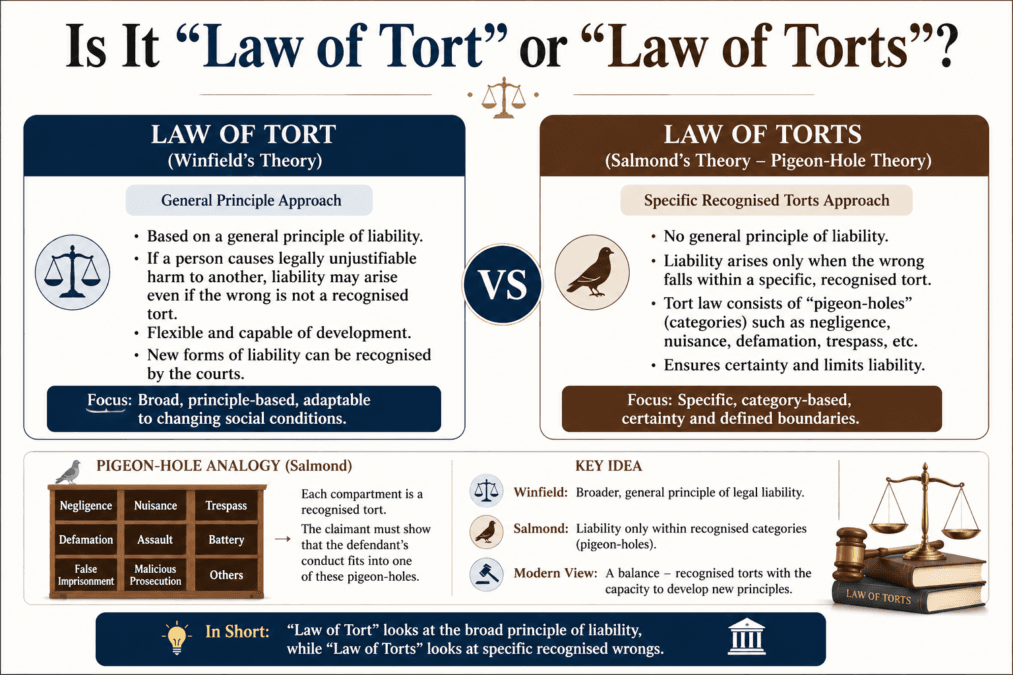
2. Winfield’s Theory
Law of Tort — General Principle
Winfield takes a broader approach to tortious liability. His theory is generally associated with the expression “Law of Tort.”
The basic idea is that tort law rests upon a general principle of liability. Where a person causes legally unjustifiable harm to another in circumstances recognised by law, liability may arise even though the particular form of wrongdoing is not already contained in a completely closed list of torts.
In simple words
According to the broader Winfield approach:
Tort law is capable of developing a remedy for new forms of legally actionable harm instead of being permanently restricted to old categories.
This makes the law flexible.
However, this does not mean that every harmful or unfair act is automatically a tort. The claimant must still establish a legally recognised basis of liability.
Why is Winfield’s approach important?
Society changes.
New situations may arise because of:
- technology;
- industrialisation;
- environmental risks;
- new forms of economic activity;
- changing relationships; and
- new forms of interference with legally protected interests.
A flexible law can respond to such developments.
Example
Suppose a new form of industrial activity causes a type of harm that was not known when older tort cases were decided.
A broad approach allows the courts to ask:
Has the defendant violated a legally protected interest in circumstances that justify liability?
rather than simply asking whether the harm has an old tort name.
3. Salmond’s Theory
Law of Torts — Specific Recognised Torts
Salmond takes a narrower approach and is associated with the expression “Law of Torts.”
According to this approach, tort law consists primarily of specific recognised categories of civil wrongs.
Examples include:
- negligence;
- nuisance;
- trespass;
- defamation;
- assault;
- battery;
- false imprisonment; and
- malicious prosecution.
The claimant must generally establish that the defendant’s conduct falls within a recognised tort and satisfy the requirements of that tort.
In simple words
Salmond’s approach asks:
“Which recognised tort has been committed?”
rather than simply:
“Has the defendant caused unjustifiable harm?”
This approach gives greater importance to certainty and established legal categories.
Salmond’s Pigeon-Hole Theory
Salmond’s approach is commonly called the Pigeon-Hole Theory.
What does “pigeon-hole” mean?
Imagine a large cabinet containing many separate compartments:
TORT LAW
│
┌──────────┼──────────┐
↓ ↓ ↓
Negligence Nuisance Trespass
│
├── Defamation
├── Assault
├── Battery
├── False Imprisonment
└── Malicious Prosecution
Each compartment represents a recognised tort.
According to the theory, if the defendant’s conduct fits into one of these recognised categories and its legal requirements are established, liability may arise.
Example
Suppose A publishes a false statement harming B’s reputation.
The student asks:
Which pigeon-hole does this conduct fit into?
Answer:
Defamation.
The student then examines whether the elements of defamation are satisfied.
What if the conduct does not fit into any recognised tort?
Under a strict version of the Pigeon-Hole approach, the claimant cannot simply argue:
“I suffered harm, therefore the defendant is liable in tort.”
The claimant must establish an actionable legal basis.
This is the central difference from the broader Winfield approach.
4. Cases
A. Ashby v White
Principle
Injuria sine damno — legal injury without actual damage.
Facts
Ashby was a qualified voter. White, the returning officer, wrongfully prevented him from exercising his right to vote.
Although Ashby could not demonstrate measurable financial loss, his legal right had been infringed.
Importance
The case illustrates that infringement of a legally protected right can be actionable even without measurable financial loss.
Exam Point
Ashby v White is a classic authority for the principle of injuria sine damno.
B. Bollinger v Costa Brava Wine Co Ltd
This case is discussed in connection with the Pigeon-Hole Theory and the requirement of establishing a recognised basis of tortious liability.
The case is useful for illustrating the broader theoretical question of whether a claimant can succeed merely by showing that conduct is wrongful or whether the claim must fall within an established category of tort.
Student takeaway
Salmond’s approach requires the claimant to establish an actionable recognised tort rather than relying merely upon the assertion that the defendant’s conduct was harmful or unfair.
Exam importance: Theoretical / supplementary
It should not be treated as one of the principal Indian tort cases.
C. Furniss v Fitchett
Furniss v Fitchett is also discussed in academic treatments of the Pigeon-Hole Theory.
It is relevant to the debate concerning whether tort law consists of a number of specific recognised wrongs or rests upon a broader general principle.
Student takeaway
The case is useful for understanding the jurisprudential debate, but it is not necessary to treat it as a core Indian authority on the current law of torts.
Exam importance: Theoretical / supplementary
D. Donoghue v Stevenson
This is one of the most important cases for understanding the development of negligence.
Facts
Mrs Donoghue consumed ginger beer from an opaque bottle. The contents allegedly included a decomposed snail. She became ill and brought proceedings against the manufacturer.
A major difficulty was that she had no contract with the manufacturer.
Decision
The House of Lords recognised the modern neighbour principle, laying an important foundation for the modern law of negligence.
Relevance to the Winfield–Salmond debate
The case demonstrates that tort law can develop and formulate broader principles of liability as new situations arise.
It therefore provides a useful illustration of the flexibility and development of tort law.
Donoghue v Stevenson illustrates the capacity of tort law to develop general principles in response to changing circumstances.
E. M.C. Mehta v Union of India
Must Know Indian Case
The Oleum Gas Leak Case is particularly important for understanding the development of Indian tort law.
The Supreme Court developed the principle of absolute liability for enterprises engaged in hazardous or inherently dangerous activities.
Why is this case important for this debate?
The Court did not simply apply the traditional English rule of Rylands v Fletcher mechanically.
It developed a principle suited to Indian conditions and circumstances.
This demonstrates that Indian tort law is capable of developing new principles of liability.
Exam Point
M.C. Mehta v Union of India demonstrates the dynamic development of Indian tort law and the willingness of the Supreme Court to formulate principles suited to Indian conditions.
5. Criticism of Both Theories
A. Criticism of Winfield’s Theory
The major advantage of Winfield’s theory is also its potential weakness: flexibility.
If the general principle is interpreted too broadly, uncertainty may arise regarding:
- what constitutes legally actionable harm;
- when a legal duty exists;
- when courts should recognise a new cause of action; and
- how far liability should extend.
Therefore:
Not every morally wrong, unfair or harmful act can automatically become a tort.
There must still be a sound legal basis for imposing liability.
B. Criticism of Salmond’s Pigeon-Hole Theory
The major criticism is that a rigid pigeon-hole system may make tort law too inflexible.
Society constantly changes, and new forms of harm may emerge.
If courts could never recognise liability unless an old category already existed, the law might fail to protect newly recognised legal interests.
The development of modern negligence and the Indian doctrine of absolute liability demonstrate that tort law can evolve.
Therefore
The Pigeon-Hole Theory should not be understood as meaning that modern tort law has an absolutely fixed and permanently closed list of torts.
It is better understood as a theory emphasising specific recognised causes of action and their established requirements.
6. Indian Position
Indian tort law does not fit perfectly into either theory.
India inherited many principles of English common law, but Indian courts have also developed and adapted tort principles according to Indian circumstances.
The development of absolute liability in M.C. Mehta v Union of India is a particularly important example.
Similarly, Indian courts have developed principles concerning:
- constitutional/public-law compensation;
- State liability;
- environmental protection;
- custodial violence;
- unlawful detention; and
- other forms of liability.
Therefore, Indian tort law cannot accurately be described as a completely closed pigeon-hole system.
At the same time, courts do not impose liability simply because conduct appears harmful or unfair. A claimant must establish a legally recognised cause of action and satisfy its applicable requirements.
The modern position can therefore be understood as a balance:
Recognised torts provide established categories and legal certainty, while judicial development allows tort law to respond to new circumstances.
7. Conclusion
The debate between “Law of Tort” and “Law of Torts” reflects two different approaches to the foundation of tortious liability.
Winfield’s theory emphasises a broader and more flexible principle of tortious liability, allowing the law to develop in response to new forms of legally actionable harm.
Salmond’s theory, represented by the Pigeon-Hole Theory, emphasises specific recognised torts and their individual requirements.
Modern tort law is better understood as neither completely closed nor completely unlimited. Established torts continue to provide the basic framework, but courts can develop legal principles when justified by precedent, legal reasoning and changing social conditions.
Exam Memory
Winfield → Law of Tort → General Principle → Flexibility
Salmond → Law of Torts → Specific Torts → Pigeon-Hole Theory
Modern position → Recognised categories + Judicial development
This is the safest way for an LL.B. student to answer the question “Is it Law of Tort or Law of Torts?” without oversimplifying the jurisprudential debate.
FAQs
1. Is it “Law of Tort” or “Law of Torts”?
“Law of Torts” is the conventional name of the subject in legal education. However, the singular “Law of Tort” is associated with Winfield’s broader theory of tortious liability, while “Law of Torts” is associated with Salmond’s specific-tort approach.
2. What is the difference between Law of Tort and Law of Torts?
Law of Tort reflects Winfield’s broader approach, which sees tortious liability as based on a general principle capable of developing with new circumstances. Law of Torts reflects Salmond’s approach, which emphasises specific recognised torts.
3. What is Salmond’s Pigeon-Hole Theory?
Salmond’s Pigeon-Hole Theory states, in simplified form, that tortious liability arises when the defendant’s conduct falls within a recognised category of tort, such as negligence, nuisance, trespass or defamation. The different torts can be imagined as separate “pigeon-holes.”
4. What is Winfield’s theory of tortious liability?
Winfield’s theory takes a broader approach, under which tortious liability is based on a general principle and can develop to accommodate new forms of legally actionable harm. It therefore gives tort law greater flexibility.
5. Is Salmond’s Pigeon-Hole Theory still applicable in India?
Not as a completely rigid rule. Indian tort law recognises established torts but has also developed new principles of liability through judicial decisions. The development of absolute liability in M.C. Mehta v Union of India is an important example of the evolving nature of Indian tort law.
Classmate Pulse Spiral Notebook ✏️ Need a Spiral Notebook for Everyday Writing? A spiral notebook…

Latest Scholarships & Fellowships 2026–27: Open Opportunities for Upcoming call
Latest Scholarships & Research Fellowships 2026–27 Last Verified: 30 September 2026 Students, researchers, PhD scholars…
Writing & Research Resources: Useful Books, Tools & Essentials for Writers and Researchers
Whether you are an author, content writer, law student, academic researcher, PhD scholar, teacher, or…