
Law of Torts Complete Notes
Historical Background and Development of Law of Torts
Introduction
The Law of Torts is a branch of civil law concerned with civil wrongs for which the law provides a remedy, generally in the form of damages or other appropriate relief. Unlike contract, tortious liability does not ordinarily arise from an agreement between the parties; it arises from duties imposed by law.
The modern law of torts developed principally through the English common-law system. It did not emerge as a complete and codified body of law at one time. Instead, it developed gradually through judicial decisions and historical forms of action, particularly trespass and trespass on the case.
India inherited much of this common-law tradition during the British period. However, Indian courts have subsequently adapted and developed tort principles in light of Indian conditions, legislation and constitutional values. The development of absolute liability and constitutional/public-law compensation are important examples of distinctly significant Indian developments.
1. Early Historical Background of Tort Law in England
The word “tort” is derived from the Old French word tort, meaning wrong. The modern legal concept of tort, however, developed through the English common-law system.
In early English law, there was no single, general law of torts. A person seeking a remedy generally had to bring a recognised form of action before the common-law courts.
Consequently, the early history of tort law is closely connected with the development of these forms of action.
2. The Early Forms of Action
Two historical forms of action were particularly important:
- Trespass
- Trespass on the Case
These should not be understood as two stages in which one simply replaced the other. Rather, they were procedural forms through which different types of civil wrongs were litigated and from which modern tort principles gradually developed.
3. Development of Trespass
The action of trespass traditionally dealt with direct and immediate interference with another person’s:
- person;
- land; or
- goods.
For example, a direct physical assault upon another person or a direct unlawful entry upon another person’s land could fall within trespass.
The significance of trespass lies in the fact that it provided an early common-law mechanism for obtaining a remedy for wrongful interference.
4. Development of Trespass on the Case
The traditional action of trespass did not cover every type of injury. In particular, difficulties arose where the harm was consequential or did not fit the requirements of direct trespass.
The common law therefore developed the action known as trespass on the case, generally shortened to case.
Case was sufficiently flexible to deal with circumstances that could not conveniently be brought within traditional trespass. Over time, actions on the case contributed significantly to the development of several modern torts.
The historical development of case was particularly important to areas such as:
- negligence;
- nuisance;
- defamation; and
- other forms of indirect harm.
Thus, the history of tort law reflects a gradual movement from highly specific procedural forms towards broader principles of civil liability.
5. Emergence of Recognised Torts
As English common law developed, courts recognised different categories of civil wrongs.
Important areas included:
- trespass to the person;
- trespass to land;
- trespass to goods;
- nuisance;
- defamation;
- negligence;
- malicious prosecution;
- conversion; and
- other civil wrongs involving person, property and economic interests.
The law was therefore developed significantly through judicial precedent.
The modern law of torts should consequently not be viewed as a single rule created by one case. It is the product of a long process of judicial development.
6. Development of Negligence
The development of negligence was one of the most important developments in modern tort law.
The modern law of negligence emerged gradually through a series of judicial decisions. A landmark case is:
Donoghue v Stevenson [1932] AC 562
The case concerned a consumer who allegedly became ill after consuming ginger beer containing a decomposed snail.
The House of Lords recognised an important general principle concerning the duty of care owed by one person to another.
Lord Atkin formulated the well-known neighbour principle, according to which a person must take reasonable care to avoid acts or omissions that can reasonably be foreseen as likely to injure persons who are sufficiently closely and directly affected by the conduct.
The decision became a foundational authority in the development of modern negligence law.
Exam point: Donoghue v Stevenson is principally important for the development of the modern duty of care/neighbour principle in negligence.
7. Development of Strict Liability
Another significant development in English tort law was the rule of strict liability associated with:
Rylands v Fletcher (1868) LR 3 HL 330
The case concerned the escape of water from a reservoir constructed on the defendant’s land, which caused damage to the claimant’s neighbouring mine.
The House of Lords established a rule imposing liability, subject to recognised exceptions, where a person brings onto and keeps on land something likely to cause harm if it escapes and the relevant requirements of the rule are satisfied. (Wikipedia)
The rule became known as the Rule in Rylands v Fletcher.
It became an important example of liability that could arise without proving ordinary negligence.
8. Introduction and Development of Tort Law in India
India does not have one comprehensive statute containing the entire law of torts.
During British rule, English common-law principles were introduced and applied by Indian courts, particularly where no specific local statutory rule governed the dispute.
However, it would be inaccurate to say that Indian courts simply copied English law. The principles were applied and developed in the Indian legal environment, including through the principles of justice, equity and good conscience.
Over time, Indian courts developed their own body of tort law through judicial decisions.
9. Early Development of State Liability in India
An important historical decision is:
P&O Steam Navigation Co. v Secretary of State for India (1861)
The case is significant in the development of the law relating to State liability in tort during the colonial period.
The decision is historically associated with the distinction between acts performed in the exercise of sovereign powers and acts that could also be performed by private individuals.
It became an important foundation for later Indian discussions concerning governmental liability.
State of Rajasthan v Vidyawati AIR 1962 SC 933
After independence, the Supreme Court considered the liability of the State in:
State of Rajasthan v. Vidyawati
A government jeep, after being taken for repairs, was being driven back when it caused a fatal accident through the negligence of its driver.
The Supreme Court upheld the State’s liability in the circumstances of the case. Later Supreme Court decisions have recognised Vidyawati as an important decision rejecting sovereign immunity on those facts and recognising State vicarious liability for the tort of its servant. (Indian Kanoon)
Importance
The case is an important milestone in the development of State liability in independent India.
Kasturi Lal Ralia Ram Jain v State of Uttar Pradesh AIR 1965 SC 1039
The Supreme Court subsequently considered sovereign immunity in:
Kasturi Lal Ralia Ram Jain v. State of Uttar Pradesh
In that case, property seized by police officers was not properly returned, and the claimant sought compensation.
The Supreme Court applied the distinction between acts connected with the exercise of sovereign powers and acts that were not based on such powers. On the facts, the State was held immune from the tort claim because the relevant acts were connected with statutory powers regarded as sovereign. (Indian Kanoon)
Important qualification
Students should not treat Kasturi Lal as stating the present complete position on State immunity. Later constitutional and public-law jurisprudence has substantially restricted the practical reach of sovereign immunity.
10. Development Beyond Kasturi Lal
Indian law subsequently moved towards a more restrictive approach to sovereign immunity.
The Supreme Court has recognised in later cases that the distinction between sovereign and non-sovereign functions cannot provide a broad immunity for all governmental activity.
For example, later Supreme Court jurisprudence has described the theory of sovereign immunity in Kasturi Lal as having yielded to newer approaches in the context of a modern welfare State. (Indian Kanoon)
Therefore, for examination purposes, the development can be remembered as:
P&O Steam Navigation → Vidyawati → Kasturi Lal → later restriction of sovereign immunity
11. Development of Absolute Liability in India
One of the most important contributions of Indian courts to modern tort law is the development of absolute liability.
M.C. Mehta v Union of India
AIR 1987 SC 1086
The case arose from the Oleum Gas Leak involving a hazardous industrial activity.
The Supreme Court developed a special rule for enterprises engaged in hazardous or inherently dangerous activities.
The Court held that such an enterprise owes an absolute and non-delegable duty to the community to ensure that no harm results from the hazardous activity.
The enterprise is absolutely liable to compensate for harm caused by such activity, and it cannot avoid liability merely by arguing that it took reasonable care or that there was no negligence. (Indian Kanoon)
Why is this important?
The doctrine goes beyond the traditional rule in Rylands v Fletcher.
Therefore:
Rylands v Fletcher → Strict Liability
M.C. Mehta → Absolute Liability in India
This distinction is extremely important for LL.B. examinations.
12. Development of Constitutional Tort in India
Indian courts have also developed a form of public-law compensation for violations of fundamental rights.
This development is particularly associated with Article 21 of the Constitution, which protects life and personal liberty.
Rudul Sah v State of Bihar (1983) 4 SCC 141
The petitioner remained in prison for more than 14 years even after his acquittal.
The Supreme Court held that merely releasing him would not provide an adequate remedy for such a serious violation of his right to liberty. The Court therefore awarded monetary compensation under its constitutional jurisdiction. (Indian Kanoon)
Importance
Rudul Sah is an important milestone in the development of public-law compensation for violation of fundamental rights.
Nilabati Behera v State of Orissa (1993) 2 SCC 746
The case concerned the death of the petitioner’s son in police custody.
The Supreme Court awarded compensation and explained the distinction between a private-law claim for damages and compensation awarded through constitutional/public-law jurisdiction.
The Court recognised that compensation could be granted in appropriate cases involving established violation of Article 21. (Indian Kanoon)
Importance
The case strengthened the development of constitutional tort/public-law compensation in India.
13.Major Stages in the Development of Tort Law
The development can be understood through the following sequence:
England
Early Common Law
↓
Forms of Action
↓
Trespass
↓
Trespass on the Case
↓
Development of Specific Torts
↓
Modern Negligence
↓
Donoghue v Stevenson
↓
Strict Liability
↓
Rylands v Fletcher
India
English Common-Law Influence
↓
P&O Steam Navigation
↓
State of Rajasthan v Vidyawati
↓
Kasturi Lal
↓
Later Restriction of Sovereign Immunity
↓
M.C. Mehta
↓
Absolute Liability
↓
Rudul Sah
↓
Nilabati Behera
↓
Constitutional/Public-Law Compensation
14. Important Cases for LL.B. Examinations
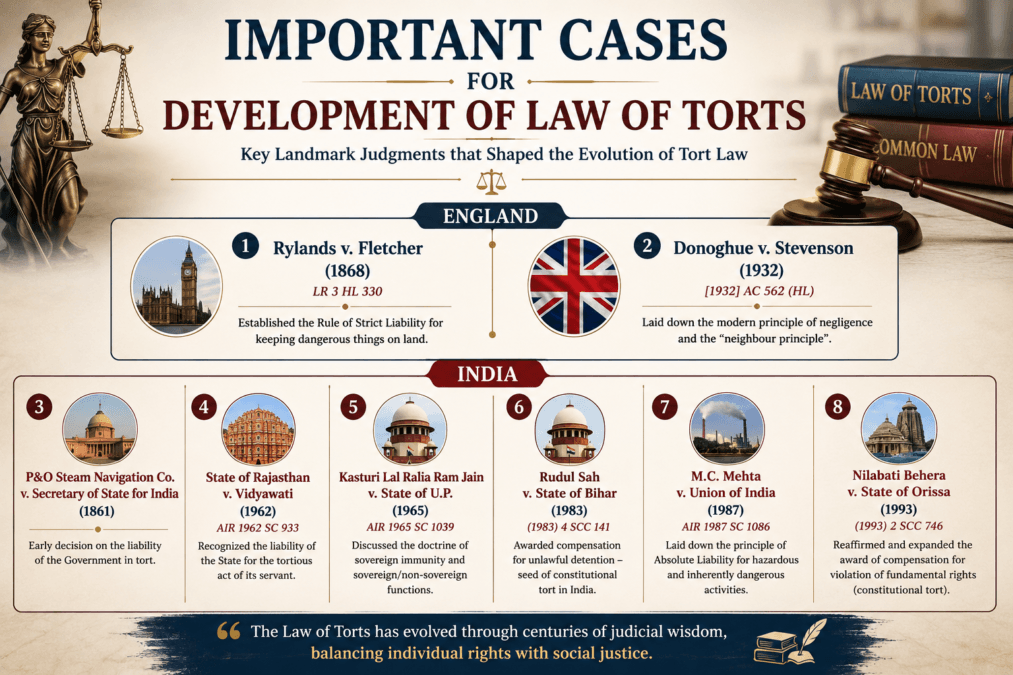
| Case | Year | Importance |
| P&O Steam Navigation Co. v Secretary of State for India | 1861 | Early development of State liability |
| Rylands v Fletcher | 1868 | Strict liability |
| Donoghue v Stevenson | 1932 | Modern negligence / duty of care |
| State of Rajasthan v Vidyawati | 1962 | State liability |
| Kasturi Lal Ralia Ram Jain v State of U.P. | 1965 | Sovereign immunity |
| Rudul Sah v State of Bihar | 1983 | Constitutional/public-law compensation |
| M.C. Mehta v Union of India | 1987 | Absolute liability |
| Nilabati Behera v State of Orissa | 1993 | Constitutional tort/public-law compensation |
15. Why Is Indian Tort Law Largely Uncodified?
India does not have a single comprehensive Indian Torts Act containing all principles of tortious liability.
Instead, Indian tort law has developed from several sources:
1. Common Law
English common-law principles provided an important historical foundation.
2. Judicial Precedents
Indian courts have progressively developed and adapted tort principles.
3. Legislation
Parliament has enacted statutes governing specific areas of liability, such as motor accident compensation, consumer protection and public liability.
4. Constitutional Law
The Constitution has enabled the courts to develop public-law remedies for certain violations of fundamental rights.
5. Justice, Equity and Good Conscience
These principles have historically assisted courts where no specific statutory rule governed the matter.
16. Is Indian Tort Law Merely English Law?
No.
English common law provided an important historical foundation, but modern Indian tort law is not simply a copy of English tort law.
Indian courts have adapted common-law principles to Indian conditions and have created important developments of their own.
The doctrine of absolute liability in M.C. Mehta is the clearest example.
Similarly, the development of constitutional/public-law compensation in cases such as Rudul Sah and Nilabati Behera reflects the influence of India’s constitutional framework. (Indian Kanoon)
17. English Law and Indian Law — Comparative Overview
| Basis | English Law | Indian Law |
| Historical foundation | English common law | Strong influence of English common law |
| Early development | Forms of action | Adopted through colonial courts |
| Comprehensive Tort Code | No single comprehensive code | No single comprehensive Tort Code |
| Judicial role | Very important | Extremely important |
| Negligence | Developed through common law | Adopted and further developed by Indian courts |
| Strict liability | Rylands v Fletcher | Applied and adapted |
| Absolute liability | — | Developed in M.C. Mehta |
| Constitutional tort | Different constitutional framework | Developed through Article 21 jurisprudence |
| State liability | Developed through common law/statute | Developed through judicial and constitutional law |
18. Present Position of the Law of Torts in India
The modern Indian law of torts is therefore a combination of:
Common-law principles + Indian judicial precedents + legislation + constitutional principles.
Traditional torts continue to form its foundation, including:
- negligence;
- nuisance;
- trespass;
- defamation;
- false imprisonment;
- malicious prosecution;
- vicarious liability; and
- strict liability.
At the same time, Indian courts have developed important modern principles concerning:
- absolute liability;
- State liability;
- public-law compensation; and
- constitutional rights.
Thus, Indian tort law remains an evolving body of law rather than a completely closed and codified system.
19. Conclusion
The Historical Background and Development of the Law of Torts reveals a gradual transformation from specific common-law forms of action into a broad body of principles governing civil wrongs.
In England, the historical development of trespass and trespass on the case played an important role in the evolution of recognised torts. Later judicial decisions significantly developed negligence and strict liability, with Donoghue v Stevenson and Rylands v Fletcher becoming major landmarks.
India inherited this common-law foundation during the colonial period, but Indian courts subsequently adapted and expanded it. The development of State liability, absolute liability in M.C. Mehta, and constitutional/public-law compensation in Rudul Sah and Nilabati Behera demonstrates that Indian tort law has developed in response to India’s own constitutional, social and industrial conditions. (Indian Kanoon)
Therefore, Indian tort law should be understood not merely as imported English common law, but as an evolving body of Indian law shaped by judicial precedent, legislation and constitutional principles.
FAQs — Historical Background and Development of Law of Torts
1. How did the Law of Torts develop in England?
The Law of Torts developed gradually through English common law, particularly through the historical actions of trespass and trespass on the case, followed by the development of specific torts such as negligence, nuisance and defamation.
2. How did the Law of Torts develop in India?
Indian tort law was historically influenced by English common law during British rule. Indian courts subsequently adapted and developed these principles through judicial decisions, legislation, and constitutional principles.
3. Why is Indian Tort Law not codified?
India does not have a single comprehensive statute governing all torts. Consequently, Indian tort law has developed through judicial precedents, specific legislation, common-law principles, and constitutional jurisprudence.
4. What are the landmark cases in the development of Tort Law?
Important landmark cases include P&O Steam Navigation Co. v. Secretary of State for India, Rylands v. Fletcher, Donoghue v. Stevenson, State of Rajasthan v. Vidyawati, M.C. Mehta v. Union of India, Rudul Sah v. State of Bihar, and Nilabati Behera v. State of Orissa.
5. What is the difference between English and Indian Tort Law?
Indian tort law has its historical foundation in English common law, but Indian courts have developed and adapted the principles to Indian conditions. The Indian doctrines of absolute liability and constitutional/public-law compensation are important examples of this independent development.
- . Law of Torts — Meaning and Definition of Tort
- 2. Is It “Law of Tort” or “Law of Torts”?
- 3. Essential Elements of Tortious Liability
- 4. Mental Elements in Tort — Intention, Motive, Malice & Fault
- 5. Tort and Other Civil Wrongs
Classmate Pulse Spiral Notebook ✏️ Need a Spiral Notebook for Everyday Writing? A spiral notebook…

Latest Scholarships & Fellowships 2026–27: Open Opportunities for Upcoming call
Latest Scholarships & Research Fellowships 2026–27 Last Verified: 30 September 2026 Students, researchers, PhD scholars…
Writing & Research Resources: Useful Books, Tools & Essentials for Writers and Researchers
Whether you are an author, content writer, law student, academic researcher, PhD scholar, teacher, or…