
- 1. Law of Torts — Meaning and Definition of Tort
- 2. Is It “Law of Tort” or “Law of Torts”?
- 3. Essential Elements of Tortious Liability
- 4. Mental Elements in Tort — Intention, Motive, Malice & Fault
- 5. Tort and Other Civil Wrongs
- 6. Development of Law of Torts in England and India
- 7. Ubi Jus Ibi Remedium
- 8. Injuria Sine Damnum
- 9. Damnum Sine Injuria
Founation of Tortious Liability
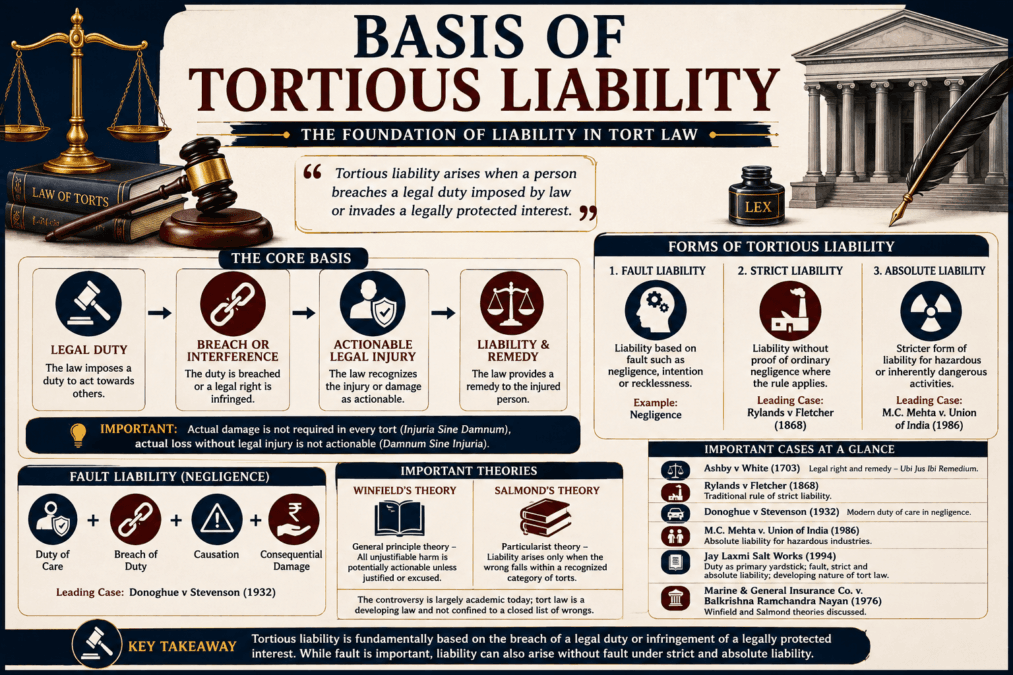
Basis of Tortious Liability is an important topic under the general principles of the Law of Torts. It explains the legal foundation on which a person may be held liable for a tort.
The central idea is that tortious liability is primarily connected with the breach of a legal duty imposed by law and the invasion of a legally protected interest. However, modern tort law is not restricted to fault-based liability. It has also developed doctrines of strict liability and absolute liability. The Supreme Court of India has expressly recognised these different forms of tortious liability. (Indian Kanoon)
1. Meaning of Tortious Liability
Tortious liability means legal liability arising from a tort or civil wrong independent of contract.
The Supreme Court in Jay Laxmi Salt Works (P) Ltd. v. State of Gujarat explained tort in terms of breach of a duty primarily fixed by law. The Court distinguished tortious duties from contractual duties, observing that in tort the duty is generally imposed by law rather than created by agreement. (Indian Kanoon)
Simple definition
Tortious liability is liability arising from the breach of a legally recognised duty or infringement of a legally protected interest, where the law provides a remedy.
2. What Is the Basis of Tortious Liability?
The primary basis of tortious liability is legal duty.
A person may be held liable when:
- the law recognises a duty or protected interest;
- the defendant breaches that duty or unlawfully interferes with that interest; and
- the requirements of the relevant tort or doctrine are satisfied.
The Supreme Court in Jay Laxmi Salt Works specifically stated that duty is the primary yardstick for determining tortious liability and that its scope can develop according to fairness and practical considerations.
Important qualification
Duty → Breach → Damage → Liability
That formula is particularly useful for negligence, but it is not a complete formula for every tort.
For example:
- some torts protect rights even without proof of actual financial loss;
- strict liability does not depend upon ordinary negligence;
- absolute liability is an even more stringent form of liability.
3. Legal Duty — The Foundation of Tortious Liability
A legal duty is an obligation recognised and enforced by law.
In tort, the duty is generally imposed by law, rather than voluntarily created by agreement.
For example, a driver has a legal duty to exercise reasonable care towards other road users.
If the driver breaches that duty and causes actionable injury, tortious liability may arise.
The Supreme Court has described duty as the central “yardstick” for determining tortious liability. (Indian Kanoon)
4. Tortious Duty and Contractual Duty
This distinction is fundamental.
| Tortious Duty | Contractual Duty |
| Primarily imposed by law | Primarily created by agreement |
| Generally exists independently of contract | Arises from contractual relationship |
| Usually concerns duties owed to persons generally or a legally defined class | Normally concerns obligations between contracting parties |
| Breach gives rise to tortious liability when the requirements of the tort are satisfied | Breach gives rise to contractual liability |
| Example: duty of reasonable care | Example: duty to deliver goods under a contract |
The Supreme Court explained this distinction in Jay Laxmi Salt Works.
5. Invasion of a Legally Protected Interest
Tortious liability is not based merely on the existence of physical harm or financial loss.
The law must recognise the claimant’s interest as legally protected and the defendant’s conduct as actionable.
This explains the distinction between:
Injuria Sine Damnum
Legal injury without actual damage.
A legal right has been violated even though the claimant may not prove actual financial loss.
Damnum Sine Injuria
Damage without legal injury.
A person may suffer actual loss but have no tort claim where no legally protected right has been infringed and no other recognised cause of action exists.
This distinction is essential for understanding the basis of tortious liability.
6. Fault as a Basis of Tortious Liability
A large part of tort law is based on fault.
Fault may involve:
- intention;
- negligence;
- recklessness;
- deliberate wrongdoing; or
- another legally recognised form of blameworthy conduct.
The most important example is negligence.
Negligence generally involves:
- a legal duty to take reasonable care;
- breach of that duty; and
- consequential damage satisfying the requirements of negligence.
The Supreme Court in Jay Laxmi Salt Works discussed negligence in terms of breach of a legal duty to take care resulting in consequential damage.
7. Is Fault Necessary for Every Tort?
No.
This is one of the most important points in this topic.
Fault is a major basis of tortious liability, but it is not the only basis.
Modern tort law recognises:
- Fault liability
- Strict liability
- Absolute liability
The Supreme Court in Jay Laxmi Salt Works expressly recognised these as forms that have developed within tort law. (Indian Kanoon)
Therefore, the proposition:
“There can be no tortious liability without negligence”
is incorrect.
8. Fault Liability
Under fault liability, the claimant generally has to establish the legally relevant fault required by the particular tort.
The clearest example is negligence.
Example
A drives a vehicle carelessly and injures B.
If B establishes:
- A owed a duty of care;
- A breached that duty; and
- the breach caused actionable damage,
A may be liable in negligence.
Important case
Donoghue v Stevenson (1932)
[1932] AC 562
The case is a landmark authority in the development of the modern duty of care in negligence.
It is therefore important when discussing fault-based tortious liability and the legal duty to take reasonable care.
The Supreme Court in Jay Laxmi Salt Works itself referred to Donoghue v Stevenson while explaining the development of duty in tort law.
9. Strict Liability
Strict liability is a major departure from ordinary fault-based liability.
Under the traditional rule, liability may arise even without proving ordinary negligence where the requirements of the doctrine are satisfied.
Rylands v Fletcher (1868)
L.R. 3 H.L. 330
The rule in Rylands v Fletcher is the classical English foundation of strict liability.
Broadly, the rule concerns the bringing onto and keeping on land something likely to cause mischief if it escapes, subject to the recognised requirements and exceptions of the rule.
Key point
Strict liability does not require proof of ordinary negligence in the same way as a negligence claim.
The Supreme Court in Jay Laxmi Salt Works treated strict liability as one of the developed forms of tortious liability.
10. Absolute Liability
Indian tort law has developed the doctrine of absolute liability, particularly for enterprises engaged in hazardous or inherently dangerous activities.
M.C. Mehta v. Union of India
Oleum Gas Leak Case
(1987) 1 SCC 395; AIR 1987 SC 1086
The Supreme Court held that an enterprise engaged in a hazardous or inherently dangerous activity owes an absolute and non-delegable duty to the community.
If harm results from that hazardous activity, the enterprise is absolutely liable to compensate those affected.
The Court made clear that it would not be sufficient for the enterprise to argue that it had taken reasonable care or that there was no negligence.
Importance
This doctrine goes beyond the traditional English rule in Rylands v Fletcher.
Therefore:
Rylands v Fletcher → Traditional strict liability
M.C. Mehta → Indian doctrine of absolute liability for hazardous/inherently dangerous enterprises
11. Strict Liability vs Absolute Liability
| Strict Liability | Absolute Liability |
| Associated with Rylands v Fletcher | Developed by Indian Supreme Court in M.C. Mehta |
| Fault need not be proved | Fault need not be proved |
| Traditional exceptions exist | Traditional Rylands exceptions do not apply in the same manner |
| Classical English doctrine | Stronger Indian doctrine |
| Applies according to requirements of the rule | Particularly applies to hazardous/inherently dangerous enterprises |
The Supreme Court’s reasoning in M.C. Mehta expressly distinguished the Indian principle from the exceptions applicable under the traditional Rylands rule.
12. Duty as the Primary Yardstick
The most important judicial statement for this topic comes from:
Jay Laxmi Salt Works (P) Ltd. v. State of Gujarat (1994) 4 SCC 1
The Supreme Court explained that:
- tort involves breach of a duty primarily fixed by law;
- tortious duties differ from contractual duties;
- invasion of a legally protected interest is important;
- tort law is a developing field;
- fault, strict and absolute liability have developed;
- duty is the primary yardstick for determining tortious liability.
“Discuss the basis of tortious liability.”
Jay Laxmi Salt Works is one of the most useful Indian authorities to cite.
13. Tort Law Is a Developing Law
Tort law is not a completely static or closed body of law.
The Supreme Court in Jay Laxmi Salt Works observed that the frontiers of tort law cannot be strictly confined and recognised the development of fault, strict and absolute liability.
This is important because new social and technological conditions can create new questions concerning:
- duty of care;
- hazardous activities;
- public authorities;
- environmental harm;
- economic interests;
- emerging forms of injury.
The law may develop through judicial decisions where the legal requirements for liability are established.
14. Winfield’s Theory of Tortious Liability
The Winfield–Salmond debate is traditionally discussed under the foundation or basis of tortious liability.
Winfield’s General Principle Theory
Winfield’s approach is broadly associated with the idea that tort law rests upon a general principle of liability for unjustifiable harm, subject to legal justification or excuse.
The theory supports the proposition that tort law can develop when courts recognise new forms of actionable harm.
However, Winfield himself later qualified the theory, distinguishing the practical view of existing tort categories from the broader historical and developmental view of tort law. The Bombay High Court discussed this nuance in Marine & General Insurance Co. Ltd. v. Balkrishna Ramchandra Nayan.
15. Salmond’s Theory
Salmond’s traditional approach is associated with the view that tort law consists of recognised categories of civil wrongs.
This is commonly described in textbooks as the “pigeon-hole theory.”
However, it is important not to oversimplify Salmond’s position by saying that he believed tort law could never develop.
The Bombay High Court, while discussing the Winfield–Salmond debate in Marine & General Insurance Co. Ltd. v. Balkrishna Ramchandra Nayan, noted that the distinction is more nuanced and that the law is capable of development.
16. Winfield vs Salmond
| Winfield | Salmond |
| Associated with a general principle approach | Associated with a particularist/category-based approach |
| Emphasises the broader development of tort law | Emphasises recognised categories of tortious liability |
| More open to explaining new forms of liability through general principles | Focuses on established legal categories |
| Recognises that the law develops gradually | Does not necessarily mean that categories can never expand |
Important conclusion
It would be inaccurate to say that modern Indian tort law follows only Winfield or only Salmond.
The Bombay High Court has treated the controversy as substantially academic, while recognising the continuing development of tort law.
17. Ashby v White — Legal Right and Remedy
Ashby v White (1703)
This case is important in understanding the relationship between legal rights and remedies.
It is traditionally associated with the maxim:
Ubi Jus Ibi Remedium
meaning:
Where there is a legal right, there is a remedy.
It therefore complements the concept of Injuria Sine Damnum, which demonstrates that infringement of a legal right can be actionable even without proof of actual monetary loss.
18. Basis of Tortious Liability and Legal Injury
The concepts can be connected as follows:
Legal Duty
The law imposes a duty.
↓
Breach or Infringement
The defendant breaches the duty or interferes with a protected interest.
↓
Actionable Injury
The law recognises the resulting injury as actionable.
↓
Liability
The claimant may obtain an appropriate legal remedy.
However, the precise requirements vary according to the particular tort.
19. Is Actual Damage Necessary in Every Tort?
No.
This is an important correction to the oversimplified formula.
Some torts may be actionable based on the infringement of a legal right, even where the claimant cannot establish actual financial loss.
This is the principle of:
Injuria Sine Damnum
Conversely:
Damnum Sine Injuria
shows that actual damage alone does not necessarily establish tortious liability.
Therefore, the better formulation is:
Tortious liability depends on a legally recognised wrong, not merely on the existence of factual loss.
20. Important Forms of Tortious Liability
A. Fault Liability
Liability based on legally relevant fault.
Example: Negligence.
Important case: Donoghue v Stevenson.
B. Strict Liability
Liability may arise without proof of ordinary negligence where the requirements of the rule are satisfied.
Important case: Rylands v Fletcher.
C. Absolute Liability
A stronger form of liability developed by Indian law for hazardous or inherently dangerous activities.
Important case: M.C. Mehta v Union of India.
21. Important Cases for This Topic
| Case | Principle |
| Ashby v White (1703) | Legal right and remedy; Ubi Jus Ibi Remedium |
| Rylands v Fletcher (1868) | Traditional strict liability |
| Donoghue v Stevenson (1932) | Modern duty of care in negligence |
| Marine & General Insurance Co. v Balkrishna Ramchandra Nayan (1976) | Winfield–Salmond debate and development of tort law |
| M.C. Mehta v Union of India (1986/1987) | Absolute liability for hazardous/inherently dangerous enterprises |
| Jay Laxmi Salt Works v State of Gujarat (1994) | Duty as primary yardstick; fault, strict and absolute liability; developing nature of tort law |
The classification is deliberate: these cases illustrate different foundations and developments of liability rather than all being authorities for one identical proposition.
22. Most Important Case — Jay Laxmi Salt Works
For this particular topic, remember:
Jay Laxmi Salt Works (P) Ltd. v. State of Gujarat
(1994) 4 SCC 1
Why is it important?
The Supreme Court considered:
- meaning of tort;
- breach of duty;
- injury and damage;
- tortious liability;
- fault liability;
- strict liability;
- absolute liability;
- negligence;
- duty of care;
- development of tort law.
Most importantly:
Duty is the primary yardstick for determining tortious liability.
23. Difference Between Fault, Strict and Absolute Liability
| Feature | Fault Liability | Strict Liability | Absolute Liability |
| Fault | Relevant | Not required in the ordinary sense | Not required |
| Negligence | Usually relevant where negligence is alleged | Need not be proved | Need not be proved |
| Main authority | Donoghue v Stevenson | Rylands v Fletcher | M.C. Mehta |
| Nature | Fault-based | No-fault in the relevant sense | More stringent no-fault liability |
| Exceptions | Depends upon the particular tort | Traditional exceptions to Rylands | Traditional Rylands exceptions do not apply in the same manner |
| Main significance | Ordinary negligence | Exceptional strict liability | Hazardous/inherently dangerous activities in India |
24. What Is the Role of Motive?
Motive is not the universal basis of tortious liability.
A person may have a good motive but still commit a tort.
Similarly, a bad motive does not automatically make every lawful act tortious.
The legal question is generally whether the conduct falls within the requirements of a recognised tort or other applicable doctrine.
This connects with your earlier topic on:
Intention, Motive, Malice and Fault in Tort.
25. Tortious Liability Is Different from Moral Liability
Not every morally wrong act is a tort.
Similarly, not every harmful act creates tortious liability.
The conduct must fall within a legally recognised basis of liability.
Therefore:
Moral wrong ≠ necessarily tort
and
Harm ≠ automatically tortious liability
The law determines when the harm constitutes an actionable legal wrong.
26. Short Exam Answer
What is the basis of tortious liability?
The basis of tortious liability is primarily the breach of a legal duty imposed by law and infringement of a legally protected interest, subject to the requirements of the particular tort or doctrine. In Jay Laxmi Salt Works (P) Ltd. v. State of Gujarat (1994), the Supreme Court explained that tortious duties are primarily fixed by law and observed that duty is the primary yardstick for determining tortious liability. The Court also recognised the development of fault, strict and absolute liability. Thus, although fault is an important basis of tortious liability, it is not necessary in every case. Strict liability under Rylands v Fletcher and absolute liability under M.C. Mehta v Union of India illustrate this development.
27. Quick Revision Notes
Basis of Tortious Liability
Primary foundation:
Legal duty + actionable breach/infringement
Main forms
- Fault liability
- Strict liability
- Absolute liability
Main theories
Winfield → General principle approach
Salmond → Particularist/category approach
Most important Indian authority
Jay Laxmi Salt Works v State of Gujarat (1994)
Other important cases
- Ashby v White
- Rylands v Fletcher
- Donoghue v Stevenson
- Marine & General Insurance v Balkrishna Ramchandra Nayan
- M.C. Mehta v Union of India
Remember
Tortious liability is primarily duty-based, but not necessarily fault-based.
Conclusion
The basis of tortious liability cannot be reduced to negligence alone.
The fundamental foundation is the existence of a legally recognised duty or protected interest, together with an actionable breach or interference. Fault liability remains central to many torts, particularly negligence, but the law has developed beyond fault through strict liability and, in India, absolute liability for hazardous or inherently dangerous activities.
The Supreme Court’s decision in Jay Laxmi Salt Works (P) Ltd. v. State of Gujarat is particularly important because it treats duty as the primary yardstick of tortious liability while recognising that tort law is a developing field.
Thus, the best exam-oriented summary is:
The basis of tortious liability is a legally recognised duty or protected interest and an actionable breach or interference; fault is important but is not indispensable in every form of tortious liability.
FAQs — Basis of Tortious Liability
1. What is the basis of tortious liability?
The primary basis is the breach of a legal duty imposed by law or infringement of a legally protected interest, subject to the requirements of the particular tort.
2. Is fault necessary for tortious liability?
No. Fault is important in many torts, especially negligence, but strict liability and absolute liability demonstrate that liability may arise without proving ordinary negligence.
3. Which is the most important case on the basis of tortious liability?
Jay Laxmi Salt Works (P) Ltd. v. State of Gujarat (1994) is particularly important because the Supreme Court discussed legal duty, tortious liability, fault, strict liability, absolute liability and the developing nature of tort law.
4. What are the main theories regarding the basis of tortious liability?
The classical debate is between Winfield’s general-principle approach and Salmond’s particularist/category-based approach. Modern tort law cannot, however, be completely reduced to either theory.
5. What is the difference between strict liability and absolute liability?
Strict liability is traditionally associated with Rylands v Fletcher and operates subject to its recognised requirements and exceptions. Absolute liability, developed by the Indian Supreme Court in M.C. Mehta, imposes a stronger liability on enterprises engaged in hazardous or inherently dangerous activities and does not permit the traditional Rylands exceptions in the same manner.
Classmate Pulse Spiral Notebook ✏️ Need a Spiral Notebook for Everyday Writing? A spiral notebook…

Latest Scholarships & Fellowships 2026–27: Open Opportunities for Upcoming call
Latest Scholarships & Research Fellowships 2026–27 Last Verified: 30 September 2026 Students, researchers, PhD scholars…
Writing & Research Resources: Useful Books, Tools & Essentials for Writers and Researchers
Whether you are an author, content writer, law student, academic researcher, PhD scholar, teacher, or…