
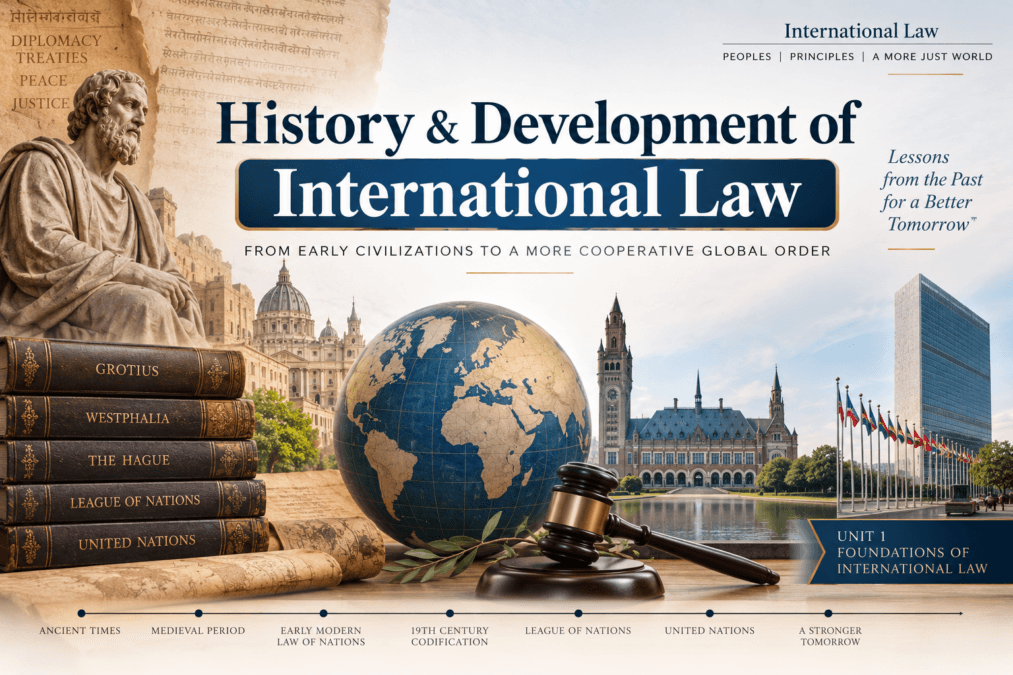
History and Development of International Law
Quick Answer: How did International Law develop?
International Law did not emerge at one particular moment. It developed gradually through treaties, diplomatic practices, customary rules, ideas of jurists, international conferences, judicial institutions and international organizations.
Unit 1: Foundations of International Law
- Meaning, Definitions, Nature, Scope and Importance of International Law
- Basis, Binding Force and Sanctions of International Law
Ancient and medieval societies already practised forms of treaty-making, diplomacy and rules concerning war and peace. Later, European intellectual developments, the work of jurists such as Hugo Grotius, the Peace of Westphalia, 19th-century codification efforts, the Hague Peace Conferences, the League of Nations and the Permanent Court of International Justice contributed to the development of the modern system.
After the Second World War, the United Nations, International Court of Justice and International Law Commission provided major institutional frameworks for the further development and codification of International Law. The UN Charter was signed on 26 June 1945 and entered into force on 24 October 1945. (United Nations Treaty Collection)
Don’t Miss New Law Opportunities!
Join our WhatsApp community for verified updates on Law Jobs, Internships, Competitions, Scholarships, LLB Notes & more.
1. What is meant by the History of International Law?
The history of International Law is the study of the gradual development of rules, principles, institutions and practices governing relations among international actors.
The historical development of International Law can be broadly understood through the following stages:
Ancient and medieval practices → intellectual development → early modern European law of nations → 19th-century codification → League of Nations and PCIJ → UN and ICJ → contemporary International Law
2. Did International Law begin in ancient times?
Ancient societies had practices relevant to international relations, including treaties, diplomacy, rules concerning war and peace, alliances and relations between political communities.
However, these practices should not simply be described as the modern system of Public International Law.
The modern discipline developed through a much longer historical process.
Important distinction
| Historical practices | Modern International Law |
| Rules often concerned particular political communities | Rules operate within a developed international legal system |
| Diplomatic and treaty practices existed | Treaties form an important formal source of law |
| Rules concerning war and peace existed | International humanitarian law has developed into an extensive body of rules |
| Arbitration and dispute settlement had historical antecedents | Permanent international judicial institutions now exist |
| Rules varied between societies and periods | International Law has increasingly developed through global institutions and multilateral processes |
Ancient and medieval practices constitute historical antecedents of International Law, but the modern international legal system developed progressively over many centuries.
3. Medieval Period and the Development of the Law of Nations
During the medieval period, Europe was characterized by a complex political and legal order involving different political authorities.
Relations among political communities continued to involve:
- treaties;
- diplomacy;
- alliances;
- rules concerning warfare;
- commercial relations; and
- practices concerning peace and settlement.
The historical development of International Law therefore cannot be reduced to a single event or century.
The modern system emerged through continuity as well as transformation.
4. Hugo Grotius and the Development of International Law
Who was Hugo Grotius?
Hugo Grotius (1583–1645) was a Dutch jurist and political thinker whose writings made an important contribution to the development and systematic study of the law of nations.
His famous work was:
De Jure Belli ac Pacis (On the Law of War and Peace), 1625
Grotius discussed legal principles relating to:
- war;
- peace;
- treaties;
- rights and obligations;
- relations among political communities.
Why is Grotius important?
Grotius is traditionally described as the “Father of International Law.”
However, this title should be understood cautiously.
He did not invent International Law.
International rules and practices existed before Grotius. His importance lies in his contribution to the systematic intellectual development and exposition of the law of nations.
“Why is Hugo Grotius called the Father of International Law?”
Hugo Grotius is traditionally called the Father of International Law because his writings, particularly De Jure Belli ac Pacis (1625), made a major contribution to the systematic development and exposition of the law of nations, especially in relation to war and peace. The title does not mean that International Law originated with Grotius.
Key Takeaway
Grotius = major intellectual contributor, not inventor of International Law.
5. What was the significance of the Peace of Westphalia, 1648?
The Peace of Westphalia refers principally to the treaties of Münster and Osnabrück, concluded in 1648.
It is traditionally treated as an important milestone in the history of the European state system.
It is frequently associated in textbooks with:
- the development of territorial States;
- sovereignty;
- interstate relations; and
- the emergence of the modern European international order.
International legal practices and intellectual traditions existed before 1648, and the modern system developed over a much longer period
The Peace of Westphalia is an important milestone in the development of the European state system and is traditionally associated with the development of sovereignty and interstate relations. However, it should not be treated as the single birth date of modern International Law.
Key Takeaway
Westphalia = important milestone, not the universally accepted “birth” of International Law.
6. From Natural Law to Positivism
Natural Law approach
Natural-law thinkers emphasized principles derived from:
- reason;
- morality;
- justice; and
- principles considered applicable beyond individual States.
Grotius is associated with this intellectual tradition, although his work cannot be reduced to a single theoretical category.
Positivist development
Later approaches increasingly emphasized:
- State consent;
- treaties;
- State practice;
- sovereignty; and
- rules accepted by States.
The development of positivist thinking was particularly important in the 19th century.
The history of International Law is not merely a history of treaties and institutions. It is also a history of changing theories about why international rules exist and why States are bound by them.
7. Nineteenth Century: The Rise of Codification
The nineteenth century was particularly important for the codification and institutional development of International Law.
The United Nations International Law Commission identifies the Congress of Vienna of 1814–1815 as an important point in the development of intergovernmental regulation of international legal questions.
Among the matters addressed were:
- international rivers;
- abolition of the slave trade; and
- rank of diplomatic agents. (United Nations Legal Affairs)
International legal rules subsequently developed through numerous diplomatic conferences concerning matters such as:
- laws of war;
- peaceful settlement of disputes;
- intellectual property;
- postal and telecommunications services;
- maritime navigation;
- aerial navigation; and
- other international social and economic questions. (United Nations Legal Affairs)
8. What is the Codification Movement?
Codification involves the systematic formulation and organization of existing rules of International Law, particularly where substantial State practice, precedent and doctrine already exist.
The movement toward codification became increasingly important during the 19th century.
The International Law Commission records that Jeremy Bentham, in the late 18th century, proposed codifying the whole of International Law. Later, private institutions and Governments also contributed to codification efforts. (United Nations Legal Affairs)
Important organizations
Two important private organizations founded in 1873 were:
- Institut de Droit International
- International Law Association
The Harvard Research in International Law, established in 1927, also contributed to the development of draft materials that facilitated later international law-making efforts. (United Nations Legal Affairs)
Why was codification needed?
Codification aimed, among other things, to:
- reduce uncertainty;
- clarify existing rules;
- organize dispersed customary rules;
- identify areas of agreement and disagreement;
- facilitate treaty-making.
Key Takeaway
19th century = major expansion of systematic codification and multilateral law-making.
9. Hague Peace Conferences of 1899 and 1907
The Hague Peace Conferences of 1899 and 1907 were important milestones in the codification and development of International Law.
The conferences addressed issues relating to:
- laws of war;
- peaceful settlement of disputes;
- arbitration; and
- other aspects of international relations.
According to the International Law Commission, the Hague Conferences reached agreement on several important conventions and greatly stimulated the movement toward codification of International Law. (United Nations Legal Affairs)
Importance
The Hague Conferences demonstrated that States could use multilateral diplomatic conferences to develop common legal rules.
Limitation
The development was not completed.
The proposed arrangements for a further conference were interrupted by the outbreak of the First World War. (United Nations Legal Affairs)
10. First World War and the League of Nations
The First World War had a major impact on the development of the international legal and institutional order.
After the war, the League of Nations was established as part of the new international order.
The League contributed to:
- international cooperation;
- peaceful settlement;
- institutional development; and
- systematic attempts at codification.
However, the League’s codification programme also demonstrated the difficulties involved in obtaining agreement among States on comprehensive international legal rules.
11. League of Nations and Codification of International Law
One of the most important developments occurred in 1924.
The League of Nations Assembly adopted a resolution on 22 September 1924 envisaging a Committee of Experts for the Progressive Codification of International Law.
The Committee consisted of 17 experts and was intended to identify subjects sufficiently suitable for international agreement and prepare the way for diplomatic conferences. (United Nations Legal Affairs)
The initiative was historically significant because it represented an attempt to address whole fields of International Law, rather than merely isolated legal problems. (United Nations Legal Affairs)
12. Hague Codification Conference of 1930
The League’s codification efforts eventually led to the Hague Codification Conference of 1930.
The conference considered three principal subjects:
- nationality;
- territorial waters; and
- State responsibility for damage caused in its territory to the person or property of foreigners.
Representatives of 47 Governments participated.
The conference adopted international instruments concerning nationality, but it did not successfully adopt conventions on territorial waters and State responsibility. (United Nations Legal Affairs)
What does this show?
The 1930 Conference demonstrates both:
Progress:
States were attempting systematic international codification.
Limitation:
Codification required sufficient agreement among Governments, which was not always available.
13. Permanent Court of International Justice (PCIJ)
What was the PCIJ?
The Permanent Court of International Justice (PCIJ) was established under the League of Nations system.
It was the predecessor of the present International Court of Justice (ICJ).
The PCIJ held its inaugural sitting on 15 February 1922. (International Court of Justice)
It was significant because it provided a permanent international judicial institution with general jurisdiction. (International Court of Justice)
Work of the PCIJ
Between 1922 and 1940, the PCIJ:
- dealt with 29 contentious cases between States; and
- issued 27 advisory opinions. (International Court of Justice)
Its judgments and advisory opinions contributed to the clarification and development of International Law.
Importance
The PCIJ contributed to:
- development of international judicial procedure;
- peaceful settlement of international disputes;
- clarification of legal principles;
- development of international jurisprudence.
PCIJ = first permanent international tribunal with general jurisdiction; predecessor of ICJ.
14. Second World War and the Transformation of International Law
The Second World War profoundly affected the international legal order.
The post-war period witnessed stronger institutional development concerning:
- international peace and security;
- human rights;
- international criminal responsibility;
- international organizations;
- peaceful settlement of disputes; and
- codification and progressive development.
One important development was the emergence of the United Nations system.
15. Establishment of the United Nations
The United Nations Conference on International Organization met in San Francisco from 25 April to 26 June 1945.
The UN Charter was signed on 26 June 1945.
It entered into force on 24 October 1945. (United Nations)
The UN Charter established a new institutional framework for international cooperation.
The Charter also contains important principles concerning:
- sovereign equality;
- peaceful settlement;
- international peace and security;
- international cooperation; and
- the development of International Law.
16. Establishment of the International Court of Justice
The International Court of Justice (ICJ) became the principal judicial organ of the United Nations.
The ICJ succeeded the PCIJ while retaining substantial institutional continuity with its predecessor.
The PCIJ was formally dissolved in April 1946, and the ICJ held its inaugural public sitting that month. The first case submitted to the ICJ was the Corfu Channel case, submitted in May 1947. (International Court of Justice)
Importance of the ICJ
The ICJ has contributed to the development and clarification of International Law through:
- judgments;
- advisory opinions;
- interpretation of treaties;
- application of customary international law; and
- clarification of general legal principles.
The ICJ’s judicial role is particularly relevant to Sources of International Law, which is covered separately in Unit 2.
17. International Law Commission (ILC)
What is the International Law Commission?
The International Law Commission (ILC) is a United Nations body concerned with the progressive development and codification of International Law.
Its mandate is stated in Article 1 of its Statute.
The ILC’s work includes:
progressive development of International Law and its codification.
The Statute distinguishes, for convenience, between:
Codification
The more precise formulation and systematization of rules where there is already substantial:
- State practice;
- precedent; and
- doctrine.
Progressive Development
Preparation of draft conventions concerning subjects:
- not yet regulated by International Law; or
- where existing law has not yet developed sufficiently through State practice.
The ILC itself notes that its work on a particular topic may involve both codification and progressive development. (United Nations Legal Affairs)
18. When was the International Law Commission established?
The ILC was established in 1947 by the United Nations General Assembly.
Its first session was held from:
12 April to 9 June 1949. (United Nations Legal Affairs)
The establishment of the ILC represented an important institutionalization of the process of codification and progressive development.
19. Post-1945 Development of International Law
After 1945, International Law expanded substantially into areas beyond traditional interstate relations.
Major areas of development include:
1. Human Rights Law
International legal regulation increasingly addressed the rights of individuals.
2. International Humanitarian Law
Rules concerning armed conflict and protection of victims of war developed substantially.
The Geneva Conventions of 1949 and their Additional Protocols form important parts of this development. The ILC identifies the 1949 Geneva Conventions as descendants of earlier humanitarian-law developments beginning with the 1864 Geneva Red Cross Convention. (United Nations Legal Affairs)
3. International Criminal Law
Post-Second World War developments included the formulation of the Nürnberg Principles.
The UN General Assembly’s Resolution 177 (II) of 21 November 1947 directed the ILC to formulate the principles recognized in the Charter of the Nürnberg Tribunal and its judgment. The ILC adopted a final formulation in 1950. (United Nations Legal Affairs)
4. Law of the Sea
International Law developed comprehensive rules concerning:
- maritime zones;
- navigation;
- resources;
- the high seas;
- seabed areas; and
- dispute settlement.
5. International Environmental Law
Environmental protection became an increasingly important field of International Law.
6. International Economic Law
International rules developed concerning:
- international trade;
- investment;
- financial relations; and
- economic cooperation.
7. International Organizations
International organizations became important participants in the international legal system.
8. International Criminal Justice
The post-war development of international criminal law contributed to the increasing recognition of individual responsibility under International Law.
20. Decolonization and the Globalization of International Law
The post-1945 period also witnessed extensive decolonization and the emergence of newly independent States.
This significantly changed the composition of the international community and contributed to debates concerning:
- sovereignty;
- self-determination;
- economic relations;
- permanent sovereignty over natural resources;
- equality of States; and
- the development of international institutions.
Important analytical point
The history of International Law should not be presented only as a European story.
Modern scholarship has increasingly examined the contribution and experiences of non-European States, peoples affected by colonialism and newly independent States.
Therefore, a modern account should distinguish between:
traditional European narratives of International Law
and
the broader global development of the international legal order.
21. From Classical International Law to Contemporary International Law
The traditional conception of International Law was heavily centred on relations between sovereign States.
Contemporary International Law has a broader field of operation.
| Traditional emphasis | Contemporary development |
| Relations between States | States + international organizations + individuals in relevant areas |
| Diplomacy | Institutionalized international cooperation |
| War and peace | Peace, security and humanitarian regulation |
| State responsibility | State and, in specified contexts, individual responsibility |
| Territorial relations | Global commons and transboundary issues |
| Custom and treaties | Treaties, custom, general principles and institutional practice |
| Bilateral relations | Extensive multilateral cooperation |
| Limited judicial institutions | ICJ and numerous specialized dispute-settlement mechanisms |
This does not mean that States have ceased to be the principal subjects of International Law. Rather, the international legal system has become more extensive and institutionally developed.
22. Contemporary Development of International Law
International Law continues to develop.
Modern legal challenges include:
- climate change;
- sea-level rise;
- environmental protection;
- international criminal justice;
- migration and refugees;
- cyber activities;
- technological developments;
- regulation of global commons;
- international trade;
- armed conflict; and
- emerging questions concerning new technologies.
These areas illustrate an important principle:
International Law is a developing legal system rather than a historically completed body of rules.
The ILC continues its work on codification and progressive development, illustrating that the process did not end with the adoption of the UN Charter. (United Nations Legal Affairs)
23. Major Thinkers and Their Contribution
| Thinker | Contribution/Significance |
| Francisco de Vitoria | Important early modern contribution to thinking about relations among peoples and political communities |
| Francisco Suárez | Contributed to natural-law and law-of-nations thought |
| Hugo Grotius | Major systematic contribution to the law of war and peace; traditionally called Father of International Law |
| Jeremy Bentham | Advocated systematic codification of International Law |
| 19th-century jurists | Contributed to systematic development of positivist approaches and legal scholarship |
| Later international jurists | Helped develop and systematize treaty, customary and institutional International Law |
Caution
The contributions of these thinkers should not be understood as isolated events in which one individual “created” International Law.
International Law developed through the interaction of:
theory + State practice + treaties + custom + institutions + judicial decisions + international cooperation.
24. Major Milestones in the Development of International Law
| Period/Year | Development | Historical significance |
| Ancient and medieval periods | Treaty, diplomatic and inter-community practices | Historical antecedents |
| 1625 | Grotius, De Jure Belli ac Pacis | Major intellectual contribution |
| 1648 | Peace of Westphalia | Important milestone in European interstate order |
| 1814–1815 | Congress of Vienna | Important stage in intergovernmental regulation |
| 1864 | First Geneva Convention | Major humanitarian-law development |
| 1873 | Institut de Droit International & International Law Association | Important codification initiatives |
| 1899 | First Hague Peace Conference | Multilateral development of legal rules |
| 1907 | Second Hague Peace Conference | Further development and codification |
| 1919 | League of Nations system | Institutional development after WWI |
| 1922 | PCIJ inaugural sitting | Permanent international judicial institution |
| 1924 | League codification initiative | Systematic codification effort |
| 1930 | Hague Codification Conference | Major but limited codification attempt |
| 1945 | UN Charter signed | Foundation of post-war UN legal order |
| 1945 | UN Charter entered into force | UN formally came into existence |
| 1946 | ICJ begins functioning | Principal judicial organ of UN |
| 1947 | ILC established | Institutional codification/progressive development |
| 1949 | First ILC session | Beginning of substantive Commission work |
| 1950 | Nürnberg Principles formulated by ILC | Post-war international criminal law development |
The dates and institutional developments above have been cross-checked against UN/ILC/ICJ sources where applicable. (United Nations Legal Affairs)
25. How did International Law change after 1945?
The development can be summarized as follows:
Before 1945
Greater emphasis on:
- sovereign States;
- diplomacy;
- treaties;
- customary rules;
- war and peace;
- territorial relations.
After 1945
Greater institutional and substantive development concerning:
- international organizations;
- human rights;
- humanitarian law;
- international criminal responsibility;
- international economic relations;
- environmental protection;
- law of the sea;
- international dispute settlement;
- global cooperation.
The post-1945 period expanded and institutionalized traditional International Law.
26. Codification and Progressive Development: Historical Importance
One of the most important developments in modern International Law has been the movement from scattered rules and practices toward greater systematization and codification.
The ILC’s mandate captures this dual process.
Codification
Existing law → clarification → systematization
Progressive Development
Insufficiently developed area → formulation of new/legal rules → possible treaty or other legal development
27. Role of International Institutions in Historical Development
The development of International Law has increasingly involved institutions.
League of Nations
Contributed to:
- international cooperation;
- codification;
- peaceful settlement;
- institutional development.
PCIJ
Contributed to:
- international judicial procedure;
- dispute settlement;
- jurisprudential development.
United Nations
Provided the principal institutional framework for post-1945 international cooperation.
ICJ
Contributes to the judicial clarification and application of International Law.
International Law Commission
Contributes to:
- codification;
- progressive development;
- preparation of draft texts;
- systematic study of international legal subjects.
28. Was the Development of International Law Linear?
No.
International legal development has not been a simple continuous progression.
It has involved:
- advances;
- setbacks;
- disagreements;
- unsuccessful conferences;
- wars;
- institutional changes;
- changing political structures;
- competing legal theories.
For example, the League’s 1930 codification conference produced some instruments on nationality but did not reach agreement on all the subjects under consideration. (United Nations Legal Affairs)
Therefore:
The history of International Law is evolutionary, but not perfectly linear.
29. Why is the History of International Law Important for LL.B. Students?
Understanding the history helps students understand:
1. Why States are central
The traditional international legal order developed around relations among political communities and sovereign States.
2. Why treaties became important
International cooperation increasingly developed through multilateral treaties and diplomatic conferences.
3. Why customary law remains important
Not all international legal rules originated in treaties.
4. Why international institutions developed
The experience of international conflicts encouraged the creation of institutions for cooperation and dispute settlement.
5. Why the UN system is important
The post-1945 order significantly institutionalized International Law.
6. Why International Law keeps developing
New international problems continue to generate legal questions requiring international regulation.
30. Exam-Oriented Definitions
History of International Law
The history of International Law refers to the gradual development of international legal rules, principles, institutions and practices governing relations within the international legal order.
Codification
Codification is the systematic formulation and organization of existing rules of International Law, particularly where substantial State practice, precedent and doctrine exist.
Progressive Development
Progressive development concerns the preparation of draft conventions concerning subjects not yet regulated, or not sufficiently developed, in International Law.
31. Important Events to Remember
1625 — Grotius
De Jure Belli ac Pacis
1648 — Westphalia
Important milestone in the European state system.
1814–1815 — Congress of Vienna
Important development in intergovernmental regulation.
1899 & 1907 — Hague Conferences
Important codification and peaceful-settlement developments.
1922 — PCIJ
Permanent Court of International Justice begins functioning.
1924 — League Codification Initiative
Committee of Experts for Progressive Codification.
1930 — Hague Codification Conference
Major League-era codification effort.
1945 — UN Charter
Signed on 26 June.
24 October 1945 — UN
Charter enters into force.
1946 — ICJ
ICJ begins functioning.
1947 — ILC
International Law Commission established.
1949 — First ILC Session
Substantive Commission work begins.
1950 — Nürnberg Principles
Final formulation adopted by ILC.
32. Long-Answer Questions
Question 1
Trace the historical development of International Law from its early antecedents to the modern international legal system.
Question 2
Discuss the contribution of Hugo Grotius to the development of International Law.
Question 3
Explain the significance of the Peace of Westphalia in the development of International Law.
Question 4
Discuss the role of the Congress of Vienna and Hague Peace Conferences in the codification of International Law.
Question 5
Explain the contribution of the League of Nations to the codification and development of International Law.
Question 6
Discuss the establishment and contribution of the Permanent Court of International Justice.
Question 7
Explain the role of the United Nations in the development of International Law after 1945.
Question 8
Discuss the establishment, functions and importance of the International Law Commission.
Question 9
Trace the development of International Law from the traditional law of nations to contemporary International Law.
Question 10
“International Law is the product of gradual historical development rather than a single event.” Discuss.
FAQs
1. When did International Law begin?
International Law does not have one universally accepted starting date. Its practices have historical antecedents in earlier societies, while the modern international legal system developed gradually through intellectual, diplomatic, treaty-based, customary and institutional developments.
2. Is 1648 the birth of International Law?
No. The Peace of Westphalia of 1648 is an important milestone in the development of the European state system, but International Law existed in various forms before 1648 and developed substantially afterward.
3. Why is Hugo Grotius called the Father of International Law?
Grotius is traditionally given this title because of his major contribution to the systematic development of the law of nations, particularly through De Jure Belli ac Pacis (1625). He did not create International Law.
4. What was the contribution of the League of Nations to International Law?
The League promoted international cooperation and made systematic attempts to codify International Law, including the 1924 Committee of Experts and the 1930 Hague Codification Conference. (United Nations Legal Affairs)
5. What role did the International Law Commission play in the development of International Law?
The International Law Commission was established by the UN General Assembly in 1947 to promote the progressive development and codification of International Law. (United Nations Legal Affairs)
33. Quick Revision: History of International Law in 8 Stages
1. Early practices
Treaties, diplomacy and rules concerning relations among political communities.
↓
2. Intellectual development
Natural-law and law-of-nations scholarship.
↓
3. Grotius
Systematic treatment of war and peace.
↓
4. Westphalia and the European state system
Important development, but not the “birth” of International Law.
↓
5. 19th-century codification
Vienna, Geneva, Hague and other multilateral developments.
↓
6. League of Nations and PCIJ
Institutional cooperation and international adjudication.
↓
7. UN, ICJ and ILC
Post-1945 institutionalization and systematic development.
↓
8. Contemporary International Law
Human rights, humanitarian law, criminal law, environmental law, law of the sea, economic law and emerging international problems.
38. Key Takeaways
- International Law developed gradually rather than being created at one particular moment.
- Ancient and medieval practices are antecedents, not identical to modern Public International Law.
- Grotius made a major intellectual contribution but did not invent International Law.
- Westphalia 1648 is an important historical milestone, not an uncontested birth date.
- The 19th century witnessed major developments in codification and multilateral law-making.
- The Hague Peace Conferences of 1899 and 1907 significantly stimulated codification.
- The League of Nations promoted systematic codification efforts.
- The PCIJ represented a major development in permanent international adjudication.
- The UN Charter created the central institutional framework of the post-1945 international order.
- The ICJ succeeded the PCIJ as the principal judicial organ of the UN.
- The ILC, established in 1947, promotes progressive development and codification.
- International Law expanded significantly after 1945 into human rights, humanitarian law, international criminal law, environmental law, economic law and other areas.
- The historical development of International Law is not perfectly linear and should be understood critically.
34. Authoritative Sources for Further Study
For this particular topic, the strongest sources used for verification were:
- UN International Law Commission — Historical Antecedents
- UN International Law Commission — League of Nations Codification Conference
- International Court of Justice — History
- International Court of Justice — Permanent Court of International Justice
- UN — History of the United Nations
- International Law Commission — Object and Work of the Commission
- International Law Commission — Nürnberg Principles
Don’t Miss New Law Opportunities!
Join our WhatsApp community for verified updates on Law Jobs, Internships, Competitions, Scholarships, LLB Notes & more.