
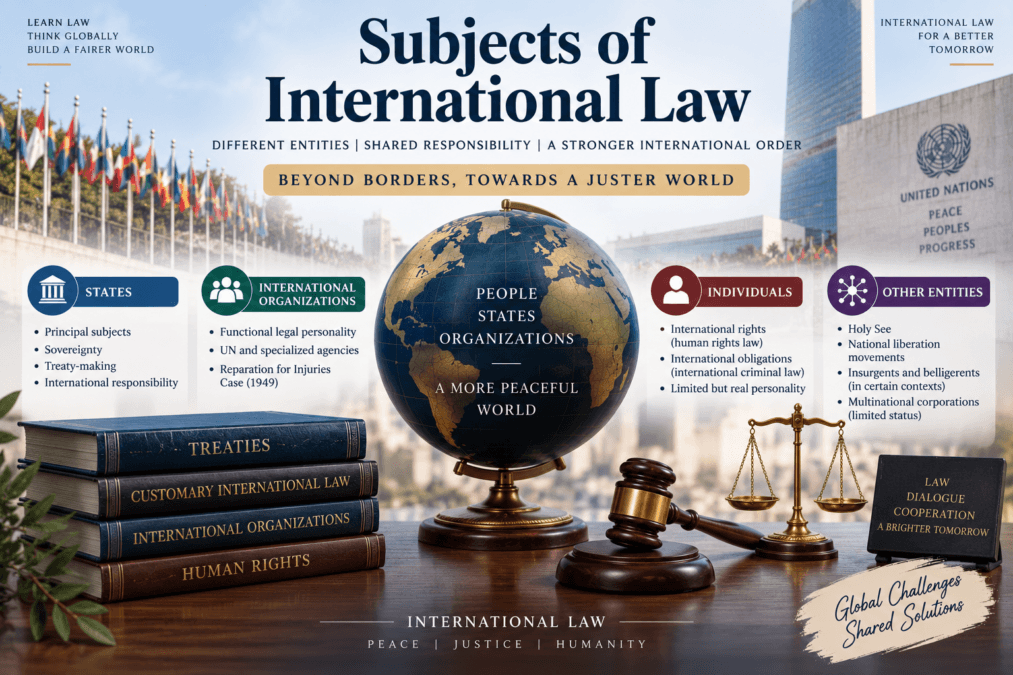
Subjects of International Law
Introduction
The concept of Subjects of International Law is fundamental to understanding who can possess rights, bear obligations, and have legal capacity under international law.
Traditionally, States were regarded as the principal subjects of international law. With the development of international organizations, international human rights law, international criminal law and other branches of international law, the international legal order has expanded. International organizations and, in particular contexts, individuals and other entities may also possess international legal personality.
However, all subjects do not possess the same rights, obligations or legal capacities. International legal personality is not necessarily identical or unlimited for every entity.
Don’t Miss New Law Opportunities!
Join our WhatsApp community for verified updates on Law Jobs, Internships, Competitions, Scholarships, LLB Notes & more.
The International Court of Justice’s landmark Reparation for Injuries Suffered in the Service of the United Nations (1949) Advisory Opinion is particularly important because the Court recognized that the United Nations possessed international personality and the capacity to operate on the international plane. (International Court of Justice)
1. Meaning of a Subject of International Law
A subject of International Law is an entity that possesses international legal personality and, to the extent recognized by international law, can have international rights and obligations and exercise legal capacities at the international level.
In simple words:
A subject of international law is an entity that is recognized by international law as capable of possessing rights, bearing obligations, or exercising legal capacities under the international legal order.
The extent of these rights and obligations depends upon the nature and legal personality of the particular entity.
Important distinction
It is incorrect to assume that every participant in international relations is automatically a full subject of international law.
For example:
- States have broad international legal personality.
- International organizations generally have personality connected with their constituent instruments and functions.
- Individuals possess certain rights and obligations directly under particular areas of international law.
- Certain other entities may have a limited or special legal status.
Therefore, international legal personality may be full, limited, functional or context-specific.
2. International Legal Personality
The expression international legal personality refers to the capacity of an entity to possess rights and obligations under international law and to exercise legal capacities at the international level.
The most important question is therefore:
What makes an entity a subject?
Depending upon the entity, relevant capacities may include:
- possessing rights under international law;
- bearing obligations under international law;
- making or participating in international agreements where legally authorized;
- bringing or receiving international claims where the applicable law permits;
- enjoying privileges and immunities;
- incurring international responsibility;
- exercising other legal capacities recognized by international law.
These capacities are not identical for all subjects.
3. States as the Principal Subjects of International Law
States remain the central and primary subjects of international law.
A State possesses extensive international legal personality and is capable of:
- entering into treaties;
- maintaining diplomatic relations;
- acquiring and exercising territorial sovereignty;
- possessing rights and obligations under customary international law;
- bringing international claims in appropriate circumstances;
- being held internationally responsible for internationally wrongful acts;
- participating in international organizations;
- exercising jurisdiction subject to international law.
The traditional international legal system was largely constructed around relations between sovereign States.
Why are States regarded as primary subjects?
States possess a comprehensive range of rights and obligations under international law. Their legal personality is not ordinarily derived from another international legal person in the same way that the personality of an international organization is derived from its constituent instrument.
4. Essential Characteristics of States as Subjects
For examination purposes, the following characteristics are important:
1. International legal personality
A State possesses international legal personality and can hold international rights and obligations.
2. Sovereignty
A State exercises sovereignty over its territory and population, subject to applicable rules of international law.
3. Treaty-making capacity
States may enter into international agreements in accordance with international law.
4. International responsibility
A State may incur international responsibility for conduct attributable to it that constitutes a breach of an international obligation.
5. Diplomatic relations
States can establish diplomatic and consular relations with other States in accordance with international law.
6. Participation in international organizations
States may become members of international organizations according to the relevant constituent instruments.
5. International Organizations as Subjects of International Law
The development of international organizations significantly changed the traditional understanding of international legal personality.
International organizations such as the United Nations possess legal personality for purposes connected with their functions.
Their international legal personality is generally functional, meaning that it is connected with the purposes, functions and powers conferred upon them by their constituent instruments and applicable international law.
6. Reparation for Injuries Case, 1949
The most important authority for this topic is:
Reparation for Injuries Suffered in the Service of the United Nations
ICJ Advisory Opinion, 11 April 1949
The issue arose after the assassination of Count Folke Bernadotte, the United Nations Mediator in Palestine, and another member of the UN mission.
The General Assembly asked the International Court of Justice whether the United Nations had the capacity to bring an international claim against the responsible State.
The Court concluded that the United Nations possessed international personality and the capacity to operate on the international plane. The Court’s reasoning was based on the functions and rights conferred upon the Organization by its Charter. (International Court of Justice)
Legal significance
The case established an important principle:
An international organization may possess international legal personality even though it is not a State.
The Court explained that the Charter had conferred upon the United Nations rights and obligations different from those of its Members, and that its functions required international personality. (International Court of Justice)
Exam Point
Reparation for Injuries (1949) is the leading authority on the international legal personality of international organizations.
7. United Nations as a Subject of International Law
The United Nations provides an important example of an international organization possessing international legal personality.
Article 104 of the UN Charter provides:
“The Organization shall enjoy in the territory of each of its Members such legal capacity as may be necessary for the exercise of its functions and the fulfilment of its purposes.”
This provision concerns the legal capacity of the Organization within the territory of its Members. (United Nations Legal Affairs)
The ICJ’s 1949 Advisory Opinion additionally recognized the international personality of the United Nations and its capacity to operate on the international plane. (International Court of Justice)
8. Nature of the Legal Personality of International Organizations
International organizations do not possess exactly the same legal personality as States.
Their powers generally depend upon:
- their constituent instrument;
- purposes and functions;
- powers expressly conferred upon them;
- powers necessary for carrying out their functions, where recognized by applicable international law.
Thus, the personality of an international organization is commonly described as functional or derivative.
Example
The United Nations can exercise legal capacities necessary for fulfilling its purposes, but it does not possess the same general sovereignty as a State.
9. Individuals as Subjects of International Law
The position of individuals is one of the most important developments in modern international law.
Traditionally, international law was primarily concerned with States. Individuals were often treated indirectly through their States.
Modern international law, however, recognizes that individuals can possess certain international rights and obligations directly, particularly in areas such as:
- international human rights law;
- international humanitarian law;
- international criminal law;
- refugee and nationality law in appropriate contexts.
Therefore, individuals can be regarded as subjects of international law to a limited or context-specific extent, rather than as subjects possessing the same comprehensive personality as States.
10. Individuals and International Human Rights Law
Modern international human rights instruments establish rights that belong to individuals.
Examples include rights relating to:
- life;
- liberty;
- equality;
- freedom from torture;
- fair treatment;
- freedom of expression;
- other recognized human rights.
Depending upon the applicable treaty and jurisdictional framework, individuals may also have access to international or regional complaint mechanisms.
This development demonstrates that international law can confer rights directly upon individuals, rather than operating exclusively through States.
11. Individuals and International Criminal Law
Individuals may also bear direct obligations under international criminal law.
International criminal law recognizes individual responsibility for certain international crimes, subject to the applicable legal framework.
Examples include:
- genocide;
- crimes against humanity;
- war crimes;
- aggression, subject to the applicable jurisdictional conditions.
This represents an important departure from the older conception under which international law was viewed primarily as a law between States.
Exam Point
Modern international law recognizes that individuals may possess both international rights and international obligations.
12. International Organizations vs Individuals
| Basis | International Organizations | Individuals |
| Nature of personality | Generally functional/derivative | Limited and context-specific |
| Basis | Constituent instrument and international law | Treaties, customary international law and particular international regimes |
| Rights | Rights necessary or relevant to functions | Human rights and other internationally recognized rights |
| Obligations | May bear international obligations | May bear obligations under international criminal law and other regimes |
| International claims | Possible where legally authorized | Possible only where the applicable legal framework provides |
| Example | United Nations | Individuals under international human rights/criminal law |
13. Other Entities and Special Categories
International law also recognizes certain entities with special or limited international legal status.
Examples discussed in international law include:
- the Holy See;
- the International Committee of the Red Cross in its particular international legal role;
- national liberation movements in specific historical and legal contexts;
- belligerent or insurgent groups in circumstances recognized by international law;
- certain territories or entities possessing a special international status.
However, these categories should not automatically be treated as equivalent to States.
Their legal capacity depends upon the relevant rules of international law and the particular circumstances.
14. The Holy See
The Holy See occupies a distinctive position in international law.
It has historically maintained international relations and participates in international legal and diplomatic affairs.
Its status should be distinguished from the ordinary legal personality of a sovereign State and from the separate legal personality of the Vatican City State.
Exam Point
The Holy See is often discussed as an example of a special subject or international legal person with a distinctive status.
15. National Liberation Movements
National liberation movements have, in certain historical and legal contexts, been recognized as possessing particular international legal capacities.
Their position developed especially in the context of:
- self-determination;
- decolonization;
- armed conflicts concerning national liberation.
However, their legal status is not equivalent to the comprehensive international personality of States.
The exact legal consequences depend on the applicable international rules and the recognition given to the particular movement.
16. Insurgents and Belligerents
International law has historically considered the status of insurgents and belligerents in connection with internal armed conflicts.
Their position may become relevant when an armed group obtains a degree of organization and control and the applicable rules of international humanitarian law become relevant.
However:
Insurgency or belligerency does not automatically make an armed group equivalent to a State.
The legal status must be determined from the applicable rules and circumstances.
17. Are Multinational Corporations Subjects of International Law?
The position of corporations is more limited and specialized.
Multinational corporations participate extensively in international economic relations and may possess rights or obligations under particular international and domestic legal regimes.
However, they should not automatically be described as full subjects of international law equivalent to States.
Their international legal position depends upon the particular legal framework involved, such as:
- investment treaties;
- international commercial arrangements;
- domestic implementing legislation;
- arbitration mechanisms;
- other applicable international rules.
Therefore, for examination purposes, it is safer to describe corporations as participants with particular rights and obligations in certain international legal regimes, rather than as full and general subjects equivalent to States.
18. Subjects and Objects of International Law
This distinction is frequently asked in examinations.
Subject
A subject possesses international legal personality and can, to some extent, possess rights or bear obligations under international law.
Object
An object is something regulated or affected by international law but does not necessarily possess international legal personality.
For example:
States → traditional subjects
International organizations → subjects with functional personality
Individuals → subjects in specific areas
Territory/resources → generally objects of regulation rather than subjects
19. Subjects, Actors and Participants — Important Distinction
The terms subject, actor, and participant should not be used as if they were identical.
Subject of International Law
An entity possessing international legal personality.
International Actor
An entity capable of influencing or participating in international relations.
Participant
A broader expression covering entities involved in international legal processes or international affairs.
Therefore:
Every subject may be an international actor, but not every international actor necessarily has the same degree of international legal personality.
This distinction helps avoid overstatement.
20. Traditional and Modern Approach
| Traditional Approach | Modern Approach |
| State was regarded as the principal subject | States remain central, but the legal order includes additional subjects |
| International law focused mainly on inter-State relations | International law also regulates individuals, organizations and other entities |
| Individuals generally acted through their State | Individuals may possess direct international rights and obligations in particular fields |
| International organizations were less prominent | International organizations exercise important international functions |
| International responsibility focused largely on States | International responsibility also applies to international organizations and individuals may incur responsibility under international criminal law |
The modern approach does not eliminate the central role of States. Instead, it recognizes a more complex international legal order.
21. Degrees of International Legal Personality
International legal personality should be understood as a matter of legal capacity, rather than an all-or-nothing concept.
Full or broad personality
States possess the broadest range of international rights, obligations and capacities.
Functional personality
International organizations possess personality connected with their purposes and functions.
Limited or context-specific personality
Individuals and certain other entities possess particular rights or obligations under specific areas of international law.
Exam Formula
International legal personality varies in scope according to the entity and the applicable rules of international law.
22. Important Case: Reparation for Injuries (1949)
Facts
Count Folke Bernadotte, a United Nations Mediator in Palestine, was assassinated while performing his official functions.
Issue
Could the United Nations bring an international claim against the responsible State?
Decision
The ICJ recognized the international personality of the United Nations and its capacity to operate on the international plane. (International Court of Justice)
Importance
The decision established an important foundation for understanding the international legal personality of international organizations.
One-Line Revision
Reparation for Injuries (1949) → International legal personality of the United Nations.
23. Important Legal Principles for Examination
Remember the following propositions:
- States are the principal subjects of international law.
- International organizations may possess international legal personality.
- The personality of international organizations is generally connected with their constituent instruments and functions.
- The UN possesses legal capacity under Article 104 of the UN Charter. (United Nations Legal Affairs)
- The ICJ recognized the international personality of the UN in the Reparation for Injuries Advisory Opinion (1949). (International Court of Justice)
- Individuals may possess international rights under human rights law.
- Individuals may bear international obligations under international criminal law.
- Not every international actor is a subject with the same degree of legal personality.
- International legal personality can be limited or functional.
- International organizations cannot simply be equated with sovereign States.
24. Why the Concept of Subjects is Important
The concept helps answer fundamental questions:
- Who has rights under international law?
- Who bears international obligations?
- Who can incur international responsibility?
- Who can bring an international claim?
- Who can conclude international agreements?
- Who can enjoy privileges and immunities?
- Who can participate in international legal processes?
Understanding subjects therefore provides the foundation for later topics such as:
- State responsibility;
- recognition of States;
- international organizations;
- diplomatic relations;
- international human rights;
- international criminal law;
- treaties;
- peaceful settlement of disputes.
25. Critical Evaluation
The traditional State-centric approach remains important because States continue to possess the broadest international legal personality.
At the same time, contemporary international law cannot be understood solely through relations between States.
The development of international organizations, human rights law and international criminal law has created legal rights and obligations for entities other than States.
However, it would be legally inaccurate to conclude that all such entities have identical status.
The better approach is to recognize different degrees and forms of international legal personality.
26. Summery
Q. Who are the subjects of International Law?
Answer:
Subjects of International Law are entities possessing international legal personality and capable, to the extent recognized by international law, of possessing international rights, bearing obligations or exercising legal capacities.
Traditionally, States were regarded as the principal subjects of international law because they possess broad international legal personality.
With the development of international organizations, the international legal order expanded. International organizations may possess functional international legal personality. In the Reparation for Injuries Advisory Opinion (1949), the ICJ recognized the international personality of the United Nations and its capacity to operate on the international plane. (International Court of Justice)
Individuals also have a more direct position in modern international law. International human rights law grants individuals internationally recognized rights, while international criminal law may impose direct obligations and individual responsibility.
Certain other entities, such as the Holy See and national liberation movements in particular legal contexts, may possess special or limited international legal capacities.
Therefore, modern international law recognizes a plurality of subjects, but their legal personality is not identical. States continue to possess the broadest and most comprehensive international legal personality.
27. Short Notes for Revision
State
The principal subject of international law with broad international legal personality.
International Organization
An organization established by international agreement or other international legal instrument and possessing legal personality to the extent recognized by its constituent framework and international law.
Individual
A person who possesses certain international rights and may bear certain international obligations under specific international legal regimes.
International Legal Personality
The capacity to possess rights and obligations and exercise legal capacities under international law.
Reparation for Injuries Case
The 1949 ICJ Advisory Opinion recognizing the international personality and international legal capacity of the United Nations.
Functional Personality
The legal personality of an international organization connected with its purposes and functions.
28. Frequently Asked Questions
1. Are States subjects of International Law?
Yes. States are the principal and most comprehensive subjects of international law.
2. Are international organizations subjects of International Law?
Yes, where international law recognizes their legal personality. Their personality is generally functional and connected with their constituent instruments and functions. The ICJ recognized the international personality of the United Nations in Reparation for Injuries (1949). (International Court of Justice)
3. Are individuals subjects of International Law?
Individuals may be regarded as subjects in specific areas because international law can confer rights directly upon them and impose certain obligations directly upon them.
4. What is the leading case on international legal personality of international organizations?
Reparation for Injuries Suffered in the Service of the United Nations, ICJ Advisory Opinion (1949).
5. Do all subjects have the same international legal personality?
No. The scope of international legal personality varies according to the entity and the applicable rules of international law.
29. Quick Revision Chart
Subjects of International Law
↓
States
→ Principal subjects
→ Broad legal personality
→ Treaties, responsibility, diplomacy, international claims
↓
International Organizations
→ Functional/derivative personality
→ UN, specialized organizations, etc.
→ Reparation for Injuries (1949)
↓
Individuals
→ Direct rights in human rights law
→ Direct obligations in international criminal law
→ Limited/context-specific personality
↓
Special Entities
→ Holy See
→ National liberation movements in relevant contexts
→ Other entities with particular legal status
Core Principle
International legal personality is not identical for every entity; its scope depends on the applicable rules of international law.
Authoritative sources examined
- International Court of Justice — Reparation for Injuries Suffered in the Service of the United Nations (1949)
Examined for the international legal personality of the United Nations and its capacity to operate on the international plane. (International Court of Justice) - United Nations Charter, Article 104
Examined for the legal capacity of the United Nations in the territories of its Members. (United Nations Legal Affairs) - United Nations International Law Commission materials
Examined to confirm the place of subjects of international law within the broader development and codification of international law. (United Nations Legal Affairs)
Author
About the Author: Dr. Rekha Khandelwal, Ph.D. in Law, is a legal academic and researcher specializing in legal education, research, and contemporary legal developments.
Read more about Dr. Rekha Khandelwal → [Author Profile]
Explore
Unit 1: Foundations of International Law
- Meaning, Definitions, Nature, Scope and Importance of International Law
- Basis, Binding Force and Sanctions of International Law
- Historical development of International Law
- Sources of International Law-Basic Introduction
Don’t Miss New Law Opportunities!
Join our WhatsApp community for verified updates on Law Jobs, Internships, Competitions, Scholarships, LLB Notes & more.
Explore More