
Statehood and Sovereignty in International Law
Introduction
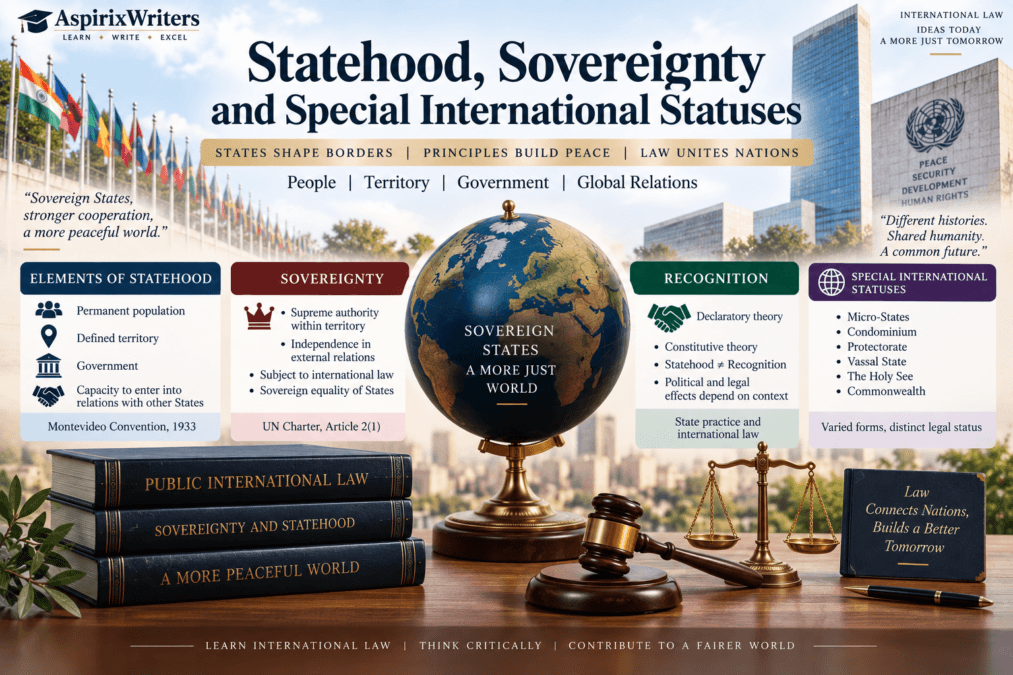
The concept of the State is central to Public International Law. States remain the principal subjects of the international legal order and possess the broadest range of international rights, obligations and legal capacities.
To understand International Law, it is therefore necessary to understand:
- what constitutes a State;
- the essential elements of statehood;
- the meaning and scope of sovereignty;
- sovereign equality;
- recognition of States;
- the distinction between Statehood and recognition;
- special international statuses such as micro-States, protectorates, condominiums, the Holy See and the Commonwealth.
The traditional concept of statehood has developed over time. Modern international law also places important limits on the exercise of State sovereignty, including obligations relating to the prohibition of force, peaceful settlement of disputes, human rights and self-determination.
1. Meaning of a State
A State is a political and legal entity possessing international legal personality and exercising governmental authority over a population and territory, subject to international law.
There is no single universally applicable treaty definition of a State in all contexts. However, Article 1 of the 1933 Montevideo Convention on Rights and Duties of States provides a widely used formulation.
It states that a State as a person of international law should possess:
- a permanent population;
- a defined territory;
- government; and
- capacity to enter into relations with other States.
These four elements are commonly used as the starting framework for analysing statehood.
Permanent population + defined territory + government + capacity to enter into international relations = classic Montevideo criteria for statehood.
2. Essential Elements of Statehood
2.1 Permanent Population
A State must have a permanent population.
The requirement does not mean that the population must be large. International law does not prescribe a minimum population size.
What matters is the existence of a stable human community associated with the territory and governmental organization of the State.
Important Point
Population size is not the decisive test of statehood.
A State may have a comparatively small population and nevertheless possess international legal personality if the other relevant requirements are satisfied.
3. Defined Territory
A State must possess a defined territory.
Territory provides the geographical framework within which a State ordinarily exercises its governmental authority.
However, the existence of a State does not necessarily require that every portion of its boundary be completely free from dispute.
A defined territory does not necessarily mean that every boundary must be finally settled and undisputed.
International practice demonstrates that territorial disputes can exist between States without automatically eliminating the statehood of the States concerned.
4. Government
A State must have a government or governmental organization capable of exercising authority.
Government is important because statehood involves the existence of an organized political authority capable of administering the territory and population.
The effectiveness and continuity of governmental authority may become particularly important where the existence or continuity of a State is disputed.
5. Capacity to Enter into Relations with Other States
The fourth Montevideo criterion is the capacity to enter into relations with other States.
This criterion relates to the State’s international legal capacity and independence in conducting external relations.
It includes the ability, within the limits of international law, to:
- conduct diplomatic relations;
- conclude international agreements;
- participate in international organizations;
- communicate with other States;
- assume international rights and obligations.
Important Distinction
The criterion is about capacity, not merely the existence of actual diplomatic relations with every other State.
6. Montevideo Convention and Statehood
The Montevideo Convention on Rights and Duties of States, 1933 is frequently used in international law textbooks and academic discussions as the classic formulation of the elements of statehood.
Article 1 identifies:
permanent population + defined territory + government + capacity to enter into relations with other States.
Article 3 further provides that the political existence of a State is independent of recognition by other States.
Caution for Students
The Montevideo Convention should be used as a classic legal formulation of statehood, not as a simplistic four-point test that resolves every modern statehood question automatically.
Issues such as self-determination, unlawful use of force, territorial acquisition, recognition and international organization membership may affect the legal analysis in particular circumstances.
7. Statehood and Recognition
A very important distinction is:
Statehood
Concerns whether an entity qualifies as a State under international law.
Recognition
Concerns the position taken by another State regarding the existence or status of that entity.
These concepts are closely connected but are not identical.
The United Nations itself explains that recognition of a new State or government is an act that other States and Governments may grant or withhold; the UN as an organization is not itself a State or government and does not possess authority to recognize a State.
8. Declaratory Theory of Recognition
Under the declaratory theory, recognition does not create the State. Instead, recognition acknowledges an existing situation of statehood.
This approach is associated with the idea that legal personality arises from international law rather than simply from the political decision of existing States.
Oxford’s treatment of recognition describes the declaratory view as treating recognition as a declaration or acknowledgement of an existing legal and factual situation.
Statehood → Recognition acknowledges it
9. Constitutive Theory of Recognition
Under the constitutive theory, recognition plays a more fundamental role in establishing the international legal personality of an entity.
In its stronger form, the theory treats recognition by existing States as a condition for the creation of international legal rights.
Oxford scholarship describes the constitutive approach as treating recognition as a precondition of legal rights, although modern scholarship also recognizes variations and mixed approaches.
Recognition → Constitutes or completes international legal personality
10. Declaratory and Constitutive Theories Compared
| Basis | Declaratory Theory | Constitutive Theory |
| Role of recognition | Acknowledges existing statehood | Plays a constitutive role |
| Statehood | Exists independently of recognition | Recognition is treated as central to legal personality |
| Focus | Objective/legal conditions | Recognition by existing States |
| Main concern | Statehood precedes recognition | Recognition contributes to international personality |
| Modern debate | Widely important in contemporary scholarship | Exists in different forms; strong versions are contested |
11. Sovereignty: Meaning
Sovereignty refers to the supreme legal authority of a State within its territory and its independence in conducting its external relations, subject to international law.
Sovereignty has both:
Internal dimension
Authority exercised within the State’s territory.
External dimension
Independence of the State in relation to other States.
Modern international law does not treat sovereignty as unlimited power.
A sovereign State remains bound by its international obligations.
12. Sovereign Equality of States
The principle of sovereign equality is expressly recognized in Article 2(1) of the United Nations Charter.
Article 2(1) provides that the United Nations is based on:
“the principle of the sovereign equality of all its Members.”
The principle means that States possess juridical equality even though they may differ significantly in:
- territory;
- population;
- military strength;
- economic capacity;
- political influence.
Important Principle
Legal equality does not mean factual equality.
A small State and a powerful State may have very different material capabilities while remaining legally equal as sovereign States.
13. Sovereignty Is Not Absolute
Modern international law places important legal limits upon sovereignty.
For example, Article 2 of the UN Charter establishes principles concerning:
- sovereign equality;
- fulfilment of Charter obligations in good faith;
- peaceful settlement of disputes;
- prohibition of the threat or use of force;
- assistance to UN action;
- non-intervention subject to the Charter’s framework.
Therefore:
Sovereignty means legal independence, not unlimited freedom from international law.
14. Sovereignty and Non-Intervention
The principle of non-intervention protects States against unlawful interference in matters falling within their domestic jurisdiction.
The principle must, however, be understood within the broader framework of the UN Charter.
In Military and Paramilitary Activities in and against Nicaragua (Nicaragua v. United States), the ICJ addressed the principles of sovereignty, non-intervention and the prohibition of force. The Court stated that Nicaragua’s sovereignty and political independence had to be respected and found violations of customary international law relating to intervention, use of force and sovereignty.
Exam Point
Nicaragua v. United States (1986) → sovereignty + non-intervention + prohibition of force.
15. Sovereignty and Territorial Authority
A State normally exercises authority over its territory.
This territorial sovereignty includes governmental authority over:
- land territory;
- internal waters;
- territorial aspects of jurisdiction recognized by international law;
- persons and activities within its territory, subject to applicable international obligations.
However, territorial sovereignty is not a licence to violate international law.
16. State Sovereignty and Self-Determination
Modern international law also recognizes the importance of the principle of self-determination of peoples.
The relationship between territorial sovereignty and self-determination can become particularly important in situations involving:
- decolonization;
- non-self-governing territories;
- foreign occupation;
- claims to independence.
The ICJ’s Western Sahara Advisory Opinion (1975) is an important authority. The Court concluded that the materials before it did not establish a territorial sovereignty tie between Western Sahara and Morocco or the Mauritanian entity of the kind that would affect the application of the principle of self-determination in the decolonization process.
Exam Point
Western Sahara (1975) → self-determination and territorial sovereignty.
17. Micro-States
A micro-State is generally understood as a State with a very small population and/or territory.
Examples commonly discussed in international law include:
- Liechtenstein;
- Monaco;
- San Marino;
- Nauru;
- Tuvalu.
The important legal point is that small size does not by itself prevent statehood.
A micro-State can possess international legal personality and enjoy sovereign equality with other States.
The legal equality of States is reflected in Article 2(1) of the UN Charter.
Exam Point
Small population or territory ≠ absence of statehood.
18. Condominium
A condominium is a territory over which sovereignty is exercised jointly by two or more States pursuant to an applicable international arrangement.
It is therefore different from ordinary exclusive territorial sovereignty.
Important Features
- joint exercise of authority;
- based on an international arrangement;
- sovereignty is shared rather than exclusively exercised by one State;
- historically unusual and relatively rare.
Exam Definition
Condominium is a territorial arrangement in which two or more States jointly exercise sovereignty over a territory.
19. Protectorate
A protectorate is a historical form of international relationship in which one State exercised a significant degree of control or protection over another political entity, particularly in external affairs, while the protected entity retained some internal authority.
The exact legal status depended upon the treaty or arrangement creating the relationship.
Important Caution
A protectorate should not automatically be treated as equivalent to a fully sovereign State.
The legal rights and obligations depended upon the particular international arrangement.
20. Vassal State
The concept of a vassal State belongs largely to historical international relations.
A vassal relationship involved a subordinate political entity owing specified obligations to a superior power while retaining varying degrees of internal autonomy.
Its legal character depended upon the historical period and the particular relationship.
Exam Point
Vassalage should primarily be understood as a historical form of unequal political relationship, rather than as a normal contemporary category of sovereign Statehood.
21. The Holy See
The Holy See occupies a distinctive position in international law.
It should be distinguished from:
- the Vatican City State; and
- the Roman Catholic Church as a religious institution.
The Holy See has long participated in international diplomatic relations and treaty-making.
It therefore represents an important example of a special international legal personality.
22. Commonwealth
The Commonwealth of Nations is an association of independent and sovereign States.
Its existence does not mean that member States lose their sovereignty.
Each member remains an independent State under international law.
Therefore:
Membership in the Commonwealth does not create a single sovereign State.
The Commonwealth should not be confused with historical forms of imperial political control.
23. Special Statuses — Comparative Table
| Concept | Basic Meaning | Present Legal Significance |
| Micro-State | Very small State in territory and/or population | Fully capable of statehood if applicable legal conditions are satisfied |
| Condominium | Territory under joint sovereignty of two or more States | Exceptional territorial arrangement |
| Protectorate | Historical relationship involving protection/control by another power | Legal status depends on the underlying arrangement |
| Vassal State | Historical subordinate political relationship | Primarily historical |
| Holy See | Distinct international legal entity with special status | Maintains diplomatic and international relations |
| Commonwealth | Association of independent sovereign States | Members retain separate sovereignty |
24. Statehood, Sovereignty and Recognition — Relationship
These three concepts should be kept separate.
Statehood
Who is a State?
Sovereignty
What is the nature of the State’s legal authority and independence?
Recognition
How do other States respond to the existence or status of that entity?
Simple Diagram
STATEHOOD
Permanent Population
↓
Defined Territory
↓
Government
↓
International Relations Capacity
↓
International Legal Personality
Then:
SOVEREIGNTY
→ Internal authority
→ External independence
→ Subject to international law
And:
RECOGNITION
→ Diplomatic/legal acknowledgement by other States
→ Legal effects depend on context
25. Sovereign Equality vs Political Equality
These terms should not be confused.
Sovereign Equality
Means equality in legal status as sovereign States.
Political Equality
Does not mean that all States have identical political influence.
For example, States may differ substantially in:
- population;
- economic strength;
- military capabilities;
- diplomatic influence;
- institutional voting arrangements.
Yet the principle of sovereign equality remains a foundational principle of the UN Charter.
26. Statehood and United Nations Membership
UN membership and Statehood are closely related but should not be treated as identical concepts.
Under Article 4 of the UN Charter, membership is open to peace-loving States that accept the obligations of the Charter and, in the judgment of the Organization, are able and willing to carry out those obligations. Admission occurs through a General Assembly decision upon the recommendation of the Security Council.
The United Nations also clarifies that it does not itself recognize States or Governments. Recognition is an act that other States and Governments may grant or withhold.
UN membership is evidence of international standing but should not be mechanically equated with the legal concept of recognition.
27. Statehood and Territorial Disputes
A State may have a territorial dispute without automatically losing its status as a State.
The existence of a disputed boundary should therefore be distinguished from the basic requirement of a defined territory.
International courts may examine:
- treaties;
- historical title;
- effectivités;
- conduct of States;
- colonial boundaries;
- applicable principles of international law.
For example, in Territorial and Maritime Dispute (Nicaragua v. Colombia), the ICJ examined sovereignty over disputed maritime features and considered treaty arrangements, uti possidetis juris, and State acts displaying authority (effectivités).
28. Uti Possidetis Juris — Basic Introduction
Uti possidetis juris is a principle associated particularly with decolonization and the determination of territorial boundaries.
In simplified terms, it may preserve the territorial boundaries of former administrative units at the time of independence, subject to the applicable legal circumstances.
The ICJ has considered the principle in territorial disputes, including Nicaragua v. Colombia.
Important
A detailed study of territorial sovereignty and uti possidetis juris belongs more appropriately to the later Unit on State Territory and Territorial Sovereignty.
29. Important Cases
1. Western Sahara Advisory Opinion (1975)
Principle: Self-determination and territorial sovereignty in the context of decolonization.
The ICJ concluded that the materials presented did not establish territorial sovereignty ties that would affect the application of the principle of self-determination in the decolonization of Western Sahara.
2. Nicaragua v. United States (1986)
Principle: Sovereignty, non-intervention and prohibition of force.
The ICJ addressed violations of customary international law concerning intervention, use of force and respect for sovereignty.
3. Nicaragua v. Colombia (2012)
Principle: Territorial sovereignty and evidence of title.
The ICJ considered treaty arrangements, uti possidetis juris and effectivités in determining sovereignty over disputed maritime features.
30. Important Legal Provisions
UN Charter Article 2(1)
Sovereign equality of States.
UN Charter Article 2(4)
Prohibition of the threat or use of force against the territorial integrity or political independence of a State, subject to the Charter framework.
UN Charter Article 4
Provides the framework for admission to UN membership.
Montevideo Convention Article 1
Classic four criteria of statehood:
- permanent population;
- defined territory;
- government;
- capacity to enter into relations with other States.
Montevideo Convention Article 3
Political existence of a State is stated to be independent of recognition by other States.
31. Critical Evaluation
The traditional concept of Statehood provides an important starting point, but modern international law cannot always be reduced to a mechanical four-element formula.
Several additional considerations may become relevant, including:
- self-determination;
- prohibition of unlawful acquisition of territory;
- independence;
- recognition;
- international organization practice;
- treaty obligations;
- special circumstances of decolonization;
- continuity and succession.
Similarly, sovereignty should not be understood as unlimited power. Modern international law recognizes sovereign equality while simultaneously imposing obligations concerning peace, force, international cooperation and other matters.
Thus:
Statehood gives an entity international legal personality; sovereignty describes its legal independence and authority; recognition concerns the position of other States toward that entity.
32. Exam-Oriented Answer
Q. What are the essential elements of a State under International Law?
Answer:
The classic formulation is found in Article 1 of the Montevideo Convention on Rights and Duties of States, 1933. A State as a person of international law should possess:
- a permanent population;
- a defined territory;
- government; and
- capacity to enter into relations with other States.
These criteria provide the traditional framework for determining statehood. However, statehood questions may also involve recognition, self-determination, independence, territorial status and other applicable rules of international law.
Q. What is sovereignty?
Answer:
Sovereignty refers to the legal authority and independence of a State, including authority within its territory and independence in its external relations. Modern sovereignty is exercised subject to international law. Article 2(1) of the UN Charter recognizes the principle of sovereign equality of States.
Q. What is the difference between Statehood and Recognition?
Answer:
Statehood concerns whether an entity possesses the characteristics and legal status of a State. Recognition concerns the act by which another State acknowledges or accepts the entity’s status. The declaratory and constitutive theories offer different explanations of the legal significance of recognition.
33. Short Notes
Statehood
The legal status of an entity as a State under international law.
Sovereignty
The legal authority and independence of a State, subject to international law.
Sovereign Equality
The principle that States are legally equal as sovereign entities, expressly recognized by Article 2(1) of the UN Charter.
Micro-State
A State with a very small population and/or territory.
Condominium
A territory subject to joint sovereignty of two or more States.
Protectorate
A historical relationship involving protection or control by another power, the exact legal effects depending on the underlying arrangement.
Holy See
A distinctive international legal entity with an established diplomatic role.
Commonwealth
An association of independent and sovereign States.
Declaratory Theory
Recognition acknowledges an existing state of affairs rather than creating statehood.
Constitutive Theory
Recognition is regarded as having a constitutive role in the creation or completion of international legal personality.
34. Frequently Asked Questions
1. What are the four elements of a State?
Permanent population, defined territory, government, and capacity to enter into relations with other States.
2. Does a State need a large population to qualify as a State?
No. International law does not prescribe a minimum population size as a general criterion of statehood.
3. Is recognition necessary for Statehood?
The issue is debated through declaratory and constitutive theories. The Montevideo Convention states that the political existence of a State is independent of recognition, while scholarship identifies competing theories concerning the legal effects of recognition.
4. Is sovereignty absolute?
No. Modern international law subjects the exercise of State sovereignty to international obligations, including obligations arising under the UN Charter and other applicable rules.
5. What is the leading ICJ case on self-determination and territorial sovereignty discussed here?
The Western Sahara Advisory Opinion (1975) is a major authority on the relationship between territorial claims and self-determination in decolonization.
35. Quick Revision
STATEHOOD
Permanent Population
↓
Defined Territory
↓
Government
↓
Capacity for International Relations
= Classic Statehood Criteria
SOVEREIGNTY
Internal Authority
+
External Independence
+
Subject to International Law
RECOGNITION
Declaratory Theory
→ Recognition acknowledges statehood
Constitutive Theory
→ Recognition has a constitutive role
SPECIAL STATUSES
Micro-State → Small State
Condominium → Joint sovereignty
Protectorate → Historical protection/control arrangement
Vassal State → Historical subordinate relationship
Holy See → Special international legal personality
Commonwealth → Association of independent sovereign States
36. Key Takeaways
- States remain the principal subjects of International Law.
- The classic criteria of statehood are permanent population, defined territory, government and capacity for international relations.
- These criteria are associated with Article 1 of the Montevideo Convention.
- Statehood and recognition are related but distinct concepts.
- Recognition is explained through declaratory and constitutive theories.
- Sovereignty means legal authority and independence, not unlimited power.
- Article 2(1) of the UN Charter recognizes sovereign equality.
- International law places important limits on the exercise of sovereignty.
- Micro-States can possess full international legal personality.
- Condominium involves joint sovereignty.
- Protectorates and vassalage are primarily historical categories whose legal effects depended on particular arrangements.
- The Holy See has a distinctive international legal status.
- The Commonwealth is an association of independent sovereign States.
- Western Sahara (1975) is important for self-determination.
- Nicaragua v. United States (1986) is important for sovereignty and non-intervention.
- Nicaragua v. Colombia (2012) is important for territorial sovereignty and effectivités.
Authoritative and scholarly sources examined
- United Nations Charter, Article 2
Examined for sovereign equality, good faith, peaceful settlement, non-use of force and the Charter framework governing State relations. - UN information on membership and recognition
Examined to distinguish UN membership from recognition and to confirm that recognition of States and Governments is an act performed by States and Governments rather than by the UN itself. - Montevideo Convention on Rights and Duties of States, 1933
Examined for the classic formulation of the elements of statehood and the treaty’s provisions concerning recognition. - Oxford Academic — Brownlie’s Principles of Public International Law
Examined for the declaratory and constitutive theories of recognition. - Oxford Academic — Recognition of States in International Law
Examined for contemporary scholarship on recognition and the continuing debate between declaratory and constitutive approaches. - ICJ — Western Sahara Advisory Opinion (1975)
Examined for self-determination and territorial sovereignty. - ICJ — Nicaragua v. United States (1986)
Examined for sovereignty, non-intervention and the prohibition of force. - ICJ — Nicaragua v. Colombia (2012)
Examined for territorial sovereignty, uti possidetis juris and effectivités.
Author
About the Author: Dr. Rekha Khandelwal, Ph.D. in Law, is a legal academic and researcher specializing in legal education, research, and contemporary legal developments.
Read more about Dr. Rekha Khandelwal → Author Profile
Don’t Miss New Law Opportunities!
Join our WhatsApp community for verified updates on Law Jobs, Internships, Competitions, Scholarships, LLB Notes & more.
Unit 1: Foundations of International Law
- Meaning, Definitions, Nature, Scope and Importance of International Law
- Basis, Binding Force and Sanctions of International Law
- Historical development of International Law
- Sources of International Law-Basic Introduction
- International Law and Municipal Law
Explore