
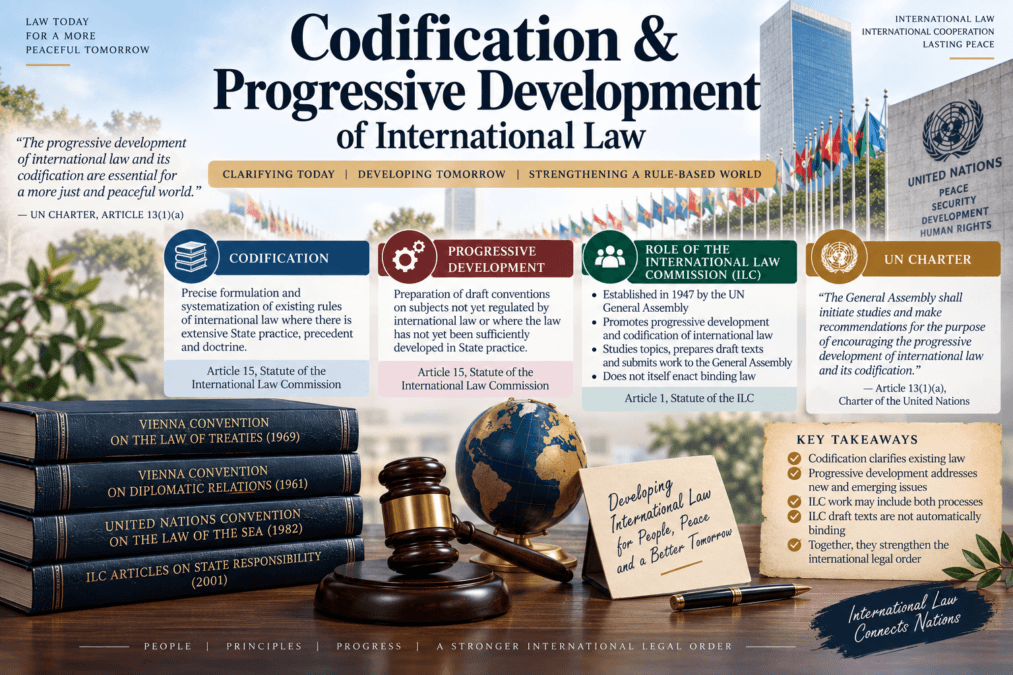
Codification and Progressive Development of International Law
Introduction
International Law is not a completely static body of rules. It develops through treaties, customary international law, judicial decisions, State practice, decisions and resolutions of international institutions, and the work of international law-making and law-developing bodies.
Two important processes in the development of International Law are codification and progressive development.
The distinction between the two is expressly recognized in the Statute of the International Law Commission (ILC). Article 15 defines them separately for the purposes of the ILC’s work.( Article 15, Statute of the International Law Commission, United Nations.)
Don’t Miss New Law Opportunities!
Join our WhatsApp community for verified updates on Law Jobs, Internships, Competitions, Scholarships, LLB Notes & more.
The General Assembly of the United Nations has a Charter-based role in encouraging both processes. Article 13(1)(a) of the UN Charter provides that the General Assembly shall initiate studies and make recommendations for the purpose of encouraging the progressive development of international law and its codification. (Article 13(1)(a), Charter of the United Nations, UN Repertory of Practice.)
1. Meaning of Codification of International Law
What is Codification?
Codification of International Law means the more precise formulation and systematization of rules of international law in areas where there is already extensive State practice, precedent and doctrine.
This is the definition provided by Article 15 of the Statute of the International Law Commission.
In simple terms, codification involves:
Existing international rules → clarification → organization → systematic formulation
Therefore, codification primarily works with areas in which substantial legal material already exists.
Example
If States have followed a particular rule for a considerable period and that rule is supported by State practice, precedent and legal writings, an international law body may examine the existing material and formulate the rule more precisely.
2. Meaning of Progressive Development of International Law
What is Progressive Development?
According to Article 15 of the ILC Statute, progressive development of international law refers, for the purposes of the Statute, to the preparation of draft conventions on subjects that have not yet been regulated by international law or in which the law has not yet been sufficiently developed in State practice. (Article 15, Statute of the International Law Commission.)
In simple terms:
Legal gap / insufficiently developed law → examination and development → proposed legal rules
Progressive development therefore deals more directly with areas in which existing international law is absent, incomplete or insufficiently developed.
3. Codification and Progressive Development Compared
| Basis | Codification | Progressive Development |
| Basic idea | Formulation and systematization of existing rules | Development of rules in areas where law is absent or insufficiently developed |
| Existing legal material | Extensive State practice, precedent and doctrine | Law not yet regulated or insufficiently developed |
| Main emphasis | Clarification and systematization | Development and formulation of further rules |
| ILC Statute | Article 15 | Article 15 |
| Typical output in ILC work | Draft articles and other formulations of existing law | Draft conventions/draft legal rules for further development |
| Relationship with State practice | Relies substantially on existing practice | May involve developing rules beyond sufficiently established practice |
| Objective | Greater precision and coherence | Address legal gaps and emerging or insufficiently regulated areas |
source: Article 15, Statute of the International Law Commission; official ILC explanation of codification and progressive development.
The ILC itself explains that, in practice, its work on a particular topic may contain both codification and progressive development. The two processes may therefore operate together. (International Law Commission, “Object of the Commission” and “Methods of Work”.)
4. Article 13(1)(a) of the UN Charter
The United Nations Charter expressly refers to both concepts.
Article 13(1)(a) provides that the General Assembly shall initiate studies and make recommendations for the purpose of:
“encouraging the progressive development of international law and its codification.” (Article 13(1)(a), Charter of the United Nations, UN Repertory of Practice.)
This provision establishes an important institutional foundation for the development and codification of International Law within the United Nations system.
Significance
Article 13(1)(a):
- recognizes the importance of developing International Law;
- recognizes codification as an international legal function;
- assigns the General Assembly a role through studies and recommendations;
- provides the Charter basis for the work associated with the ILC.
5. International Law Commission
Establishment of the ILC
The International Law Commission (ILC) was established by the UN General Assembly in 1947 to undertake the work associated with the progressive development and codification of International Law. (United Nations International Law Commission, official institutional history.)
Article 1(1) of the ILC Statute states that:
“The Commission shall have for its object the promotion of the progressive development of international law and its codification.”
The ILC is therefore one of the principal institutional mechanisms through which the United Nations contributes to the systematic development of International Law.
6. Role of the International Law Commission
The ILC’s work includes studying areas of International Law, considering State practice and other relevant legal materials, preparing draft texts, and submitting its work through the procedures established by its Statute.
Its work is not equivalent to the work of a domestic legislature.
The ILC does not itself enact binding legislation applicable to all States. The UN’s own explanation of the drafting history of Article 13 notes that States did not confer general legislative power on the United Nations to enact binding rules of International Law. (UN International Law Commission, “Drafting and implementation of Article 13, paragraph 1, of the Charter of the United Nations.”)
Therefore:
ILC work ≠ automatically binding International Law
The legal effect of an ILC text depends upon its nature, subsequent State practice, State acceptance, treaty-making processes, judicial treatment and other relevant circumstances.
7. Codification under the ILC Statute
The ILC Statute contains a specific framework for codification.
Article 18 requires the Commission to survey the whole field of International Law with a view to selecting topics for codification. The Commission may also recommend to the General Assembly the codification of a particular topic considered necessary and desirable. ( Articles 18–24, Statute of the International Law Commission.)
The process can broadly be understood as:
Selection of topic
↓
Study of existing International Law
↓
Examination of State practice, precedent and doctrine
↓
Preparation of draft text
↓
Consideration and comments
↓
Finalization of the Commission’s work
↓
Possible consideration by States / General Assembly / diplomatic conference
The exact procedure depends upon the nature of the topic and the applicable provisions of the ILC Statute.
8. Progressive Development under the ILC Statute
The ILC Statute also establishes procedures for progressive development.
Articles 16 and 17 address different ways in which proposals concerning progressive development may come before the Commission. (Articles 16–17, Statute of the International Law Commission.)
The Commission may therefore work on subjects where:
- International Law has not yet adequately regulated the subject;
- State practice is insufficiently developed;
- new legal questions require systematic consideration; or
- further legal development may be appropriate.
The objective is not simply to record existing law but to contribute to the formulation of legal rules for further consideration.
9. Codification Does Not Always Mean Creation of New Law
This distinction is particularly important for examination purposes.
When a rule is codified, the resulting formulation may reflect:
- an already existing customary rule;
- a clarification or systematization of existing law;
- a rule whose precise formulation has been developed through the codification process; or
- a combination of existing law and further development.
Therefore, the statement:
“Every codified rule is automatically new law”
would be incorrect.
Similarly, it would be incorrect to assume that every provision in a codification treaty automatically represents customary international law applicable to every State.
The legal status of each rule must be determined according to the relevant sources and circumstances.
10. Codification and Progressive Development May Operate Together
The ILC expressly recognizes that the distinction between codification and progressive development is made “for convenience” and that, in practice, a particular project may contain elements of both. (Article 15, ILC Statute; official ILC “Object of the Commission” and “Methods of Work”.)
For example, when an existing body of law is being systematized, examination of that law may reveal gaps or areas requiring further development.
Thus:
Codification → identification of existing rules
and
Progressive development → development of further rules
may occur within the same broader project.
They are conceptually distinguishable under Article 15 of the ILC Statute, but in practical ILC work they may overlap.
11. Examples of Codification and Progressive Development
11.1 Vienna Convention on the Law of Treaties, 1969
The Vienna Convention on the Law of Treaties, 1969 is an important example of the codification and progressive development of the law of treaties.
The official UN materials record that the ILC selected the law of treaties as a topic for codification in 1949 and worked on draft articles before the diplomatic conference adopted the Convention in 1969.
The Convention itself recognizes that the codification and progressive development of the law of treaties were achieved through the Convention.
Authoritative source: UN Codification Division, United Nations Conference on the Law of Treaties, 1968–1969; Vienna Convention on the Law of Treaties, 1969.
12. Vienna Convention on Diplomatic Relations, 1961
The Vienna Convention on Diplomatic Relations, 1961 is another major example associated with codification and progressive development.
The United Nations records that the Convention codifies some of the rules governing diplomatic relations between States.
Authoritative source: UN Codification Division, United Nations Conference on Diplomatic Intercourse and Immunities, 1961.
The Convention therefore demonstrates how existing diplomatic practice can be formulated into a systematic international legal framework.
13. Law of the Sea
The development of the modern law of the sea also illustrates the relationship between codification and progressive development.
The United Nations Law of the Sea process resulted in the United Nations Convention on the Law of the Sea (UNCLOS), 1982, which brought together a comprehensive framework concerning maritime zones, navigation, marine resources, environmental protection and other aspects of the law of the sea.
For examination purposes, UNCLOS can be discussed as an important example of the broader development and consolidation of international rules concerning the law of the sea.
Authoritative source: United Nations, Codification Division materials on the Third United Nations Conference on the Law of the Sea.
14. Draft Articles on Responsibility of States for Internationally Wrongful Acts
The Articles on Responsibility of States for Internationally Wrongful Acts, 2001 are an important example of the ILC’s work.
They should, however, not be described as a treaty.
The ILC completed the Articles and submitted them to the General Assembly. The General Assembly took note of the Articles and annexed them to Resolution 56/83.
Authoritative source: International Law Commission, Articles on Responsibility of States for Internationally Wrongful Acts, 2001; UN General Assembly Resolution 56/83.
Exam Point
The Articles are frequently used in international legal argument and judicial reasoning, but they are not themselves a convention creating treaty obligations for all States.
15. Role of State Practice
State practice is particularly important in the development and identification of International Law.
For codification, extensive State practice may provide the material from which existing rules can be formulated and systematized.
For progressive development, the existing practice may be insufficient, requiring consideration of whether and how further rules should be developed.
Therefore:
State practice is relevant to both codification and progressive development, but its function may differ depending upon the legal task being undertaken.
16. Role of Judicial Decisions and Legal Scholarship
Judicial decisions and legal scholarship can assist the study and formulation of International Law.
They may help identify:
- existing rules;
- competing interpretations;
- State practice;
- historical development;
- doctrinal approaches; and
- areas requiring clarification.
However, judicial decisions and scholarly writings should not automatically be treated as independent legislation of International Law.
Their legal significance depends upon the applicable rules concerning sources and subsidiary means.
This topic should be studied together with Article 38 of the Statute of the International Court of Justice, which is dealt with in greater detail in Unit 2: Sources of International Law.
17. Codification and Treaty-Making
Codification frequently results in the preparation of draft articles that may subsequently provide the basis for treaty negotiations.
A simplified sequence may be represented as:
Existing practice and legal materials
↓
ILC study
↓
Draft articles
↓
State comments and consideration
↓
Diplomatic conference / treaty process, where applicable
↓
Convention
The Vienna Convention on the Law of Treaties provides a clear historical example of this type of process.
Authoritative source: UN Codification Division, United Nations Conference on the Law of Treaties, 1968–1969.
However, not every ILC project necessarily ends in a treaty.
18. Is Codification Legally Binding?
Codification itself does not automatically make every formulation legally binding on all States.
The legal effect depends on the instrument and circumstances.
For example:
Treaty
A treaty generally creates treaty obligations for its parties according to the applicable rules of treaty law.
ILC Draft Articles
Draft articles are not automatically treaties merely because the ILC has adopted them.
Customary International Law
A rule may be binding as customary International Law if the requirements for customary law are satisfied.
Therefore, the following distinction is important:
Codification is a legal-development process; it is not itself a universal source of binding obligations.
19. Importance of Codification
Codification is important because it can:
1. Clarify existing rules
It can make complicated or dispersed legal rules more precise.
2. Systematize International Law
It can bring related principles and rules into an organized framework.
3. Promote certainty
Clearer formulation may make international obligations easier to understand.
4. Facilitate international cooperation
States may find it easier to negotiate and apply clearly formulated rules.
5. Support uniform interpretation
Systematic legal texts can provide a common reference point for States and international institutions.
20. Importance of Progressive Development
Progressive development is important because International Law must respond to changing international circumstances.
It can help address:
- emerging technologies;
- environmental problems;
- new forms of international cooperation;
- changing international relations;
- gaps in existing legal regulation;
- new forms of international responsibility; and
- developing areas of international concern.
However, progressive development should not be confused with unilateral creation of binding international law.
The development of International Law involves States, international institutions, treaty processes, State practice, customary law and other recognized legal processes.
21. Codification and Progressive Development in Contemporary International Law
International Law continues to develop as international relations become more complex.
Contemporary issues include:
- climate change and sea-level rise;
- protection of the environment;
- international criminal responsibility;
- cybersecurity;
- technological developments;
- law of the sea;
- protection of individuals;
- international organizations;
- transnational criminal activities; and
- emerging questions concerning new technologies.
The ILC continues to examine selected areas of International Law as part of its mandate.
Authoritative source: United Nations International Law Commission, current programme of work and recent reports.
22. Codification vs Progressive Development vs Unification
These concepts should not be confused.
| Concept | Meaning |
| Codification | Precise formulation and systematization of existing International Law |
| Progressive Development | Development of rules where International Law is absent or insufficiently developed |
| Unification | Bringing different legal rules or systems into greater uniformity |
| Domestic Legislation | Creation of binding law within a State’s domestic legal system |
Codification and progressive development concern the development of International Law; domestic legislation operates within a State’s municipal legal order.
23. ILC and the United Nations General Assembly
The General Assembly has the Charter-based role under Article 13(1)(a) of encouraging progressive development and codification.
The ILC was established by the General Assembly in 1947 to assist in carrying out this broader function.
Therefore:
UN Charter Article 13(1)(a)
↓
General Assembly’s role
↓
International Law Commission
↓
Study, formulation and development of International Law
Authoritative sources: Article 13(1)(a), UN Charter; Articles 1 and 15, ILC Statute.
24. Difference Between Codification and Progressive Development — Short Answer
Codification
Codification means the more precise formulation and systematization of existing rules in areas where there is extensive State practice, precedent and doctrine.
Progressive Development
Progressive development means the preparation of draft conventions concerning subjects not yet regulated by International Law or where the law is not sufficiently developed in State practice.
Key distinction
Codification primarily works with sufficiently developed existing law, whereas progressive development addresses areas where the law is absent or insufficiently developed.
Important qualification
The two may overlap in actual ILC work.
25. Important Legal Provisions
| Provision | Importance |
| UN Charter, Article 13(1)(a) | General Assembly’s role in encouraging progressive development and codification |
| ILC Statute, Article 1 | Object of the ILC |
| ILC Statute, Article 15 | Definitions of codification and progressive development |
| ILC Statute, Articles 16–17 | Procedures concerning progressive development |
| ILC Statute, Articles 18–24 | Procedures concerning codification |
| ICJ Statute, Article 38 | Sources of International Law; studied in greater detail in Unit 2 |
Primary authorities: Charter of the United Nations; Statute of the International Law Commission; Statute of the International Court of Justice.
26. Important Examples
Remember these examples:
- Vienna Convention on the Law of Treaties, 1969 — development/codification of the law of treaties.
- Vienna Convention on Diplomatic Relations, 1961 — codification of rules concerning diplomatic relations.
- UNCLOS, 1982 — comprehensive development and consolidation of the law of the sea.
- Articles on Responsibility of States for Internationally Wrongful Acts, 2001 — important ILC draft text concerning State responsibility; not a treaty.
27. Critical Evaluation
Codification provides greater precision and organization, but the process can be difficult because States may disagree about the content of existing customary law.
Progressive development is also challenging because developing new rules may involve differences in State interests, legal policy and views about the appropriate direction of International Law.
The ILC’s work therefore operates within a balance between:
Stability of existing law
and
Development of International Law
The official ILC explanation notes that the two concepts were deliberately distinguished while recognizing that actual ILC work may contain elements of both.
Authoritative source: International Law Commission, “Methods of Work”.
28. Exam-Oriented Questions
Long Answer Questions
- Define codification and progressive development of International Law.
- Explain the distinction between codification and progressive development.
- Discuss the role of the International Law Commission in the codification and progressive development of International Law.
- Explain Article 15 of the Statute of the International Law Commission.
- Discuss the role of Article 13(1)(a) of the UN Charter.
- Explain the relationship between codification and progressive development.
- Discuss the importance of codification in the development of International Law.
- Explain the role of State practice in codification and progressive development.
- Discuss the legal significance of ILC draft articles.
- Explain the importance of the Vienna Convention on the Law of Treaties as an example of the development of International Law.
Codification and Progressive Development of International Law
Codification and progressive development are two important processes through which International Law is developed.
Under Article 15 of the ILC Statute, codification means the more precise formulation and systematization of rules in fields where there is extensive State practice, precedent and doctrine. Progressive development concerns the preparation of draft conventions on subjects that have not yet been regulated by International Law or where the law is insufficiently developed in State practice.
Article 13(1)(a) of the UN Charter assigns the General Assembly the function of encouraging the progressive development and codification of International Law.
The International Law Commission, established in 1947, performs an important role in this field. Its work may contain elements of both codification and progressive development.
Thus, codification mainly systematizes existing law, while progressive development contributes to the development of further rules in areas where existing International Law is absent or insufficiently developed.
30. Ten-Mark Answer Framework
If asked:
“Discuss Codification and Progressive Development of International Law.”
Use this structure:
Introduction
↓
Meaning of Codification
↓
Meaning of Progressive Development
↓
Article 13(1)(a), UN Charter
↓
International Law Commission
↓
Article 15, ILC Statute
↓
Difference between the two
↓
Relationship and overlap
↓
Examples
↓
Legal significance of ILC work
↓
Conclusion
This structure is suitable for an LL.B. examination answer.
31. Quick Revision
Codification
Existing law → formulation → systematization
Progressive Development
Insufficient/undeveloped law → further formulation → development
UN Charter
Article 13(1)(a)
ILC
Established in 1947
ILC Statute
Article 1 → object of Commission
Article 15 → definitions
Articles 16–17 → progressive development
Articles 18–24 → codification
Key qualification
Codification and progressive development may overlap in actual ILC work.
Important examples
VCLT 1969
VCDR 1961
UNCLOS 1982
State Responsibility Articles 2001
32. Key Takeaways
- Codification and progressive development are distinct but related concepts.
- Article 15 of the ILC Statute provides their principal definitions.
- Codification concerns the precise formulation and systematization of law where extensive legal material already exists.
- Progressive development concerns areas where International Law has not yet regulated a subject or is insufficiently developed.
- Article 13(1)(a) of the UN Charter recognizes the General Assembly’s role in encouraging both processes.
- The ILC was established in 1947 to promote the progressive development and codification of International Law.
- ILC texts are not automatically binding law.
- A draft text may later contribute to treaty-making or may have significance in identifying or developing International Law, depending upon the circumstances.
- Codification and progressive development can occur together.
- The Vienna Convention on the Law of Treaties is an important example of the development and codification of treaty law.
33. Frequently Asked Questions
1. What is codification of International Law?
Codification is the more precise formulation and systematization of International Law in areas where there is extensive State practice, precedent and doctrine.
2. What is progressive development of International Law?
It refers, under Article 15 of the ILC Statute, to the preparation of draft conventions concerning subjects not yet regulated by International Law or where the law is insufficiently developed in State practice.
3. Which Article of the UN Charter deals with codification and progressive development?
Article 13(1)(a) of the UN Charter.
4. Which Article of the ILC Statute defines codification and progressive development?
Article 15.
5. Are ILC draft articles automatically binding on States?
No. An ILC draft text does not become a treaty merely because the ILC adopts it. Its legal significance depends on the nature of the text and subsequent legal developments.
Authoritative sources examined
- Charter of the United Nations — Article 13(1)(a)
Examined through the United Nations Repertory of Practice. - Statute of the International Law Commission — Articles 1, 15–24
Examined through the official United Nations Legal Affairs / ILC materials. - International Law Commission — Object of the Commission
Used to verify the distinction between codification and progressive development and the fact that ILC work may involve both. - International Law Commission — Methods of Work
Used to verify the practical relationship between codification and progressive development. - International Law Commission — Drafting and Implementation of Article 13
Used to verify the institutional background and the distinction between ILC work and legislative power. - United Nations Conference on the Law of Treaties, 1968–1969
Used to verify the history of the Vienna Convention on the Law of Treaties and the ILC’s role. - United Nations Conference on Diplomatic Intercourse and Immunities, 1961
Used to verify the codification role of the Vienna Convention on Diplomatic Relations.
About the Author
Dr. Rekha Khandelwal, Ph.D. in Law, is a legal academic and researcher specializing in legal education, legal research and contemporary legal developments.
Read more about Dr. Rekha Khandelwal →
Don’t Miss New Law Opportunities!
Join our WhatsApp community for verified updates on Law Jobs, Internships, Competitions, Scholarships, LLB Notes & more.
Unit 1: Foundations of International Law
- Meaning, Definitions, Nature, Scope and Importance of International Law
- Basis, Binding Force and Sanctions of International Law
- Historical development of International Law
- Sources of International Law-Basic Introduction
Explore