
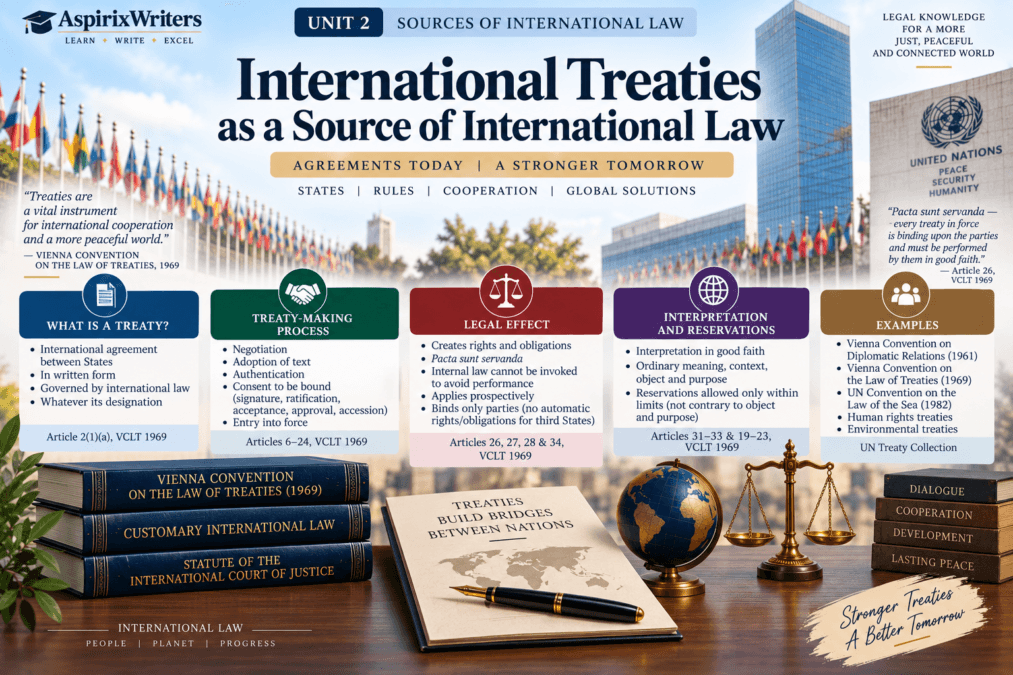
International Treaties as a Source of International Law
Introduction
International treaties are one of the principal sources of International Law. Article 38(1)(a) of the Statute of the International Court of Justice refers to international conventions, whether general or particular, establishing rules expressly recognized by the contesting States.
The modern law governing treaties between States is principally codified in the Vienna Convention on the Law of Treaties, 1969 (VCLT).
The United Nations records that the International Law Commission worked on the law of treaties from 1949 to 1966, adopted draft articles in 1966, and that the Vienna Convention was subsequently adopted in 1969. (United Nations International Law Commission, Law of Treaties)
Join our WhatsApp community for verified updates on Law Jobs, Internships, Competitions, Scholarships, LLB Notes
1. Meaning of an International Treaty
Article 2(1)(a) of the Vienna Convention defines a treaty, for the purposes of the Convention, as an international agreement concluded between States in written form and governed by International Law, whether contained in one instrument or several related instruments and whatever its particular designation.
Unit 1: Foundations of International Law
- Meaning, Definitions, Nature, Scope and Importance of International Law
- Basis, Binding Force and Sanctions of International Law
- Historical development of International Law
- Sources of International Law-Basic Introduction
In simple language
A treaty is an international agreement that creates legal rights and obligations under International Law.
The agreement may be called:
- Treaty
- Convention
- Covenant
- Protocol
- Agreement
- Charter
- Statute
- Pact
- Exchange of instruments
The name alone does not determine its legal character. Article 2(1)(a) expressly provides that the agreement may have whatever particular designation the parties give it.
Authoritative source: Article 2(1)(a), VCLT.
2. Treaty as a Source of International Law
Article 38(1)(a) of the ICJ Statute recognizes international conventions as a source applied by the Court.
Treaties can perform different functions, including:
- creating obligations between States;
- establishing institutional arrangements;
- regulating international cooperation;
- codifying existing rules;
- developing further rules;
- establishing procedures for dispute settlement; and
- creating rights and obligations in specialized areas of International Law.
Examples include treaties concerning:
- human rights;
- diplomatic relations;
- law of the sea;
- international environmental protection;
- international criminal cooperation;
- trade and economic relations; and
- international organizations.
3. Vienna Convention on the Law of Treaties, 1969
The Vienna Convention on the Law of Treaties, 1969 is the central international instrument concerning the general law of treaties.
The Convention was adopted at Vienna on 23 May 1969 and entered into force on 27 January 1980.
The UN Treaty Collection records the Convention as a multilateral treaty deposited with the Secretary-General of the United Nations.
Authoritative source: United Nations Treaty Collection.
Historical development
The International Law Commission selected the law of treaties as a topic for codification in 1949. The Commission completed its draft articles in 1966, after which the General Assembly decided to convene a diplomatic conference.
The United Nations Conference on the Law of Treaties met in Vienna in 1968 and 1969, and the Convention was adopted on 23 May 1969.
Authoritative source: United Nations Conference on the Law of Treaties, 1968–1969.
4. Scope of the Vienna Convention
The VCLT principally regulates treaties between States.
The International Law Commission’s 1966 draft articles were expressly concerned with treaties concluded between States.
The VCLT therefore should not simply be described as regulating every possible international agreement involving every international actor.
A separate 1986 Vienna Convention addresses treaties between States and international organizations and treaties between international organizations.
Authoritative source: United Nations International Law Commission, Treaties concluded between States and international organizations or between two or more international organizations.
5. Essential Characteristics of a Treaty
For examination purposes, the following characteristics are important:
1. International agreement
There must be an agreement at the international level.
2. Between States
For the purposes of the 1969 VCLT, the treaty is an agreement between States.
3. Written form
The VCLT definition concerns agreements in written form.
4. Governed by International Law
The agreement must be intended to operate under International Law.
5. One or more instruments
The agreement may be contained in a single instrument or in several related instruments.
6. Particular designation is not decisive
The agreement may be called a treaty, convention, protocol, agreement or by another name.
Authoritative source: Article 2(1)(a), VCLT.
6. Capacity of States to Conclude Treaties
Article 6 of the VCLT provides that every State possesses capacity to conclude treaties.
This provision reflects the basic principle that States, as subjects of International Law, possess treaty-making capacity.
However, the authority to act for a particular State is a separate question governed by the relevant rules concerning representation and full powers.
7. Who Can Represent a State?
Article 7 of the VCLT deals with the representation of States for the purpose of adopting or authenticating the text of a treaty or expressing the consent of a State to be bound.
Certain officials are treated as representing their State by virtue of their functions, including:
- Heads of State;
- Heads of Government; and
- Ministers for Foreign Affairs,
for the relevant treaty acts specified in Article 7.
Other representatives generally require appropriate full powers, unless the circumstances or established practice indicate otherwise.
8. Negotiation of a Treaty
Treaty-making normally begins with negotiations between States.
During negotiations, States may discuss:
- subject matter;
- rights and obligations;
- institutional arrangements;
- procedures;
- dispute settlement;
- reservations;
- duration; and
- entry into force.
The VCLT regulates the legal stages surrounding the adoption, authentication and expression of consent to be bound.
Authoritative source: Articles 6–18, VCLT.
9. Adoption of the Text
Article 9 of the VCLT deals with the adoption of the text of a treaty.
The adoption of a treaty text and the consent of a State to be bound are different legal stages.
This distinction is important.
Adoption
Concerns agreement upon the text.
Consent to be bound
Concerns the State’s acceptance of legal obligations under the treaty.
Authoritative source: Articles 9 and 11, VCLT.
10. Authentication of the Treaty Text
Article 10 deals with the authentication of the text.
Authentication establishes the text as authentic and definitive.
This stage should therefore be distinguished from the later expression of consent to be bound.
11. Consent to Be Bound by a Treaty
Article 11 provides several ways in which a State may express its consent to be bound, including:
- signature;
- exchange of instruments constituting a treaty;
- ratification;
- acceptance;
- approval;
- accession; or
- another agreed means.
Authoritative source: Article 11, VCLT.
The particular method depends upon the treaty and the circumstances.
12. Signature
Signature may have different legal consequences depending on the treaty and applicable circumstances.
In some cases, signature itself expresses the State’s consent to be bound.
In other cases, the treaty may require subsequent ratification, acceptance or approval.
Authoritative source: Articles 11–14, VCLT.
Important Exam Point
Do not write:
“Every treaty becomes binding as soon as it is signed.”
That is incorrect.
The legal effect of signature depends upon the treaty and the method by which consent to be bound is expressed.
13. Ratification
Ratification is one of the recognized methods through which a State expresses consent to be bound.
Article 14 of the VCLT provides for consent to be expressed by ratification, acceptance or approval in the circumstances specified by the Convention.
Authoritative source: Article 14, VCLT.
Ratification should therefore be distinguished from the earlier act of signature.
Simplified sequence
Signature
↓
Ratification, where required
↓
Entry into force
The exact procedure depends upon the treaty.
14. Accession
Accession is another method of expressing consent to be bound.
Article 15 of the VCLT provides for accession in specified circumstances.
Authoritative source: Article 15, VCLT.
In general terms, accession allows a State to become bound by a treaty in circumstances where the treaty provides for that method.
15. Entry into Force
A treaty does not necessarily become operative merely because its text has been adopted or signed.
Article 24 provides that a treaty enters into force in the manner and upon the date provided in the treaty or as agreed by the negotiating States.
Therefore, treaty students must distinguish:
Adoption → Authentication → Consent to be bound → Entry into force
These are related but legally distinct stages.
16. Pacta Sunt Servanda
One of the fundamental principles of treaty law is pacta sunt servanda.
Article 26 of the VCLT states:
“Every treaty in force is binding upon the parties to it and must be performed by them in good faith.”
Authoritative source: Article 26, Vienna Convention on the Law of Treaties.
Meaning
Once a treaty is in force for its parties, the parties must perform their treaty obligations in good faith.
This principle is fundamental to the reliability of treaty relations.
17. Can a State Use Its Domestic Law to Avoid a Treaty Obligation?
Article 27 of the VCLT establishes an important rule:
“A party may not invoke” its internal law as justification for failure to perform a treaty.
This is an important distinction between:
International level
The State remains responsible for performing its treaty obligations under International Law.
Domestic level
The constitutional or legislative process through which a State gives domestic effect to a treaty may differ from State to State.
This point is particularly important when studying International Law and Municipal Law, which was covered in Unit 1.
18. Non-Retroactivity of Treaties
Article 28 establishes the general rule of non-retroactivity.
Unless a different intention appears or is otherwise established, treaty provisions do not bind a party concerning acts, facts or situations that occurred or ceased to exist before the treaty entered into force for that party.
Exam Point
The general rule is:
Treaty obligations operate prospectively unless the treaty or applicable circumstances indicate otherwise.
19. Territorial Application of Treaties
Article 29 provides that, unless a different intention appears or is otherwise established, a treaty is binding upon each party with respect to its entire territory.
The treaty itself may, however, provide for a different territorial application.
20. Treaties and Third States
A fundamental principle of treaty law is that treaties do not ordinarily create obligations or rights for third States without the conditions required by treaty law.
Article 34 of the VCLT states:
“A treaty does not create either obligations or rights for a third State without its consent.”
This principle is commonly expressed through the maxim:
Pacta tertiis nec nocent nec prosunt
In simplified form:
Agreements do not ordinarily impose obligations or confer rights on third parties without their consent.
21. Interpretation of Treaties
Treaty interpretation is governed principally by Articles 31–33 of the VCLT.
Article 31 establishes the general rule of interpretation.
A treaty is to be interpreted:
“in good faith”
according to the ordinary meaning of its terms, in their context and in light of the treaty’s object and purpose.
Authoritative source: Article 31(1), VCLT.
Article 32
Article 32 allows recourse to supplementary means of interpretation, including preparatory work and the circumstances of the treaty’s conclusion, in the circumstances specified by the Convention.
Authoritative source: Article 32, VCLT.
Article 33
Article 33 addresses interpretation of treaties authenticated in two or more languages.
Authoritative source: Article 33, VCLT.
22. Reservations to Treaties
A reservation is defined in Article 2(1)(d) of the VCLT as a unilateral statement made by a State, however phrased or named, when signing, ratifying, accepting, approving or acceding to a treaty, whereby the State purports to exclude or modify the legal effect of certain provisions of the treaty in their application to that State.
Authoritative source: Article 2(1)(d), VCLT.
Reservations are principally regulated by Articles 19–23.
A reservation cannot be formulated in circumstances prohibited by the treaty or where it is incompatible with the treaty’s object and purpose.
Authoritative source: Article 19, VCLT.
Important distinction
A reservation is not the same as an interpretative declaration.
23. Invalidity of Treaties
The VCLT also contains rules concerning circumstances in which a State’s consent may be affected or a treaty may be invalid.
Relevant provisions include:
- Article 46 — internal law regarding competence to conclude treaties;
- Article 48 — error;
- Article 49 — fraud;
- Article 50 — corruption of a representative;
- Article 51 — coercion of a representative;
- Article 52 — coercion of a State by threat or use of force;
- Article 53 — conflict with a peremptory norm of general International Law.
Authoritative source: Articles 46–53, VCLT.
24. Jus Cogens and Treaties
Article 53 provides that a treaty is void if, at the time of its conclusion, it conflicts with a peremptory norm of general International Law (jus cogens).
Authoritative source: Article 53, VCLT.
Article 64 further addresses the emergence of a new peremptory norm after the conclusion of a treaty.
Authoritative source: Article 64, VCLT.
Exam Point
Jus cogens therefore has a special position in relation to treaty validity.
This topic should be studied in greater detail under Jus Cogens and Related Concepts.
25. Termination and Withdrawal from Treaties
The VCLT contains rules governing termination and withdrawal.
Article 54 deals with termination or withdrawal in accordance with:
- the provisions of the treaty; or
- the consent of all parties after consultation with the other contracting States.
Authoritative source: Article 54, VCLT.
Other provisions address:
- denunciation or withdrawal where no provision exists;
- termination or suspension resulting from breach;
- impossibility of performance;
- fundamental change of circumstances;
- emergence of a new jus cogens norm.
Authoritative source: Articles 56, 60, 61, 62 and 64, VCLT.
26. Fundamental Change of Circumstances — Rebus Sic Stantibus
Article 62 deals with a fundamental change of circumstances as a limited ground for invoking a change in the legal consequences of a treaty.
The Convention imposes strict conditions before Article 62 can be invoked.
Authoritative source: Article 62, VCLT.
Therefore, students should not write:
“A State can withdraw from any treaty whenever circumstances change.”
That is incorrect.
The doctrine is exceptional and subject to the requirements of Article 62.
27. Registration and Publication of Treaties
Article 102 of the Charter of the United Nations provides for the registration and publication of treaties and international agreements entered into by UN Members.
Article 102(1) states that treaties and international agreements entered into by UN Members after the Charter enters into force shall, as soon as possible, be registered with the Secretariat and published by it.
Article 102(2) provides a consequence concerning invocation of an unregistered treaty or international agreement before UN organs.
Important Distinction
Registration is different from the creation of the treaty itself.
28. Treaties and Customary International Law
A treaty and customary International Law are distinct sources, but they may interact.
A treaty may:
- codify an existing customary rule;
- contribute to the development or crystallization of a customary rule; or
- establish treaty obligations applicable to its parties.
The International Law Commission’s 1966 work on the law of treaties expressly recognized that the relationship between treaty law and customary law involves separate legal questions and was not fully covered by the draft articles.
Authoritative source: ILC, Draft Articles on the Law of Treaties with Commentaries, 1966.
29. Treaties and the ICJ
Treaties are directly connected with Article 38(1)(a) of the ICJ Statute.
When a treaty applicable to the parties governs the legal dispute, the ICJ may interpret and apply the treaty according to the relevant rules of International Law.
The Court’s function is to decide disputes submitted to it in accordance with International Law.
Authoritative source: Articles 36 and 38, Statute of the ICJ.
30. Important Principles of Treaty Law
| Principle | Provision | Meaning |
| Treaty definition | Article 2 | Defines “treaty” for VCLT purposes |
| Capacity | Article 6 | Every State has capacity to conclude treaties |
| Representation | Article 7 | Determines who may represent a State |
| Adoption | Article 9 | Adoption of treaty text |
| Authentication | Article 10 | Establishes authentic and definitive text |
| Consent | Articles 11–17 | Methods of expressing consent |
| Entry into force | Article 24 | Treaty enters into force according to treaty/agreement |
| Pacta sunt servanda | Article 26 | Treaties in force must be performed in good faith |
| Internal law | Article 27 | Internal law cannot justify treaty non-performance |
| Non-retroactivity | Article 28 | General rule against retroactive application |
| Territorial application | Article 29 | General territorial rule |
| Third States | Article 34 | No obligations/rights without consent |
| Interpretation | Articles 31–33 | General and supplementary interpretation rules |
| Reservations | Articles 19–23 | Regulation of reservations |
| Invalidity | Articles 46–53 | Grounds affecting treaty validity |
| Termination | Articles 54 onwards | Rules concerning termination/withdrawal |
| Jus cogens | Articles 53 & 64 | Special rules concerning peremptory norms |
Authoritative source: Vienna Convention on the Law of Treaties, 1969.
31. Treaty-Making Process — Quick Flowchart
Stage 1
Negotiation
↓
Stage 2
Adoption of Text
↓
Stage 3
Authentication
↓
Stage 4
Signature / Other Expression of Consent
↓
Stage 5
Ratification / Acceptance / Approval / Accession, where applicable
↓
Stage 6
Entry into Force
↓
Stage 7
Performance in Good Faith
Primary authority: Articles 6–26, VCLT.
32. Important Distinctions
Treaty vs Convention
A convention is one possible designation for an international treaty.
Signature vs Ratification
Signature and ratification are distinct legal acts.
Treaty vs Domestic Law
An international treaty creates obligations at the international level; its domestic legal effect depends upon the constitutional and legal system of the State concerned.
Treaty vs Custom
A treaty is based upon agreement, while customary International Law is identified through general practice accepted as law.
Reservation vs Interpretative Declaration
A reservation purports to exclude or modify the legal effect of specified treaty provisions in their application to the reserving State.
Termination vs Invalidity
Invalidity concerns the legal validity of a treaty or consent to it; termination concerns the ending of treaty relations according to applicable rules.
33. Important Cases for Treaty Law
1. Reservations to the Convention on Genocide, Advisory Opinion (1951)
The ICJ considered the legal issues concerning reservations to the Genocide Convention.
Authority: Reservations to the Convention on the Prevention and Punishment of the Crime of Genocide, Advisory Opinion, ICJ Reports 1951.
This case is important for understanding the development of the law concerning treaty reservations.
2. North Sea Continental Shelf Cases (1969)
The ICJ examined the relationship between treaty provisions and customary International Law.
Authority: North Sea Continental Shelf, Judgment, ICJ Reports 1969.
The case is particularly important when studying whether a treaty provision has become or reflects customary International Law.
3. Gabčíkovo-Nagymaros Project (1997)
The ICJ considered important issues concerning treaty performance, termination, suspension, necessity and changed circumstances.
Authority: Gabčíkovo-Nagymaros Project (Hungary/Slovakia), Judgment, ICJ Reports 1997.
34. Why Treaties Are Important
Treaties are important because they provide a formal mechanism through which States can establish agreed legal rules.
They can:
- create specific international obligations;
- codify areas of International Law;
- facilitate international cooperation;
- establish institutions;
- regulate international relations;
- provide dispute-settlement mechanisms;
- protect human rights;
- regulate international spaces and resources; and
- address emerging international problems.
35. Limitations and Challenges of Treaty Law
Treaties also present certain legal and practical challenges.
1. Consent
Treaty obligations generally depend upon the State’s consent to be bound.
2. Reservations
Reservations can create differences in the legal relationships between treaty parties.
3. Interpretation
Treaty language may require careful interpretation.
4. Compliance
International Law does not operate through a single centralized enforcement authority comparable to a domestic legal system.
5. Relationship with Custom
A treaty rule and customary rule may overlap, but their legal bases must be distinguished.
6. Changing circumstances
Long-term treaties may encounter changed circumstances, but the VCLT imposes strict conditions for invoking them.
36. Summery
International Treaties as a Source of International Law
International treaties are an important source of International Law. Article 38(1)(a) of the ICJ Statute refers to international conventions establishing rules expressly recognized by the contesting States.
The Vienna Convention on the Law of Treaties, 1969 is the principal general international instrument concerning treaties between States. Article 2 defines a treaty for the purposes of the Convention, while Articles 6–18 deal with capacity, representation and consent to be bound.
Article 26 embodies the principle of pacta sunt servanda, requiring treaties in force to be performed in good faith. Articles 31–33 provide rules concerning interpretation, while Articles 19–23 regulate reservations. Articles 46–64 address important questions concerning invalidity, termination and related matters.
Thus, treaties provide an important mechanism for States to create, codify and develop international legal obligations.
37. Long Answer Framework
If the question is:
“Discuss International Treaties as a Source of International Law.”
Use the following structure:
Introduction
↓
Article 38(1)(a), ICJ Statute
↓
Meaning of Treaty
↓
Vienna Convention, 1969
↓
Essential Characteristics
↓
Treaty-Making Process
↓
Consent to Be Bound
↓
Pacta Sunt Servanda
↓
Interpretation
↓
Reservations
↓
Invalidity and Termination
↓
Treaties and Custom
↓
Important Cases
↓
Conclusion
38. Quick Revision
Article 38(1)(a)
International Conventions
VCLT
Vienna Convention on the Law of Treaties, 1969
Article 2
Definition
Article 6
Capacity of States
Article 7
Representation
Articles 11–15
Consent to be bound
Article 24
Entry into force
Article 26
Pacta sunt servanda
Article 27
Internal law
Articles 31–33
Interpretation
Articles 19–23
Reservations
Article 34
Third States
Articles 46–53
Invalidity
Articles 54–64
Termination and related rules
Article 53
Jus cogens
Article 102, UN Charter
Registration of treaties
39. Frequently Asked Questions
1. What is an international treaty?
For the purposes of the VCLT, a treaty is a written international agreement between States governed by International Law, regardless of its particular designation.
2. Which Article recognizes treaties as a source of International Law?
Article 38(1)(a) of the ICJ Statute.
3. What is pacta sunt servanda?
It is the principle under Article 26 of the VCLT that treaties in force are binding upon the parties and must be performed in good faith.
4. Can a State invoke its domestic law to avoid performing a treaty?
As a matter of international treaty law, Article 27 of the VCLT provides that internal law cannot be invoked as justification for failure to perform a treaty.
5. What are the main rules for treaty interpretation?
Articles 31–33 of the VCLT contain the principal rules.
40. Key Takeaways
- Treaties are a principal source of International Law.
- Article 38(1)(a) of the ICJ Statute recognizes international conventions.
- The Vienna Convention on the Law of Treaties, 1969 is the central general treaty-law instrument for treaties between States.
- The name of an international agreement does not by itself determine whether it is a treaty.
- Signature, ratification, accession and entry into force are legally distinct concepts.
- Article 26 establishes pacta sunt servanda.
- Article 27 prevents reliance on internal law as justification for treaty non-performance at the international level.
- Articles 31–33 establish important rules of treaty interpretation.
- Articles 19–23 regulate reservations.
- Articles 46–64 contain important rules concerning invalidity, termination and related matters.
- Treaties and customary International Law may interact, but they remain distinct legal bases.
- Not every treaty provision automatically constitutes customary International Law.
- Article 2 — definition;
- Article 6 — capacity;
- Article 7 — representation;
- Articles 9–10 — adoption and authentication;
- Articles 11–15 — consent;
- Article 24 — entry into force;
- Article 26 — pacta sunt servanda;
- Article 27 — internal law;
- Article 28 — non-retroactivity;
- Article 29 — territorial application;
- Articles 31–33 — interpretation;
- Articles 34–38 — third States;
- Articles 19–23 — reservations;
- Articles 46–53 — invalidity;
- Articles 54–64 — termination and related matters.
3. International Law Commission
The ILC’s official materials on the Law of Treaties were examined to verify the historical development of the Convention and its relationship with the Commission’s codification work.
6. ICJ Cases
The following decisions were selected because they directly assist examination of treaty law:
About the Author
Dr. Rekha Khandelwal, Ph.D. in Law, is a legal academic and researcher specializing in legal education, legal research and contemporary legal developments.
Read more about Dr. Rekha Khandelwal → https://aspirixwriters.com/dr-rekha-khandelwal/
Join our WhatsApp community for verified updates on Law Jobs, Internships, Competitions, Scholarships, LLB Notes