
Cluster Post 3 | Module 9: Academic Career Development
From Concept to Submission Series | 2026
Academic Writing Mastery: The Complete 2026 Guide To Research Papers, Thesis & Dissertation Writing
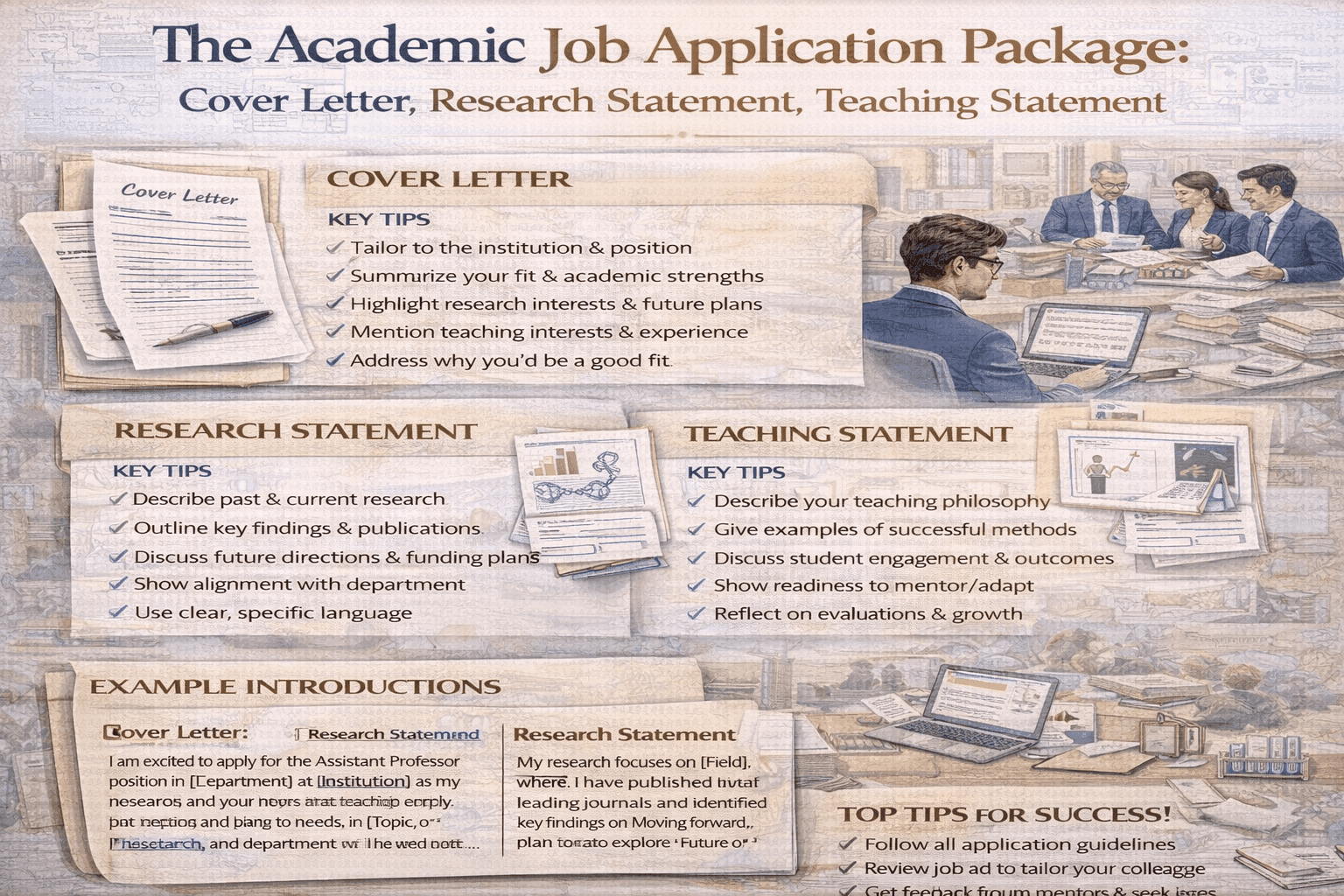
The Academic Job Application Package
The module overview lists the components of an academic application. This post goes deeper: the structural logic of each document, what each one must accomplish that the others do not, the most common errors in each, and worked examples for the sections that most often distinguish competitive from unsuccessful applications.
The Application Package as a Coordinated Argument
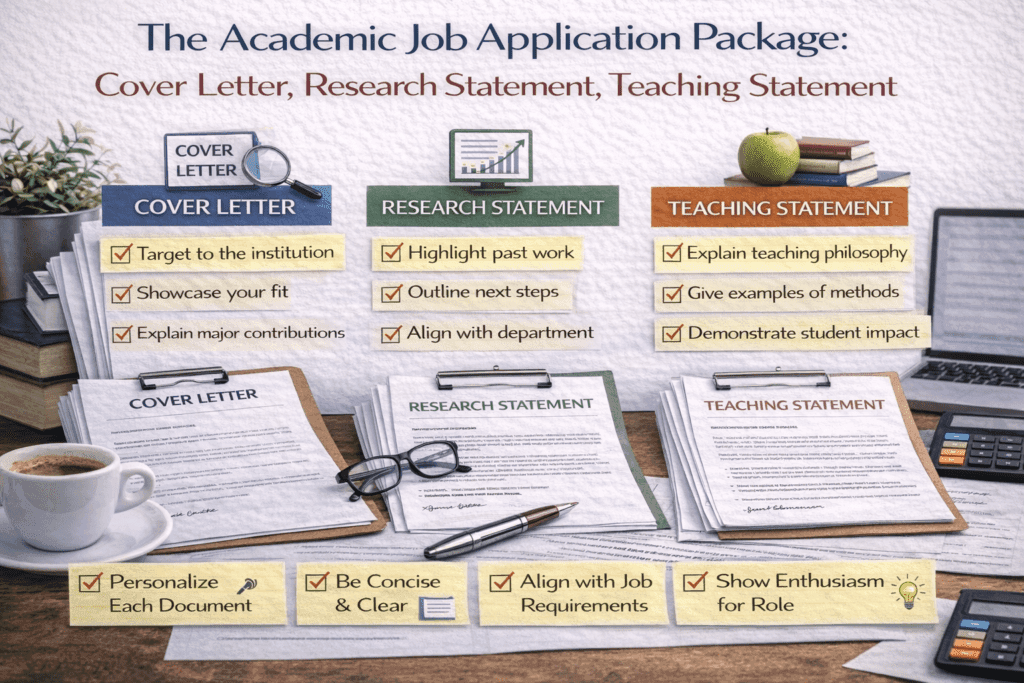
An academic job application is not a collection of independent documents — it is a coordinated argument for why this particular researcher is the right person for this particular position. Each document serves a distinct function, and the package fails when any document either repeats what another has already established or leaves a question unanswered that the search committee needs answered.
| Document | Its specific job |
| Cover letter | Make the argument for fit: why this person for this position at this institution. Synthesises all other documents. The only document that directly addresses the specific position. |
| Research statement | Establish intellectual identity and trajectory: what the research is, what it has produced, where it is going. Must read as a coherent programme, not a list of projects. |
| Teaching statement | Demonstrate teaching competence and philosophy. Must be specific enough to show actual teaching experience, not just aspirations. |
| Writing sample | Provide direct evidence of scholarly quality. No framing needed — the work speaks. |
| Recommendation letters | Provide third-party validation of claims made in other documents. You cannot control these, but you can ensure recommenders have the information they need. |
The Cover Letter: Three Functions, Three Sections
Most cover letters open with a formulaic statement of interest and proceed through the CV chronologically. This structure fails because it does not make an argument — it summarises. A strong cover letter makes three specific arguments in three sections.
Section 1: Why this position (the fit argument)
The first paragraph should name the position specifically, identify something specific about the department or institution that makes this position genuinely attractive, and connect that something to your research or teaching identity. Generic opening sentences — ‘I am writing to apply for the position of Assistant Professor in Constitutional Law’ — are acceptable but miss an opportunity to immediately distinguish the letter.
Generic opening: ‘I am writing to express my interest in the Assistant Professor position in Constitutional Law at [University].’ Specific opening: ‘I am writing to apply for the position of Assistant Professor in Constitutional Law at [University]. [University]’s focus on the intersection of technology, rights, and constitutional governance — reflected in the recently established Centre for Digital Constitutionalism — aligns directly with my research programme on judicial review of AI surveillance under Article 21, and I believe I could contribute both to the Centre’s research agenda and to the constitutional law curriculum.’
Section 2: The research argument
This is the most important section of the cover letter for research-focused positions. It must do three things in two to three paragraphs: describe the completed research (what it found and why it matters), describe the current research (what you are working on now), and describe the research agenda (where the programme is heading over the next five years). The forward-looking component is often omitted by early-career researchers, but it is what hiring committees use to assess long-term potential.
Research argument structure (condensed): ‘My completed thesis develops a proportionality framework for judicial review of AI surveillance under Article 21, drawing on the Puttaswamy judgment’s adoption of German proportionality doctrine. The framework has been accepted for publication at [Journal] and addresses a significant gap in Indian constitutional scholarship: no existing work operationalises the Puttaswamy proportionality standard for technological contexts. I am currently extending this work in two directions.
First, a comparative article examining how Indian proportionality doctrine interacts with EU approaches to AI regulation under the AI Act, under review at [Journal]. Second, an empirical study of how Indian courts have engaged with technical AI evidence — the first systematic study of judicial AI literacy in Indian constitutional adjudication. My five-year research agenda centres on constitutional governance of emerging technologies in democracies with limited regulatory capacity. I plan to develop this into a monograph examining how constitutional courts in India, South Africa, and Brazil have adapted rights frameworks developed before the AI era.’
Section 3: The teaching argument
For positions with teaching responsibilities, the final section should identify specific courses you can teach and connect them to your research. ‘I can teach constitutional law and administrative law’ is weak. ‘My research programme gives me the capacity to develop a new course on technology and constitutional rights — the first such course at the undergraduate level in this faculty — while contributing to the existing constitutional law, administrative law, and human rights courses’ is specific and shows how your appointment adds to the curriculum.
The Research Statement: Building a Coherent Programme
The most common failure of research statements from PhD candidates and early postdocs is that they read as thesis summaries rather than research programmes. A research programme has direction and growth; a thesis summary has a topic. The statement should show that the research is going somewhere.
The three-horizon structure
Research statements work best when they explicitly organise the research into three time horizons: completed (the thesis and resulting publications), current (work in progress), and future (the agenda over five to ten years). This structure demonstrates intellectual continuity and shows the search committee that funding this appointment is an investment in ongoing scholarship, not just the conclusion of a dissertation.
The future research section is where many candidates write vaguely — ‘I plan to extend my research to explore further questions in this area.’ This tells the committee nothing. The future section should name specific projects, their methodological approach, their likely publication venues, and any funding you plan to seek. ‘I am developing a manuscript on judicial AI literacy for submission to [Journal], with a view to eventually developing a monograph. I plan to apply to ICSSR for a research grant to fund the empirical component in Year 2.’
Showing how the research fits the institution
Near the end of the research statement, one paragraph should address how your research connects to the department’s existing strengths or research priorities. This requires genuine research into the department — knowing which faculty work on adjacent topics, which research centres are relevant, and what gaps in the department’s portfolio your appointment would fill.
The Teaching Statement: Specificity Over Philosophy
Teaching statements fail when they consist entirely of pedagogical philosophy without evidence. ‘I believe students learn best through active engagement and critical dialogue’ is an aspiration, not a record. A strong teaching statement is grounded in specific teaching experience and uses philosophical claims only to explain teaching choices that the evidence demonstrates.
The evidence-then-principle structure
Philosophy-first (weak): ‘I believe that legal education should develop students’ capacity for critical analysis rather than rote doctrine memorisation. I therefore use Socratic dialogue and problem-based learning in my classes. Evidence-first (strong): ‘In my Constitutional Law tutorial at [institution], I restructured the problem sets to require students to apply proportionality doctrine to novel factual scenarios before class discussion — moving Socratic engagement from a time-consuming in-class activity to a post-preparation discussion of where students’ applications diverged. Student feedback noted improvement in confidence applying doctrine to unseen problems (end-of-year evaluation: 4.3/5.0 on this dimension, up from 3.6/5.0 the previous year). This reflects my view that legal education should build application skill, not just doctrinal knowledge.’
The worked example demonstrates: a specific teaching innovation, the evidence that it worked, and the pedagogical principle it reflects — in that order. The committee can evaluate whether the approach works; they cannot evaluate philosophy alone.
Legal Research and Writing: Complete Guide for Law Students and Legal Researchers
FAQs
Q: What documents are required for an academic job application in India?
Indian university faculty applications typically require: a completed application form (institution-specific); academic CV; copies of educational certificates and marks sheets; proof of UGC-NET qualification or PhD certificate; API score calculation with supporting documents; publications list with copies or DOI links; no-objection certificate from current employer (if employed); and caste/PwD certificate if applicable. NLU applications additionally require: a research statement; teaching statement or sample syllabus; and sometimes a writing sample. Read each position’s advertisement carefully — requirements vary by institution.
Q: How do you write an academic cover letter?
An academic cover letter (1–2 pages) should: open with the specific position you are applying for and why it is the right fit for your research and teaching; summarise your research agenda in 2–3 sentences (not a paper-by-paper list); describe your teaching experience and approach briefly; explain why this institution specifically — connect your work to faculty members’ research or the department’s strengths; and close with your availability and contact details. Avoid generic cover letters — selection committees identify them immediately. Every letter must demonstrate genuine knowledge of the department you are applying to.
Q: How do you write a research statement for an academic job application?
A research statement (1,000–1,500 words) describes: your current research — the central question you address, your methodology, and your most significant findings; your publications and how they fit together as a research programme; your next project — what you will work on in the next 3–5 years; and how your research connects to broader debates in your field. Write it for an intelligent non-specialist — not a journal article, but an explanation of why your research matters and where it is going. Selection committees assess whether you have a research programme, not just a completed thesis.
Q: What is a teaching statement in an academic job application?
A teaching statement (500–800 words) describes your teaching philosophy and practice. It should include: your core belief about what good teaching in your discipline achieves; specific examples of teaching approaches you use (case studies, Socratic method, problem-based learning); how you assess student learning; how you adapt to diverse student backgrounds; and courses you can teach. Avoid platitudes (‘I believe every student can succeed’) without evidence — selection committees have seen every generic statement. Use one or two specific examples that illustrate your approach concretely.
Q: How do you prepare a writing sample for an academic job application?
A writing sample for an academic job application should be your best published or near-publication-ready piece of work — typically a single journal article or thesis chapter of 7,000–12,000 words. Choose a piece that: demonstrates your strongest analytical writing; shows your research methodology; represents your core research area; and has been through rigorous revision (published or peer-reviewed). Do not submit a rough draft or an early thesis chapter. Some institutions specify the writing sample length or type — follow these requirements exactly. Your writing sample is read carefully by selection committees at shortlisting stage.
References
- Kelsky, K. (2023). The Professor Is In. Penguin.
- Vick, J. M., et al. (2022). The Academic Job Search Handbook (6th ed.). University of Pennsylvania Press.
- Semenza, G. C. (2024). Graduate Study for the Twenty-First Century (3rd ed.). Palgrave.
Next: Cluster Post 4 — The Indian Academic Job Market: UGC-NET, API, Promotions, and Navigating the System
- Module 1 The Complete Guide to Research Paper and Thesis Structure
- Module 2 The Academic Writing Process: Complete Guide from First Draft to Submission (2026)
- Module 3 Research Methodologies: Complete Guide to Quantitative, Qualitative, Mixed Methods & Legal Research (2026)
- Module 4 Data Analysis and Results Presentation: Complete Guide for Quantitative, Qualitative & Legal Research (2026)
- Module 5 Organization and Academic Tone: Complete Guide to Professional Scholarly Writing (2026)
- Module 6 Peer Review and Publication: Complete Guide from Submission to Acceptance (2026)
- Module 7 AI Tools in Academic Research: Opportunities, Ethics, and Best Practices (2026)
- Module 8 Grant Writing and Research Funding: Complete Guide to Finding Money for Your Research (2026)
- Module 9Academic Career Development: Complete Guide to Building Your Professional Life in Research (2026)
Next in series
Module 10 Research Ethics and the IRB Process: Complete Guide to Doing Research Responsibly (2026)
Research Ethics for Legal Researchers: Privilege, Confidentiality, Vulnerable Participants, and the DPDPA 2023
Research Ethics for Legal Researchers Academic Writing Mastery: The Complete 2026 Guide To Research Papers,…
Academic Career Development for Legal Researchers
Academic Career Development for Legal Researchers: NLU Faculty Pathways, Law School Hiring, and Building a…

Grant Writing and Research Funding for Legal Researchers
Academic Career Development: Complete Guide To Building Your Professional Life In Research (2026) Back to…
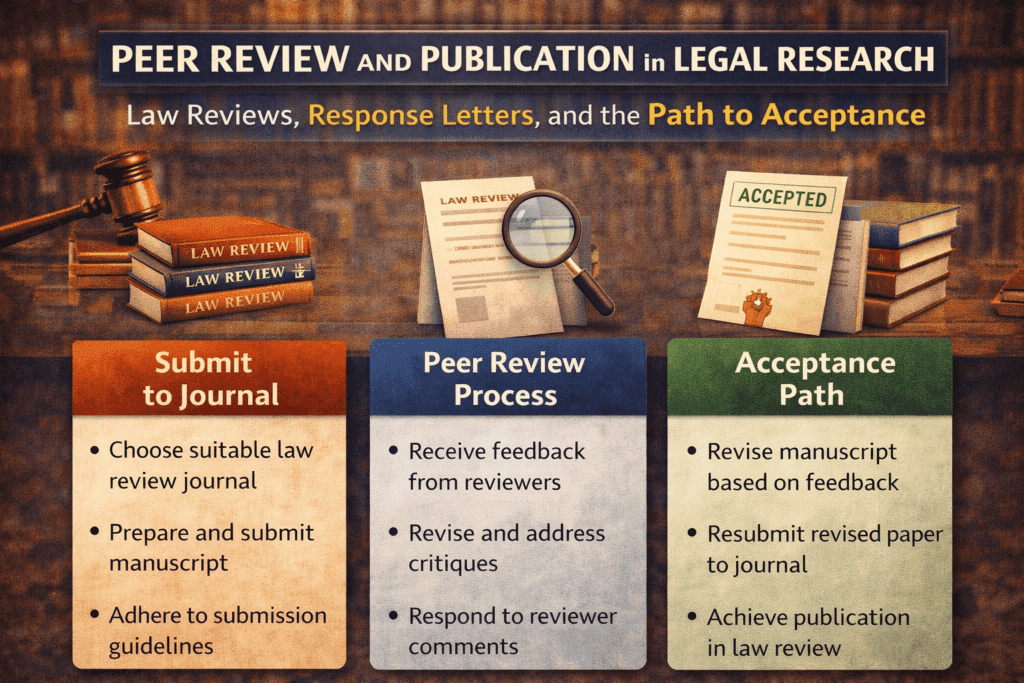
Peer Review and Publication in Legal Research
Peer Review and Publication in Legal Research: Law Reviews, Response Letters, and the Path to…
Academic Writing Mastery: The Complete 2026 Guide to Research Papers, Thesis & Dissertation Writing
Academic Writing Master From Concept to Submission Series Academic Writing Mastery Whether you are writing…

Research Integrity: Data Handling Authorship Ethics and the Indian Regulatory Framework
Cluster Post 5 | Module 10: Research Ethics and the IRB Process From Concept to…