
Cluster Post 1 | Module 6: Peer Review, Responding to Feedback, and Publication Strategies
From Concept to Submission Series | 2026
Academic Writing Mastery: The Complete 2026 Guide To Research Papers, Thesis & Dissertation Writing
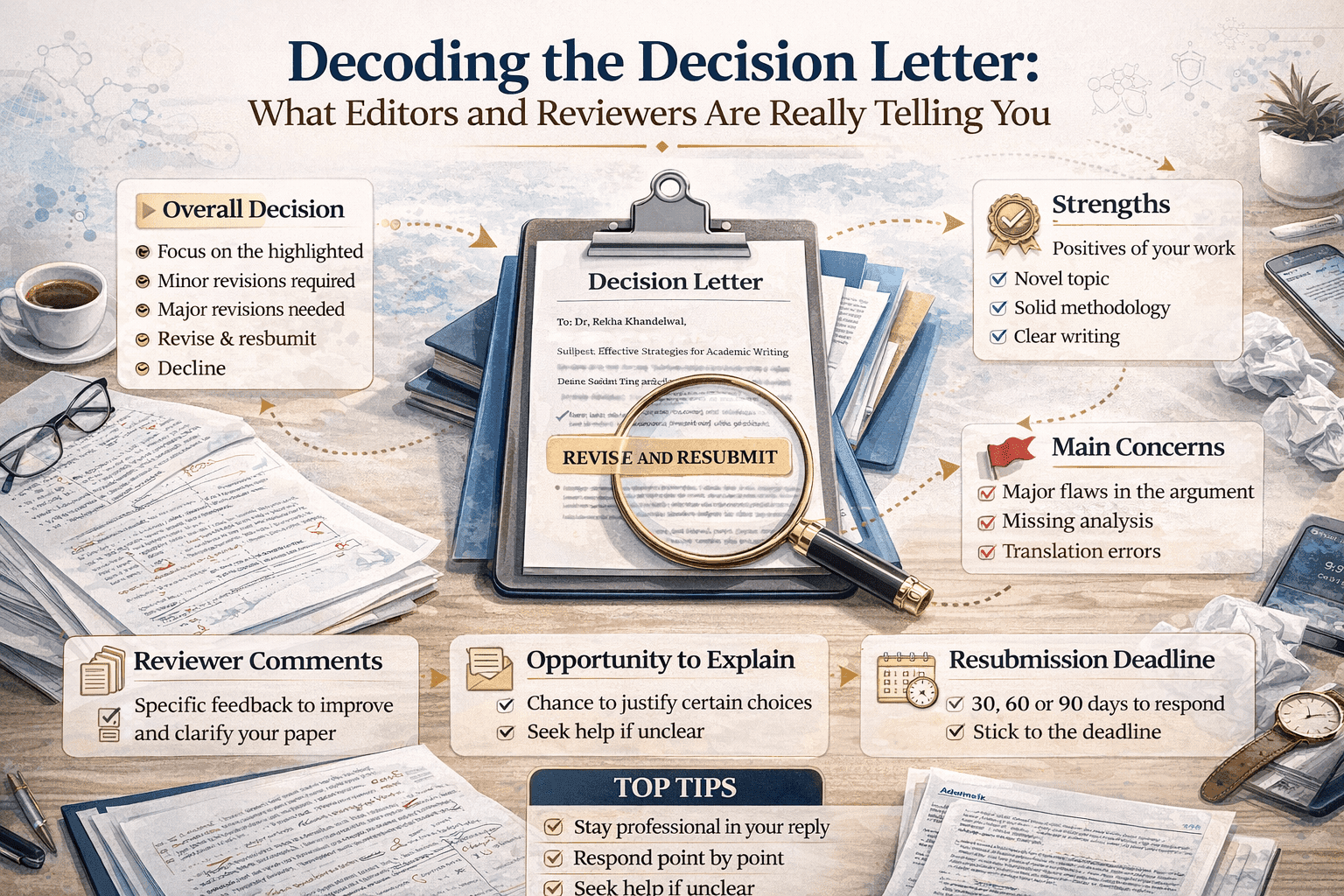
Decoding the Decision Letter: What Editors and Reviewers Are Really Telling You
The module overview describes the five possible outcomes of peer review. This post goes deeper: the honest interpretation behind each decision type, how to read a review report strategically rather than reactively, how to identify which reviewer’s concerns are actually driving the editorial decision, and what the editor’s letter — not the reviewer comments — is really telling you.
Read the Editor’s Letter First
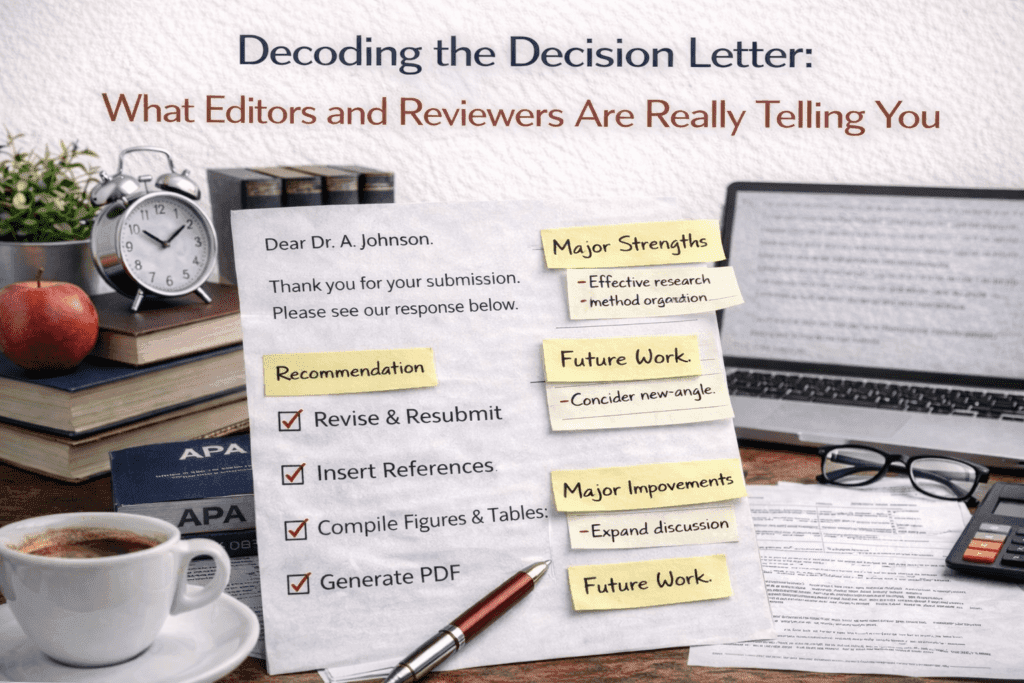
Most researchers open a decision email and immediately scroll to the reviewer comments. This is the wrong order. The editor’s letter comes first for a reason: it synthesises the reviewers’ positions and tells you what the editor actually cares about. The reviewer comments are the raw evidence; the editor’s letter is the verdict.
The editor’s letter tells you three things: the overall decision, the specific concerns the editor considers most important (often not identical to what reviewers emphasised), and implicitly, whether the editor wants the paper or is looking for a reason to reject it. Reading reviewer comments before the editor’s letter means you may spend hours responding to concerns that the editor has already indicated are secondary or dismissed.
Editor’s letter signal reading: ‘Both reviewers found the theoretical contribution valuable, though Reviewer 2 raises methodological concerns that must be addressed before this paper can be considered for publication.’ — This tells you that the theoretical contribution is secure (do not re-litigate it) and that Reviewer 2’s methodological concerns are the deciding issue. Focus your revision energy there. ‘The reviewers raise significant concerns about both the literature review and the methodology. I share these concerns and would need to see substantial revision before this paper could be considered further.’ — This tells you the editor is not yet persuaded. A minimal revision strategy will not work; only substantial changes will satisfy this editor. ‘I was persuaded by the paper’s contribution, though the reviewers have identified areas requiring clarification.’ — This tells you the acceptance decision is essentially made; the revision is about addressing specifics, not defending the paper’s right to exist.
The Five Decisions: Honest Interpretations
The module describes the five outcomes accurately. This section adds what the official descriptions do not say — the subtext that shapes how to respond.
Accept without revisions (fewer than 5% of submissions)
What it officially means: the paper is accepted as submitted. What it really means: the reviewers either had no substantive concerns, had concerns they considered minor enough not to raise, or were junior reviewers unlikely to push back. The paper may still have weaknesses that escaped notice. Accept this decision graciously, read the proofs carefully, and do not introduce new content at the proof stage.
Minor revisions
What it officially means: small improvements needed. What it really means: the editor has decided to accept the paper and is giving you the opportunity to address a small number of remaining concerns. This is not a conditional acceptance that could be reversed by a poor revision — barring a deeply inadequate response letter, the paper will be accepted. The revision is about respect for the reviewers’ remaining concerns, not about re-evaluating the paper’s merit.
Minor revision response letters should be brief and specific. Each concern addressed in two to four sentences. Elaborate defences of decisions already implicitly accepted by the editor waste everyone’s time and occasionally create new doubts where none existed.
Major revisions (revise and resubmit)
What it officially means: significant problems must be addressed. What it really means: this is the most common outcome for papers that will eventually be published, and it is also the outcome with the highest variance. A major revision from a journal with a 10% acceptance rate is not the same as a major revision from a journal with a 40% acceptance rate. At selective journals, major revisions are genuinely conditional — a poor revision leads to rejection. At less selective journals, major revision often means the paper has essentially been accepted and revision is a formality.
The most important question is: does the editor believe in the paper? If the editor’s letter is enthusiastic about the contribution and the major revision requests concern execution rather than conception — methodology, presentation, literature coverage — this is a strong signal. If the editor’s letter is cool and the requests concern the paper’s fundamental argument or contribution, the bar for acceptance is much higher.
Reject and resubmit
What it officially means: serious problems but the topic is promising. What it really means: the reviewers and editor found something valuable but could not accept the current version because it would require changes so substantial that it is effectively a different paper. The crucial distinction from major revision: the revised version will be treated as a new submission, will likely go to new reviewers, and carries no implicit promise of acceptance.
The honest strategic question: given that rejection and resubmit carries the full uncertainty of a new submission, is this venue worth the effort? In some cases the answer is yes — if the journal is a strong fit and your work needs the kind of transformation the reviewers are describing. In other cases, submitting a substantially revised version to a different, better-fit journal is the more efficient path.
Rejection
What it officially means: the paper will not be published here. What it really means: one or more of four things. First, poor fit — the paper is competent but does not match the journal’s audience, scope, or theoretical orientation. This is the easiest rejection to recover from: revise minimally and submit to a better-fit venue. Second, insufficient contribution — the paper is technically sound but does not advance the field enough for this venue. This requires either improving the contribution or targeting a different tier of journal. Third, methodological flaws — fundamental problems with the research design or analysis that undermine the conclusions. This is the hardest rejection; it may require additional data collection or substantial conceptual revision before the work is publishable. Fourth, poor presentation — the argument is unclear, the writing is inadequate, or the organisation is confusing. This is often the most recoverable rejection, since the underlying research may be sound.
Reading Reviewer Comments Strategically
Reviewer comments should be read in the following order, each read serving a different purpose.
First read: orientation (do not take notes)
Read all reviewer comments completely and without stopping to respond mentally to individual points. The purpose of the first read is to understand the overall picture: what do the reviewers think the paper’s problems are, and are those problems about substance, method, or presentation? This read gives you the gestalt before you get lost in details.
Resist the urge to start defending immediately. The emotional reaction — ‘that is not what I said’ or ‘they clearly misread the methodology’ — is natural and usually contains a grain of truth, but it produces defensive responses that editors can recognise. The first read is purely diagnostic. Note your reactions but do not act on them yet.
Second read: categorisation
Go through comments systematically and categorise each one:
- Must-do: Changes the reviewers indicate are required for acceptance, and that the editor has explicitly or implicitly endorsed. These are non-negotiable.
- Should-do: Changes that would strengthen the paper and that are feasible within the revision timeline. These are not required but their absence may invite a negative second review.
- Consider: Suggestions that may or may not improve the paper, depending on your judgment. Implement if they genuinely help; explain why you did not if they do not.
- Politely decline: Requests that are methodologically inappropriate, would require the paper to become something it is not, or reflect a misunderstanding of the paper’s argument. These require a careful, evidence-based explanation in the response letter — not silence.
Third read: identifying the decisive reviewer
Not all reviewers carry equal weight in the editorial decision. In most review processes, one reviewer’s concerns are more closely aligned with the editor’s own assessment of the paper’s problems. Identifying this reviewer allows you to prioritise your revision energy appropriately.
Signals that a reviewer’s concerns are decisive: their concerns are echoed in the editor’s letter; their critique addresses the paper’s contribution rather than its execution; the editor requests that the revision specifically address ‘the concerns of Reviewer 2’; their review is the most detailed and technically engaged. A reviewer who raises many small points without engaging the paper’s core argument is less decisive than one who identifies a fundamental tension in the theoretical framework, even if the former wrote more.
When Reviews Feel Unfair
Reviews that feel unfair fall into two categories that require different responses. The first is a review that is harsh in tone but substantively engaged with the paper. The second is a review that is genuinely wrong about what the paper says or does.
Harsh-but-substantive reviews are common and require no special response strategy — extract the valid concerns, address them, and write a professional response letter. The tone of the review is not your concern; the content is.
Genuinely erroneous reviews — where a reviewer has misread the methodology, attributed to you an argument you did not make, or criticised the paper for failing to do something it explicitly disclaims — are rarer but real. The appropriate response is not to argue with the reviewer but to clarify in your response letter and in the revised manuscript. If a reviewer thought your study was quantitative when it was qualitative, the problem is in your paper — something about the methods section created that impression. Fix the paper, then note in your response letter that you have clarified the methodology to prevent this misreading.
Escalation to the editor — appealing the review — is legitimate only in cases where the review contains factual errors that cannot be addressed through revision, or where a reviewer has a clear conflict of interest. This is a high-stakes action that should be used sparingly. Most perceived unfairness does not meet this bar.
For Law Students
Peer review in Indian law journals
The peer review process at Indian law journals differs in several respects from the international model the module describes. Understanding these differences prepares you for what to expect.
Double-blind review is the standard at most Indian peer-reviewed law journals — NUJS Law Review, NLSIR, NALSAR Law Review, JILI, and most NLU journals. However, the review timelines are typically longer than at international journals, often three to six months or more. Some journals are still transitioning to formalised peer review systems; decisions may be made by editorial boards rather than independent reviewers.
Indian law journal rejection decisions are less likely to include detailed reviewer feedback than international journals. A desk rejection — typically cited as ‘outside the scope of the journal’ or ‘not meeting our quality standards’ — is common and provides little actionable information. If this happens, the appropriate response is to review the journal’s published articles for scope and quality benchmarks, assess whether your work genuinely fits, and either revise for better fit or move to a different venue.
The examiner report in Indian PhD examination
For PhD candidates at Indian universities, the equivalent of the reviewer decision is the examiner’s report submitted after external evaluation of the thesis. Under UGC regulations, a PhD thesis is evaluated by at least two external examiners, typically one from within India and one from abroad (or from a different institution). Their reports may recommend: accept as submitted, accept with minor corrections, accept with major corrections, or reject and resubmit.
Unlike journal peer review, examiner reports in Indian university PhD processes are not always made available to the candidate before the viva. The candidate may receive only a summary or may see the full reports, depending on institutional practice. Understanding this before submission means preparing for the viva without full knowledge of the examiners’ specific concerns — which is why viva preparation must be comprehensive rather than targeted only at known weaknesses.
References
- Silvia, P. J. (2019). How to Write a Lot: A Practical Guide to Productive Academic Writing (2nd ed.). APA.
- Belcher, W. L. (2019). Writing Your Journal Article in Twelve Weeks (2nd ed.). University of Chicago Press.
- Sword, H. (2012). Stylish Academic Writing. Harvard University Press.
- UGC Regulations on Minimum Standards and Procedure for Award of Ph.D. Degrees, 2022. University Grants Commission.
Next: Cluster Post 2 — Writing the Response Letter That Gets Your Paper Accepted
Module 1 (Pillar Post)- The Complete Guide To Research Paper Structure: IMRAD Format, Thesis Organization & Academic Writing (2026)
Module 2 (Pillar Post) –The Academic Writing Process: Complete Guide from First Draft to Submission (2026)
Module 3 (Pillar Post) Research Methodologies: Complete Guide To Quantitative, Qualitative, Mixed Methods & Legal Research (2026)
Module 4 (Pillar Post) : Data Analysis and Results Presentation: Complete Guide for Quantitative, Qualitative & Legal Research (2026)
Module 5 (Pillar Post) : Organization and Academic Tone: Complete Guide to Professional Scholarly Writing (2026)
Next in Series:
- Pillar Post : Peer Review and Publication: Complete Guide from Submission to Acceptance (2026) (Module 6)
- Pillar Post : AI Tools in Academic Research: Opportunities, Ethics, and Best Practices (2026) (Module 7)
- Pillar Post: Grant Writing and Research Funding: Complete Guide to Finding Money for Your Research (2026) (Module 8)
- Pillar Post : Academic Career Development: Complete Guide to Building Your Professional Life in Research (2026) (Module 9)
- Pillar Post : Research Ethics and the IRB Process: Complete Guide to Doing Research Responsibly (2026) (Module 10)

Research Ethics for Legal Researchers: Privilege, Confidentiality, Vulnerable Participants, and the DPDPA 2023
Research Ethics for Legal Researchers Academic Writing Mastery: The Complete 2026 Guide To Research Papers,…

Academic Career Development for Legal Researchers
Academic Career Development for Legal Researchers: NLU Faculty Pathways, Law School Hiring, and Building a…

Grant Writing and Research Funding for Legal Researchers
Academic Career Development: Complete Guide To Building Your Professional Life In Research (2026) Back to…
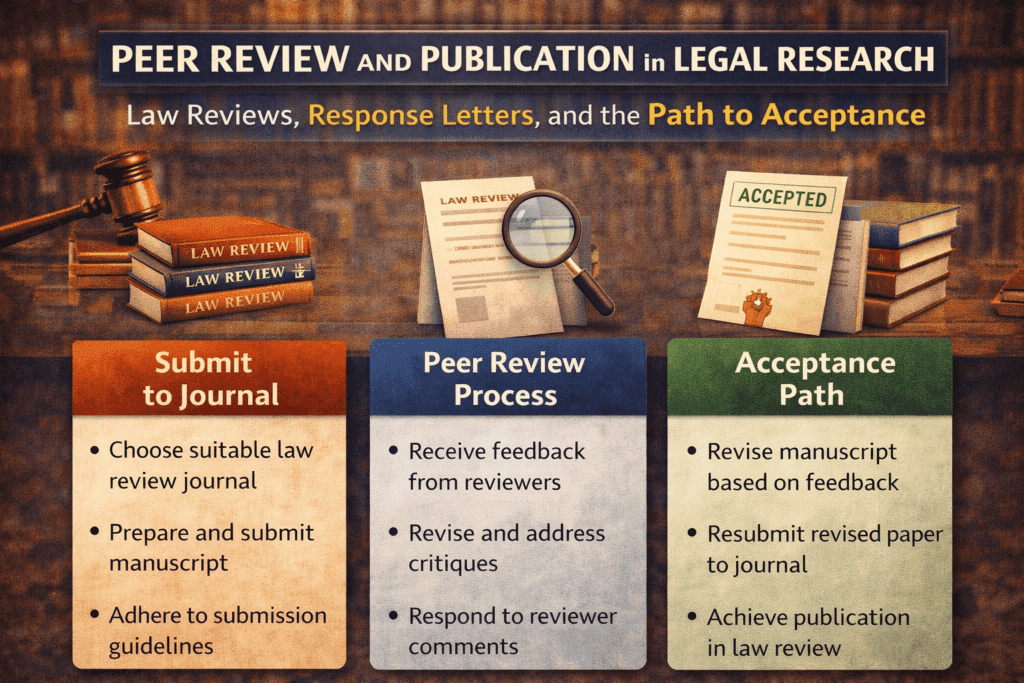
Peer Review and Publication in Legal Research
Peer Review and Publication in Legal Research: Law Reviews, Response Letters, and the Path to…

Academic Writing Mastery: The Complete 2026 Guide to Research Papers, Thesis & Dissertation Writing
Academic Writing Master From Concept to Submission Series Academic Writing Mastery Whether you are writing…

Research Integrity: Data Handling Authorship Ethics and the Indian Regulatory Framework
Cluster Post 5 | Module 10: Research Ethics and the IRB Process From Concept to…