
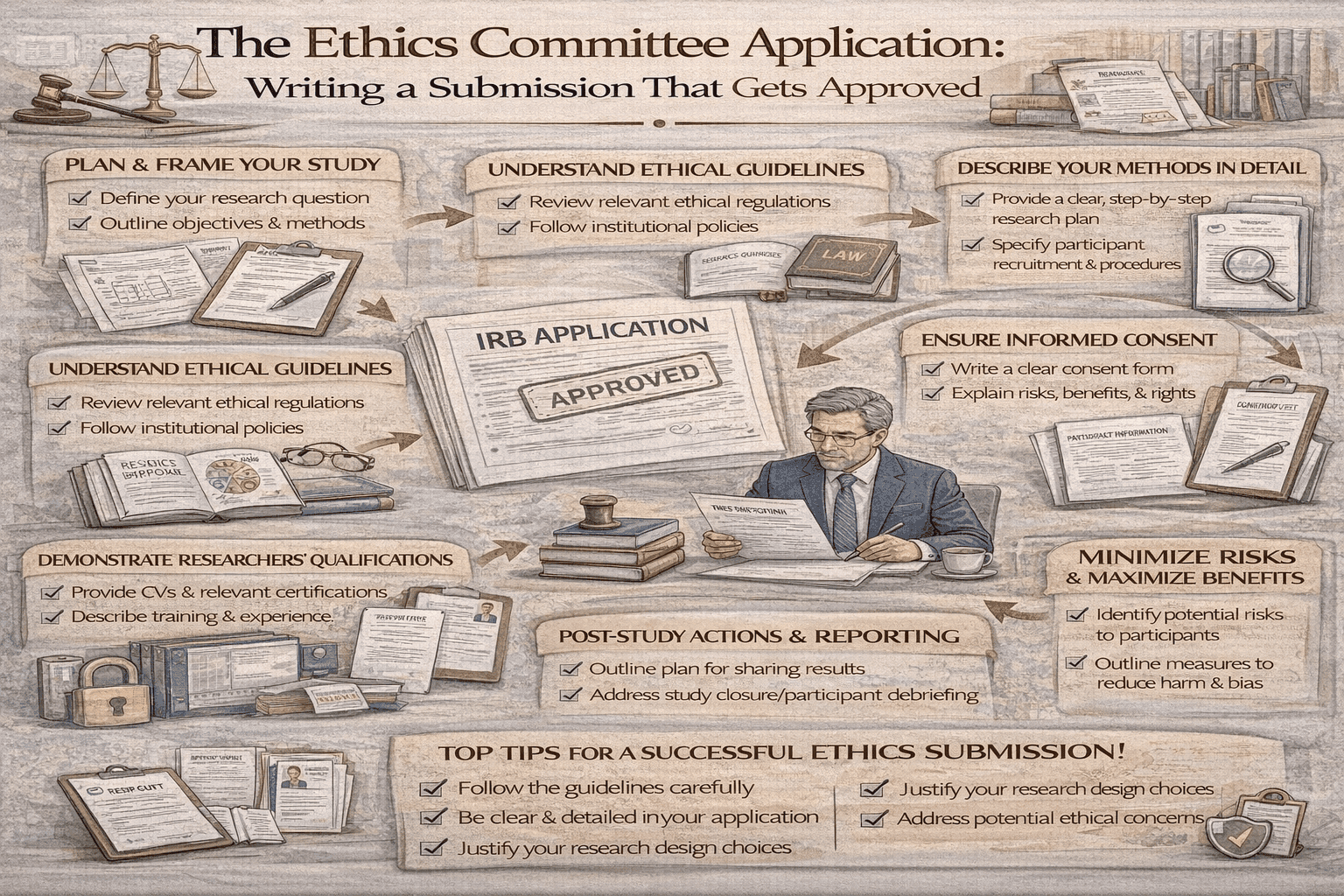
The Ethics Committee Application – Module 10: Research Ethics and the IRB Process
From Concept to Submission Series | 2026
Academic Writing Mastery: The Complete 2026 Guide To Research Papers, Thesis & Dissertation Writing
The Ethics Committee Application
The module overview explains what ethics committee applications require. This post goes deeper: how Indian Institutional Ethics Committees (IECs) actually make decisions, the specific sections that most commonly cause delays or require revision, how to describe risk honestly without triggering unnecessary scrutiny, and the practical differences between the Indian IEC process and international IRB processes.
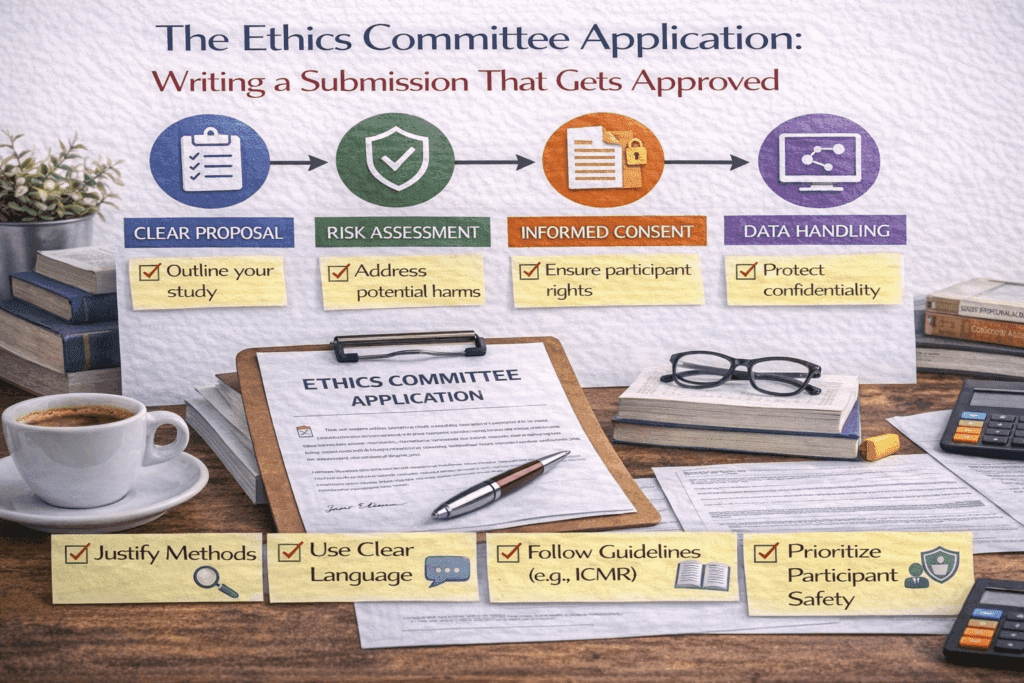
How Indian IECs Actually Make Decisions
The module correctly notes that ethics committees can approve, require modifications, or reject proposals. What it does not describe is the internal decision logic that determines which outcome you receive — and therefore how to write an application that moves efficiently through review.
Indian IECs reviewing social science, education, and law research primarily ask three questions: Is the research genuinely necessary (i.e., does the committee need to protect anyone)? Are the risks to participants proportionate to the research’s potential benefit? Are the researchers competent to handle the risks they have identified?
Most social science and law research at the university level poses minimal risk to participants — interviews with adults about non-sensitive professional topics, surveys on public issues, archival document analysis. For this research, the committee’s real concern is procedural completeness: has the researcher demonstrated they have thought through participant protection systematically? A well-organised, specific application signals methodological competence and usually moves through review quickly. A vague or incomplete application signals that the researcher has not thought carefully about participants — and triggers detailed scrutiny.
The India-Specific Context: ICMR Guidelines and DPDPA
All IECs at Indian universities must follow the ICMR National Ethical Guidelines for Biomedical and Health Research Involving Human Participants (3rd edition, 2023). Although the title references biomedical research, the guidelines apply broadly to all research involving human participants at ICMR-registered institutions — which includes social science, education, and legal research. Researchers in these fields are often unaware of this, and applications that do not reference the ICMR framework may face delays at institutions that require it.
The Digital Personal Data Protection Act 2023 (DPDPA) adds a data governance layer to ethics applications involving personal data. If your research collects, stores, or processes personal data about identifiable individuals — which most interview-based and survey-based research does — the ethics application should address DPDPA compliance. Specifically: what personal data is being collected, what is the legal basis for processing it (consent under Section 7), how will it be stored securely, and how will it be deleted after the retention period. IECs at institutions that are aware of DPDPA will increasingly ask for this; getting ahead of the question strengthens the application.
The NEC-BHR single ethics review system (2026) allows multi-site studies to receive a single ethics approval covering all participating institutions. If your research involves sites at multiple universities or institutions, check whether single review applies — it substantially reduces administrative burden.
The Sections That Most Commonly Cause Delays
Risk description: the understatement problem
The most common reason social science ethics applications are returned for revision is inadequate risk description. Many researchers, particularly in low-risk research, write risk sections that say only ‘this research poses no significant risk to participants.’ IECs know this is almost never literally true — any research involving human participants carries at least the theoretical risk of discomfort, breach of confidentiality, or time cost — and a risk section that denies this signals that the researcher has not thought carefully about participant welfare.
The correct approach: describe every risk honestly, then explain why each is minimal and how you will mitigate it. A well-written risk section for a low-risk interview study looks like this:
Risks and mitigations for semi-structured interview study with adult professionals: Psychological discomfort: Participants may experience mild discomfort when discussing professional challenges or workplace conflicts. Risk level: low (topic is professional rather than personally sensitive). Mitigation: Participants will be informed of interview topics in advance, may skip any question, and may stop the interview at any time without explanation. A list of professional support resources will be provided at interview close. Confidentiality breach: If interview content were disclosed, participants could potentially face professional embarrassment. Risk level: low-moderate given the professional context. Mitigation: All recordings will be deleted after transcription; transcripts will be de-identified with pseudonyms; identifying details (specific role titles, institutional affiliations) will be generalised in publications. Time cost: Participation requires approximately 60 minutes. Risk level: minimal. Mitigation: Participants are fully informed of time commitment before agreeing to participate; scheduling is flexible to participant availability. This section demonstrates systematic thinking about participant welfare, which is what the committee is looking for.
Recruitment description: the specificity problem
Recruitment sections often describe the population (‘teachers in secondary schools’) without describing the recruitment process specifically enough for the committee to assess whether coercion or undue influence is possible. The committee needs to know: how will potential participants be first contacted, what will that first contact say, and who controls whether someone participates.
Weak recruitment description: ‘Participants will be recruited from secondary schools in the district.’ Strong description: ‘School principals will be contacted by email with a study information sheet (attached). Principals who agree to share the information with their staff will forward the sheet to teachers. Teachers who wish to participate will contact the researcher directly — the principal will not know which teachers responded. Initial contact will be by email; participation decisions are made independently of the school administration. The recruitment email explicitly states that participation is voluntary and that the school administration will not be informed of individual participation decisions.’
The strong version addresses the power differential concern — that teachers might feel pressure from their employer to participate — by showing that the process specifically prevents this.
Data storage: the vague assurance problem
Data storage sections often say ‘data will be stored securely.’ Committees want specifics: what kind of storage, who has access, for how long, and how will data be destroyed. Provide the details:
‘Audio recordings will be stored on the researcher’s institutional cloud storage account (password-protected, two-factor authentication enabled), accessible only to the researcher. Recordings will be permanently deleted within 30 days of verified transcription. De-identified transcripts will be stored on the same institutional system and retained for 5 years after publication in accordance with institutional data retention policy. The link between participant pseudonyms and real identities will be stored separately in a password-protected file on institutional storage, deleted immediately after the project concludes.’
Timelines: Building Ethics Approval into Your Research Plan
| Institution type | Typical review timeline |
| Full board review (more than minimal risk, vulnerable populations) | 6–12 weeks from submission at most Indian universities |
| Expedited review (minimal risk, standard procedures) | 2–4 weeks at most Indian institutions |
| Exempt category (anonymous surveys, archival public data) | 1–3 weeks for confirmation of exempt status |
| Revision and resubmission after initial review | Add 4–8 weeks to any timeline above |
Build ethics approval time into your research plan from the beginning. Researchers who submit ethics applications two weeks before their planned data collection start date are almost always delayed. Plan for a minimum of eight weeks between submission and data collection, and twelve weeks if your research involves sensitive topics or vulnerable populations.
Legal Research and Writing: Complete Guide for Law Students and Legal Researchers
FAQs
Q: What should an ethics committee application include?
A complete ethics committee application includes: study title and researcher details; research objectives and significance; study design and methodology; participant recruitment strategy and inclusion/exclusion criteria; informed consent process and consent form; data collection instruments (interview guide, survey, observation protocol); data storage and security measures; risk assessment (potential harms to participants and how they will be minimised); confidentiality and anonymisation plan; data retention and deletion plan; and any relevant ethical considerations specific to the study population. Most ethics committees provide a prescribed application form — use it exactly.
Q: How do you write a risk assessment for an ethics application?
A risk assessment for an ethics application identifies: potential physical, psychological, social, economic, or legal risks to participants; the probability that each risk will occur; the severity if it does; the measures in place to minimise each risk; and the residual risk after mitigation. For most social science research, risks are minimal: psychological discomfort from sensitive questions, time burden, and minor confidentiality risks. Be specific rather than generic — ‘participants may feel uncomfortable discussing past trauma’ is more credible than ‘there are no significant risks.’ Underestimating risks in an application damages researcher credibility.
Q: What is the difference between exempt, expedited, and full ethics review?
In India (following international practice): exempt review applies to research with minimal risk — anonymous surveys, secondary data analysis, observation in public spaces. Expedited review (by a subcommittee or chair) applies to research with more than minimal risk but no special population vulnerabilities — most standard interview-based social science research. Full committee review applies to research with significant risks, vulnerable populations, or sensitive topics requiring the full committee’s deliberation. Most NLU ethics committees use a two-category system: expedited or full review. Check your institution’s specific procedures — not all institutions use the exempt category.
Q: How do you write an ethics application for qualitative research?
A qualitative research ethics application must describe: how participants will be recruited and selected (purposive sampling criteria); how many participants and why this number; the informed consent process — including what participants are told and how voluntariness is ensured; the interview setting and how privacy will be maintained; how recordings will be stored and when they will be deleted; how participants will be anonymised in publications; and your plan for responding if a participant discloses distress or harm during an interview. Qualitative applications often require more description than quantitative ones because procedures are less standardised.
Q: What happens if you conduct research without ethics approval?
Conducting research without required ethics approval has serious consequences: journals will reject papers if no ethics approval is reported for research requiring it; institutions can take disciplinary action against researchers; data collected without approval may be unusable; and in health research, ICMR-regulated research without ethics approval is a regulatory violation. If you began research without approval believing it was exempt and later discover approval was required, stop data collection, apply for retrospective approval immediately, and disclose the situation to your supervisor and ethics committee. Most committees take a proportionate approach to good-faith errors.
References
- ICMR National Ethical Guidelines (3rd ed., 2023). icmr.gov.in
- NEC-BHR — Single Ethics Review System. ethics.ncdirindia.org
- Digital Personal Data Protection Act 2023. meity.gov.in
Next: — Informed Consent in Practice: Designing Forms and Processes That Actually Protect Participants
- Module 1 The Complete Guide to Research Paper and Thesis Structure
- Module 2 The Academic Writing Process: Complete Guide from First Draft to Submission (2026)
- Module 3 Research Methodologies: Complete Guide to Quantitative, Qualitative, Mixed Methods & Legal Research (2026)
- Module 4 Data Analysis and Results Presentation: Complete Guide for Quantitative, Qualitative & Legal Research (2026)
- Module 5 Organization and Academic Tone: Complete Guide to Professional Scholarly Writing (2026)
- Module 6 Peer Review and Publication: Complete Guide from Submission to Acceptance (2026)
- Module 7 AI Tools in Academic Research: Opportunities, Ethics, and Best Practices (2026)
- Module 8 Grant Writing and Research Funding: Complete Guide to Finding Money for Your Research (2026)
- Module 9Academic Career Development: Complete Guide to Building Your Professional Life in Research (2026)
- Module 10 Research Ethics and the IRB Process: Complete Guide to Doing Research Responsibly (2026)
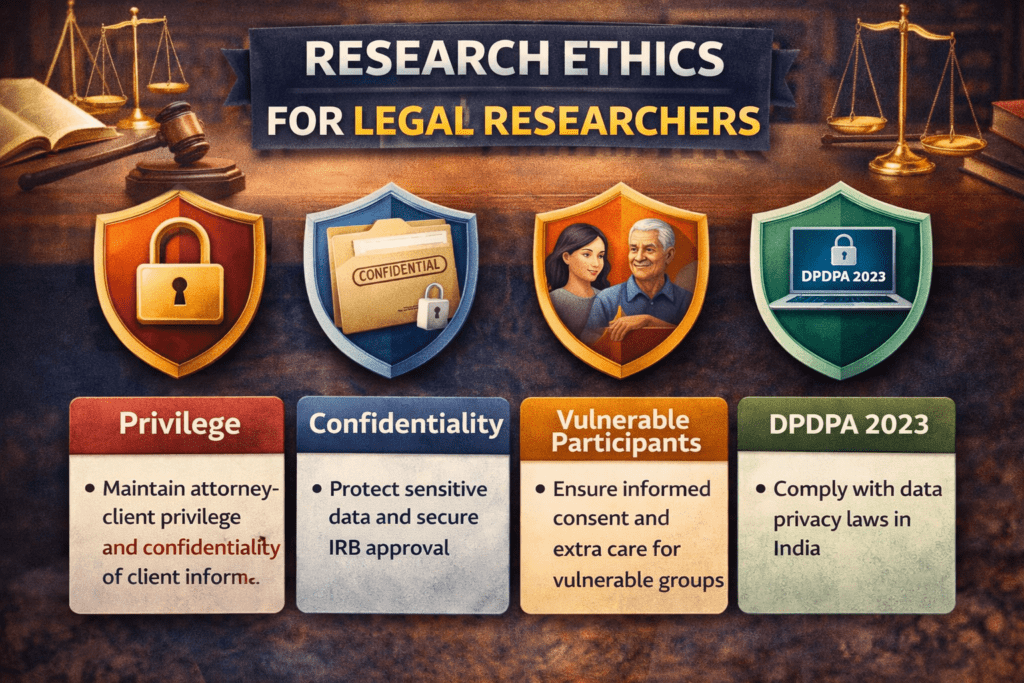
Research Ethics for Legal Researchers: Privilege, Confidentiality, Vulnerable Participants, and the DPDPA 2023
Research Ethics for Legal Researchers Academic Writing Mastery: The Complete 2026 Guide To Research Papers,…
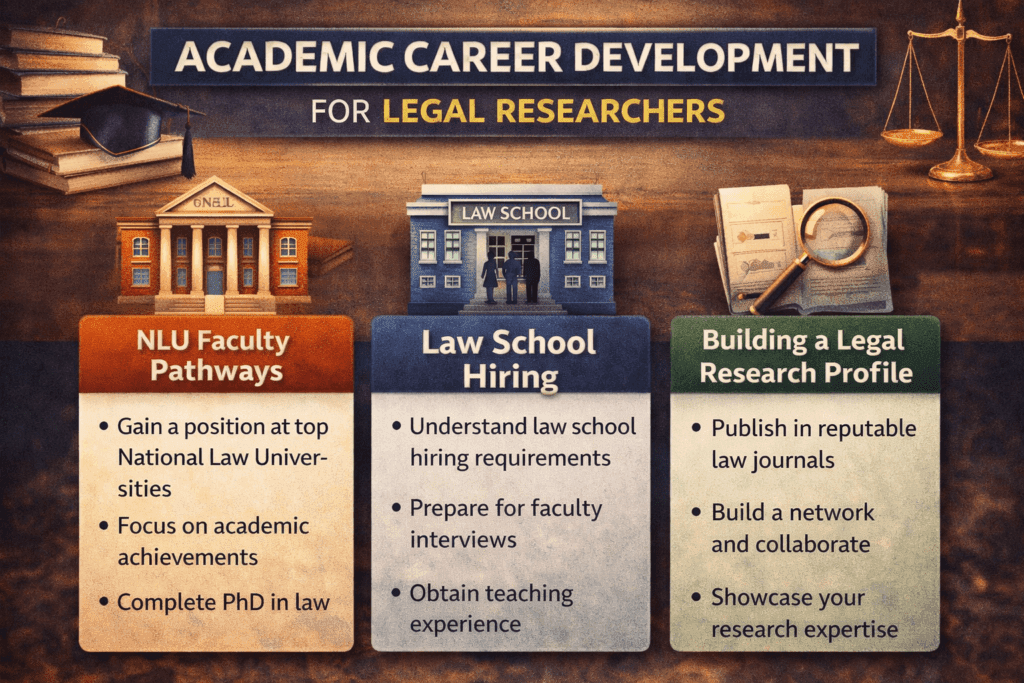
Academic Career Development for Legal Researchers
Academic Career Development for Legal Researchers: NLU Faculty Pathways, Law School Hiring, and Building a…
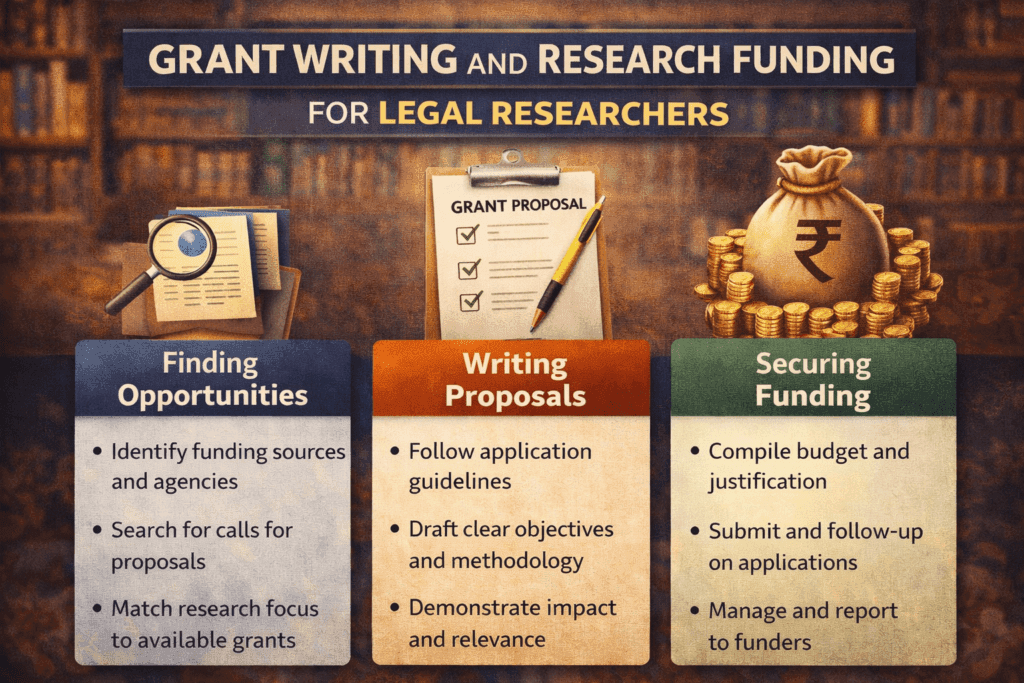
Grant Writing and Research Funding for Legal Researchers
Academic Career Development: Complete Guide To Building Your Professional Life In Research (2026) Back to…
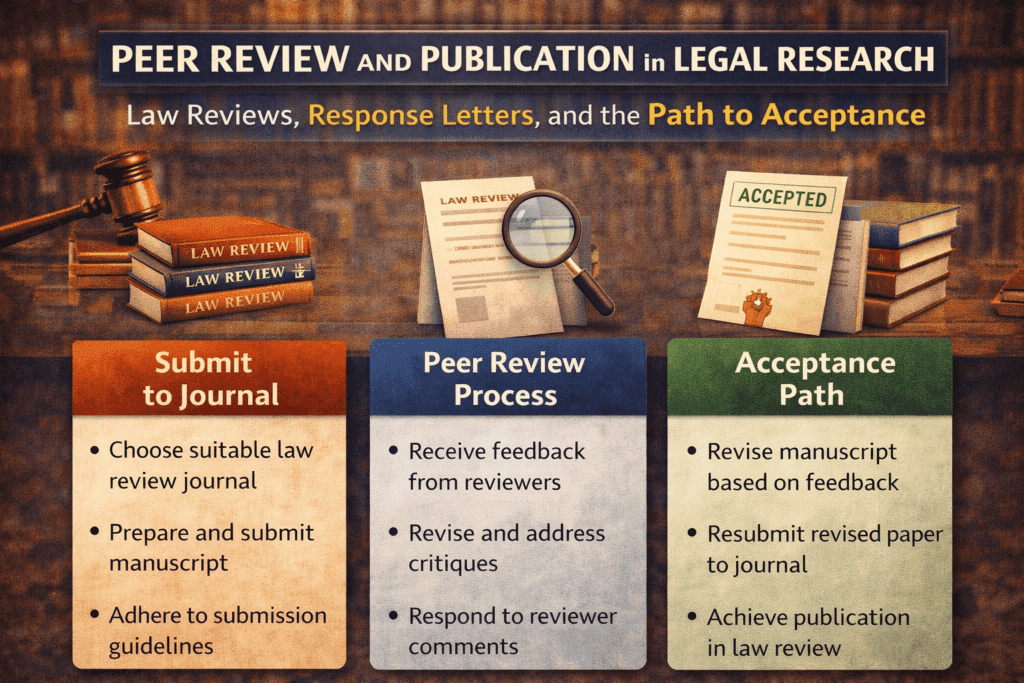
Peer Review and Publication in Legal Research
Peer Review and Publication in Legal Research: Law Reviews, Response Letters, and the Path to…

Academic Writing Mastery: The Complete 2026 Guide to Research Papers, Thesis & Dissertation Writing
Academic Writing Master From Concept to Submission Series Academic Writing Mastery Whether you are writing…
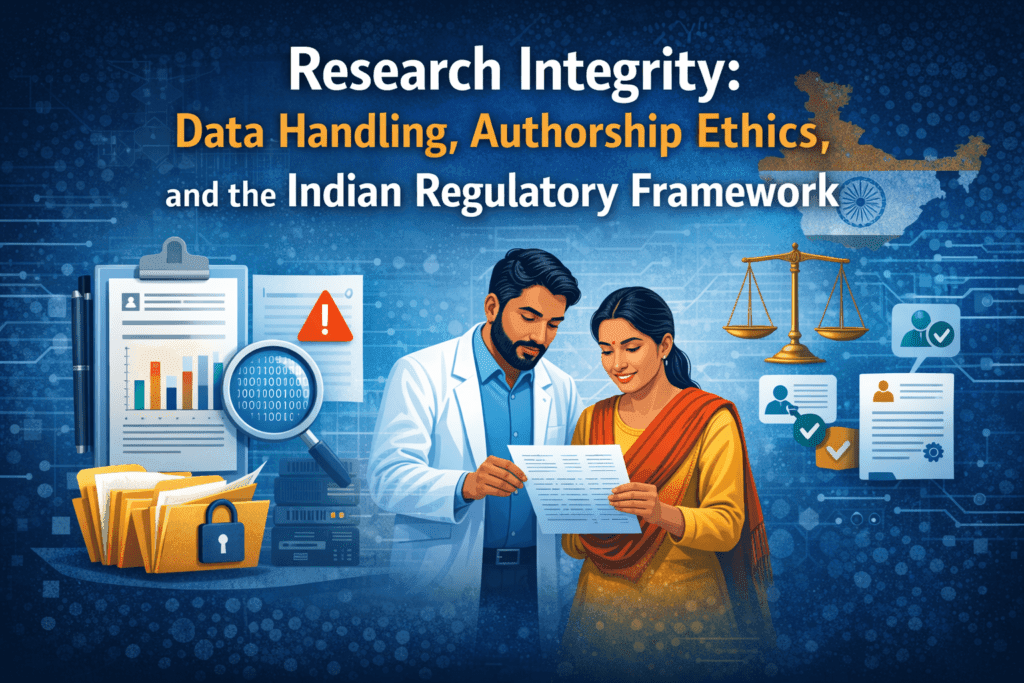
Research Integrity: Data Handling Authorship Ethics and the Indian Regulatory Framework
Cluster Post 5 | Module 10: Research Ethics and the IRB Process From Concept to…