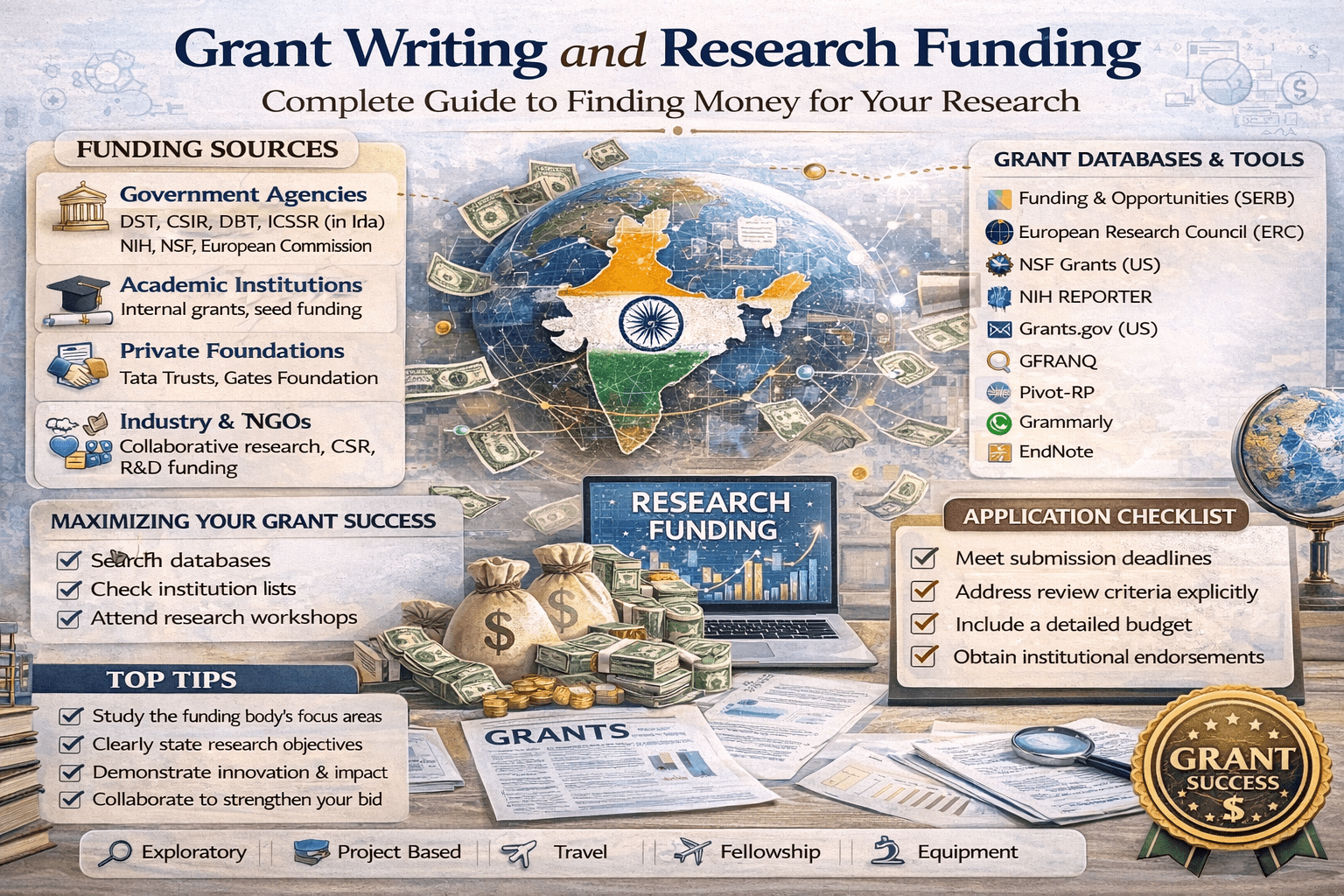
Module 8 Grant Writing and Research Funding: Complete Guide to Finding Money for Your Research
Grant Writing and Research Funding
Academic Writing Mastery: The Complete 2026 Guide To Research Papers, Thesis & Dissertation Writing
Why Funding Changes Everything About Your Research
Here’s what nobody tells PhD students early enough: unfunded research is limited research. You can only go so far on your own resources. At some point, external funding is not a luxury—it’s what separates research that gets done from research that stays in your notebook.
Grant writing seems intimidating until you understand how the system works. Funders want the same basic things across every application: important research, a feasible plan, a qualified researcher, and good value for money. Once you understand those four pillars, every proposal you write gets stronger.
This guide walks you through the entire process—from identifying the right opportunities to managing money responsibly after you win.
This comprehensive guide covers:
- Types of research funding sources (internal, government, foundation, industry)
- Indian funding agencies and fellowship amounts (2026)
- How to find opportunities that match your research
- Writing each section of a winning grant proposal
- Common mistakes that sink good proposals
- Handling rejection and managing awarded funds responsibly
- Building your funding track record step by step
Types of Research Funding: Know Your Options
Different funding sources work in different ways. Understanding your options helps you target the right opportunities—and avoid wasting time on grants you’re unlikely to get.
Internal University Funding
Start here. Internal grants are easier to get, faster to process, and specifically designed for students and early-career researchers.
| Type | What to Know |
| Graduate school grants | Pilot studies, preliminary data, research materials. Amounts: ₹10,000–₹5,00,000. Turnaround: 4–8 weeks. |
| Conference travel grants | Cover registration, travel, accommodation. Often available multiple times per year. |
| Dissertation completion fellowships | Support your final writing phase. Competitive, but worth applying. |
| Departmental awards | Check with your department administrator—many go unadvertised. |
How to find them: Graduate school website, department administrator, your supervisor, and the student funding office. Ask senior PhD students what they’ve successfully applied for.
Government Funding Agencies
These are the big ones—substantial amounts, prestigious credentials, multi-year support. They’re competitive, but they transform what’s possible in your research.
🇮🇳 Key Indian Funding Schemes (2026):
| Scheme / Agency | Amount & Details |
| Prime Minister’s Research Fellowship (PMRF) | ₹70,000–₹80,000/month for top PhD students at IITs, IISc, IISERs. Highly competitive. pmrf.in |
| ICSSR Doctoral Fellowship | ₹20,000/month + contingency grant. For social science research. icssr.org |
| SERB Start-up Research Grant (SRG) | Up to ₹30 lakh per project for early-career researchers. serb.gov.in |
| CSIR JRF/SRF | ₹37,000–₹42,000/month for science and technology research. csir.res.in |
| ICMR JRF/SRF | Biomedical and health research fellowships. icmr.gov.in |
| UGC STRIDE Grants | Trans-disciplinary research for India’s developing economy. ugc.gov.in |
| DBT Research Grants | Biotechnology and life sciences. dbtindia.gov.in |
- Typical acceptance rates: 5–20% for major government grants. Plan to apply multiple times.
- Wait times: 3–9 months from submission to decision. Start early.
Private Foundations
Foundations fund research aligned with their missions. If your work genuinely fits, the competition is narrower and the process often more flexible than government grants.
- Indian foundations: Tata Trusts, Azim Premji Foundation, Sir Dorabji Tata Trust, Bharti Foundation, Infosys Foundation.
- International: Gates Foundation, Ford Foundation, Fulbright Program, Rhodes Scholarships, DAAD (German Academic Exchange).
- Key advantage: May fund innovative or risky projects that government grants avoid.
- Key challenge: Must align closely with the foundation’s specific mission. Read their funded projects list before applying.
Industry Funding
- Companies fund research relevant to their business. Useful for applied research with commercial potential, but comes with important trade-offs.
- May restrict or delay publication—know the terms before signing anything
- Intellectual property issues need careful attention
- Possible conflicts of interest that must be disclosed
Important: Always check your university’s policies on industry funding and discuss terms with your supervisor before accepting.
Finding the Right Opportunity: Match Before You Apply
The key to funding success isn’t writing better proposals—it’s finding grants that genuinely match your research. An excellent proposal for the wrong grant will fail. A good proposal for the right grant can succeed.
Where to Search
- Your institution first: Graduate school funding database, research office website, your supervisor.
- ugc.gov.in | icssr.org | serb.gov.in | pmrf.in
- ResearchGate Funding | IndianScholarships.com
- Ask senior PhD students and postdocs what worked for them—the best leads are often word-of-mouth.
The Matching Test: Four Questions to Ask
| Question | Why It Matters |
| Does my topic fit their scope? | Read their ‘aims and scope’ and recent funded projects. If your work doesn’t appear there, it probably won’t get funded. |
| Am I eligible? | Check career stage (student? postdoc?), institutional affiliation, citizenship/residency requirements. Don’t apply if you’re not eligible. |
| Is my geographic context relevant? | Some grants fund research in specific regions. India-focused research fits some Indian funders perfectly—use that advantage. |
| What’s the realistic timeline? | Major grants take 3–9 months to decide. If you need funds soon, internal grants or faster foundations are better. |
Good fit example:
You’re studying sustainable agriculture in rural India. The Sir Dorabji Tata Trust funds rural development. Their environmental sustainability program specifically mentions agricultural innovation. You’re an eligible Indian PhD student. → Apply.
Poor fit example:
Same study, but you’re applying to the US National Institutes of Health. NIH funds health research primarily; agriculture rarely fits unless framed through a nutrition or food security lens, and you’d need US institutional affiliation. → Don’t waste time.
What Every Funder Wants (Even If They Say It Differently)
Strip away the jargon from any funding application and you’ll find the same four requirements underneath. Understanding these is more valuable than any template.
| The Four Things Every Funder Is Looking For |
| 1. IMPORTANT RESEARCH: Your question must matter. It should address a real problem, fill a knowledge gap, and have potential impact—academic, social, or practical. |
| 2. FEASIBLE PLAN: Can you actually do what you propose? Is your timeline realistic? Are your methods appropriate? They won’t fund projects that seem impossible to complete. |
| 3. QUALIFIED RESEARCHER: Why should they trust you? Show your background, training, relevant experience, and your supervisor’s expertise. Early-career researchers show potential and preparation. |
| 4. GOOD VALUE FOR MONEY: Your budget should include only necessary expenses at reasonable costs, with clear connections between activities and budget items. No padding. |
Writing a Winning Grant Proposal
Grant proposals follow similar structures across funding sources. Master these elements and you can write for almost any funder.
The Abstract/Summary: Your Most Important Section
Many reviewers decide whether your proposal is fundable based on the abstract alone. Get this right first.
Strong abstract structure (250–500 words):
- Context: One sentence on the broad issue
- Problem: The specific gap or need you’re addressing
- Your project: What you will do
- Methods: How you’ll do it (briefly)
- Impact: Why it matters and who benefits
Example abstract:
“India’s rural primary schools face persistent literacy challenges, with 55% of Grade 5 students unable to read Grade 2 level texts (ASER 2023). While various interventions exist, evidence on teacher training effectiveness remains limited for under-resourced rural contexts. This research will evaluate the impact of a low-cost, locally-adapted teacher training program on student literacy outcomes in rural Rajasthan using a quasi-experimental design comparing 40 intervention schools with 40 control schools over one academic year. Expected outcomes include quantitative evidence on training effectiveness, contextual implementation factors, and practical scaling recommendations. Findings will inform education policy potentially improving literacy for millions of rural students.”
Notice: problem, method, and impact are all present and specific. No vague language.
The Problem Statement: Convince Them It Matters
| What to Include | What to Avoid |
| Recent data and statistics with citations | Old data (more than 5 years unless historical) |
| The specific gap in knowledge | Overly broad claims about ‘changing the world’ |
| Connection to funder’s priorities | Assuming reviewers know your field deeply |
| Why the gap matters now | Technical jargon without explanation |
Methods: Proving You Can Do the Work
This is where proposals succeed or fail. Vagueness suggests you haven’t thought it through; specificity builds confidence.
Weak: “I will interview teachers.”
Strong: “I will conduct semi-structured interviews with 30 teachers (15 trained, 15 untrained) using a protocol covering implementation experiences and classroom adaptations. Interviews will last 45–60 minutes, be audio-recorded and transcribed, and analyzed using thematic analysis (Braun & Clarke, 2006).”
Your methods section must answer: Who? How many? How selected? What data? When? How analyzed? What challenges might arise and how will you handle them?
The Budget: Show Good Value, Not Just Low Cost
Your budget must be reasonable and well-justified. Every line item needs a clear connection to your research activities.
| Budget Justification Example |
| Research Assistants (₹3,60,000): Two part-time RAs at ₹15,000/month for 12 months to conduct classroom observations and data entry across 80 schools. |
| Travel (₹1,80,000): Transportation to 80 schools (3 visits each for baseline, midpoint, endpoint) at ₹750 per visit. Schools are spread across rural Rajasthan requiring extensive travel. |
| Participant Compensation (₹96,000): ₹200 per teacher for 30 interview participants (₹6,000) and ₹3,000 per school for 30 parent focus groups (₹90,000). |
| Data Analysis Software (₹25,000): NVivo license for qualitative data and SPSS for quantitative analysis. Essential for managing large mixed-methods datasets. |
The Realistic Timeline
Show the project is completable within the proposed period. Be realistic and allow time for delays—reviewers know fieldwork rarely goes perfectly.
Example: 2-year project timeline
| Year 1 | Year 2 |
| Months 1–3: Finalize instruments, ethics approval, recruit schools | Months 13–15: Midpoint data collection |
| Months 4–6: Baseline data collection | Months 16–18: Continued implementation |
| Months 7–12: Intervention + teacher training | Months 19–21: Endpoint data collection |
| Months 22–24: Analysis, write-up, dissemination |
Common Grant Proposal Mistakes (And How to Avoid Them)
These are the most common reasons strong research ideas fail to get funded. Most are avoidable.
| Mistake | How to Avoid It |
| Not following instructions (fastest route to rejection) | Check page limits, font, margins, required sections. Submit before the deadline—never the last minute. |
| Being too ambitious | Don’t promise more than one person can realistically accomplish. Reviewers recognize overreach. |
| Vague methods | Be specific: how many people, how selected, what exactly you’ll do, how you’ll analyze it. |
| Ignoring funder priorities | Read their mission, funded projects, and review criteria. Explicitly connect your work to what they care about. |
| Poor writing | Short sentences, active voice, no jargon. Have someone outside your field read your draft. |
| Padding the budget | Include only what you need and justify every line. Reviewers notice inflated budgets. |
Understanding the Review Process
Knowing how your proposal is evaluated helps you write one that meets those standards.
Who Reviews Your Proposal
- Peer reviewers: Experts in your field who evaluate your proposal against criteria. Usually 2–5 reviewers.
- Program officers: Funding agency staff who manage the process and sometimes add their own assessment.
- Review panels: For some grants, reviewers meet as a panel to discuss proposals and reach consensus rankings.
What Reviewers Are Scoring
| Criterion | What It Means in Practice |
| Intellectual Merit | How important is the question? How well-designed? Are methods appropriate? |
| Qualifications | Can this researcher do this work? Does the team have the expertise? |
| Feasibility | Is the timeline realistic? Budget appropriate? Major obstacles? |
| Broader Impacts | Who benefits? What’s the potential impact? How will results be shared? |
Only the top 10–20% of proposals get funded. Your goal is to be in that top tier across all criteria—not perfect on one and weak on others.
Handling Rejection—and Success
When You’re Rejected (and You Will Be)
Even successful researchers face many grant rejections. What separates them from those who give up is what they do next.
| Your Post-Rejection Checklist |
| Read the reviewer feedback carefully—what were the main concerns? |
| Wait a few days before responding emotionally |
| Decide whether to revise and resubmit to the same funder |
| Use the feedback even if you resubmit elsewhere—next reviewers may raise the same issues |
| Move on quickly: don’t wait months. Submit to your next target within 1–2 weeks |
Common rejection reasons (most are fixable):
- Poor fit with funder’s priorities—research the fit before applying next time
- Methods not rigorous enough—get feedback on your methods section
- Significance not clearly articulated—work on your abstract and problem statement
- Budget too high or not well-justified—revise with specific justifications
- Very competitive round with limited funding—try again or try a different funder
When You’re Awarded Funding
Congratulations—now comes the hard part: doing the research and managing the money responsibly.
| Immediately After Award | Ongoing Responsibilities |
| Read award letter carefully—what are your obligations? | Spend only on approved items |
| Meet your institution’s grants office | Keep detailed records: receipts, invoices, timesheets |
| Set up proper accounting from Day 1 | Follow institutional spending policies |
| Understand reporting deadlines | Submit reports on time—missing a deadline can mean returning funds |
| Thank the funder professionally | Document everything—if you’re unsure, ask before spending |
Critical rule: Never use grant money for personal expenses. Never mix grant funds with personal money. If you’re unsure about a purchase, ask first—it’s better to ask permission than beg forgiveness.
Building Your Funding Track Record
Grant writing gets easier with practice. Here’s the strategic path from your first application to major research grants.
| The Funding Progression Ladder |
| STEP 1 — Start Small: Internal university grants (easier to get) | Conference travel grants | Pilot study funding |
| STEP 2 — Build Up: Small external grants | Dissertation research grants | Postdoctoral fellowships |
| STEP 3 — Scale Up: Research grants as faculty | Multi-year projects | Large collaborative grants |
Each funded grant builds your track record for the next one. Funded work produces publications; publications strengthen future proposals. The snowball effect is real—start it rolling now.
Grant Writing Tips from Successful Researchers
| Do This | Not This |
| Start 3–4 months before the deadline | Start the week before |
| Get feedback from supervisor, peers, and someone outside your field | Only revise based on your own reading |
| Read previously funded proposals (many funders share them) | Guess what format works |
| Write for reviewers who may not be in your exact subfield | Assume all reviewers are deep specialists |
| Tell a compelling story: problem → gap → your study → impact | List facts without a clear narrative arc |
Legal Research and Writing: Complete Guide for Law Students and Legal Researchers
FAQs
Q: How do you get funding for academic research in India?
Indian researchers can apply to: ICSSR (Major and Minor Research Projects for social science and humanities); UGC-STRIDE and other UGC schemes for faculty at recognised universities; DST-SERB (Core Research Grant and Startup Research Grant for science and technology); ICMR for health and biomedical research; and NHRC for human rights research. Early-career researchers should start with ICSSR Minor Projects or institutional seed funding before applying for major grants. Apply through your institution’s research office — most funders require institutional endorsement.
Q: What makes a research grant proposal successful?
Successful grant proposals share five characteristics: a clearly defined research problem with genuine significance; a specific, answerable research question; a methodology that is feasible within the proposed timeline and budget; demonstrated researcher capacity — prior publications, relevant expertise; and a realistic impact statement connecting the research to practical or policy outcomes. The most common failure is a vague problem statement that does not identify a specific unresolved question or demonstrate that the proposed research will produce a distinct, measurable output.
Q: What is the difference between a research grant and a fellowship?
A research grant provides funding for a specific research project — covering personnel, fieldwork costs, equipment, and publication fees. It is tied to a project with defined outputs and timelines. A fellowship provides a stipend or salary to support a researcher’s time, often with more flexibility in how the time is used — completing a dissertation, developing a new research programme, or pursuing a specific intellectual agenda. Some fellowships also include project funds. For Indian PhD students, the UGC Junior Research Fellowship (JRF) and Senior Research Fellowship (SRF) provide stipends to support thesis completion.
Q: When should researchers start applying for grants?
Start building a grant-seeking track record from the beginning of your PhD. In Year 1: apply for conference travel grants and small institutional awards. In Year 2–3: apply for ICSSR Minor Research Projects as a co-investigator with a faculty supervisor. After PhD completion: apply for ICSSR Major Projects or UGC-STRIDE as principal investigator. Most major Indian grants require evidence of prior research activity and publications. Applying for a major grant without prior publications or smaller grants rarely succeeds — build the track record first.
Q: What are the main research funding bodies in India?
The main Indian research funding bodies are: ICSSR (Indian Council of Social Science Research) for social science and humanities; UGC (University Grants Commission) for university faculty across disciplines; DST-SERB (Science and Engineering Research Board) for science, technology, and interdisciplinary research; ICMR (Indian Council of Medical Research) for health and biomedical research; ICAR (Indian Council of Agricultural Research) for agricultural science; and ISRO’s RESPOND programme for space-related research. The Ministry of Education and various state governments also fund research through ad hoc schemes.
Key Takeaways from Module 8
You now understand the complete funding landscape—from internal university grants to major government schemes—and what it takes to win them.
| What to Remember |
| Multiple sources exist: internal, government, foundations, industry, and alternatives. Start small and build up. |
| Match matters most: Find grants that genuinely fit your research—don’t force your work to fit any grant. |
| Funders want four things: Important research, feasible plan, qualified researcher, good value. |
| Good proposals are specific: Vague methods and vague significance lose. Specific details win. |
| Rejection is normal: Even top researchers face many rejections. Learn from feedback and keep going. |
| Start early: Major proposals take 3–4 months to write well. Never start a week before the deadline. |
| Track record builds on itself: Each funded grant makes the next one more likely. |
Funding isn’t just about money—it’s validation that your work matters and support to do it properly. Start building your track record now, with whatever grants are available to you at your current career stage.
Author
Dr. Rekha Khandelwal, a legal scholar and academic writing expert, is the founder of AspirixWriters. She has extensive experience in guiding students and researchers in writing research papers, theses, and dissertations with clarity and originality. Her work focuses on ethical AI-assisted writing, structured research, and making academic writing simple and effective for learners worldwide.
Author Profile Dr. Rekha Khandelwal | Academic Writer, Legal Technical Writer, AI Expert & Author | AspirixWriters
Selected References for Further Reading
Grant Writing Guides
- Gerin et al. (2023). Writing the NIH Grant Proposal (4th ed.). Sage.
- Miner & Miner (2024). Proposal Planning & Writing (8th ed.). Greenwood.
- Browning (2024). Grant Writing for Dummies (9th ed.). Wiley.
Indian Funding Sources
- PMRF – Prime Minister’s Research Fellowship Guidelines (2026)
- SERB – Start-up Research Grant (SRG) and Core Research Grant (CRG) (2026)
- UGC STRIDE Scheme (2026)
- ICSSR Doctoral Fellowship & Research Grant Schemes (2025)
- DBT Research & Development Grants (2026)
- ICMR Junior/Senior Research Fellowship (2026)
International Opportunities for Indian Researchers
- Fulbright-Nehru Doctoral Research Fellowships (2026)
- DAAD Research Grants for Indian PhD Students (2026)
- Commonwealth Scholarship Commission (2024)
Research Design
- Creswell & Creswell (2022). Research Design (6th ed.). Sage.
- Locke et al. (2022). Proposals That Work (8th ed.). Sage.
- The Indian Research Funding Landscape: What’s Actually Available and Who Gets It
- Writing the Proposal Abstract and Problem Statement That Get Funded
- Methods and Budget: The Two Sections That Lose Most Grants
- The Proposal Review Process: How Grants Are Actually Decided
- International Funding for Indian Researchers: Fulbright, DAAD, Commonwealth, and Beyond
- Module 1 The Complete Guide to Research Paper and Thesis Structure
- Module 2 The Academic Writing Process: Complete Guide from First Draft to Submission (2026)
- Module 3 Research Methodologies: Complete Guide to Quantitative, Qualitative, Mixed Methods & Legal Research (2026)
- Module 4 Data Analysis and Results Presentation: Complete Guide for Quantitative, Qualitative & Legal Research (2026)
- Module 5 Organization and Academic Tone: Complete Guide to Professional Scholarly Writing (2026)
- Module 6 Peer Review and Publication: Complete Guide from Submission to Acceptance (2026)
- Module 7 AI Tools in Academic Research: Opportunities, Ethics, and Best Practices (2026)
- Module 8 Grant Writing and Research Funding: Complete Guide to Finding Money for Your Research (2026)
- Module 9Academic Career Development: Complete Guide to Building Your Professional Life in Research (2026)
- Module 10 Research Ethics and the IRB Process: Complete Guide to Doing Research Responsibly (2026)
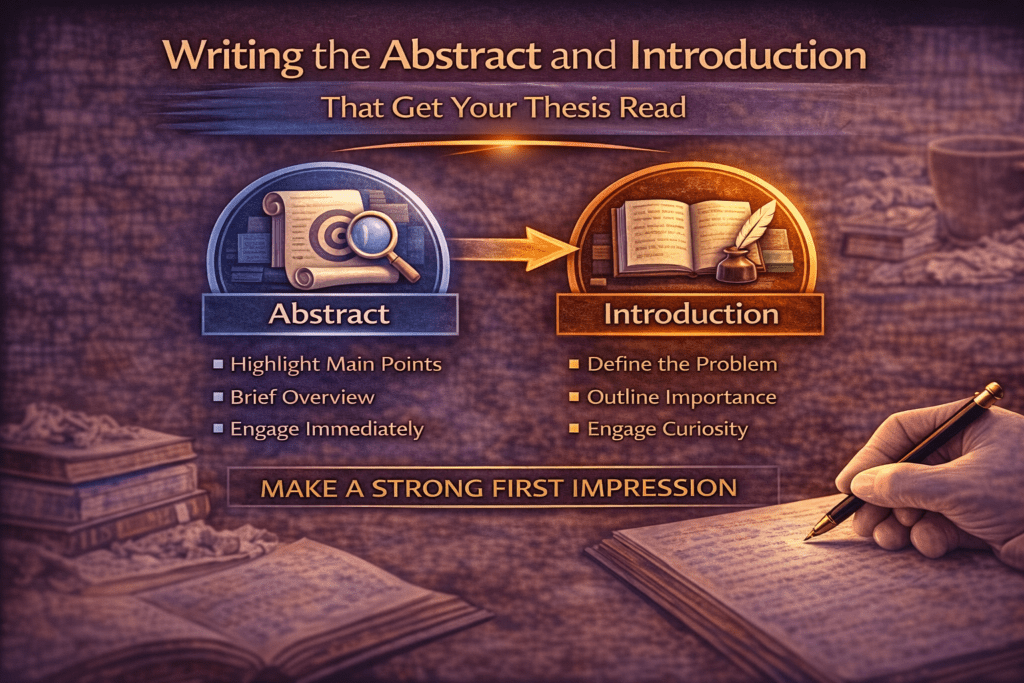
Writing the Thesis Abstract and Introduction
Cluster Post 2 | Module 5: Thesis Writing and Submission From Concept to Submission Series …
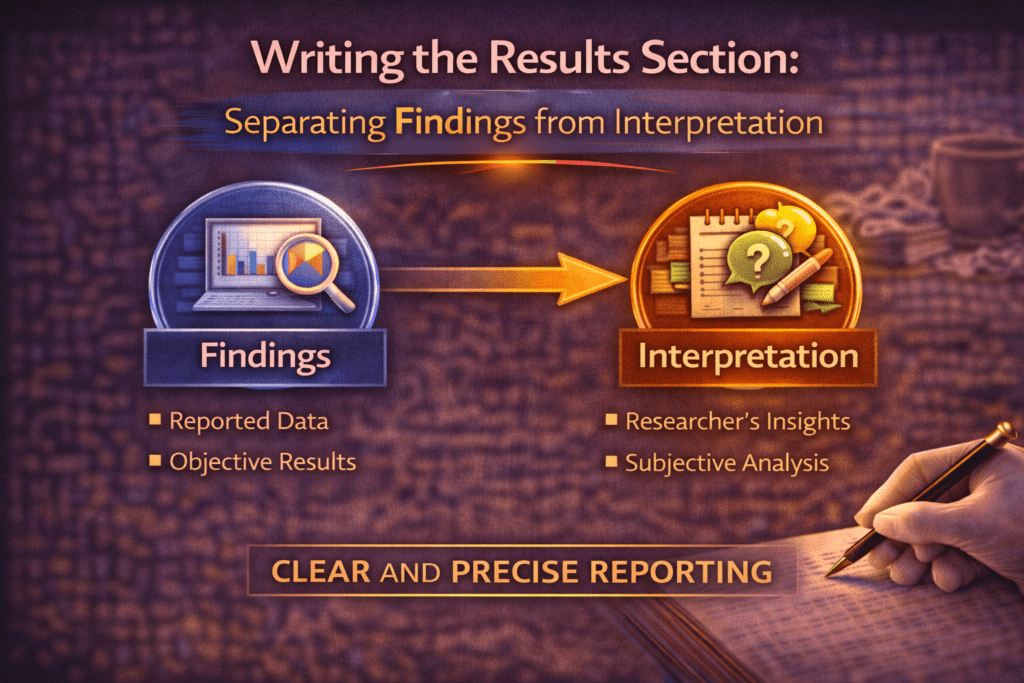
Writing the Results Section: Separating Findings from Interpretation
Cluster Post 6 | Module 4: Data Analysis and Presenting Results From Concept to Submission…
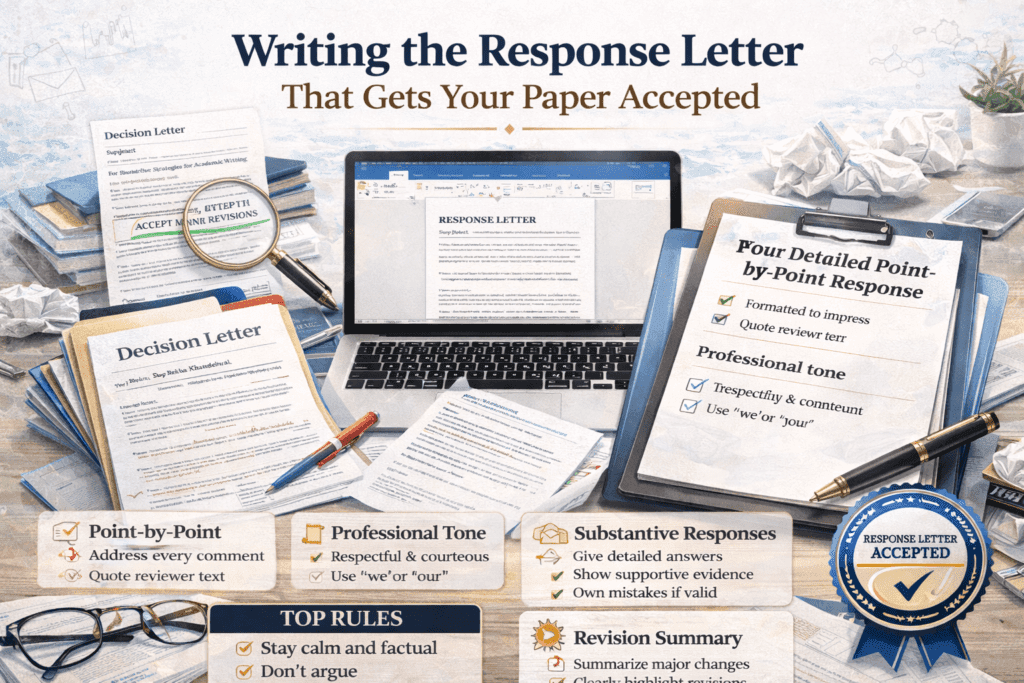
Writing the Response Letter That Gets Your Paper Accepted
Cluster Post 2 | Module 6: Peer Review, Responding to Feedback, and Publication Strategies From…
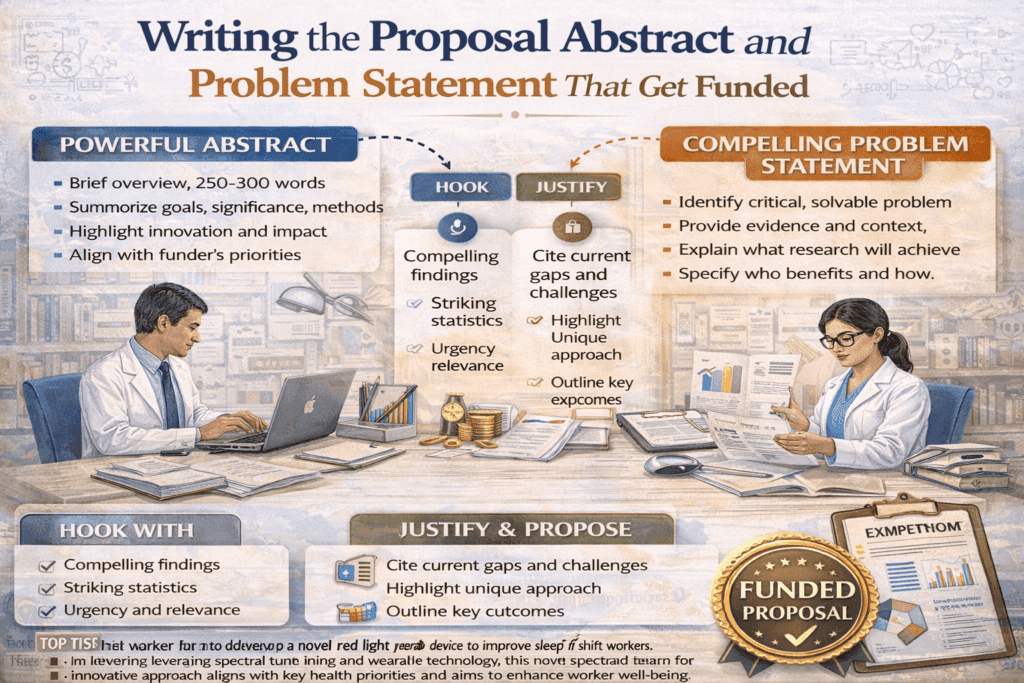
Writing the Proposal Abstract and Problem Statement That Get Funded
Cluster Post 2 | Module 8: Grant Writing and Research Funding From Concept to Submission…
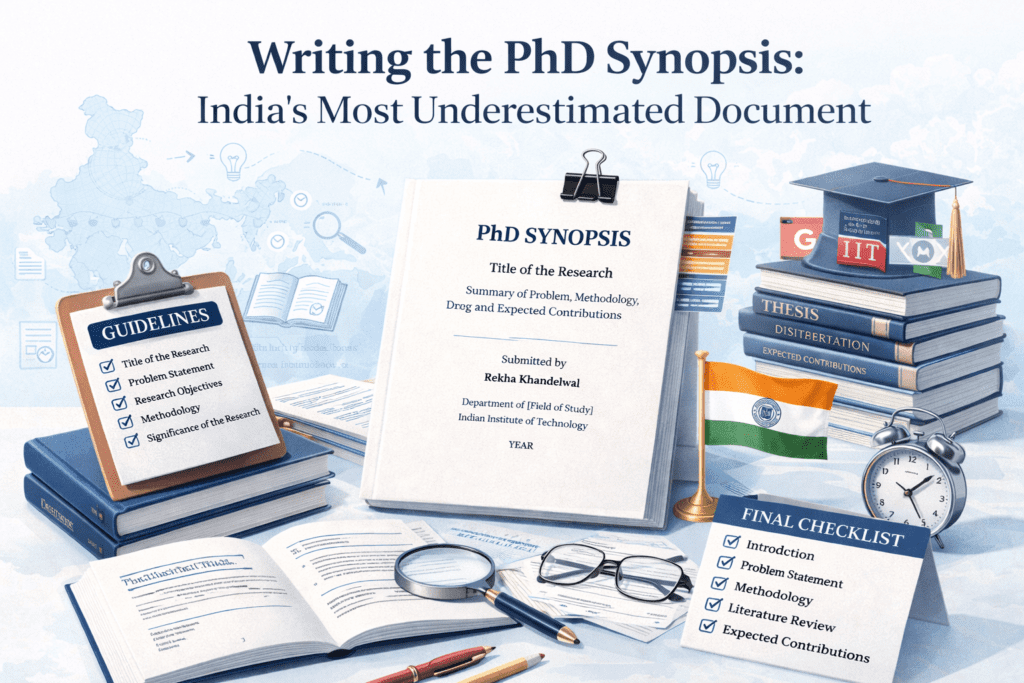
Writing the PhD Synopsis: India’s Most Underestimated Document
Cluster Post 6 | Module 5: Thesis Writing and Submission From Concept to Submission Series …
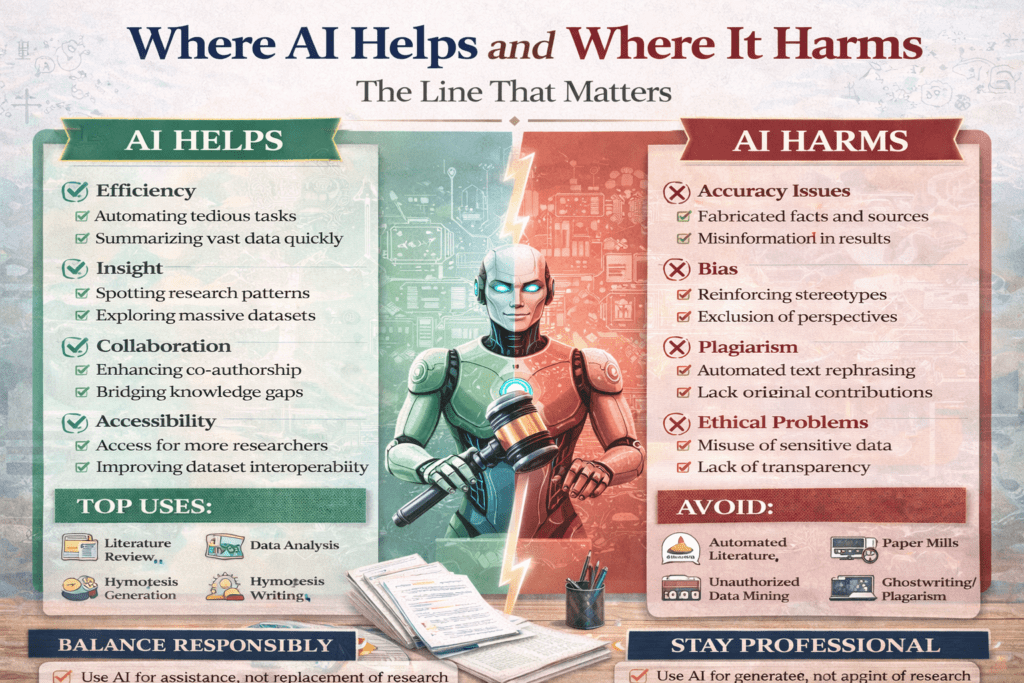
Where AI Helps and Where It Harms: The Line That Matters
Cluster Post 2 | Module 7: AI Tools in Academic Research — Opportunities, Ethics, and…