Last Updated: April 8, 2026
Jasper AI Review 2026
AI Tools Reviews: Real Testing, Comparisons & Honest Insights (2026)
Jasper’s entire marketing pitch is speed. Generate more content, faster, at scale. For a writer handling multiple client accounts with tight turnarounds, that pitch is genuinely attractive — which is why I tested it.
Jasper doesn’t write better content. It helps you write faster — but only if you already know what you’re doing and only if the content type matches what Jasper is actually built for. That distinction took me a test run to fully understand, and it is the one thing most Jasper reviews skip entirely.
The test I ran was specifically on social media content — the use case Jasper markets most aggressively as a strength. Here is what actually happened.
→ Best free AI writing tools in 2026→ ChatGPT vs Claude vs Gemini: which wins?
The speed test — what I actually got
The brief was straightforward: generate social media captions for a content-focused brand. Multiple posts, different formats — Instagram captions, LinkedIn updates, short engagement posts. Jasper’s templates are specifically designed for this, which is why it seemed like the right tool for the job.
The speed claim held up. Jasper generated output faster than manually writing each caption, and faster than asking ChatGPT with a fresh prompt each time. On volume alone, it delivered.
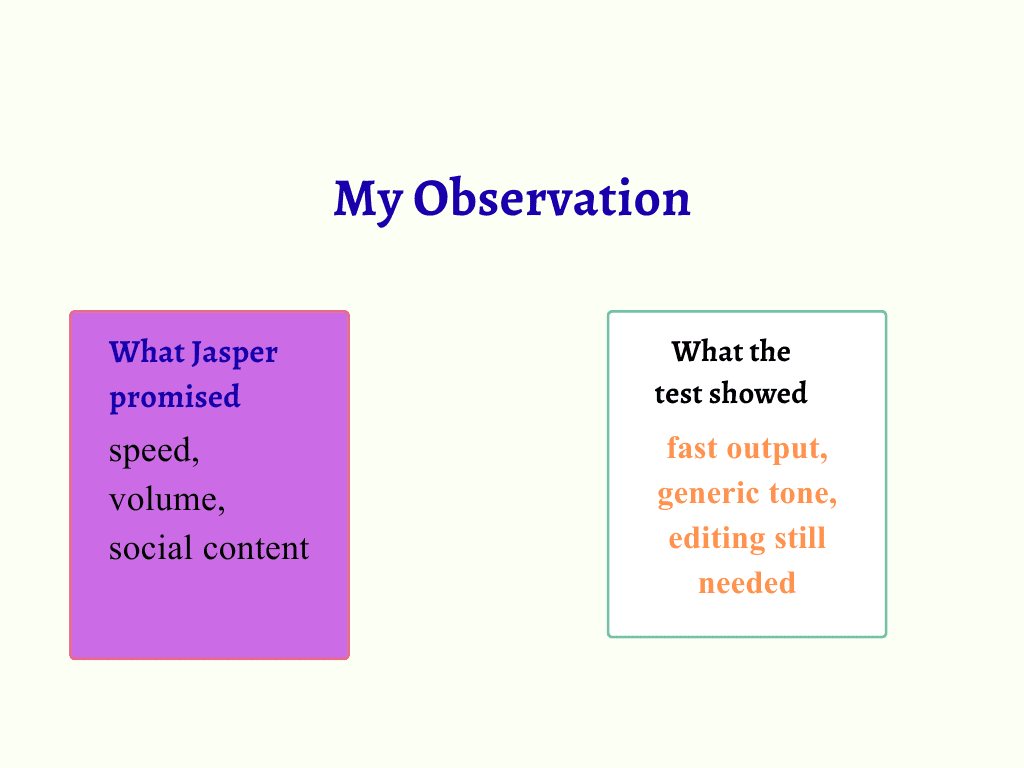
The disappointment was in the output quality. Not because the captions were grammatically wrong — they were fine. The problem was that every caption felt like it came from the same invisible brand. The tone was correct but generic. The hooks were readable but predictable. The calls to action were present but interchangeable across completely different post types.
Speed test — what was expected vs what came back
| Speed | Delivered as promised. Generating 10 caption variations took a fraction of the time it would take manually. On pure volume, Jasper wins. |
| Tone variation | Disappointing. Captions across different post types — educational, promotional, engagement — felt structurally similar. The template logic shows through the output. |
| Brand voice | Weak without heavy briefing. Without a detailed brand voice setup, Jasper defaults to a pleasant, safe, forgettable tone that could belong to any brand in any industry. |
| Editing required | More than expected. Nearly every caption needed at least one rewrite on the opening line before it was usable. The speed gain was partially offset by the editing time. |
The honest summary: Jasper is fast at generating social media content. It is not good at making that content feel like it belongs to a specific brand without significant setup and editing work on top.
What Jasper actually does well — and for whom
The disappointment on social media content does not mean Jasper is a weak tool overall. It means social media caption quality – where brand voice and specificity matter most -is not where Jasper’s strength lies.
Jasper is built for marketing teams and agencies producing content at scale. Its real strength is in structured, template-driven content types: long-form blog drafts, email sequences, product descriptions, ad copy variations. These are content types where a consistent, professional tone across high volume is more valuable than a distinctive, specific brand voice on individual pieces.
Marketers who use Jasper consistently for blog content report that the tool handles long-form structure better than most alternatives — producing article frameworks, section summaries, and paragraph-level drafts that reduce the time from brief to first draft significantly. For blog content where SEO structure matters more than voice, this is a genuine time-saver.
The distinction is important: Jasper is a volume and structure tool, not a voice and specificity tool. Writers who go in expecting the first get exactly what they paid for. Writers expecting the second leave disappointed.
The insight most Jasper reviews miss
Jasper’s templates are its biggest strength and its biggest limitation simultaneously. Templates produce consistent, professional output quickly — which is exactly what a marketing team producing 50 blog posts a month needs. But templates also mean the output has a ceiling. The best Jasper output still reads like Jasper output. Breaking past that ceiling requires editing skill that the tool cannot provide.
Where Jasper consistently disappoints
Social media voice and specificity
As the speed test showed, Jasper’s social media output defaults to a brand-neutral professional tone that works for no specific brand particularly well. For accounts where the brand voice is the point — personal brands, founder-led companies, niche community accounts — Jasper’s output requires so much editing that the speed advantage disappears.
The tool does offer a Brand Voice feature that attempts to learn a specific brand’s style. In practice, without extensive examples and consistent use, the voice capture is shallow. It adjusts vocabulary and formality level but does not capture the specific rhythm, humour, or perspective that makes a brand’s social content recognisable.
Free tier is genuinely limited
Unlike ChatGPT or Claude, which offer meaningful free tiers for individual writers, Jasper’s free access is restricted to a short trial. The full tool — including the templates, Brand Voice, and document editor — requires a paid subscription starting at $49 per month. For freelancers and individual bloggers, this is a significant cost compared to alternatives that cover many of the same use cases at no charge.
The cost becomes justifiable for teams or agencies producing large content volumes. For an individual blogger producing 4–6 posts per month, the math does not work — ChatGPT Plus at $20 per month covers most of the same drafting needs at less than half the price.
Fact accuracy – the same problem as every AI tool
Jasper generates content from training data, not from live web sources. On regulated or rapidly changing topics — legal, financial, medical, recent events — Jasper’s output can be confidently outdated. This is not unique to Jasper, but it is worth stating clearly: Jasper is not a research tool. Any factual claim in Jasper-generated content needs independent verification before publication.
Jasper’s word count limit per plan, its subscription cost, and its lack of real-time sourcing make it a tool built for a specific type of professional — not for every writer. Knowing which type you are before subscribing saves both money and frustration.
Jasper vs ChatGPT vs Claude — through real use cases
| Use case | Jasper | ChatGPT / Claude |
| High-volume blog drafts For teams producing 20+ posts/month | Strong — templates reduce brief-to-draft time significantly for structured content | Also strong — but requires more prompt engineering per post; no built-in template system |
| Social media captions Brand-specific voice required | Weak — fast output but generic tone; editing often cancels the speed advantage | Better — with a strong prompt and brand brief, ChatGPT produces more distinctive output |
| Long document editing Academic or legal content | Not designed for this — no large context window for document-level work | Claude significantly stronger — 200K context window handles full documents |
| Cost for individual writers Producing under 10 posts/month | Expensive — $49/month minimum for features that matter | ChatGPT Plus at $20/month covers most use cases at less than half the cost |
The honest comparison: Jasper wins for marketing teams producing structured content at volume. ChatGPT and Claude win for individual writers, freelancers, and anyone working on content types that require voice, specificity, or document-level context.
Who should actually use Jasper – and who should not
| Jasper makes sense for | Jasper does not make sense for |
| Marketing teams producing 20+ blog posts per month | Individual bloggers producing under 10 posts per month |
| Agencies managing multiple client content calendars | Personal brands where voice is the product |
| E-commerce businesses needing product description volume | Writers working on academic, legal, or technical content |
| Writers who already know how to edit AI output efficiently | Anyone on a tight budget — free alternatives cover most needs |
| Teams where consistent structure matters more than distinctive voice | Social media managers who need platform-specific, brand-specific voice |
The clearest signal that Jasper is right for you: you are already spending more time on content production than on content strategy. Jasper solves a volume problem. If volume is not your problem, Jasper is not your solution.
Frequently Asked Questions
Q1. Is Jasper worth the price for individual bloggers?
For most individual bloggers — no. At $49 per month minimum, the cost is difficult to justify when ChatGPT Plus at $20 per month covers most of the same drafting needs. Jasper’s value is in its template system and volume capacity, which individual bloggers producing 4–8 posts per month rarely need. The exception: bloggers who have already maxed out ChatGPT’s capabilities and specifically need Jasper’s structured templates.
Q2. Is Jasper better than ChatGPT for marketing content?
For structured, high-volume marketing content — yes, Jasper’s template system reduces the prompt engineering required for each piece. For content that needs a distinctive brand voice or platform-specific tone — no, ChatGPT with a strong prompt and brand brief consistently produces more specific output. The answer depends entirely on whether volume or voice is the priority.
Q3. Can Jasper replace a content writer?
No — and this is not a diplomatic answer, it is a practical one. Jasper produces first drafts that still require editing, fact-checking, and voice adjustment before publication. What it replaces is the blank-page problem and the initial structural work. The writer’s judgment, experience, and subject knowledge remain essential for the output to be publishable and trustworthy.
Q4. Does Jasper content rank on Google?
Jasper-generated content can rank — but only after proper editing that adds genuine expertise, specific examples, and experience-based insights. Unedited Jasper output has the same E-E-A-T problem as any unedited AI content: it is structurally correct and factually generic, which produces thin content that Google’s quality systems deprioritise. The editing is not optional.
Q5. Is there a free version of Jasper?
Jasper offers a short free trial but no ongoing free tier with meaningful access. This is a significant difference from ChatGPT, Claude, and Perplexity — all of which offer free tiers that cover real use cases. For writers evaluating Jasper, the trial is worth running on your specific content type before committing to a subscription.
Q6. What happens if I cancel Jasper mid-subscription?
Monthly plans can be cancelled anytime and access continues until the billing period ends. One important user warning noted in reviews: if you choose to pause your subscription rather than cancel, access ends immediately even if you have remaining days paid — Jasper’s support team does not make exceptions on this policy. Cancel cleanly rather than pausing.
References
- Jasper AI — Official website and pricing: jasper.ai
- Jasper AI — Pricing page: jasper.ai/pricing
About Author
Dr. Rekha Khandelwal is a certified expert in AI tools and academic content development, with a strong focus on leveraging platforms like ChatGPT, Claude, and Gemini for research and digital writing. With a Ph.D. in Law and specialized training in AI-driven content creation, she helps students, researchers, and professionals create high-quality, SEO-optimized, and impactful content.
Author Profile Dr. Rekha Khandelwal | Academic Writer, Legal Technical Writer, AI Expert & Author | AspirixWriters
- Motivational, Creative & Ghostwriting
- Legal & Technical Writing Services
- Academic Writing Assistance
- Editing & Proofreading
- SEO Blogwriting Services
Perplexity AI Review 2026: Is It Really Better Than ChatGPT for Research?
Perplexity AI Review 2026: I don’t use Perplexity to write content. I use it to…
Notion AI vs ChatGPT (2026): They Are Not Competitors – Here Is What That Means for You
Notion AI vs ChatGPT (2026) AI Tools Reviews: Real Testing, Comparisons & Honest Insights (2026)…
Jasper AI Review 2026: Is It Worth It for Bloggers and Marketers?
Jasper AI Review 2026 AI Tools Reviews: Real Testing, Comparisons & Honest Insights (2026) Jasper’s…
ChatGPT vs Claude vs Gemini: Which AI Tool Is Actually Worth It in 2026?
ChatGPT vs Claude vs Gemini I stopped asking “which AI is best?” about six months…
Best Free AI Writing Tools in 2026: Tested, Ranked & Honestly Reviewed
Best Free AI Writing Tools in 2026 I stopped using half the AI tools I…