Last Updated: April 8, 2026
Perplexity AI Review 2026:
I don’t use Perplexity to write content. I use it to verify what I’m about to write.
That distinction took me three months to figure out. When I first started using it, I treated Perplexity the way I treated ChatGPT — as a drafting assistant. The output was cleaner than ChatGPT in some ways, but it was not obviously better for the kind of work I do: academic editing, legal content, and SEO blogs on regulated topics where one outdated fact damages credibility.
The shift happened during a project involving AI regulations for a client. I asked ChatGPT about current AI regulation. It gave me a confident, well-structured answer. I used it. The client’s legal reviewer flagged it — the circular ChatGPT cited had been superseded eight months earlier. I went back and asked the same question on Perplexity. It surfaced the correct current circular with a direct link to the AI regulation, timestamped. That was the moment I understood what Perplexity is actually for.
ChatGPT gave me an answer. Perplexity gave me a source I could verify. For regulated content, those are not the same thing.
ChatGPT vs Claude vs Gemini: Which AI Tool Is Actually Worth It in 2026?
What actually makes Perplexity different
Most AI tools are trained on data up to a cutoff date and generate answers from that training. Perplexity works differently — it queries the live web, pulls current sources, and surfaces answers with clickable citations attached. You can see exactly where each claim came from and open the source directly.
This sounds like a small feature. In practice it changes the entire relationship between you and the AI output. With ChatGPT, I have to independently verify facts after I receive them — which means running a separate search anyway. With Perplexity, the verification layer is built into the answer. I still check the sources, but the tool has already narrowed down where to look.
The second difference is how it handles recency. For topics that change frequently — regulations, policy updates, market data, recent research publications — Perplexity is reliably more current than any model with a fixed training cutoff. This is not a subtle edge. On legal and financial content, a 6-month-old answer can be materially wrong.
| What Perplexity does well | What it does not do |
| Current information — pulls from live web, not training data. Cited answers — every claim has a clickable source. Research efficiency — surfaces multiple relevant sources in one query instead of requiring multiple searches. | Long-form drafting — not designed for it. Document analysis — cannot process uploaded files the way Claude can. Creative or structured writing — answers are functional, not polished prose. |
My actual research workflow – where Perplexity fits
Perplexity opens first. Always. Before I touch Claude, ChatGPT, or any drafting tool, I use Perplexity to establish the factual foundation of whatever I am writing.
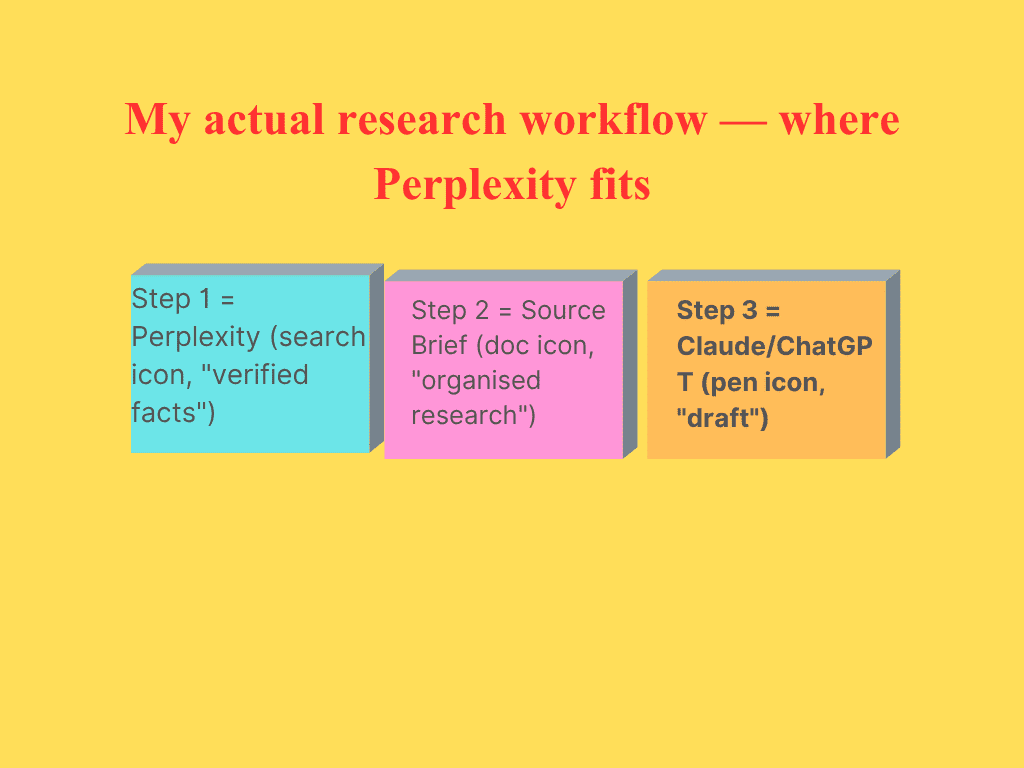
- Perplexity = verified facts with sources
- Source brief = my fact file
- Claude = structure + language
- Human = judgment + experience
Perplexity→ Source brief (Google Doc) →Claude (outline + draft) →Human edit →Hemingway + Originality.ai
The source brief is a Google Doc where I paste verified facts, direct quotes from official sources, and source URLs — everything Perplexity surfaced that I confirmed by checking the actual linked page. This document goes into Claude alongside the writing brief. Claude drafts from verified material, not from its own training data guesses.
Why don’t I write directly from Perplexity? Because it is not designed for prose. Its answers are structured for information delivery — clear, functional, organised. But they lack the flow, the argument structure, and the specificity to the target reader that a publishable post needs. Perplexity collects and verifies. Claude writes. I edit. The division of labour is clear and it works.
Where Perplexity genuinely works best
Three situations where I reach for Perplexity before anything else:
Regulated topic research. Any content touching law, finance or government policy. The version of a regulation that ChatGPT knows may not be the version currently in force. Perplexity surfaces what is current- and more importantly, it shows you the government or institutional source so you can confirm directly rather than trusting the AI’s interpretation.
Academic literature — recent publications. For PhD and research clients, finding papers published in the last 12–18 months is something ChatGPT and Claude cannot reliably do. Perplexity queries academic databases and recent publications and surfaces them with citations. I still use Connected Papers for citation mapping, but Perplexity handles the initial “what has been published on this recently” query faster than any other tool I have tested.
Fact-checking before publication. I run specific factual claims through Perplexity before any post goes live — statistics, named studies, regulatory references, company information. If Perplexity cannot find a sourced reference for a claim, that claim either gets removed or gets rewritten as the author’s observation rather than a stated fact.
Perplexity is not a replacement for primary source research. It is a faster way to find what to read — and a reliable way to catch facts that are no longer accurate before they reach a reader.
Where Perplexity actually fails
Every Perplexity review lists its strengths. Most skip this part. I am not going to.
Citation present does not mean interpretation correct
Perplexity can cite a real source accurately while drawing a conclusion from it that the source does not actually support. I have seen it summarise a research paper in a way that overstated the paper’s findings — the citation was real, the interpretation was a stretch. Always read the linked source, not just the summary.
Source quality is only as good as what it finds
Perplexity pulls from what is indexed and accessible. For niche Indian regulatory topics — state-specific laws, SEBI circulars, RBI notifications that are not well-indexed — it sometimes surfaces secondary commentary rather than the primary document. I always verify that the source Perplexity cites is the original source, not a blog summarising the original.
Over-simplification on complex legal or technical topics
Perplexity answers are built for general audiences. On technical legal questions — jurisdiction-specific clause interpretation, tax treatment edge cases — it simplifies in ways that lose important nuance. For those queries, Claude with the primary document uploaded is more reliable than Perplexity’s web-sourced summary.
Not useful for deep document analysis
If I need to analyse a specific 40-page document — a contract, a thesis chapter, a regulatory filing — Perplexity cannot help. It queries the web; it does not process uploaded documents the way Claude does. For document-level work, Claude is the tool.
The “confident but wrong” problem – why citations are not enough
This is the most important section in this review, and the one most Perplexity guides skip entirely.
Perplexity shows sources. This creates a feeling of reliability that is not always warranted. In my experience, the tool can be confidently incorrect in two specific ways that the presence of citations does not prevent.
First: a source can be real and correctly cited while the AI’s synthesis of multiple sources produces a conclusion that none of the individual sources actually state. I have seen Perplexity combine two partially related studies into a single confident claim that neither study makes individually. The citations check out. The claim does not.
Second: sources become outdated and Perplexity does not always flag when a cited source has been superseded. A regulation that was current when the source was published may have since been amended. Perplexity may cite the older source without noting that the law has changed since publication.
Perplexity shows sources — but that does not mean the interpretation is correct, the synthesis is accurate, or the source is still current. It is a research starting point, not a research conclusion.
Real example from my workflow
I used Perplexity to research FEMA compliance requirements for NRI property transactions. It cited two legitimate sources. The summary it generated implied a specific documentation requirement that, when I read the actual RBI circular, applied only to a specific transaction category — not the general case the client needed. The sources were real. The extrapolation from those sources was wrong. The NRI client would have complied with a requirement that did not apply to their situation.
Perplexity vs ChatGPT vs Claude — through real use
Not a feature table. This is what I have actually observed when I use all three for the same research need.
| The question I asked | What each tool gave me |
| Current RBI guidelines on UPI merchant settlement timelines A regulatory question where currency and source matter | ChatGPT:Confident answer, no sources, based on training data. Turned out to be 8 months outdated. Perplexity:Current answer with direct RBI circular link. Needed 5 minutes to verify the source directly — but the source was correct. Claude: Without internet access, worked from training data like ChatGPT. More nuanced analysis but same currency limitation. |
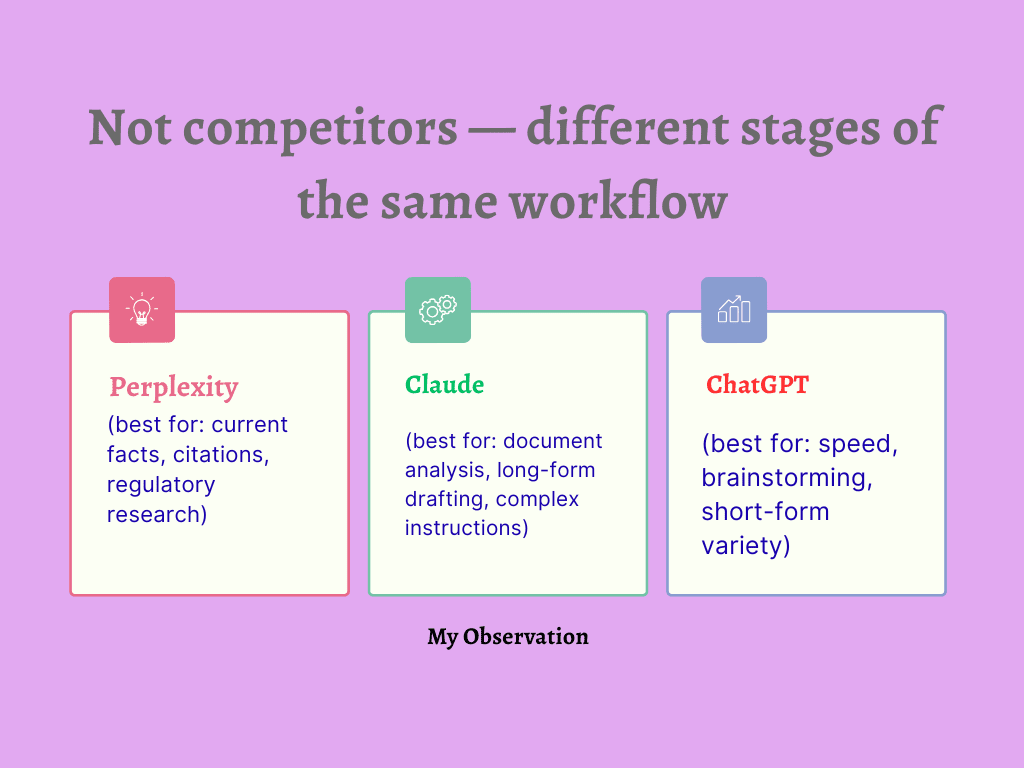
The pattern holds across most regulated topics: Perplexity for current facts, Claude for deep analysis of those facts, ChatGPT for drafting speed once the facts are established. They are not competitors for the same job. They cover different stages of the same workflow.
How I use Perplexity safely – 4 rules I follow without exception
- Never copy from Perplexity directly into a draft
Perplexity’s answers go into my source brief as research notes, not into the draft as prose. The writing always happens in Claude or ChatGPT from my own structured notes — not from Perplexity’s output verbatim. This prevents both plagiarism risk and the risk of publishing an AI interpretation as fact.
2. Always open and read the cited source – not just the summary
Every fact I plan to use gets verified against the actual linked document. Perplexity’s summary is a navigation tool that tells me what to read. The source itself is what I cite in the final post — not Perplexity’s interpretation of the source.
3.Check that the source is primary, not secondary
I confirm that what Perplexity cited is the original document — not a blog, a news article, or a commentary summarising the original. For regulatory and academic content, I only count primary sources: official government publications, journal papers, institutional reports.
4. Note the publication date of every source
I check when each source was published and whether there has been a more recent update. A correctly cited 2023 source on a regulation that was amended in 2025 is worse than no source — it creates false confidence in outdated information.
Best Free AI Writing Tools In 2026: Tested, Ranked & Honestly Reviewed
FAQs
Q. Is Perplexity better than Google for research?
For synthesising information from multiple sources quickly — yes. For finding a specific primary document, a government notification, or a niche Indian regulatory filing — Google is still more reliable because its index is more comprehensive. I use both: Perplexity to understand a topic quickly, Google to find the exact primary source I need to cite.
Q. Can I trust Perplexity for academic work?
As a starting point for identifying relevant literature — yes, carefully. As a source you cite directly — no. Academic work requires primary sources verified independently. Perplexity helps you find what to read. What you cite must come from reading the actual paper or document, not from Perplexity’s summary of it.
Q. Is Perplexity better than ChatGPT?
For research and fact verification — yes, significantly. For writing, brainstorming, and general-purpose tasks — no. They solve different problems. Asking which is better overall is like asking whether a library is better than a word processor. The right question is: which one do you need right now?
Q. Is the free tier of Perplexity good enough?
For most research workflows — yes. The free tier handles web-sourced research queries with citations. The paid tier (Perplexity Pro) adds deeper source access, more queries per day, and the ability to choose between different underlying models. For casual research, free is sufficient. For daily professional use on regulated topics, Pro removes the query limits that become frustrating quickly.
Q. Does Perplexity replace Perplexity in my workflow? (Does it replace a research assistant?)
It reduces the time spent on initial source-finding significantly — from 45 minutes to under 15 on most queries. What it cannot replace is the judgment involved in evaluating whether a source is credible, whether the information is current, and whether the synthesis is accurate. That judgment remains human work, and it is where the real research value lives.
References
- Perplexity AI — Official website: perplexity.ai
- Perplexity AI — Pro pricing: perplexity.ai/pro
About the Author
Dr. Rekha Khandelwal is a certified expert in AI tools and academic content development, with a strong focus on leveraging platforms like ChatGPT, Claude, and Gemini for research and digital writing. With a Ph.D. in Law and specialized training in AI-driven content creation, she helps students, researchers, and professionals create high-quality, SEO-optimized, and impactful content.
Author Profile Dr. Rekha Khandelwal | Academic Writer, Legal Technical Writer, AI Expert & Author | AspirixWriters
- Legal & Technical Writing Services
- Academic Writing Assistance
- Editing & Proofreading
- SEO Blogwriting Services
- Motivational, Creative & Ghostwriting
AI SEO Checklist 2026: How to Rank Your Website in ChatGPT, Perplexity & Google AI Overviews
Here is an uncomfortable reality:Read expert guide on AI SEO Checklist, Research by Dr. Rekha…
Best Free AI Writing Tools in 2026: Tested, Ranked & Honestly Reviewed
Best Free AI Writing Tools in 2026 I stopped using half the AI tools I…
Notion AI vs ChatGPT (2026): They Are Not Competitors – Here Is What That Means for You
Notion AI vs ChatGPT (2026) AI Tools Reviews: Real Testing, Comparisons & Honest Insights (2026)…
Jasper AI Review 2026: Is It Worth It for Bloggers and Marketers?
Jasper AI Review 2026 AI Tools Reviews: Real Testing, Comparisons & Honest Insights (2026) Jasper’s…
Perplexity AI Review 2026: Is It Really Better Than ChatGPT for Research?
Perplexity AI Review 2026: I don’t use Perplexity to write content. I use it to…
ChatGPT vs Claude vs Gemini: Which AI Tool Is Actually Worth It in 2026?
ChatGPT vs Claude vs Gemini I stopped asking “which AI is best?” about six months…