
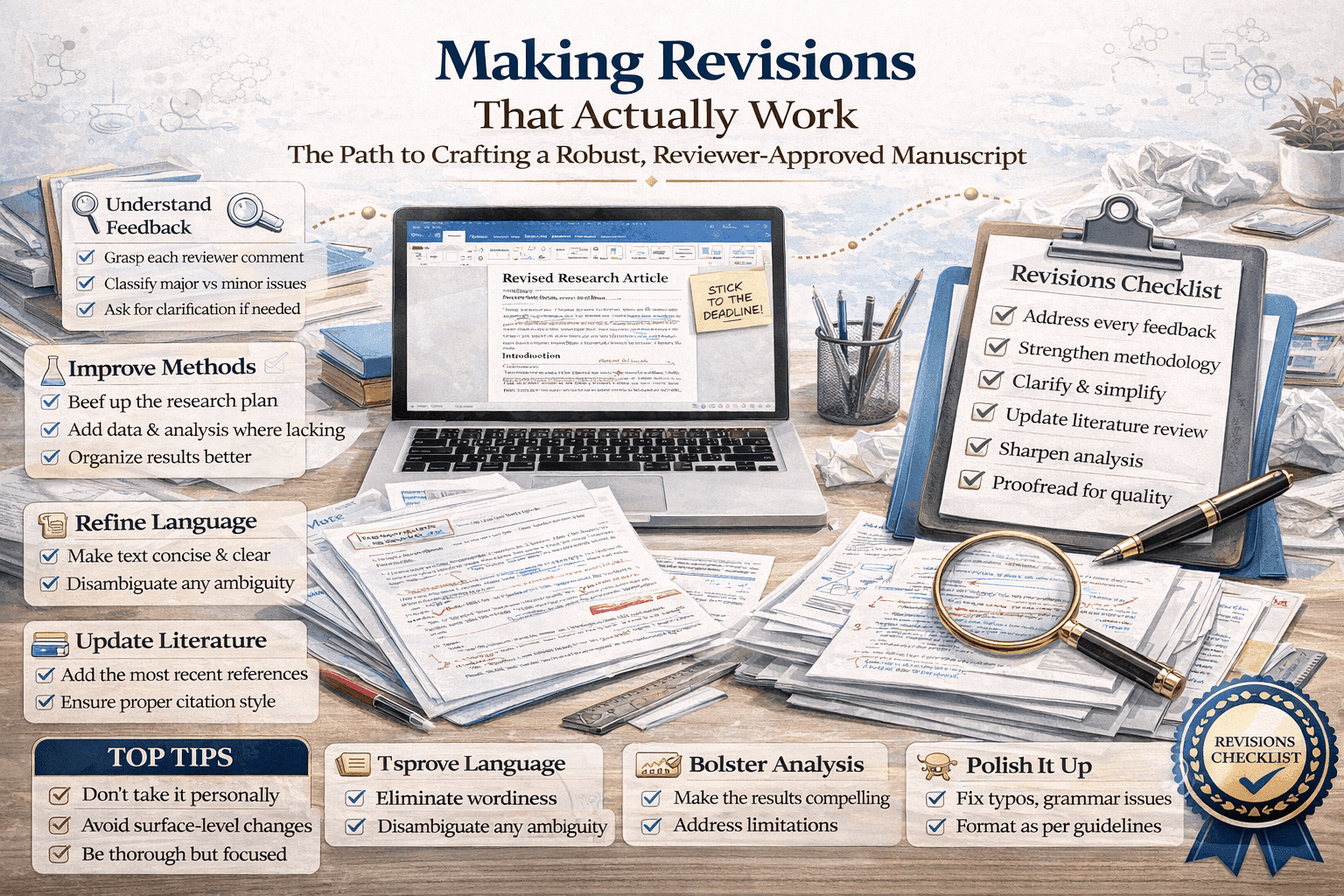
Cluster Post 3 | Module 6: Peer Review, Responding to Feedback, and Publication Strategies
From Concept to Submission Series | 2026
Academic Writing Mastery: The Complete 2026 Guide To Research Papers, Thesis & Dissertation Writing
Making Revisions That Actually Work
The module overview gives a seven-step revision process. This post goes deeper: the revision planning spreadsheet that prevents missed comments and scope creep, how major revisions create coherence problems that point-by-point changes introduce, the specific coherence check that catches these problems before resubmission, and the honest criteria for deciding when to withdraw rather than revise.
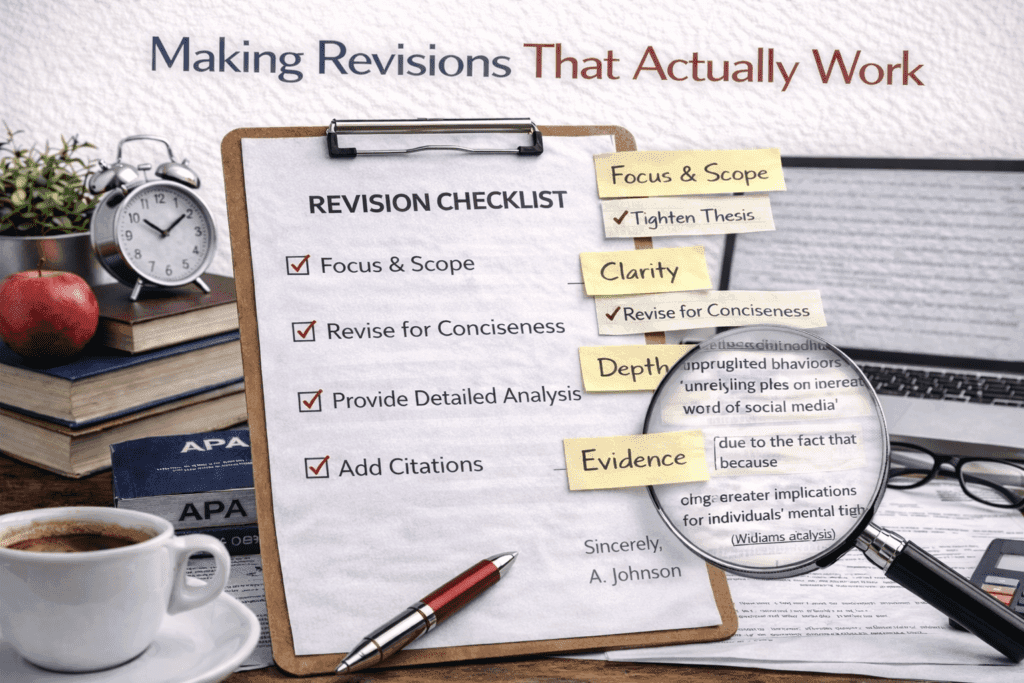
The Problem With Point-by-Point Revision
The module’s seven-step process is sound, but it understates a problem that catches many researchers off-guard. Addressing reviewer comments one by one — the only practical way to ensure completeness — tends to produce a revised manuscript that is more responsive to reviewers but less coherent as a document. New paragraphs appear that do not flow from their neighbours. Expanded sections change the paper’s proportions in ways that distort the overall argument. A new limitation added in the methodology creates a tension with an implication claimed in the discussion.
Point-by-point revision optimises locally but can degrade globally. Each individual change may be an improvement. The sum of the changes may produce a paper that is harder to read, structurally imbalanced, or internally inconsistent. Addressing this requires two separate passes: the revision pass (making each change) and the coherence pass (reading the whole paper as if for the first time and checking that it still works as a unified argument). Most researchers do the revision pass and skip the coherence pass. This is why second reviews sometimes say ‘the paper has improved but now has new structural problems.’
The Revision Planning Spreadsheet
Before making a single change to the manuscript, build a revision planning spreadsheet. This takes about an hour and prevents both missed comments and revision scope creep.
The spreadsheet has one row per reviewer comment and eight columns:
| Column | What to record |
| Reviewer number | R1, R2, R3 |
| Comment number | The number within that reviewer’s report |
| Comment (quoted) | The full text of the comment, verbatim |
| Category | Must-do / Should-do / Consider / Decline (see Cluster Post 1) |
| Response plan | What you will change or say |
| Section affected | Which section of the manuscript this touches |
| Effort level | Quick (under 30 min) / Moderate (half day) / Substantial (multiple days) |
| Status | Not started / In progress / Draft response written / Complete |
The spreadsheet serves three functions. First, it ensures completeness — every comment is visible and trackable. Second, it reveals scope: how many substantial changes are needed tells you how long the revision will realistically take, which prevents the common error of promising a two-week turnaround on a revision that requires six weeks. Third, it reveals patterns — if four comments from two different reviewers all point to the same section of the paper, that section has a fundamental problem that requires a structural solution, not four separate fixes.
Sequencing the Revision: Structural Before Textual
The module says to tackle major issues first. This is correct but the reasons matter for deciding what counts as major. The sequencing principle is: structural changes before textual changes, because structural changes affect which text needs to change.
A structural change is any change that reorganises, adds, or removes a significant section. If reviewers have asked you to add a new analytical section, reorganise the literature review thematically, or move the methodology section earlier, these are structural. They must be done first because they alter the context in which all the surrounding text makes sense. Doing line edits in a section you later move or significantly expand is wasted effort.
The revision sequence
- Step 1 — Structural changes: Add or remove sections, reorganise the sequence of major elements, move significant passages. Read the full restructured document before proceeding.
- Step 2 — New analysis or content: Run any additional analyses reviewers requested. Draft any new substantive sections. These often require new literature, new data, or new argumentation and are the most time-consuming changes.
- Step 3 — Expansion and clarification: Expand existing sections, add clarifying sentences, incorporate new literature. This is the largest category of changes by count.
- Step 4 — Limitation and scope adjustments: Revise claims to match what the study can support, add or expand the limitations discussion, adjust the scope framing in the introduction. Do this after content changes so you know what the revised paper actually claims.
- Step 5 — Textual and citation changes: Line edits, corrections to existing sentences, additional citations, formatting adjustments. Do these last — they are quick and should not influence structural decisions.
- Step 6 — Coherence pass: Full read-through of the revised manuscript as described below.
- Step 7 — Response letter: Draft the response letter with specific page references from the now-final revised manuscript.
The Coherence Pass: What to Check
The coherence pass is a complete read-through of the revised manuscript with a specific focus on the joins — the places where revised text meets unrevised text, and the places where structural changes have created new adjacencies. These joins are where incoherence is most likely to have been introduced.
Six coherence checks
- The introduction still commits to what the paper delivers: After revision, the research questions stated in the introduction may no longer match the questions actually answered in the results and discussion. Verify alignment. If you added a new analytical section in response to reviewers, does the introduction signal it?
- The literature review still builds to the gap: If you added new literature, does it integrate into the argument or does it sit as an isolated section? New literature added in response to reviewers often appears as a paragraph dropped into the existing review without connecting to what comes before and after.
- The methodology still matches what you did: If reviewers asked you to be more explicit about the analysis approach, did the new explanation you added actually describe what you did — or did it describe what you should have done, which is different? This is a common inconsistency that second reviewers notice immediately.
- New content has transitions: Read the paragraph before and after every passage you added. Does the new content arrive without warning and depart without consequence? New sections need introductory and closing sentences that connect them to the surrounding argument.
- Claims and limitations are consistent: If you tightened claims in the results section in response to a generalisability critique, check that the discussion section does not still contain the broader claims you removed from the results. Point-by-point revision often fixes claims in one place while leaving the same claim elsewhere untouched.
- Word count and proportions: After adding new content, do the chapter proportions still make sense? A literature review that has grown to 35% of the paper in response to reviewer requests for more literature engagement may now need condensing elsewhere.
When to Withdraw Rather Than Revise
The module says withdrawing is legitimate and lists conditions. This section provides more concrete decision criteria, because ‘fundamental mismatch’ and ‘impossible demands’ are easier to identify in principle than in the middle of a difficult revision.
Withdraw and submit elsewhere when: the reviewers’ requests would require you to make claims the data cannot support; when addressing all the concerns would produce a paper that no longer argues what you believe is true; when the revision requires data collection or analysis you genuinely cannot complete (not just that would take longer than you wanted); or when two or more reviewers have fundamentally misunderstood what the paper argues, suggesting the paper is a poor fit for this journal’s readership regardless of revision quality.
Continue revising when: the concerns, even if numerous, are about execution rather than conception — the reviewers believe in the contribution and are asking for a better version of the same paper; when at least one major reviewer’s concerns are addressable without distorting the paper’s argument; or when the journal is sufficiently important to your career that the effort is worth the uncertainty.
The practical test: read the reviewer comments and ask ‘if I address all of these fully and honestly, will the result be a better version of the paper I wanted to write?’ If the answer is yes, revise. If the answer is ‘the result will be a different paper that addresses different questions,’ that is usually a signal to withdraw. Note: this test requires intellectual honesty. Many researchers who should revise tell themselves the reviewers are asking for a different paper, because revision is hard. Make sure you are applying the test honestly.
Managing the Revision Timeline
Major revisions typically come with a deadline — often three to six months from the decision date. Journals vary in how strictly they enforce this, but treating the deadline as firm is wise. Late revisions can mean the original reviewers are unavailable and must be replaced, which restarts the review process.
The most common timeline error is underestimating effort on the first pass of the spreadsheet. Researchers look at fifteen reviewer comments and think ‘I can address these in two weeks.’ Then Step 2 (new analysis) takes three weeks alone. Build the timeline from the effort column in your revision spreadsheet: count the number of substantial changes, estimate a realistic time for each, add the coherence pass and response letter, and add a buffer of at least a week for unexpected complications.
If you realise mid-revision that you cannot complete the work by the deadline, contact the editor early. Editors routinely grant extensions to researchers who ask in advance with a clear completion date. Letting a deadline pass without communication is a much worse outcome than requesting an extension.
For Law Students
Revising doctrinal theses after examination
Doctrinal thesis revisions after examiner reports have a specific coherence challenge that empirical research revisions do not: when examiners request changes to the doctrinal analysis, revising one chapter often creates inconsistencies in the conclusions of other chapters that relied on that analysis.
Run a citation chain check as part of your coherence pass. If you change the interpretation of a key case in Chapter 3, trace every subsequent reference to that case through Chapters 4 and 5. If you revise the doctrinal framework in the analysis chapter, check whether the conclusion chapter’s summary of that framework still accurately represents the revised analysis. Doctrinal revisions propagate through a thesis in ways that line-by-line revision does not catch.
The post-viva revision protocol
Most Indian universities require post-viva corrections to be submitted within a specified period — commonly one to three months for minor corrections, three to six months for major corrections. The revised thesis is typically reviewed by the supervisor (for minor corrections) or by one or both examiners (for major corrections) before the degree is awarded.
Treat post-viva corrections with the same systematic rigour as journal revisions. Build the spreadsheet, sequence structural before textual changes, run the coherence pass, and document every change with page references in the corrections response document. Post-viva corrections that are incomplete or that introduce new inconsistencies can delay degree conferral by months.
References
- Belcher, W. L. (2019). Writing Your Journal Article in Twelve Weeks (2nd ed.). University of Chicago Press.
- Murray, R. (2011). How to Write a Thesis (3rd ed.). Open University Press.
- Silvia, P. J. (2019). How to Write a Lot (2nd ed.). APA.
Next: Cluster Post 4 — Preparing for Your Viva Voce
Module 1 (Pillar Post)- The Complete Guide To Research Paper Structure: IMRAD Format, Thesis Organization & Academic Writing (2026)
Module 2 (Pillar Post) –The Academic Writing Process: Complete Guide from First Draft to Submission (2026)
Module 3 (Pillar Post) Research Methodologies: Complete Guide To Quantitative, Qualitative, Mixed Methods & Legal Research (2026)
Module 4 (Pillar Post) : Data Analysis and Results Presentation: Complete Guide for Quantitative, Qualitative & Legal Research (2026)
Module 5 (Pillar Post) : Organization and Academic Tone: Complete Guide to Professional Scholarly Writing (2026)
Next in Series:
- Pillar Post : Peer Review and Publication: Complete Guide from Submission to Acceptance (2026) (Module 6)
- Pillar Post : AI Tools in Academic Research: Opportunities, Ethics, and Best Practices (2026) (Module 7)
- Pillar Post: Grant Writing and Research Funding: Complete Guide to Finding Money for Your Research (2026) (Module 8)
- Pillar Post : Academic Career Development: Complete Guide to Building Your Professional Life in Research (2026) (Module 9)
- Pillar Post : Research Ethics and the IRB Process: Complete Guide to Doing Research Responsibly (2026) (Module 10)
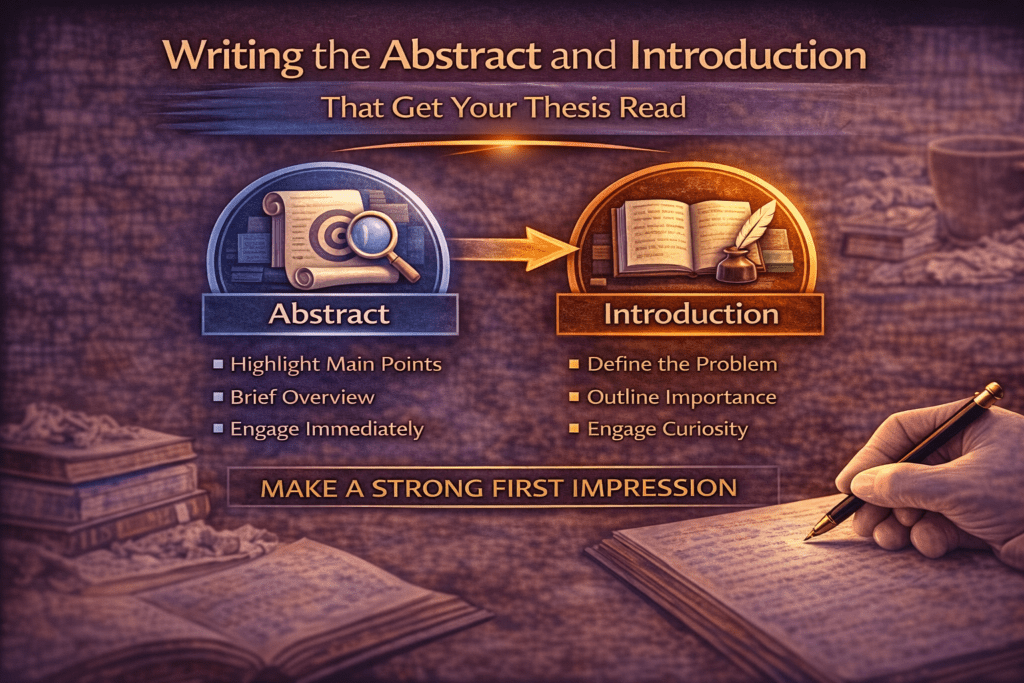
Writing the Thesis Abstract and Introduction
Cluster Post 2 | Module 5: Thesis Writing and Submission From Concept to Submission Series …
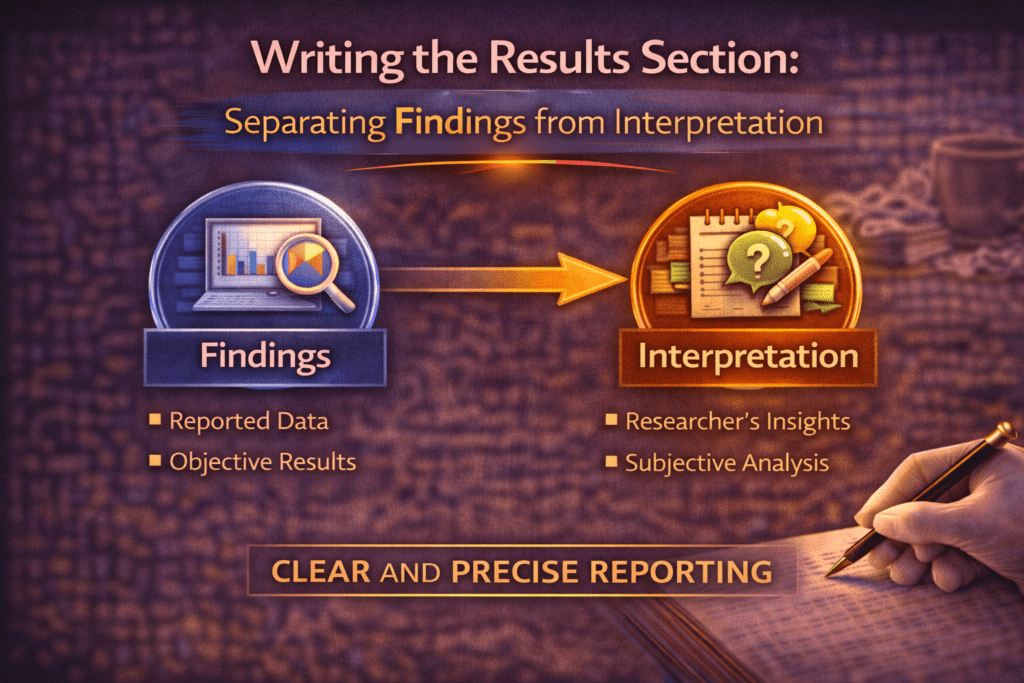
Writing the Results Section: Separating Findings from Interpretation
Cluster Post 6 | Module 4: Data Analysis and Presenting Results From Concept to Submission…
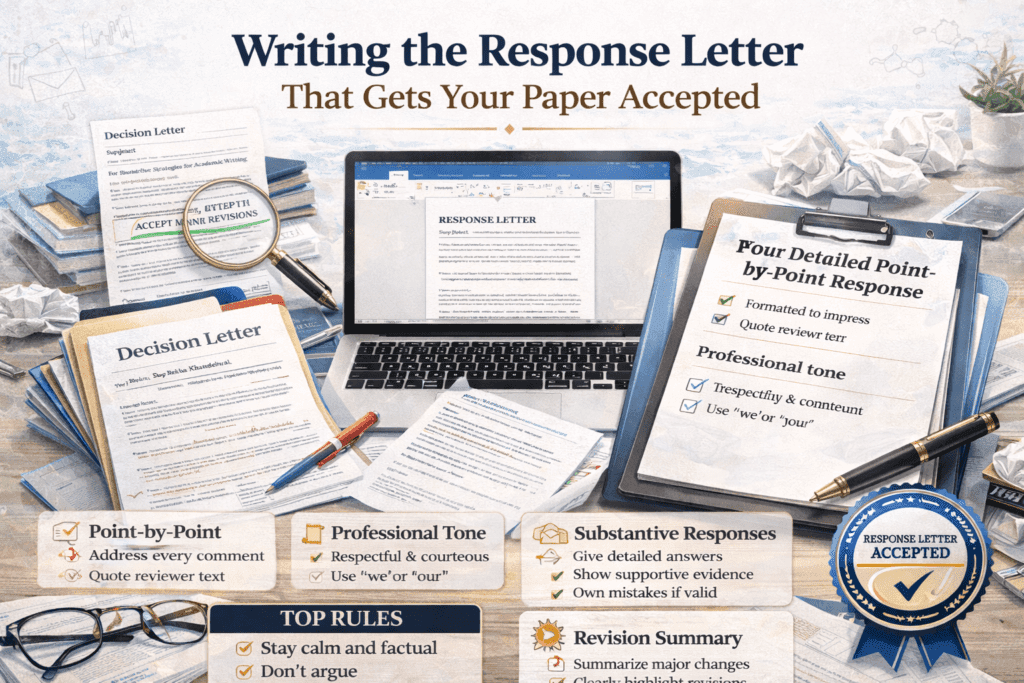
Writing the Response Letter That Gets Your Paper Accepted
Cluster Post 2 | Module 6: Peer Review, Responding to Feedback, and Publication Strategies From…
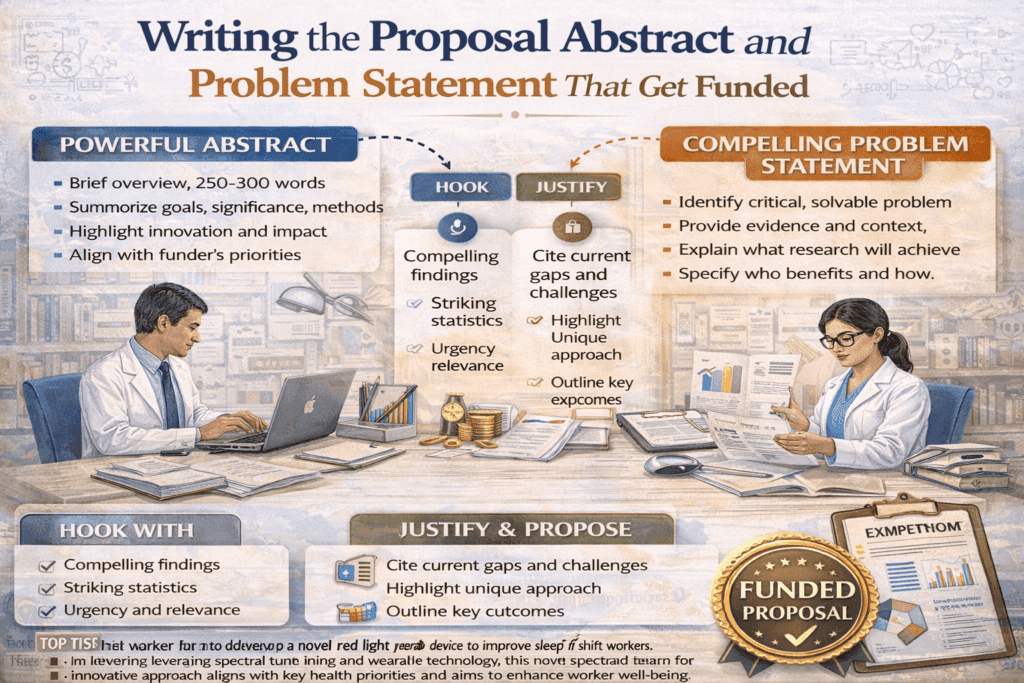
Writing the Proposal Abstract and Problem Statement That Get Funded
Cluster Post 2 | Module 8: Grant Writing and Research Funding From Concept to Submission…

Writing the PhD Synopsis: India’s Most Underestimated Document
Cluster Post 6 | Module 5: Thesis Writing and Submission From Concept to Submission Series …
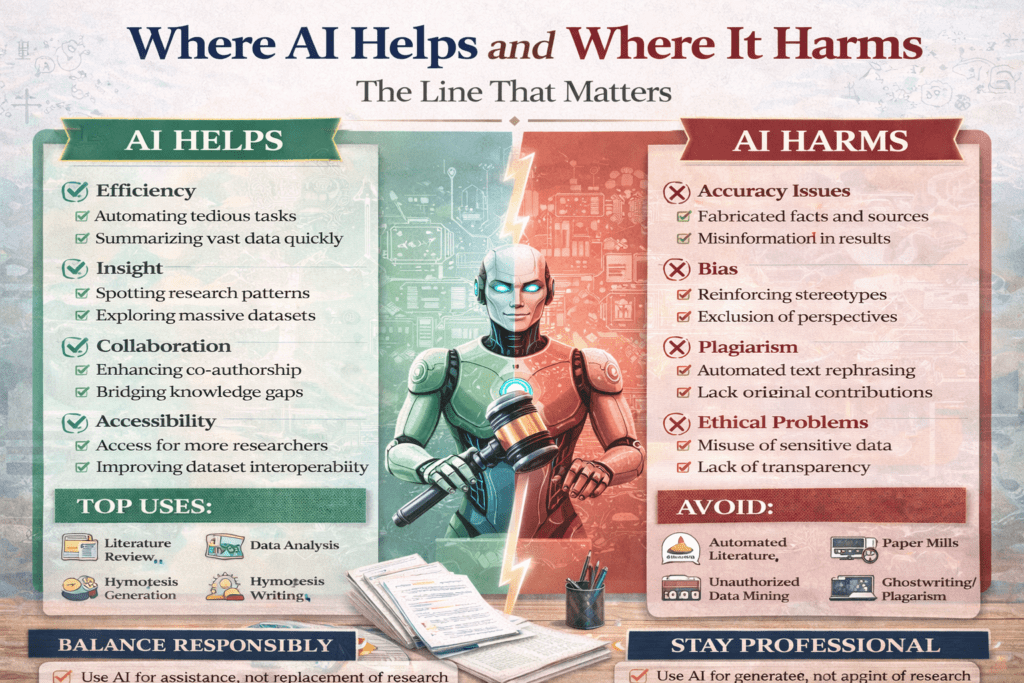
Where AI Helps and Where It Harms: The Line That Matters
Cluster Post 2 | Module 7: AI Tools in Academic Research — Opportunities, Ethics, and…