
Cluster Post 6 | Module 5: Thesis Writing and Submission
From Concept to Submission Series | 2026
Academic Writing Mastery: The Complete 2026 Guide To Research Papers, Thesis & Dissertation Writing

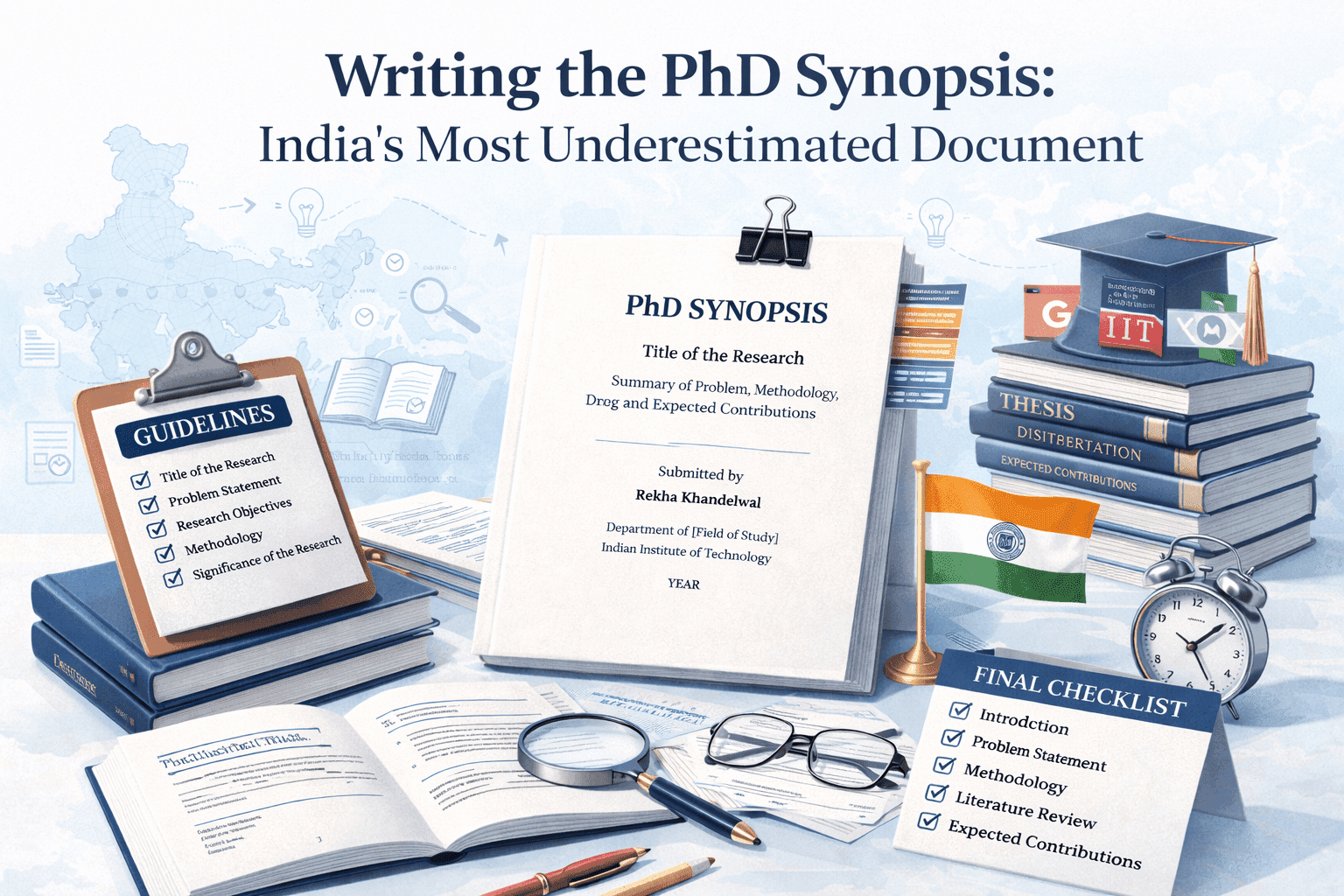
Writing the PhD Synopsis: India’s Most Underestimated Document
Most Indian PhD students treat the synopsis as a formality to get through before ‘real’ research begins. This is a mistake. The synopsis is the document that determines whether your research is approved, shapes your entire thesis arc, and — when written well — becomes the foundation for your first grant proposal and your conference abstract.
This post covers what a synopsis is and is not, how it differs from the thesis abstract and executive summary, the standard Indian university synopsis structure, the most common rejection reasons, and how to write each section so that your Doctoral Research Committee approves it with minimal revision.
Three Documents That Are Frequently Confused
| Document | When it is written | Purpose and audience |
| Synopsis | Before research begins — submitted for PhD registration and DRC approval | Proposes what you intend to research and how. Written in future tense. Audience: Doctoral Research Committee, supervisors, ethics committee. This is a plan, not a summary of completed work. |
| Thesis Abstract / Executive Summary | After thesis is complete — submitted with the final thesis | Compressed summary of completed research: what was done, found, and contributed. Written in past tense. Audience: examiners, library, Shodhganga. Required for online upload. |
| Research Paper Abstract | After the paper is written — submitted to the journal | Standalone summary designed to help readers decide whether to read the full paper. Very tight, 150–250 words. Audience: journal readers and database search systems. |
The fundamental distinction: the synopsis is prospective — it describes research you will do. The thesis abstract is retrospective — it describes research you have done. Treating the synopsis as a mini-abstract (summarising existing literature rather than proposing original research) is the most common conceptual error in Indian PhD synopses.
What the Synopsis Must Accomplish
A synopsis serves three distinct purposes, and a strong synopsis satisfies all three simultaneously:
- Registration approval: the DRC must be satisfied that the proposed research is original, feasible within the PhD timeline, methodologically appropriate, and supervised by someone with relevant expertise. The synopsis is your evidence for all four.
- Research design clarity: writing the synopsis forces you to think through the entire research design before data collection begins. Researchers who write strong synopses have fewer mid-research crises because they have already resolved the foundational questions about scope, method, and argument.
- Foundation document: a well-written synopsis becomes the skeleton of your thesis introduction and methodology chapters, your ethics committee application, and your first grant proposal. The intellectual work done for the synopsis is not wasted — it is invested.
Standard Indian University Synopsis Structure
While individual universities vary in their specific requirements, the following structure is consistent with UGC guidelines and the practices of most central universities and NLUs. Always verify your institution’s specific format requirements and page limits before writing.
1. Title
The title is a research commitment, not a topic label. A topic label says what area you are working in (‘Artificial Intelligence and Constitutional Law’). A research title says what question you are asking or what argument you are making (‘Judicial Review of AI Surveillance Under Article 21: Towards a Proportionality Framework’).
Topic label (weak): ‘A Study of Tribal Land Rights in Jharkhand’ Research title (strong): ‘Customary Land Rights, State Acquisition, and the Limits of the Fifth Schedule: An Empirical Study of Displacement in Jharkhand’s Coal Belt (2010–2024)’
The strong title specifies: the legal framework (Fifth Schedule), the method (empirical), the geographic scope (Jharkhand’s coal belt), and the time period. A reader knows exactly what the research is. The DRC can assess originality and feasibility from the title alone.
2. Introduction / Background (500–800 words)
Establish the real-world and academic context for the research. This section answers: why does this research matter, and why now? Open with the stakes — what problem in the world or in the discipline makes this research necessary — then narrow to the specific gap your research will address.
Common error: spending the entire introduction summarising existing literature chronologically. The introduction should establish context, not review literature. Literature review comes in its own section.
3. Statement of the Problem (200–400 words)
The single most important section of the synopsis. State precisely what your research will investigate, why this specific question is not yet answered by existing scholarship, and what the consequence of this gap is. The problem statement should be narrow enough to be answerable within a PhD timeline and significant enough to justify the research.
Weak problem statement: ‘There is a lack of research on AI and human rights in India. This research will study this important topic.’ Strong problem statement: ‘While the Supreme Court’s Puttaswamy judgment (2017) established proportionality as the governing standard for privacy rights adjudication, no systematic framework exists for applying this standard to AI-enabled surveillance systems — a gap with practical urgency as law enforcement agencies deploy facial recognition and predictive policing technologies without clear constitutional guidance. Existing scholarship addresses either proportionality doctrine in general or AI governance in policy terms, but does not integrate the two into an operational judicial review framework. This research addresses that gap.’
Notice what the strong statement does: it names the specific legal gap, explains why it matters practically, identifies what existing scholarship does and does not cover, and states precisely what the research will do.
4. Review of Related Literature (800–1,500 words)
Not a comprehensive literature review — a targeted review that establishes the research gap. Cover: what is known about the topic, what the major debates and perspectives are, where the disagreements lie, and — crucially — what has not been studied that your research will study. Organise thematically, not author by author.
The literature review in the synopsis must end with the gap. Every paragraph should be moving toward the conclusion: ‘Despite this body of work, X remains unstudied.’ If the review does not culminate in a clear gap, the DRC cannot assess the originality of the proposed research.
5. Objectives of the Study (bulleted list)
Three to five specific, measurable objectives stated clearly. Each objective should correspond to a chapter or major section of the thesis. Objectives are what you will achieve; research questions are what you will ask. Some universities require both; others require only one. Check your institution’s format.
Objectives (for a mixed-methods empirical legal study): 1. To map the current judicial interpretation of proportionality under Article 21 in cases involving surveillance technologies (2017–2024). 2. To develop an operational framework for applying Puttaswamy proportionality doctrine to AI surveillance systems. 3. To empirically assess whether current AI surveillance deployments by Indian law enforcement agencies satisfy the proposed framework. 4. To recommend constitutional and legislative safeguards for AI surveillance governance in India.
Each objective is specific, achievable, and maps onto a distinct research activity.
6. Hypotheses or Research Questions
For empirical quantitative research: state testable hypotheses. For qualitative and doctrinal research: state research questions. For mixed methods: state both, noting which question each method addresses.
Research questions must be questions, not topics. ‘The relationship between judicial review and AI surveillance’ is a topic. ‘Does the Puttaswamy proportionality framework provide adequate constitutional protection against AI-enabled mass surveillance?’ is a research question.
7. Research Methodology (600–1,000 words)
The section that most synopses underwrite and most DRCs scrutinise most carefully. Cover:
- Research approach: doctrinal, empirical qualitative, empirical quantitative, mixed methods — and why this approach is appropriate for your research questions.
- Sources and data: for doctrinal research, which primary sources (courts, time period, jurisdiction); for empirical research, who participants are, how many, how selected.
- Data collection methods: cases, interviews, surveys, observations, documents — described specifically enough for the DRC to assess feasibility.
- Analytical framework: how you will analyse the data — doctrinal analysis, thematic analysis, regression, content analysis. Name the method and briefly explain why it is appropriate.
- Limitations: acknowledge the scope constraints honestly. A synopsis that claims to study everything about a broad topic is less credible than one that clearly defines its boundaries.
8. Proposed Chapter Plan
A provisional table of contents with two to three sentences describing the content and argument of each proposed chapter. This shows the DRC that you have thought through how the research will build into a coherent argument from beginning to end.
Chapter 1: Introduction — Establishes the research problem, the constitutional gap in AI surveillance governance, and the structure of the thesis. Chapter 2: Proportionality Doctrine in Puttaswamy and Its Development — Traces the adoption of German proportionality doctrine and maps current judicial application. Chapter 3: AI Surveillance Technologies and Their Constitutional Implications — Analyses the technical characteristics of facial recognition, predictive policing, and related systems that are constitutionally relevant. Chapter 4: An Operational Proportionality Framework for AI Surveillance — Develops the core doctrinal contribution of the thesis. Chapter 5: Empirical Assessment — Tests the framework against current law enforcement deployments using interview and documentary data. Chapter 6: Conclusions and Recommendations — Summarises the contribution, draws implications for legislation and judicial practice, and identifies directions for future research.
9. Significance of the Study (200–300 words)
Why does this research matter? Write to three audiences: the academic community (what knowledge gap it fills), the policy community (what practical implications it has), and the legal/social community (who benefits from the research). Do not be modest — the significance section is where you make the case that this work deserves three to five years of doctoral-level attention.
10. Bibliography / References
A preliminary bibliography of 30–60 sources that you have already identified as central to the research. This demonstrates that you know the field and have done the preliminary reading. Use the citation format required by your institution consistently throughout. Every source in the bibliography should be genuinely relevant to the proposed research.
Why Synopses Are Rejected: The Seven Most Common Reasons
| Rejection reason | How to avoid it |
| Research question is too broad to be answered in a PhD | Apply the five-year test: can this research genuinely be completed by one person in five years? If not, narrow the scope. Geographical, temporal, and jurisdictional limits are your tools. |
| No clear research gap — the proposed research already exists | Before submitting, search Shodhganga, ProQuest Dissertations, and your field’s key journals systematically. If substantially similar research exists, differentiate clearly or change the question. |
| Methodology section is vague or absent | Name your method specifically and justify it. ‘Qualitative methods will be used’ is not adequate. ‘Semi-structured interviews with 25 district court judges selected through purposive sampling, analysed using thematic analysis’ is adequate. |
| Objectives are not achievable within the thesis | Check that every objective corresponds to a concrete research activity and that the sum of activities is feasible within your institution’s PhD timeline. |
| Literature review does not establish the gap | Restructure: every paragraph should be building toward the conclusion that something specific is missing. If reviewers cannot see the gap from reading the literature review, rewrite to make it explicit. |
| Title does not match the proposed research | Write the title last, after the objectives and methodology are finalised. The title should be a compressed version of the research question, not a broad topic area. |
| Bibliography is thin or not representative of the field | Spend two to three weeks on preliminary reading before writing the synopsis. A bibliography of fewer than 30 sources suggests insufficient familiarity with the field. |
The Synopsis-to-Thesis Transition
A well-written synopsis is not discarded when thesis writing begins — it is transformed. Here is how each synopsis section becomes thesis content:
| Synopsis section | Becomes in the thesis |
| Introduction / Background | First half of Chapter 1 (Introduction) |
| Statement of the Problem | Research gap section in Chapter 1 |
| Review of Related Literature | Expanded into full Literature Review chapter |
| Objectives and Research Questions | Retained verbatim in Chapter 1 |
| Methodology | Expanded into full Methodology chapter with additional detail |
| Chapter Plan | Actual chapter structure of the thesis |
| Bibliography | Starting point for the final reference list — expanded significantly during research |
Important: the methodology you described in the synopsis is what your DRC approved. If you need to change your research design significantly during the research — different method, different sample, different scope — you typically need to submit a revised synopsis or an amendment for DRC approval. Check your institution’s regulations on this before making major design changes.
For Law Students
Writing the synopsis for doctrinal legal research
Doctrinal legal research synopses face a specific challenge: the methodology section is harder to write because the method (doctrinal analysis) is less familiar to committee members from other disciplines, and the research ‘data’ (cases, statutes, treaties) is not collected through a field process in the way empirical data is.
How to write the methodology section for a doctrinal synopsis:
- Name the methodology explicitly: ‘This research uses doctrinal legal analysis as its primary methodology.’ Define it briefly: doctrinal analysis involves systematic examination of primary legal sources — legislation, judicial decisions, and international instruments — to identify legal rules, principles, and their application.
- Specify your primary sources: which courts, which time period, which jurisdiction. ‘All Supreme Court decisions on surveillance and privacy from 2017 to 2025, and selected High Court decisions where they involve novel constitutional interpretation’ is specific. ‘Relevant cases’ is not.
- Describe your analytical framework: how will you analyse the cases? Proportionality analysis, doctrinal synthesis, comparative analysis? Name the approach and explain why it is appropriate for your research question.
- Note your secondary sources: academic commentary, law commission reports, parliamentary debates, comparative jurisdiction materials. Explain how these will be used — to contextualise doctrine, to identify reform arguments, to enable comparison.
NLU-specific synopsis requirements
Most NLUs require the synopsis to be presented before the Doctoral Research Committee within six to twelve months of PhD registration. Some NLUs also require a separate pre-synopsis seminar where you present the research plan to faculty and receive feedback before formal DRC submission. Check your NLU’s PhD regulations for the specific timeline and process.
The pre-synopsis seminar — where it is required — is effectively a practice DRC. Treat it seriously: prepare a 20-minute presentation covering your research question, the gap, your methodology, and your chapter plan. The feedback received at the seminar should be incorporated into the formal synopsis before DRC submission.
A Note on Tense
The synopsis is written in future tense throughout — because you are describing research you have not yet done. This is one of the clearest markers that distinguishes a synopsis from a thesis abstract or a journal article.
Synopsis (future tense): ‘This research will examine… The study will use semi-structured interviews… Chapter 3 will develop a framework…’ Thesis abstract (past tense): ‘This research examined… The study used semi-structured interviews… Chapter 3 developed a framework…’
Mixing tenses — switching between ‘this research will examine’ and ‘this research examines’ — is one of the small errors that signal a hastily written synopsis. Maintain future tense consistently.
References
- UGC Minimum Standards and Procedure for Award of PhD Degree Regulations 2022. ugc.gov.in
- Shodhganga — thesis upload guidelines. shodhganga.inflibnet.ac.in
- Locke, L. F., et al. (2022). Proposals That Work (8th ed.). Sage.
- Creswell, J. W. & Creswell, J. D. (2022). Research Design (6th ed.). Sage.
Module 1 (Pillar Post)- The Complete Guide To Research Paper Structure: IMRAD Format, Thesis Organization & Academic Writing (2026)
Module 2 (Pillar Post) –The Academic Writing Process: Complete Guide from First Draft to Submission (2026)
Module 3 (Pillar Post) Research Methodologies: Complete Guide To Quantitative, Qualitative, Mixed Methods & Legal Research (2026)
Module 4 (Pillar Post) : Data Analysis and Results Presentation: Complete Guide for Quantitative, Qualitative & Legal Research (2026)
Module 5 (Pillar Post) : Organization and Academic Tone: Complete Guide to Professional Scholarly Writing (2026)
Next in Series:
- Pillar Post : Peer Review and Publication: Complete Guide from Submission to Acceptance (2026) (Module 6)
- Pillar Post : AI Tools in Academic Research: Opportunities, Ethics, and Best Practices (2026) (Module 7)
- Pillar Post: Grant Writing and Research Funding: Complete Guide to Finding Money for Your Research (2026) (Module 8)
- Pillar Post : Academic Career Development: Complete Guide to Building Your Professional Life in Research (2026) (Module 9)
- Pillar Post : Research Ethics and the IRB Process: Complete Guide to Doing Research Responsibly (2026) (Module 10)
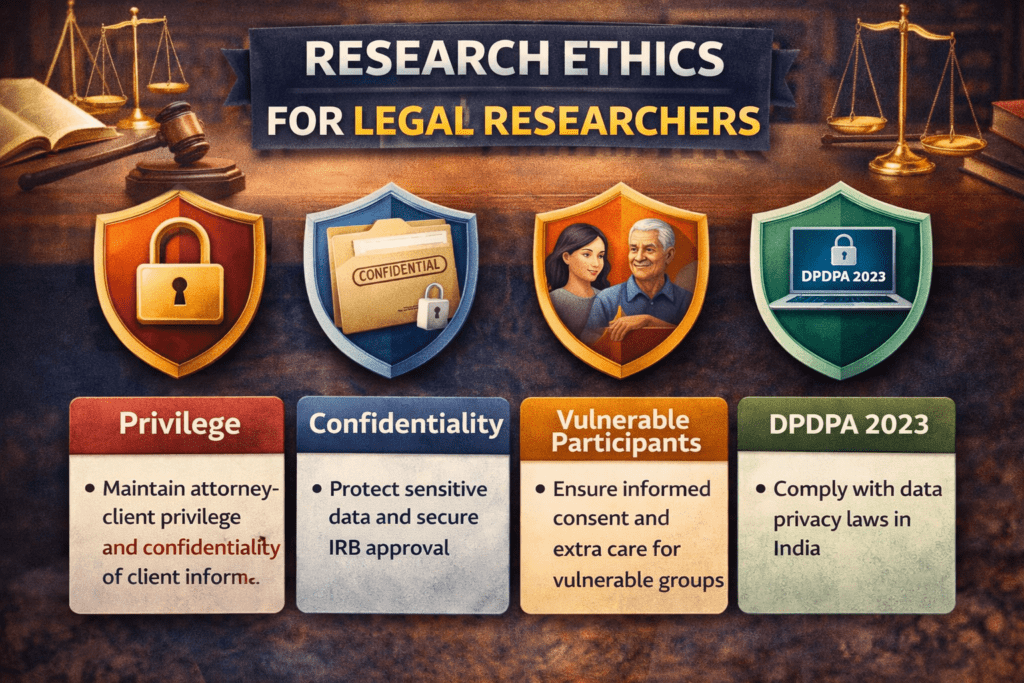
Research Ethics for Legal Researchers: Privilege, Confidentiality, Vulnerable Participants, and the DPDPA 2023
Research Ethics for Legal Researchers Academic Writing Mastery: The Complete 2026 Guide To Research Papers,…

Academic Career Development for Legal Researchers
Academic Career Development for Legal Researchers: NLU Faculty Pathways, Law School Hiring, and Building a…
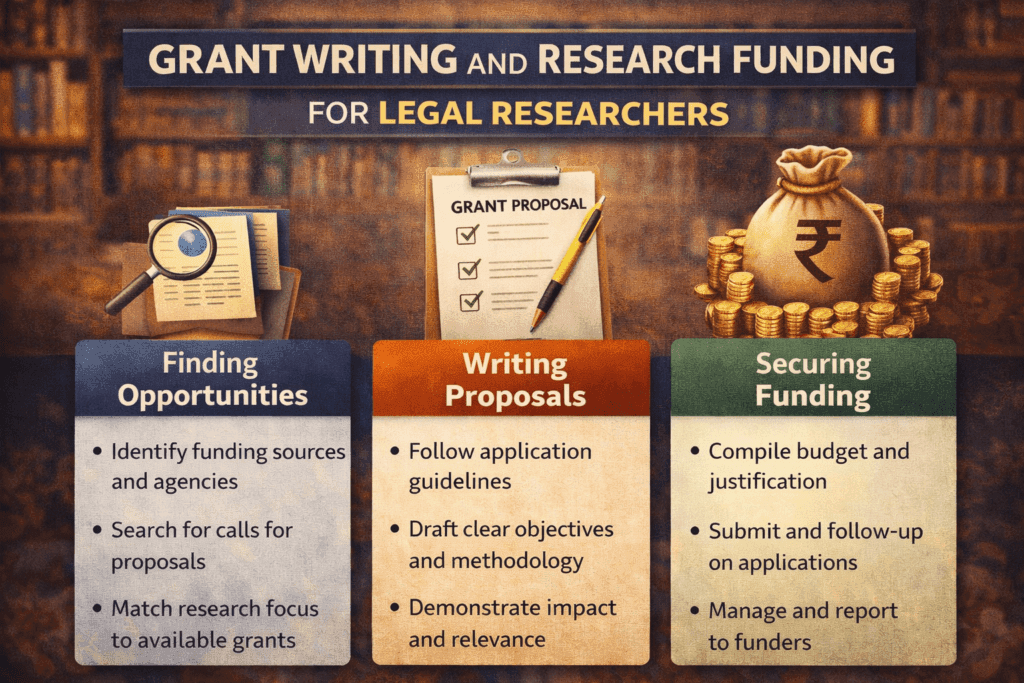
Grant Writing and Research Funding for Legal Researchers
Academic Career Development: Complete Guide To Building Your Professional Life In Research (2026) Back to…
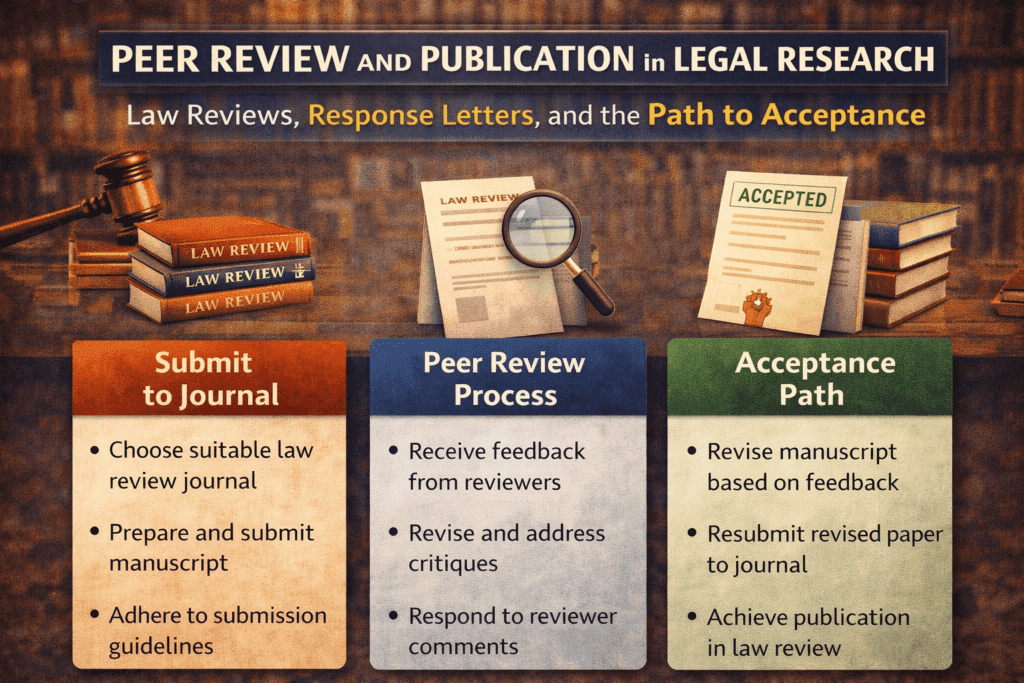
Peer Review and Publication in Legal Research
Peer Review and Publication in Legal Research: Law Reviews, Response Letters, and the Path to…

Academic Writing Mastery: The Complete 2026 Guide to Research Papers, Thesis & Dissertation Writing
Academic Writing Master From Concept to Submission Series Academic Writing Mastery Whether you are writing…

Research Integrity: Data Handling Authorship Ethics and the Indian Regulatory Framework
Cluster Post 5 | Module 10: Research Ethics and the IRB Process From Concept to…