
Cluster Post 4 | Module 6: Peer Review, Responding to Feedback, and Publication Strategies
From Concept to Submission Series | 2026
Academic Writing Mastery: The Complete 2026 Guide To Research Papers, Thesis & Dissertation Writing
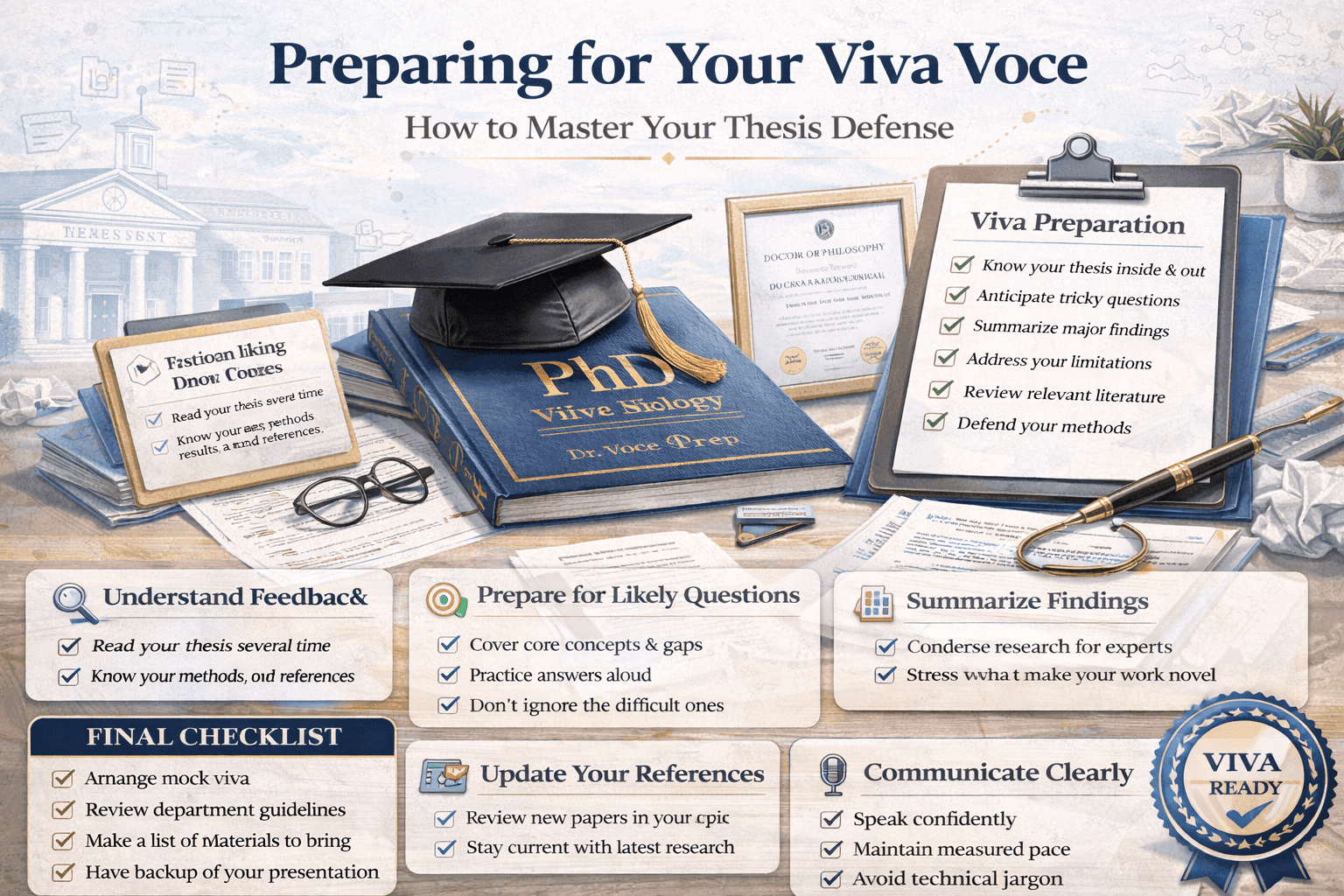
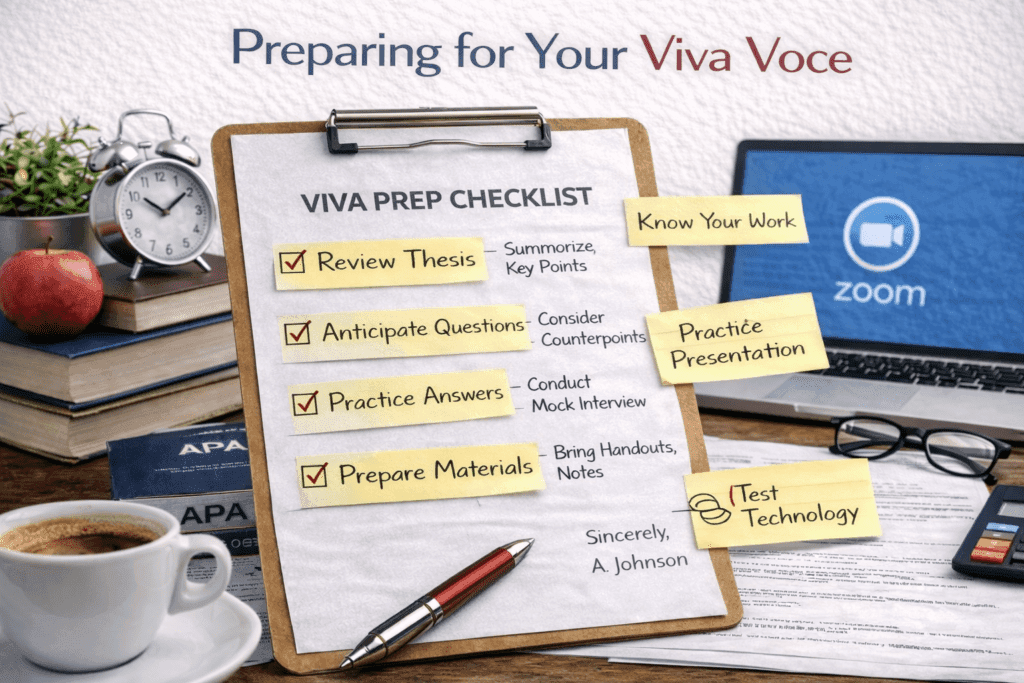
Preparing for Your Viva Voce
The module overview describes the viva format and common questions. This post goes deeper: the Indian university viva format specifically, the four question categories with targeted preparation strategies, how to handle questions you genuinely cannot answer, the mock viva protocol that makes the most of limited preparation time, and the most common viva failures and how to avoid them.
What the Viva Actually Tests
The module describes the viva as a scholarly conversation. This is accurate but understates the examination dimension. The viva tests three things simultaneously — and each requires different preparation.
First, mastery of the thesis: do you know your own work thoroughly enough to discuss any part of it, defend any claim, and explain any methodological decision? This is tested by questions about specific chapters, specific arguments, and specific evidence. Preparation: re-read the thesis systematically, make notes on each chapter’s main claims and the evidence for each.
Second, positioning in the field: do you know where your work sits in relation to the existing literature well enough to explain what you have contributed and what remains to be done? This is tested by questions about how your findings relate to other scholars’ work, what you would argue against, and what your work does not address. Preparation: write a one-page map of the field showing where your thesis sits and how it relates to the four or five most important existing works.
Third, intellectual confidence: can you defend your decisions, acknowledge limitations without appearing to undermine your own work, and engage with challenging questions as intellectual equals rather than as a student being examined? This is tested by the questions that push back, propose alternatives, or identify genuine weaknesses. Preparation: the mock viva — you cannot develop this through solitary re-reading.
The Indian University Viva Format
The module describes a generic international viva format. The Indian university PhD viva has specific features worth understanding.
Format: Indian university vivas are typically open to the public — faculty, students, and other scholars may attend. The candidate presents a summary of the thesis (usually 15–20 minutes) before examination begins. Two or three examiners are present: one or two external examiners (from other institutions, one may be from abroad) and an internal examiner or supervisor. The supervisor may or may not ask questions, depending on institutional convention.
Duration: The presentation plus examination typically runs two to three hours, shorter than UK-style vivas (which can run four hours or more) but longer than US-style dissertation defenses (which often run ninety minutes).
The presentation: The opening presentation is not just a summary — it is your first opportunity to frame the thesis on your own terms. Use it to establish the problem clearly, state the contribution explicitly, and pre-empt the two or three most predictable weaknesses by acknowledging them briefly and explaining how you addressed them. This signals intellectual maturity and reduces the likelihood that examiners will spend the examination on predictable points.
Outcomes under Indian university regulations: The UGC regulations specify that the viva outcome may be: award of degree (pass), pass with minor corrections (to be submitted within one month and approved by supervisor), pass with major revisions (to be resubmitted for fresh evaluation), or rejection of the thesis. Outright rejection at the viva stage is very rare at Indian universities. The vast majority of candidates pass, though major corrections are not uncommon.
The Four Question Categories and How to Prepare for Each
Category 1: Contribution questions
These ask what your thesis adds to the field. They are usually the first questions and set the tone for everything that follows. A weak answer — hesitant, vague, or excessively modest — creates an impression that takes the rest of the viva to overcome.
Typical contribution questions: ‘What is the original contribution of this thesis?’ ‘How does your work differ from Singh and Menon (2022), which covers similar ground?’ ‘If someone had already read everything in your literature review, what would they learn from your thesis that they did not know?’
Preparation: Write a two-minute spoken answer to ‘What is the original contribution of this thesis?’ This answer must be specific — not ‘I fill a gap in the literature’ but ‘I develop the first doctrinal framework for judicial review of AI surveillance under Article 21 by synthesising the proportionality standard from Puttaswamy with the operational requirements of AI systems as established in the technical literature.’ Rehearse it until you can deliver it without hesitation.
Category 2: Methodology questions
These test whether you understand why you made the methodological choices you did, what the limitations of those choices are, and how you would defend them against reasonable alternatives.
Typical methodology questions: ‘Why doctrinal methodology rather than empirical research?’ ‘Why did you select these particular cases and not others?’ ‘Your comparative analysis covers the EU and UK — why not the US, which has the most developed AI governance debate?’ ‘What would the study look like if you had used socio-legal methods instead?’
Preparation: For every major methodological decision in your thesis, write out the decision, the alternative you rejected, and the reason for your choice. Examiners rarely accept ‘this was the appropriate method’ without a comparison to the alternative. Your justification must show you considered the alternative seriously.
Category 3: Limitation and weakness questions
These are the most feared questions and the ones candidates are least prepared for, because preparation typically focuses on strengths rather than weaknesses. But limitation questions are actually an opportunity — a candidate who identifies limitations clearly, explains why they do not undermine the core contribution, and describes how future research could address them demonstrates intellectual maturity that impresses examiners.
Typical limitation questions: ‘Your study is limited to Supreme Court and High Court decisions — does this mean your framework is inapplicable to lower courts?’ ‘The cases you analyse are mostly from 2017–2025. How do you account for the possibility that the law has moved on since you finished writing?’ ‘You acknowledge your comparative analysis is limited to two jurisdictions. Isn’t that too narrow a basis for proposing a framework for Indian courts?’
Preparation: List the five most significant limitations of your thesis. For each, write: what the limitation is, why it exists (resource, methodological, or conceptual constraint), why it does not invalidate the core contribution, and what future research could do to address it. The key framing: a limitation is not a fatal flaw — it is a boundary condition on what you claim. Examiners accept boundaries; they object to overclaiming.
Category 4: Future directions questions
These assess whether you can think beyond your own thesis — whether the research has produced genuine intellectual generativity. They also test whether you understand your work’s place in a larger scholarly conversation.
Typical future directions questions: ‘Where would you take this research next?’ ‘What question does your thesis raise that it does not answer?’ ‘If you had another three years and unlimited resources, what would the follow-up study look like?’
Preparation: Prepare two to three specific future research directions. They should be genuinely connected to what your thesis found — the natural next questions that your work raises. Do not say ‘more research is needed’ — this tells the examiners nothing. Say ‘The framework I propose assumes judicial willingness to engage with technical AI evidence; empirical research on how Indian judges actually process technical expert testimony would be a valuable next step that could either validate or require adjustment of the framework.’
Handling Questions You Cannot Answer
Every viva includes at least one question the candidate cannot fully answer. How you handle this moment is itself an assessment. The wrong responses are: guessing confidently when you do not know (examiners detect this and it damages credibility far more than admitting uncertainty); freezing; or deflecting with a tangentially related answer.
The right response has three parts: acknowledge you are not certain, offer what you do know that is relevant, and engage with the intellectual question even if you cannot answer it definitively.
Handling a question you cannot fully answer: Examiner: ‘How does your proportionality framework interact with Section 69 of the Information Technology Act? The state’s surveillance powers under that provision seem to be in direct tension with the framework you propose.’ You: ‘That is an important question that I have not fully worked through in the thesis. I discuss Section 69 briefly on page 147 in the context of data retention, but I did not analyse its surveillance powers systematically. My instinct is that the framework I propose would require Section 69 surveillance orders to meet the same proportionality standard as surveillance under other legal regimes — but I would want to work through the specific procedural requirements of Section 69 more carefully before committing to that position. It is clearly a gap in the thesis that future work should address.’
This answer: acknowledges the gap, locates where the topic is touched in the thesis, engages the intellectual question at a general level, declines to commit beyond what you can support, and identifies it as a future direction. This is exactly what intellectual honesty looks like — and it is more impressive to examiners than a confident wrong answer.
The Mock Viva Protocol
A mock viva is the single most effective viva preparation activity, and most candidates do it too casually or not at all. A well-run mock viva does three things: it reveals the questions you are not prepared for, it builds tolerance for uncomfortable challenges to your work, and it develops the rhythm of sustained oral defence.
- Who to ask: Ideally, one faculty member who has not read your thesis (who will not know your arguments and will ask the questions a fresh examiner would ask) and one colleague who has read it (who can probe specific arguments). If only one person is available, a thesis-reader is more useful.
- When to run it: One to two weeks before the actual viva. Early enough to act on what you learn; not so early that the preparation value dissipates.
- How to run it: Begin with your opening presentation. Then sixty to ninety minutes of open questioning, followed by fifteen minutes of feedback. Record it if possible — you will hear things in the recording that you do not notice in the moment.
- What to take from it: A list of the three or four questions you struggled with most. These are the questions you are not yet prepared to answer. Spend the remaining preparation time on exactly these questions.
For Law Students
Doctrinal viva: the case knowledge test
The Indian law PhD viva has a feature that distinguishes it from most social science vivas: examiners frequently ask candidates to discuss specific cases in detail. ‘Walk me through the reasoning in Gobind v. State of Madhya Pradesh’ or ‘How do you distinguish Justice Chandrachud’s analysis in Puttaswamy from Justice Kaul’s?’ are standard lines of questioning at law vivas.
Case knowledge preparation: Identify the twenty to thirty most important cases in your thesis. For each, you must be able to: state the facts briefly, state the holding, explain the reasoning, and explain why it matters for your argument. Prepare a one-page case note for each key case. At the viva, you should be able to discuss any of these cases for five minutes without consulting the thesis.
The doctrinal contribution question
Law examiners often probe the normative dimension of doctrinal theses more sharply than social science examiners probe empirical theses. If your thesis proposes a framework or reform, be prepared for: ‘Why should courts adopt your framework rather than the existing approach?’ and ‘What is the normative basis for the reform you propose?’
The normative basis question is the hardest for many candidates because the answer requires moving from doctrinal analysis (‘this is what the law says’) to normative argument (‘this is what the law should say, and here is why’). If your thesis makes reform proposals, you must be able to articulate the values or principles that justify them — not just the doctrinal inconsistencies that make reform necessary.
References
- Murray, R. (2011). How to Write a Thesis (3rd ed.). Open University Press.
- Trafford, V., & Leshem, S. (2008). Stepping Stones to Achieving Your Doctorate. Open University Press.
- UGC Regulations on Minimum Standards and Procedure for Award of Ph.D. Degrees, 2022.
- Wisker, G. (2012). The Good Supervisor: Supervising Postgraduate and Undergraduate Research for Doctoral Theses and Projects (2nd ed.). Palgrave Macmillan.
Next: Cluster Post 5 — Publication Strategy for Indian Academic Careers
Module 1 (Pillar Post)- The Complete Guide To Research Paper Structure: IMRAD Format, Thesis Organization & Academic Writing (2026)
Module 2 (Pillar Post) –The Academic Writing Process: Complete Guide from First Draft to Submission (2026)
Module 3 (Pillar Post) Research Methodologies: Complete Guide To Quantitative, Qualitative, Mixed Methods & Legal Research (2026)
Module 4 (Pillar Post) : Data Analysis and Results Presentation: Complete Guide for Quantitative, Qualitative & Legal Research (2026)
Module 5 (Pillar Post) : Organization and Academic Tone: Complete Guide to Professional Scholarly Writing (2026)
Next in Series:
- Pillar Post : Peer Review and Publication: Complete Guide from Submission to Acceptance (2026) (Module 6)
- Pillar Post : AI Tools in Academic Research: Opportunities, Ethics, and Best Practices (2026) (Module 7)
- Pillar Post: Grant Writing and Research Funding: Complete Guide to Finding Money for Your Research (2026) (Module 8)
- Pillar Post : Academic Career Development: Complete Guide to Building Your Professional Life in Research (2026) (Module 9)
- Pillar Post : Research Ethics and the IRB Process: Complete Guide to Doing Research Responsibly (2026) (Module 10)
Writing the Thesis Abstract and Introduction
Cluster Post 2 | Module 5: Thesis Writing and Submission From Concept to Submission Series …
Writing the Results Section: Separating Findings from Interpretation
Cluster Post 6 | Module 4: Data Analysis and Presenting Results From Concept to Submission…
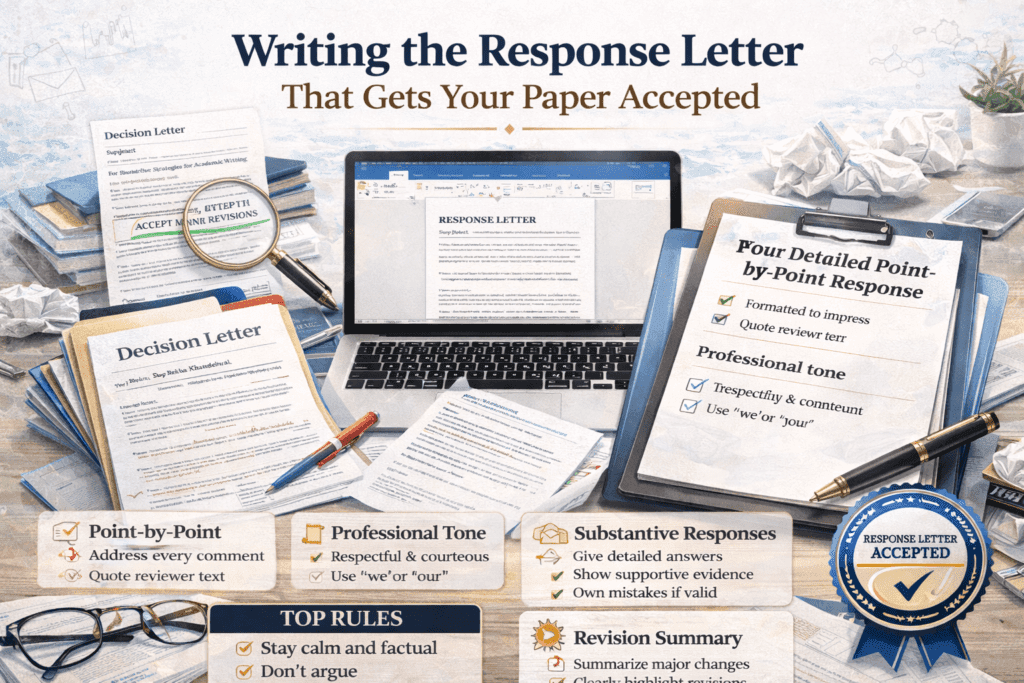
Writing the Response Letter That Gets Your Paper Accepted
Cluster Post 2 | Module 6: Peer Review, Responding to Feedback, and Publication Strategies From…
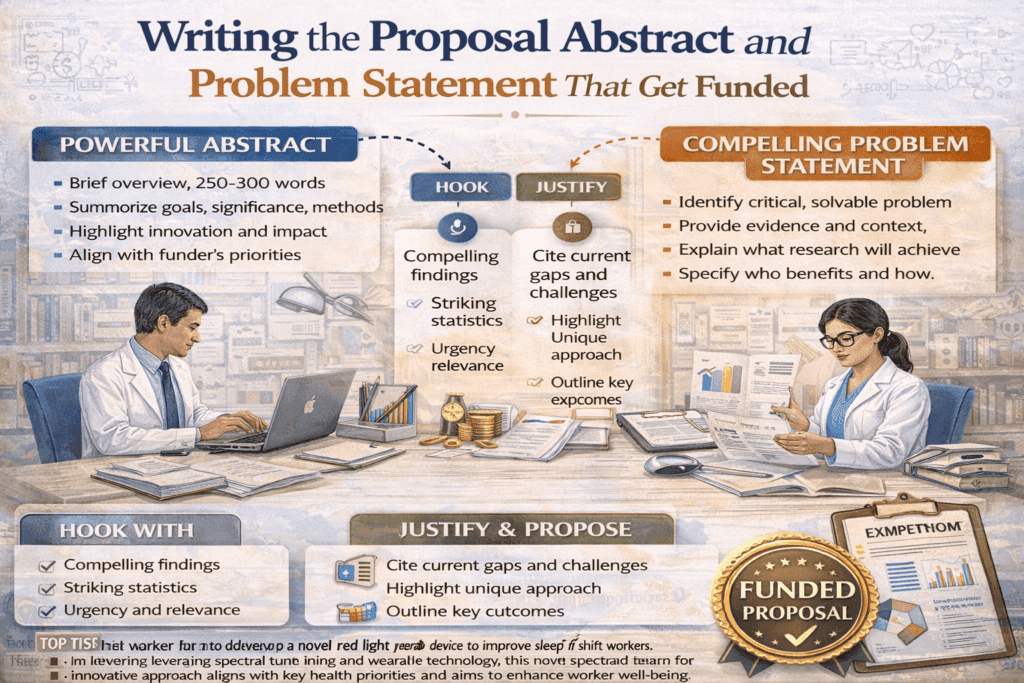
Writing the Proposal Abstract and Problem Statement That Get Funded
Cluster Post 2 | Module 8: Grant Writing and Research Funding From Concept to Submission…
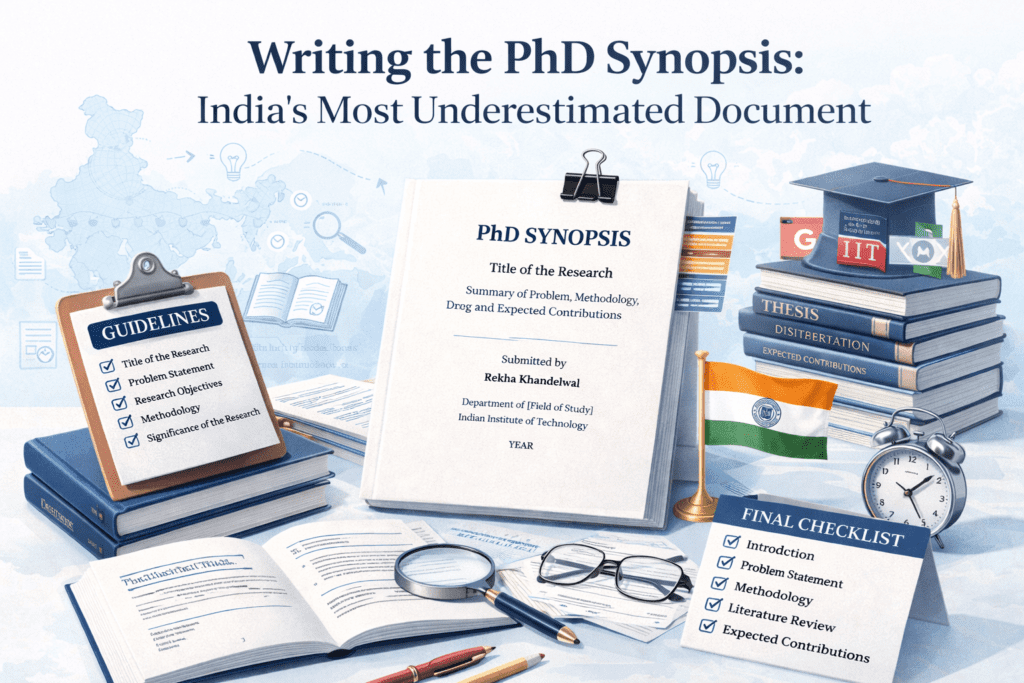
Writing the PhD Synopsis: India’s Most Underestimated Document
Cluster Post 6 | Module 5: Thesis Writing and Submission From Concept to Submission Series …
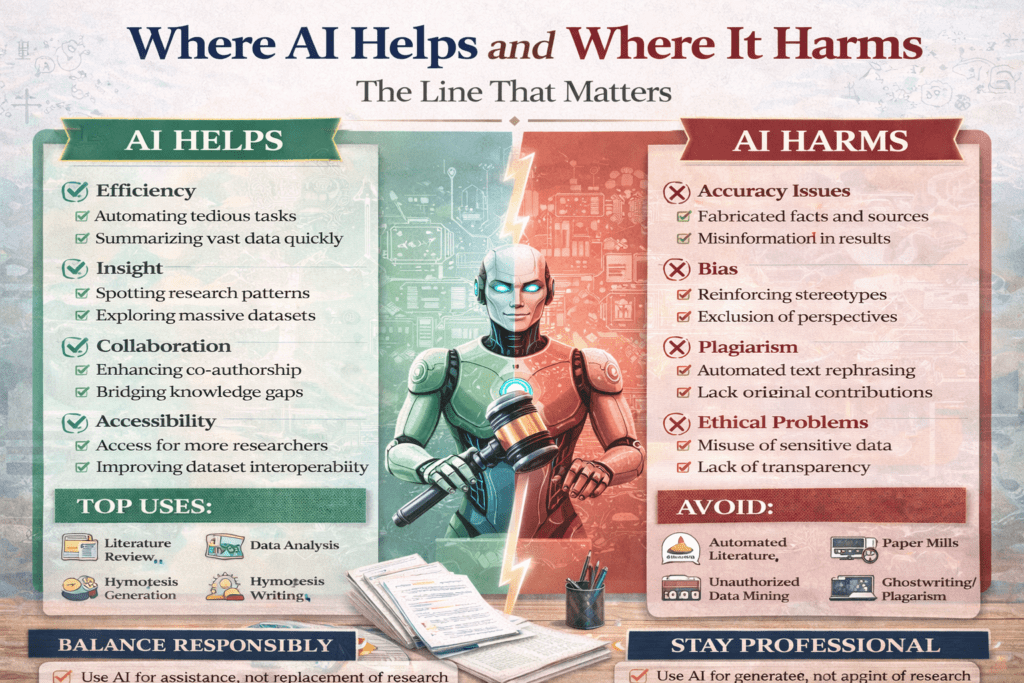
Where AI Helps and Where It Harms: The Line That Matters
Cluster Post 2 | Module 7: AI Tools in Academic Research — Opportunities, Ethics, and…