
Cluster Post 2 | Module 6: Peer Review, Responding to Feedback, and Publication Strategies
From Concept to Submission Series | 2026
Academic Writing Mastery: The Complete 2026 Guide To Research Papers, Thesis & Dissertation Writing
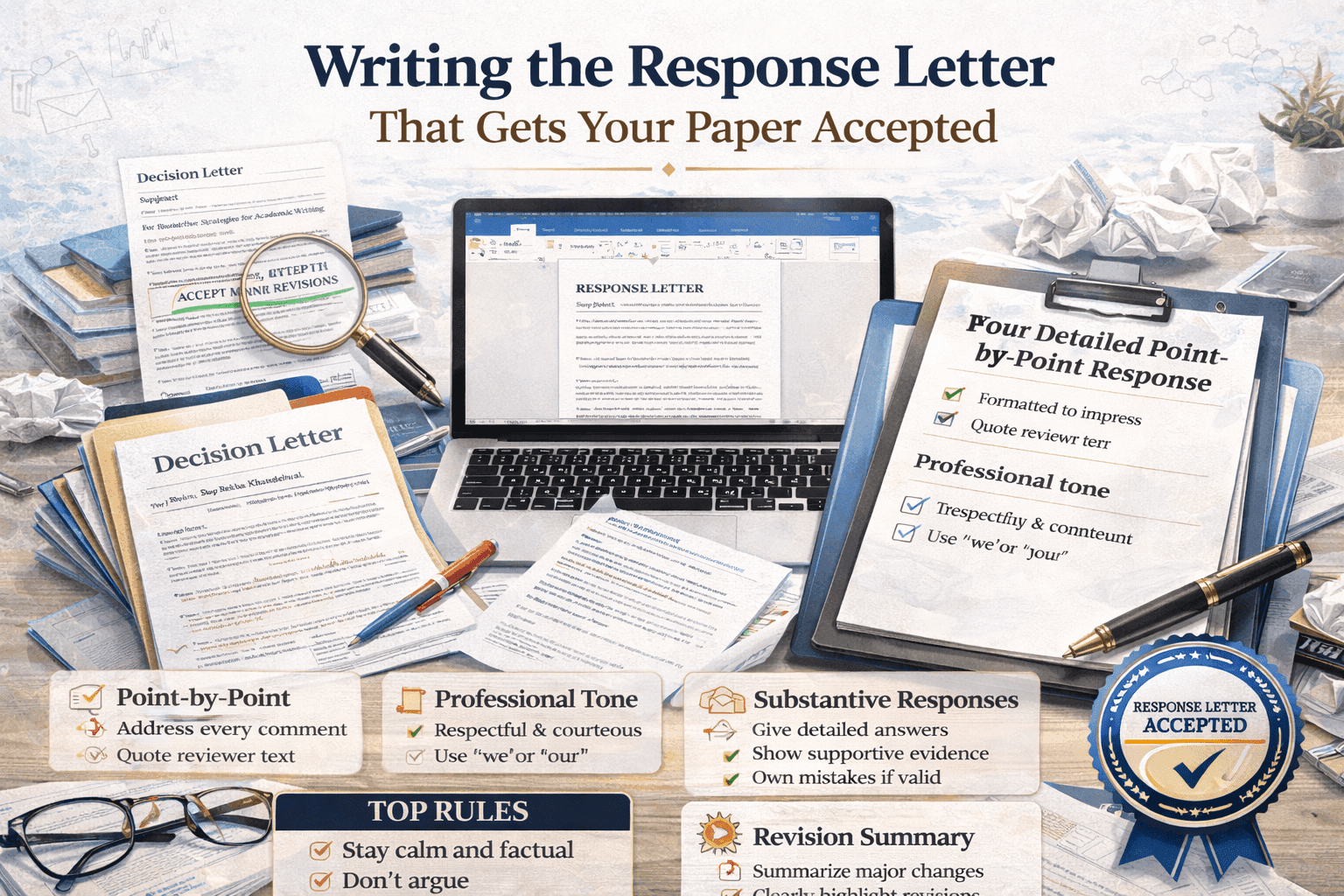
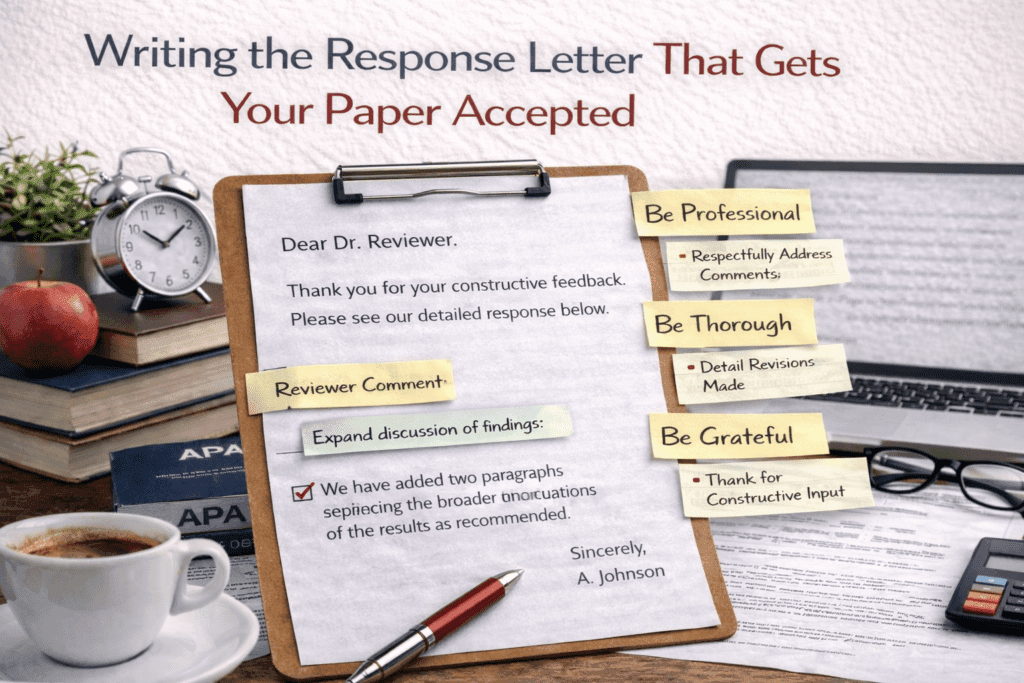
Writing the Response Letter That Gets Your Paper Accepted
The module overview gives worked examples for several comment types. This post goes deeper: the complete response letter structure with a template you can use immediately, the three things editors look for that most response letters miss, worked examples for every major comment category, and how to handle reviewer contradictions without alienating either reviewer.
What the Response Letter Is Actually For
Most researchers think of the response letter as documentation — proof that they addressed the reviewers’ comments. This is partly right but misses the letter’s primary purpose. The response letter is the argument that your revised manuscript deserves acceptance. The editor, who may or may not re-read the full revised paper in detail, uses the response letter to assess whether your revision was serious, competent, and complete.
Three things editors look for that most response letters miss: First, evidence that you understood the reviewer’s concern rather than just complied with the surface request. A reviewer who asks for ‘more discussion of limitations’ wants to see that you understood why the limitations matter, not just that you added a paragraph. Second, specific page and line references for every change — ‘we revised this section’ tells the editor nothing; ‘we revised the methodology section, pages 12–14, and added a new paragraph on page 23’ tells them exactly where to look. Third, intellectual engagement with disagreements rather than passive compliance or flat rejection — a well-reasoned explanation of why you are not making a requested change is more professionally impressive than either capitulating to every demand or refusing without explanation.
The Response Letter Template
Dear Professor [Editor’s Name], Thank you for the opportunity to revise our manuscript, ‘[Title]’ (Manuscript ID: [ID]). We are grateful to the editor and reviewers for their careful reading and constructive feedback. The reviews have significantly improved the paper, and we believe the revised version is substantially stronger as a result. Below we provide a point-by-point response to all comments from both reviewers. We have organised our response by reviewer. All changes in the revised manuscript are indicated by tracked changes [or: highlighted in yellow / listed with page references below]. — RESPONSE TO REVIEWER 1 [Reviewer comment quoted in full] Response: [Your response] Revision: [What you changed, with specific page reference] [Next comment…] — RESPONSE TO REVIEWER 2 [Continue as above] — We hope these revisions address the reviewers’ concerns adequately. We remain committed to making any further changes the editor or reviewers consider necessary. Sincerely, [Authors’ names]
The template looks simple. The difficulty is in the content of each response entry. The following section gives worked examples for every major comment type.
Worked Examples for Every Comment Type
Type 1: Clarification request
A reviewer did not understand something. The appropriate response has two parts: a brief acknowledgement that the passage was unclear (do not blame the reviewer for misunderstanding), and a description of how you rewrote it.
Reviewer 1, Comment 4: ‘I found the discussion of proportionality on pages 8-9 confusing. The authors seem to conflate the proportionality test under Article 21 with the proportionality standard used in administrative law. These are distinct doctrines.’ Response: We thank the reviewer for identifying this ambiguity. The passage was indeed unclear about which proportionality framework was being invoked. We have substantially revised pages 8-9 to distinguish explicitly between the constitutional proportionality standard established in Puttaswamy (drawing on the German origins traced in that judgment) and the administrative law proportionality test applied in review of delegated legislation. A new paragraph on page 9 explains why we apply the constitutional standard rather than the administrative one in the context of AI surveillance challenges.
Note what this response does: it does not argue about whether the reviewer was right to find it confusing. It acknowledges the problem, explains what you changed, and adds information that shows you understood the doctrinal distinction the reviewer was drawing.
Type 2: Additional literature requested
A reviewer suggests you should engage with sources you did not cite. This is almost always a ‘must-do’ — declining to engage with literature a reviewer identifies is rarely justifiable and signals that you may not have read it.
Reviewer 2, Comment 1: ‘The authors do not engage with Singh and Menon (2022), which addresses the proportionality framework in AI surveillance contexts in the Indian context. This is directly relevant to the paper’s argument.’ Response: We agree this is an important omission and have now read Singh and Menon (2022) carefully. We have incorporated discussion of this work in two places: first, in the literature review (pages 6-7), where we situate our contribution relative to their analysis; and second, in the discussion (page 28), where we explain how our proposed framework extends their argument by addressing the specific evidentiary standard for AI transparency that their analysis leaves undeveloped. We are grateful to the reviewer for drawing our attention to this work.
The final sentence of gratitude is not mere politeness — it signals that you found the suggestion genuinely useful, which reassures the reviewer that their contribution was taken seriously.
Type 3: Methodological critique
A reviewer challenges your methods. This is the most nuanced comment type because it may require you to either make a genuine change, acknowledge a limitation, or defend the approach you took. The response depends on whether the critique is valid.
Reviewer 1, Comment 7: ‘The sample of twenty-six interviewees is insufficient to support the broad claims the authors make about judicial attitudes toward AI surveillance. A larger sample or different methodology would be needed.’ Response: We appreciate this concern and have addressed it in two ways. First, we have revised our findings section to ensure that all claims are scoped to what our sample can support — specifically, we have replaced general statements about ‘judicial attitudes’ with statements about ‘the attitudes of the judges interviewed in this study’ throughout (see pages 19-26). Second, we have expanded our limitations section (page 31) to acknowledge explicitly that our findings are not generalisable to all Indian judges and to specify the purposive sampling rationale that guided participant selection. We respectfully note, however, that our sample size is consistent with established practice in qualitative studies of judicial decision-making (see, e.g., [cite comparable studies]): qualitative research aims for theoretical saturation rather than statistical representativeness, and we provide a justification for saturation on page 14.
This response does three things: makes genuine changes in response to the valid core of the critique (tightening claims), expands the limitation discussion, and respectfully defends the methodological approach with reference to disciplinary norms. It does not simply capitulate to the demand for a larger sample (which would require a different study) nor does it dismiss the concern.
Type 4: Principled disagreement
A reviewer disagrees with your interpretation, argument, or analytical conclusion. This is the most professionally demanding comment type because you must engage intellectually without being dismissive.
Reviewer 3, Comment 2: ‘The authors argue that proportionality is the appropriate standard for reviewing AI surveillance. I disagree. The better approach would be a substantive due process framework, which is both more established in Indian constitutional law and more capable of protecting against the specific harms AI surveillance creates.’ Response: We are grateful for this substantive engagement with the paper’s central argument. We have added a new section (pages 24-25) that engages directly with the substantive due process alternative and explains our reasons for preferring the proportionality framework in this context. In brief: while substantive due process is indeed well-established in Indian constitutional law, it has developed primarily in the context of personal liberty and bodily autonomy. Its application to informational privacy and data governance raises questions the case law has not yet resolved. The proportionality framework, which Puttaswamy itself identifies as the operative standard for privacy limitations, has the advantage of already being constitutionally authorised for this purpose and provides clearer criteria for the evidentiary analysis we propose. We acknowledge, however, that the reviewer’s position has scholarly support, and we have noted this in a footnote on page 25 to ensure readers are aware of the competing view.
This response engages the reviewer’s argument substantively, explains the reasoning behind your position, and acknowledges the competing view in the paper — without abandoning your argument. The footnote acknowledging the alternative is a particularly effective move: it shows intellectual fairness without surrendering the central claim.
Type 5: Unclear or vague comment
Reviewer 2, Comment 6: ‘The theoretical framework needs strengthening throughout.’ Response: We have worked to strengthen the theoretical framework throughout the revised manuscript and would welcome clarification on any specific aspects that remain underdeveloped. In this revision, we have: (a) added an explicit statement of the theoretical premises on which the proportionality framework rests (page 7); (b) developed the connection between the theoretical framework and our doctrinal methodology more explicitly (pages 11-12); and (c) ensured that each analytical chapter returns explicitly to the theoretical framework in its conclusion. We hope these revisions address the reviewer’s concern, and we remain open to further guidance if specific elements still require development.
The offer to receive further guidance is a professional signal that you are engaging in good faith, not just trying to close out the comment.
Handling Reviewer Contradictions
When two reviewers directly contradict each other — one wants more theoretical depth, the other thinks the theory already dominates too much — you cannot satisfy both. The response letter must acknowledge this explicitly and explain your decision.
Handling a contradiction in the response letter: ‘We note that Reviewer 1 and Reviewer 2 expressed different preferences regarding the level of theoretical elaboration. Reviewer 1 requested more extensive engagement with constitutional theory (Comment 3), while Reviewer 2 suggested the theoretical discussion was already extensive and should be condensed (Comment 1). After careful consideration, we have taken a middle path. We have retained the core theoretical framework that Reviewer 1 found valuable but have restructured it to be more concise, moving some of the extended theoretical exposition to a new online appendix. The main text now contains a focused 1,500-word theoretical section (pages 6-9) rather than the original 2,500-word version. We hope this satisfies both reviewers’ underlying concerns — ensuring theoretical grounding is adequate while preventing the theory from overwhelming the doctrinal analysis.’
This response names the contradiction explicitly, demonstrates that you heard both reviewers, explains your reasoning, and describes a concrete resolution. Editors appreciate this kind of transparent reasoning.
For Law Students
Responding to examiner reports on PhD theses
The response letter for a PhD thesis revision follows the same principles as a journal response letter, with adaptations for the thesis examination context. Where a journal response letter goes to an editor, the thesis revision response goes to the supervisor, the Head of Department, or directly to the examiners depending on institutional procedure — verify your university’s process before writing the response.
The most important adaptation: thesis revision responses typically require a separate document that lists each examiner’s comment alongside your response and the location of the change in the revised thesis. Some universities provide a prescribed format for this document. Where no format is prescribed, use the same quoted-comment structure as the journal response letter, adding: the examiner number, the comment, your response, the specific pages of the revised thesis where the change was made, and a brief description of the change made.
Responding to doctrinal critiques
Reviewers of doctrinal legal scholarship often disagree about the correct interpretation of cases or the appropriate analytical framework. These disagreements are genuine doctrinal disputes, not just methodological preferences, and responding to them requires engaging at the doctrinal level.
The strongest responses to doctrinal disagreements do three things: acknowledge the competing view as a legitimate reading of the authorities, explain why your reading is better supported by the case law or the underlying constitutional principle, and cite the specific cases or passages that support your position. Responses that simply assert ‘we respectfully maintain our interpretation’ without providing doctrinal grounds are not adequate engagement with a substantive critique.
References
- Belcher, W. L. (2019). Writing Your Journal Article in Twelve Weeks (2nd ed.). University of Chicago Press.
- Silvia, P. J. (2019). How to Write a Lot (2nd ed.). APA.
- Murray, R. (2011). How to Write a Thesis (3rd ed.). Open University Press.
Next: Cluster Post 3 — Making Revisions That Actually Work
Module 1 (Pillar Post)- The Complete Guide To Research Paper Structure: IMRAD Format, Thesis Organization & Academic Writing (2026)
Module 2 (Pillar Post) –The Academic Writing Process: Complete Guide from First Draft to Submission (2026)
Module 3 (Pillar Post) Research Methodologies: Complete Guide To Quantitative, Qualitative, Mixed Methods & Legal Research (2026)
Module 4 (Pillar Post) : Data Analysis and Results Presentation: Complete Guide for Quantitative, Qualitative & Legal Research (2026)
Module 5 (Pillar Post) : Organization and Academic Tone: Complete Guide to Professional Scholarly Writing (2026)
Next in Series:
- Pillar Post : Peer Review and Publication: Complete Guide from Submission to Acceptance (2026) (Module 6)
- Pillar Post : AI Tools in Academic Research: Opportunities, Ethics, and Best Practices (2026) (Module 7)
- Pillar Post: Grant Writing and Research Funding: Complete Guide to Finding Money for Your Research (2026) (Module 8)
- Pillar Post : Academic Career Development: Complete Guide to Building Your Professional Life in Research (2026) (Module 9)
- Pillar Post : Research Ethics and the IRB Process: Complete Guide to Doing Research Responsibly (2026) (Module 10)
Writing the Thesis Abstract and Introduction
Cluster Post 2 | Module 5: Thesis Writing and Submission From Concept to Submission Series …
Writing the Results Section: Separating Findings from Interpretation
Cluster Post 6 | Module 4: Data Analysis and Presenting Results From Concept to Submission…

Writing the Response Letter That Gets Your Paper Accepted
Cluster Post 2 | Module 6: Peer Review, Responding to Feedback, and Publication Strategies From…
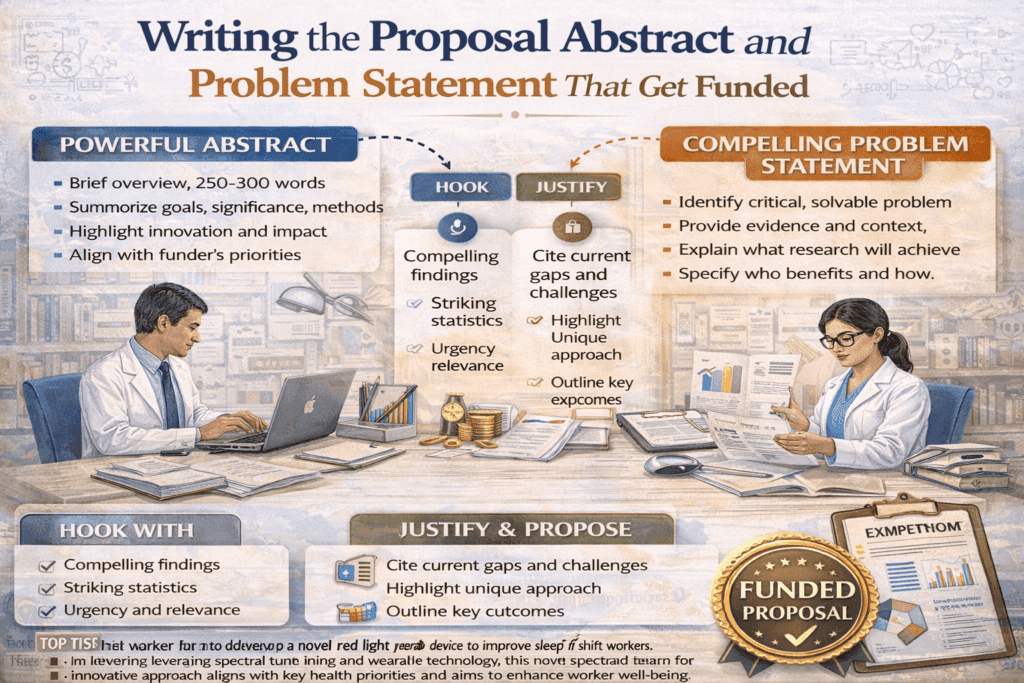
Writing the Proposal Abstract and Problem Statement That Get Funded
Cluster Post 2 | Module 8: Grant Writing and Research Funding From Concept to Submission…

Writing the PhD Synopsis: India’s Most Underestimated Document
Cluster Post 6 | Module 5: Thesis Writing and Submission From Concept to Submission Series …

Where AI Helps and Where It Harms: The Line That Matters
Cluster Post 2 | Module 7: AI Tools in Academic Research — Opportunities, Ethics, and…