Last Updated: June 30, 2026
Here is an uncomfortable reality:Read expert guide on AI SEO Checklist, Research by Dr. Rekha Khandelwal…
Right now, millions of people are asking questions directly to ChatGPT, Perplexity, and Google AI Overviews — and getting instant answers without ever clicking a website.
That means your website may never even be seen.
Traditional SEO was built around ranking on Google and getting clicks. But in 2026, AI-powered search is changing that model completely. Zero-click searches are rapidly growing, and AI systems are becoming the new gatekeepers of visibility.
Today, success is no longer just about ranking higher.
It is about being trusted enough for AI to use your content as the answer.
The brutal truth: if your website is not optimized for AI search engines, you are becoming invisible — even if you rank number one on Google.
The good news? You can fix this. You can get your website cited by AI tools, referenced in AI answers, and recommended to millions of users. This guide tells you exactly how.
What Is AI SEO — And What Is GEO?
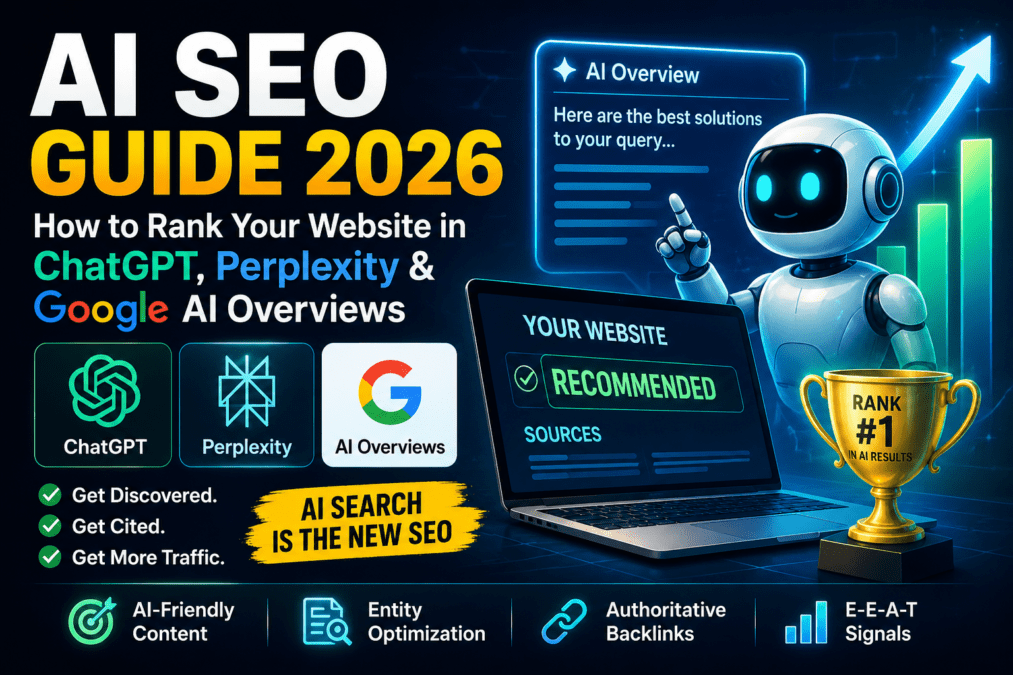
AI SEO is the process of optimizing your website so AI-powered search engines like ChatGPT, Perplexity, and Google AI Overviews can find, trust, and cite your content in their answers.
It is also known as Generative Engine Optimization (GEO).
Traditional SEO focused mainly on rankings through keywords and backlinks. AI SEO focuses on creating trustworthy, well-structured, expert-driven content that AI systems consider reliable enough to use as the answer itself.
Traditional SEO vs AI SEO: The Key Differences
This is where most guides skip the most important part. Understanding this comparison changes everything about how you approach content in 2026.
| Traditional SEO | AI SEO in 2026 |
| Ranks pages on search results | Gets cited inside AI-generated answers |
| Backlinks are the primary signal | E-E-A-T and topical authority matter most |
| Keyword density and placement | Semantic relevance and natural language |
| Optimizes for clicks | Optimizes for citations and mentions |
| Google-focused | Google + ChatGPT + Perplexity + Gemini |
| Page-level optimization | Site-wide topical authority |
| Traffic through ranking | Visibility through being trusted as a source |
| Featured snippets as a bonus | Featured snippets as a primary goal |
| Link building drives authority | Brand mentions and entity signals drive authority |
| One algorithm to satisfy | Multiple AI systems with different retrieval methods |
“In traditional SEO, you competed for position. In AI SEO, you compete for trust.”
How AI Search Engines Actually Work
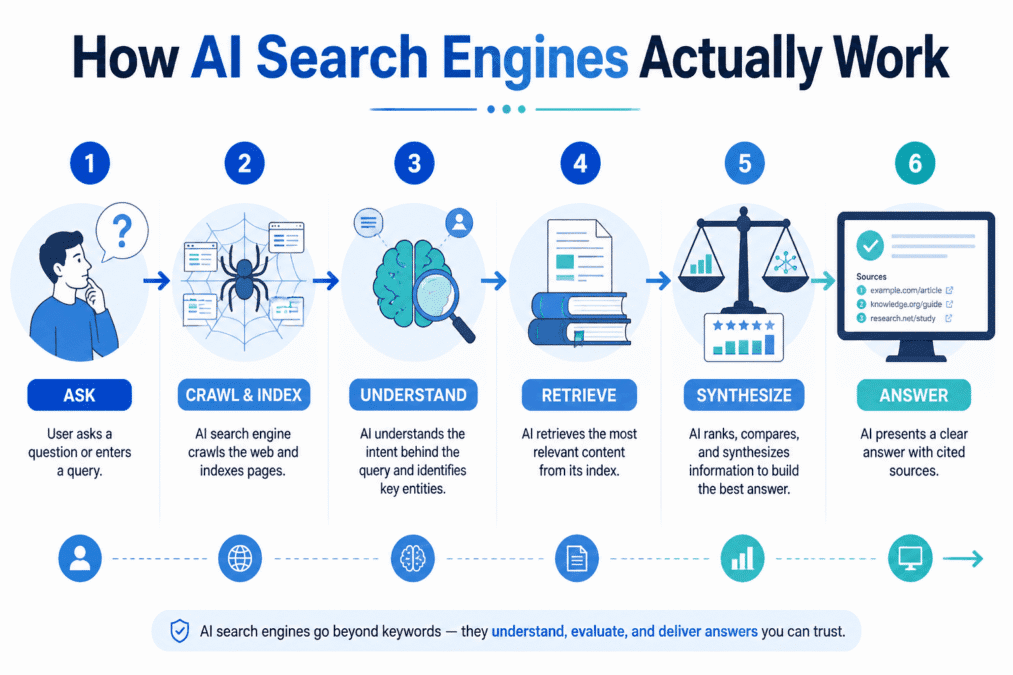
How AI Search Works Behind the Scenes
Most AI search tools use a system called Retrieval-Augmented Generation (RAG).
In simple terms, when someone asks ChatGPT or Perplexity a question, the AI searches the web in real time, reads relevant pages, and uses trusted sources to generate an answer.
This means your content must be:
- easy to crawl,
- well-structured,
- and trustworthy enough for AI systems to use as a source.
If your website lacks authority or clear formatting, AI tools may choose competitor content instead.
Knowledge Graphs: The Hidden AI SEO Factor
Knowledge graphs help AI systems understand relationships between:
- brands,
- people,
- topics,
- organizations,
- and concepts.
When your brand is consistently connected with a topic across websites, content, and structured data, AI systems begin recognizing you as an authority in that niche.
According to AI experts here are best free AI writing tools in 2026: Tested, Ranked & Honestly Reviewed
For example, if your website is frequently associated with:
- AI SEO,
- content marketing,
- and search optimization,
AI tools are more likely to mention your brand in relevant answers over time.
How to build your knowledge graph presence:
To improve AI SEO and knowledge graph visibility:
- Keep your brand information consistent across your website, social profiles, and directories.
- Use Organization and Person schema markup to help AI systems understand your brand.
- Try building presence on trusted platforms like Wikidata or Wikipedia if eligible.
- Earn mentions from authoritative websites in your niche.
Traditional SEO built authority through backlinks.
AI SEO builds authority through entity recognition, trust, and brand visibility across the web.
Entity Recognition and AI Search Engines
Entity recognition helps AI systems identify and understand real people, brands, organizations, and concepts mentioned in your content. This is a major part of modern AI search engine optimization.
To improve your chances to rank content in AI search results, use:
- real expert names,
- verified facts,
- trusted organizations,
- and clear, specific language.
The more your content connects with recognized entities, the easier it becomes for AI systems like ChatGPT, Perplexity, and Google AI Overviews to trust and cite your website.
How to Rank in ChatGPT Search
ChatGPT Search combines Bing indexing with AI-generated answers. If your website is not indexed on Bing, ChatGPT may not find your content.
ChatGPT vs Claude vs Gemini: Which AI Tool Is Actually Worth It in 2026?
That is why Bing optimization is now an important part of:
- AI SEO Checklist 2026
- how to rank in ChatGPT search
- and AI search ranking factors.
How to Rank in Perplexity
Perplexity directly cites websites inside its answers. It prefers:
Perplexity AI Bettern Than ChatGPT: Is It Really Better Than ChatGPT for Research?
- authoritative content,
- direct answers,
- updated information,
- and well-structured pages.
This makes Perplexity one of the best platforms for increasing brand visibility through AI SEO.
How to Rank in Google AI Overviews
Google AI Overviews appear above traditional search results and summarize answers instantly.
If your website is not featured in the Overview, users may never reach your page — even if you rank organically.
To improve visibility:
- use FAQ sections,
- structured formatting,
- semantic SEO,
- and concise answers.
Gemini, Claude & Microsoft Copilot
AI assistants like Gemini, Claude, and Microsoft Copilot are becoming major search tools in 2026.
All of them rely heavily on:
- Retrieval-Augmented Generation (RAG),
- E-E-A-T signals,
- topical authority,
- and trustworthy content.
That is why websites focusing on:
- how to optimize website in AI search results,
- structured content,
- and expert-driven information
have a much higher chance of AI visibility and citations.
AI Search Ranking Factors in 2026
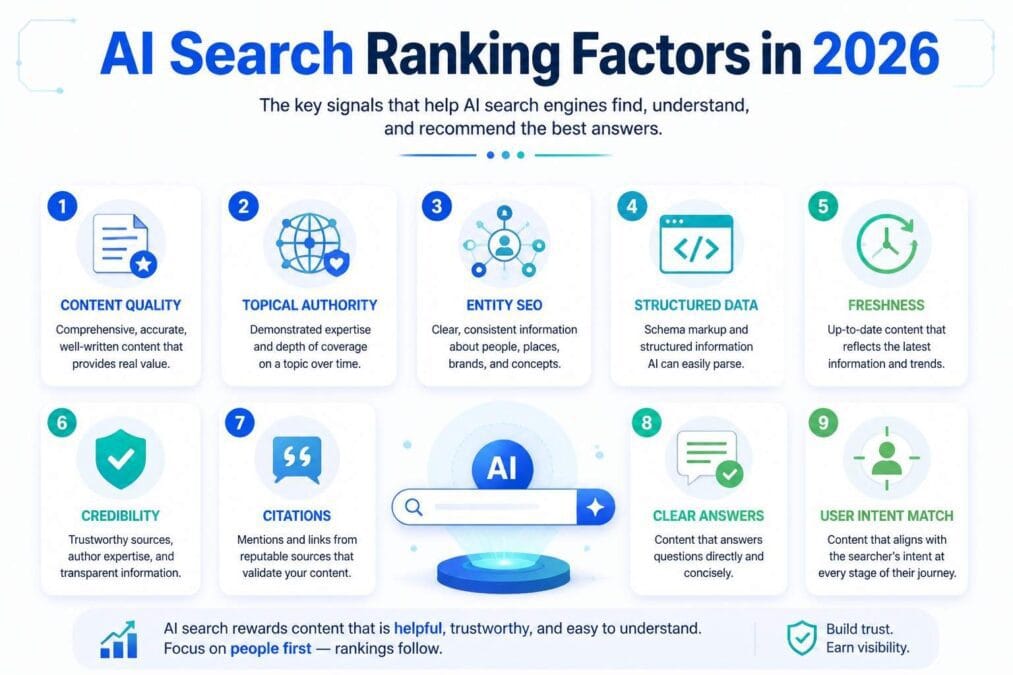
Here is what actually determines whether AI tools cite your website — explained with real examples.
E-E-A-T Signals
Experience, Expertise, Authoritativeness, and Trustworthiness. This framework has existed for years but in 2026 it is the single most important concept in AI SEO.
Experience means your content reflects real, first-hand knowledge.
Expertise means demonstrable knowledge in the field.
Authoritativeness means your website is recognized as a trusted source in its niche.
Trustworthiness means transparency
Topical Authority
AI models do not just evaluate individual pages. They evaluate your entire website and ask: does this site deeply and comprehensively cover this subject?
Build topical clusters. Cover your subject from every possible angle. Become the most complete resource on your topic.
Structured Data and Schema Markup
Schema markup tells AI systems exactly what your content is — an article, a FAQ, a product listing, a how-to guide, a review. When content is properly marked up, AI tools extract and use it far more efficiently.
Brand Mentions and Entity Authority
AI models track where brands are mentioned across the web — not just where they are linked. If reputable websites, industry forums, Reddit threads, and publications mention your brand by name, that builds what SEO professionals now call entity authority.
Content Freshness
AI search engines strongly prefer current, up-to-date information.
User Engagement Signals
This is a ranking factor that most AI SEO guides completely overlook — and it is becoming increasingly important.
The key engagement signals that matter in 2026:
- Time on page tells AI systems whether users are actually reading your content or leaving immediately.
- Bounce rate and return behavior indicates whether users found what they needed.
- Click-through rate from search results reflects how compelling your title and meta description are
- Scroll depth measures how far down your page users actually read
How to improve engagement specifically for AI SEO:
Open every article with your strongest, most immediately valuable content. Do not bury the answer three paragraphs down. AI-optimized content gives users what they came for immediately — and then keeps them reading with deeper context, examples, and related insights.
Reddit and Forum Mentions
AI models, particularly Perplexity and ChatGPT, increasingly pull from community discussions on Reddit, Quora, and niche forums. When your brand or content is mentioned positively in these communities, it adds a layer of social proof that AI systems recognize and weight as a trust signal.
Semantic SEO and Natural Language
AI systems understand language the way humans do — contextually and semantically, not mechanically.
How to Rank in ChatGPT Search
- Step one: Get indexed by Bing.
- Step two: Write content that directly answers questions.
- Step three: Use conversational headings.
- Step four: Include original expert insights.
- Step five: Build your Bing presence deliberately.
How to Rank in Perplexity
Perplexity is arguably the most transparent and therefore most optimizable AI platform available in 2026.
- Write definitive, comprehensive guides.
- Open each section with a direct answer.
- Build authority through external citations.
- Keep data current.
How to Rank in Google AI Overviews
- Match search intent with precision.
- Structure your content for easy extraction.
- Optimize aggressively for featured snippets.
- Add FAQ sections to every important article.
- Satisfy Google’s helpful content standards.
.
AI SEO Checklist 2026
Use this checklist for every important page on your website.
Content Quality
- Does this page directly answer the main question in the title within the first two paragraphs?
- Is there original insight, data, or first-hand experience that cannot be found elsewhere?
- Is the content current with up-to-date information and statistics?
- Does each major section open with a clear, direct answer?
- Is there a well-structured FAQ section at the bottom?
- Are there real examples that illustrate key points?
Authority and Trust Signals
- Is there a clear, credentialed author bio on the page?
- Does the author have a verifiable presence on LinkedIn or in industry publications?
- Are claims supported by citations to reputable external sources?
- Is the website recognized as a topical authority in this subject area?
- Is there a clear About page, editorial policy, or transparency statement on the site?
Technical Optimization
- Is the page indexed by both Google and Bing?
- Is appropriate schema markup applied — Article, FAQ, HowTo, Organization, or Person?
- Is the page fast, mobile-friendly, and easy to navigate?
- Are internal links connecting this page to related topical content?
- Is the robots.txt file checked and confirmed not blocking important pages?
Entity and Knowledge Graph Signals
- Is your brand mentioned consistently across reputable external websites?
- Do you have Organization or Person schema markup applied sitewide?
- Is your brand listed on Wikidata or Wikipedia if applicable?
- Are you cited in forums, Reddit, industry publications, or relevant communities?
- Do you have consistent brand presence across multiple platforms?
User Engagement Optimization
- Does the article open with the most valuable content immediately?
- Is the formatting scannable with short paragraphs and clear subheadings?
- Are there internal links to related content encouraging further exploration?
- Does the article end with a clear next step or related content suggestion?
- Is the title and meta description compelling enough to earn strong click-through rates?
Topical Coverage
- Does your site have multiple interlinked articles covering this topic from different angles?
- Are there content gaps in your topical cluster that competitors are covering and you are not?
Best AI Tools for SEO in 2026
- Surfer
- Frase
- Clearscope
- Semrush and Ahrefs
- MarketMuse
- NeuronWriter
Perplexity and ChatGPT as Research Tools
Underrated and underused for SEO purposes. Search your own topic in both tools and study the answers they generate. Which sources are they citing? What format are those sources using? What questions are they answering that your content is not? This research directly and immediately informs your optimization strategy.
The Role of E-E-A-T in AI Search
If there is one concept that ties this entire guide together, it is E-E-A-T.
AI models are built to be accurate. To be accurate, they need to cite trustworthy sources. To identify trustworthy sources, they look for the same signals humans use to judge credibility — qualifications, experience, transparency, and reputation.
This means the most effective AI SEO strategy is also simply being genuinely good at what you do, and making that expertise visible online.
Write author bios that reflect real expertise. Cite your sources clearly. Show your methodology. Be transparent about who you are and why you are qualified to write about your topic. Engage publicly in your industry. Build a reputation that exists beyond the walls of your own website.
These are not optimization tricks. They are the foundations of credibility — and in 2026, credibility is the primary currency of AI search.
“The websites AI tools cite most are not the ones with the most backlinks. They are the ones that have earned the right to be trusted.”
Common AI SEO Mistakes to Avoid
- Publishing thin AI-generated content at scale.
- No author credibility.
- Keyword stuffing.
- Making claims without citations.
- Ignoring Bing indexing
- Publishing and never updating
- Ignoring knowledge graph and entity building.
- No topical depth.
- Poor engagement signals.
The Future of AI Search
Zero-click search is not coming. It is already here — and accelerating.
In 2026, a growing and measurable percentage of searches end without a single website being visited. Users receive their answer from an AI Overview, a ChatGPT response, or a Perplexity citation and move on without ever clicking through to the source.
Estimates suggest that zero-click searches now account for more than 60 percent of all Google searches in informational categories. For AI-native platforms like Perplexity and ChatGPT, the percentage is even higher — because the entire purpose of these tools is to give users answers, not send them elsewhere.
This does not mean websites are dying. It means the websites that survive and thrive will be the ones that AI tools trust enough to cite, recommend, and reference consistently.
Personal AI agents are the next frontier.
These are AI systems acting on behalf of individual users — booking travel, researching purchases, comparing services, recommending resources. When someone’s personal AI agent looks for the best project management software, the most trusted nutritionist in their city, or the most authoritative guide to filing taxes, it will pull recommendations from a knowledge base built entirely on the authority signals described in this guide.
The brands that invest in genuine topical authority, E-E-A-T signals, knowledge graph presence, and AI-optimized content today will be the ones those agents recommend to millions of users tomorrow.
Search is becoming personal, conversational, and entity-driven.
The future of search is not ten blue links. It is a trusted AI assistant that knows your preferences, understands your context, and recommends sources it has already verified as authoritative. Getting into that recommendation layer requires exactly what this guide has outlined — credibility, depth, freshness, engagement, and entity recognition.
The window to get ahead of this shift is still open. But it is closing faster than most people realize.
“In 2026, the question is no longer whether AI search will change your traffic. It already has. The question is whether you will adapt before your competitors do.”
FAQs
How do I rank my website in AI search engines?
Build topical authority, improve E-E-A-T signals, use structured content, add schema markup, and ensure your website is indexed on Google and Bing.
Can ChatGPT recommend my website?
Yes. If your website is authoritative, Bing-indexed, and clearly structured, ChatGPT can cite it in responses.
How does Perplexity choose its sources?
Perplexity prefers trustworthy, well-structured, updated, and directly answer-focused content.
What are the top AI search ranking factors in 2026?
Major factors include:
- E-E-A-T
- topical authority
- schema markup
- content freshness
- user engagement
- entity presence
- Bing indexing
Is traditional SEO dead?
No. Traditional SEO still matters, but AI SEO and traditional SEO now work together.
How do I optimize for Google AI Overviews?
Use concise answers, FAQs, structured formatting, semantic SEO, and strong user engagement signals.
What is GEO in SEO?
GEO (Generative Engine Optimization) means optimizing content for AI answer engines like ChatGPT, Perplexity, and Google AI Overviews.
Does E-E-A-T matter for AI search?
Yes. AI systems strongly prefer expert, trustworthy, and authoritative content.
What is a knowledge graph in AI SEO?
A knowledge graph helps AI systems understand relationships between brands, people, and topics, improving AI visibility.
How do user engagement signals affect AI SEO?
Higher engagement like longer time on page and lower bounce rate tells AI systems your content is valuable and trustworthy.
Conclusion
Search has changed permanently. In 2026, websites win not by stuffing keywords or chasing backlinks alone, but by becoming trusted sources for AI systems like ChatGPT, Perplexity, and Google AI Overviews.
The future belongs to websites that:
- build topical authority,
- strengthen E-E-A-T signals,
- use structured AI-friendly content,
- improve user engagement,
- and provide real expertise.
Today, ranking is no longer just about appearing on page one.
It is about becoming the answer itself.
And the brands that earn AI trust today will dominate tomorrow’s search landscape.
Author –
Dr. Rekha Khandelwal is a legal researcher, academic writer, and AI content strategist specializing in AI SEO, legal education, and research-based content.She creates practical, expert-driven content on AI SEO, legal knowledge, and digital growth through AspirixWriters.
must read – Does The EU AI Act Apply To Indian Companies?| 2026 Guide