
Ubi Jus Ibi Remedium
1. Meaning of Ubi Jus Ibi Remedium
Ubi Jus Ibi Remedium is a Latin legal maxim which means:
“Where there is a legal right, there is a legal remedy.”
In simple words, when the law recognises a person’s legal right, the law should also provide a means to enforce or protect that right when it is violated.
The maxim is an important principle underlying the Law of Torts because tort law generally provides remedies when a legally protected interest or right is wrongfully interfered with.
However, the maxim should not be understood as meaning that every loss, hardship or unfairness automatically gives rise to a legal remedy. There must first be a recognised legal right or legally actionable interest.
2. Meaning of the Words
The maxim consists of two important expressions:
Jus
Jus means a legal right or an interest recognised and protected by law.
Remedium
Remedium means a legal remedy or means of obtaining redress for the violation of that right.
Therefore:
Jus = Legal Right
Remedium = Legal Remedy
Easy Formula
Legal Right → Violation → Legal Remedy
3. Principle Behind the Maxim
The basic idea is that a legal right should not remain meaningless or unenforceable.
If a person has a legally recognised right and another person wrongfully interferes with that right, the legal system should ordinarily provide an appropriate method of redress.
The remedy may take different forms depending upon the nature of the wrong, including:
- damages;
- injunction;
- restitution;
- declaration;
- specific statutory relief; or
- in appropriate constitutional cases, monetary compensation through public-law jurisdiction.
Thus, “remedy” does not necessarily mean damages alone.
4. Importance in the Law of Torts
The maxim is closely connected with the development of tort law.
A person may suffer a legal injury even where there is no measurable financial loss. This is particularly illustrated by the principle of injuria sine damno.
Conversely, a person may suffer actual financial or physical loss without any violation of a legal right. Such a situation is described as damnum sine injuria, and the loss may not be actionable.
Therefore, the maxim helps explain why the law focuses not merely on whether a person has suffered loss, but on whether a legal right has been violated.
5. Ubi Jus Ibi Remedium and Injuria Sine Damno
The relationship between these two principles is particularly important for LL.B. examinations.
Injuria Sine Damno
It means:
Legal injury without actual damage.
Where a person’s legal right is violated, the person may have a cause of action even though no actual financial loss has been suffered.
The classic authority is:
Ashby v White (1703)
This case is traditionally regarded as the leading illustration of injuria sine damno and the principle of ubi jus ibi remedium.
6. Imp. Cases
Leading Case: Ashby v White
Ashby v White (1703) 2 Ld Raym 938; 92 ER 126
Facts
Ashby was a qualified voter in a parliamentary election.
The defendant, White, was a returning officer/constable responsible for receiving votes. White wrongfully refused to allow Ashby to cast his vote.
Importantly, the candidate whom Ashby intended to support was elected despite Ashby’s vote being rejected.
Therefore, Ashby did not suffer any identifiable financial loss as a result of being prevented from voting.
Decision
The case became a leading authority for the proposition that the infringement of a legal right can itself constitute actionable injury even where actual financial loss is absent.
The judgment is closely associated with both:
- Ubi jus ibi remedium, and
- Injuria sine damno
Importance
The case demonstrates:
Violation of legal right + no actual loss = actionable legal injury
This is why Ashby v White is one of the most important cases to remember for this topic.
Indian Case: Bhim Singh v State of J&K
Bhim Singh, MLA v State of Jammu & Kashmir (1985) 4 SCC 677; AIR 1986 SC 494
This is an important Indian case illustrating the principle that a violation of a legally protected right may require an effective remedy.
Facts
Bhim Singh was a Member of the Legislative Assembly of Jammu & Kashmir.
He was arrested while travelling to attend a session of the Legislative Assembly. The circumstances of his detention prevented him from attending the Assembly session.
The Supreme Court found serious violations concerning his personal liberty and the constitutional safeguards surrounding arrest and detention. (Indian Kanoon)
Decision
The Supreme Court directed the State to pay ₹50,000 as monetary compensation.
The case is particularly important because the Court provided a public-law remedy for the violation of fundamental rights. (Indian Kanoon)
Importance
Bhim Singh demonstrates that where a person’s fundamental right is seriously violated by State action, constitutional courts can provide effective monetary relief rather than merely declaring that the detention was unlawful.
Exam point: This is better described as a constitutional/public-law remedy rather than treating it as an ordinary private tort action.
Rudul Sah v State of Bihar
Rudul Sah v State of Bihar (1983) 4 SCC 141
This case is another important development in Indian public-law remedies.
Facts
Rudul Sah remained in prison for more than 14 years after his acquittal.
He approached the Supreme Court under Article 32.
Decision
Although he had already been released, the Supreme Court awarded monetary compensation for the unlawful deprivation of his liberty.
The case is recognised as one of the early decisions in which the Supreme Court granted compensation through its constitutional jurisdiction for violation of fundamental rights.
Importance
It demonstrates that an effective remedy may be necessary even after the immediate violation has ended.
Nilabati Behera v State of Orissa
Nilabati Behera v State of Orissa (1993) 2 SCC 746
This case further developed the constitutional remedy of compensation for violation of fundamental rights.
The Supreme Court recognised that compensation could be awarded under Articles 32 and 226 for established violations of fundamental rights, particularly the right to life and personal liberty.
The Court also distinguished such public-law compensation from an ordinary private-law action for damages.
Importance
The case strengthened the principle that constitutional rights must have effective constitutional remedies.
7. Essentials of Ubi Jus Ibi Remedium
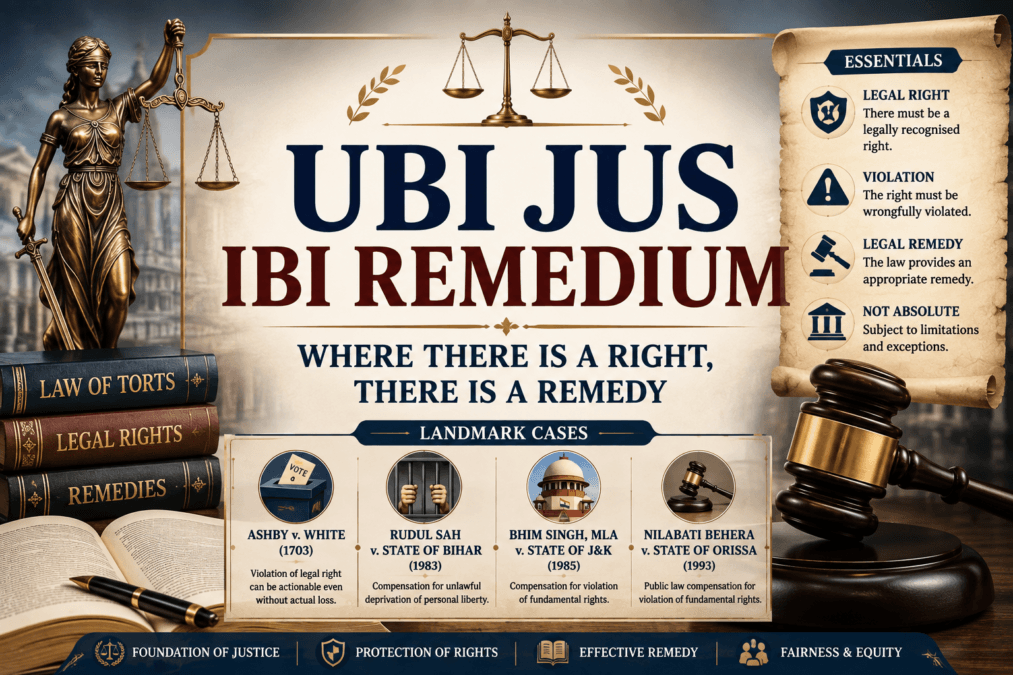
For examination purposes, remember the following points:
1. There must be a legal right
The claimant must possess a right recognised or protected by law.
A mere moral expectation, personal grievance or feeling of unfairness is generally insufficient.
2. The legal right must have been violated
There must be an infringement or wrongful interference with the legally protected right.
3. The violation must be legally actionable
The law must recognise the particular infringement as giving rise to a remedy.
4. The appropriate legal remedy must be available
The remedy may be damages, injunction, declaration, restitution or another form of relief depending on the circumstances.
5. Actual financial loss is not always necessary
This is an important point.
In cases of injuria sine damno, violation of a legal right itself may be actionable even without proof of actual financial loss.
Ashby v White is the classic illustration.
8. Limitations of the Maxim
The maxim is not absolute.
1. There must be a legal right
The maxim does not mean that every wrong or hardship must have a legal remedy.
For example, a purely moral grievance may not create a legal cause of action.
2. Mere damage is insufficient
A person may suffer actual loss without suffering a legal injury.
This is the principle of:
Damnum sine injuria
For example, lawful competition may cause financial loss to another person without violating that person’s legal right.
3. The law may restrict or exclude a remedy
A statutory scheme may prescribe the available remedy or limit the circumstances in which an action can be brought.
4. Public rights may have special requirements
In areas such as public nuisance, a private individual generally needs to satisfy the applicable requirements before bringing an individual action.
5. Not every legal right has damages as its remedy
Some rights may be enforced through:
- injunction;
- declaration;
- writ;
- restitution;
- statutory procedure; or
- another specific remedy.
Therefore, remedium does not necessarily mean compensation.
9. Ubi Jus Ibi Remedium vs Damnum Sine Injuria
| Ubi Jus Ibi Remedium | Damnum Sine Injuria |
| Where there is a legal right, there is a remedy | Damage without violation of a legal right |
| Focuses on protection of legal rights | Focuses on absence of legal injury |
| Legal injury may give rise to an action | Mere loss may not give rise to an action |
| Closely associated with injuria sine damno | Opposite concept to injuria sine damno |
| Ashby v White is a leading illustration | Gloucester Grammar School Case is a classic illustration |
10. Relationship with Injuria Sine Damno
Ubi Jus Ibi Remedium
Where there is a legal right, there is a remedy.
Injuria Sine Damno
Legal injury without actual damage.
Damnum Sine Injuria
Actual damage without legal injury.
Easy way to remember
Jus → Remedy
Injuria without Damnum → Actionable
Damnum without Injuria → Generally not actionable
11. Important Cases at a Glance
| Case | Principle / Importance |
| Ashby v White (1703) | Violation of a legal right can be actionable even without actual financial loss |
| Gloucester Grammar School Case | Illustrates damnum sine injuria |
| Donoghue v Stevenson (1932) | Development of duty of care and modern negligence |
| Rudul Sah v State of Bihar (1983) | Constitutional compensation for unlawful deprivation of liberty |
| Bhim Singh v State of J&K (1985) | Compensation for serious violation of constitutional rights |
| Nilabati Behera v State of Orissa (1993) | Public-law compensation for violation of fundamental rights |
12. Exam-Oriented Short Answer
What is Ubi Jus Ibi Remedium?
Ubi Jus Ibi Remedium means “where there is a legal right, there is a legal remedy.” It is an important principle underlying the Law of Torts. It signifies that where the law recognises a person’s legal right and that right is wrongfully violated, the law ordinarily provides an appropriate remedy. The remedy may be damages, injunction, declaration or another form of legal relief. The maxim is closely illustrated by Ashby v White (1703), where the plaintiff’s legal right to vote was wrongfully denied even though he suffered no actual financial loss. In India, decisions such as Rudul Sah and Bhim Singh demonstrate the development of effective public-law remedies for serious violations of fundamental rights.
- Law of Torts — Meaning and Definition of Tort
- 2. Is It “Law of Tort” or “Law of Torts”?
- 3. Essential Elements of Tortious Liability
- 4. Mental Elements in Tort — Intention, Motive, Malice & Fault
- 5. Tort and Other Civil Wrongs
- 6. Development of Law of Torts in England and India
Conclusion
Ubi Jus Ibi Remedium expresses a fundamental principle of legal justice: a legally recognised right should ordinarily be capable of being effectively vindicated when it is violated.
Its importance in tort law is particularly visible through injuria sine damno, where infringement of a legal right may be actionable even without measurable financial loss. Ashby v White remains the classic historical illustration. In India, the principle has also developed in the constitutional context through cases such as Rudul Sah, Bhim Singh and Nilabati Behera, where the Supreme Court recognised monetary compensation as an appropriate public-law remedy for serious violations of fundamental rights.
Therefore, the maxim is not simply “every wrong must receive compensation”; its more precise meaning is that a violation of a legally recognised right should have an appropriate legal means of redress, subject to the limitations imposed by law.
FAQs — Ubi Jus Ibi Remedium
1. What does Ubi Jus Ibi Remedium mean?
Ubi Jus Ibi Remedium is a Latin maxim meaning “Where there is a legal right, there is a legal remedy.” It means that when a legally recognised right is violated, the law generally provides an appropriate remedy.
2. What is an example of Ubi Jus Ibi Remedium?
The classic example is Ashby v White (1703). The plaintiff was wrongfully prevented from exercising his legal right to vote, even though the result of the election was not affected. The case illustrates that violation of a legal right may be actionable even without actual financial loss.
3. What is the difference between Ubi Jus Ibi Remedium and Injuria Sine Damno?
Ubi Jus Ibi Remedium means that a legal right should have a legal remedy when violated, whereas Injuria Sine Damno means a legal injury without actual damage. Ashby v White is commonly associated with both principles.
4. Is Ubi Jus Ibi Remedium an absolute rule?
No. The maxim is subject to limitations. A person must generally establish a legally recognised right and an actionable violation. Not every loss, moral wrong or personal grievance creates a legal remedy.
5. What are the important cases related to Ubi Jus Ibi Remedium?
Important cases include Ashby v White, Rudul Sah v State of Bihar, Bhim Singh v State of J&K, and Nilabati Behera v State of Orissa. These cases illustrate the development of legal and constitutional remedies for violations of recognised rights.
Classmate Pulse Spiral Notebook ✏️ Need a Spiral Notebook for Everyday Writing? A spiral notebook…

Latest Scholarships & Fellowships 2026–27: Open Opportunities for Upcoming call
Latest Scholarships & Research Fellowships 2026–27 Last Verified: 30 September 2026 Students, researchers, PhD scholars…
Writing & Research Resources: Useful Books, Tools & Essentials for Writers and Researchers
Whether you are an author, content writer, law student, academic researcher, PhD scholar, teacher, or…