
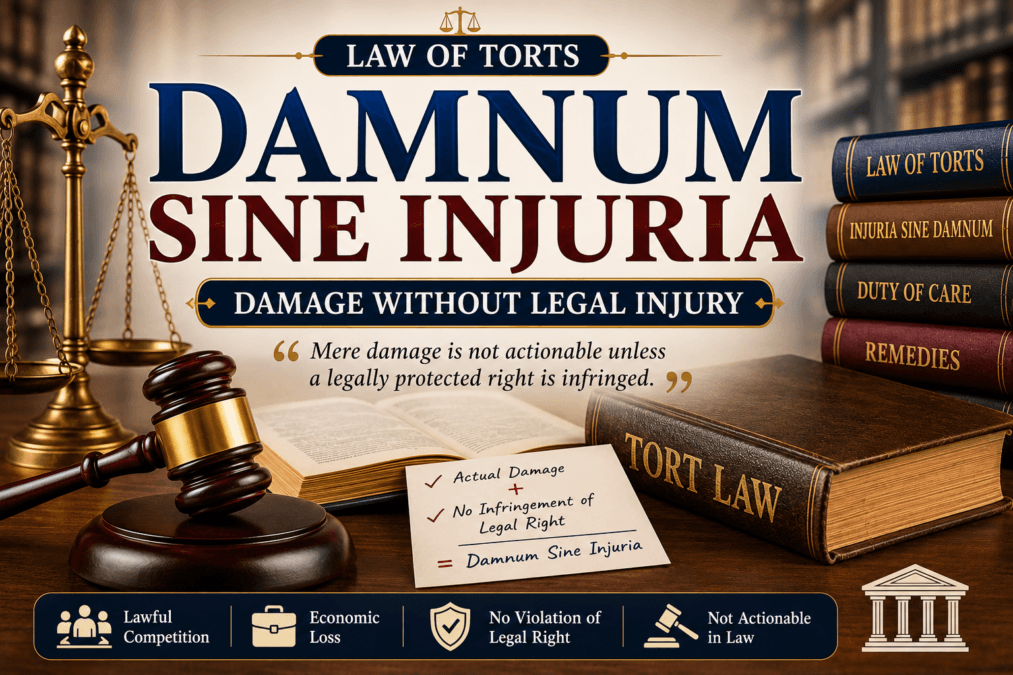
Damnum Sine Injuria
Damnum Sine Injuria is an important maxim in the Law of Torts. It explains that a person may suffer actual loss or damage, but the loss will not ordinarily be actionable in tort unless a legally protected right has been infringed or another recognised cause of action is established.
The classic illustration is the Gloucester Grammar School Case (1410), where lawful competition caused financial loss to an existing school, but no legal right of the school was violated.
- Law of Torts — Meaning and Definition of Tort
- 2. Is It “Law of Tort” or “Law of Torts”?
- 3. Essential Elements of Tortious Liability
- 4. Mental Elements in Tort — Intention, Motive, Malice & Fault
- 5. Tort and Other Civil Wrongs
- 6. Development of Law of Torts in England and India
- 7. Ubi Jus Ibi Remedium
1. Meaning of Damnum Sine Injuria
Damnum Sine Injuria is a Latin maxim meaning:
Damage without legal injury.
The words can be understood as:
- Damnum = damage, loss or harm
- Sine = without
- Injuria = infringement of a legal right
Therefore:
Actual damage + No infringement of a legally protected right = Damnum Sine Injuria
The principle is based on an important distinction between actual loss and legal injury.
A person may lose money, customers or business because of another person’s conduct. However, if that conduct does not infringe a legally protected right and does not constitute some other recognised legal wrong, the loss alone will generally not give rise to a tort claim.
2. What Is Legal Injury?
Legal injury does not simply mean physical harm or financial loss.
In tort law, it generally refers to the infringement of a right recognised and protected by law.
For example:
A operates a shop. B opens another shop nearby and lawfully sells the same products at lower prices. A loses customers and profits.
A has suffered damage.
But if B has not violated any legal right of A, A’s financial loss alone does not necessarily create a tort claim.
This is the basic idea of Damnum Sine Injuria.
3. Is Damnum Sine Injuria a Tort?
No.
This is an important point for accurate LL.B. notes.
Damnum Sine Injuria is a legal maxim/principle, not an independent tort.
It helps explain why mere damage or economic loss is insufficient for tortious liability when no legally protected right has been infringed.
Therefore, instead of writing:
“The essentials of the tort of Damnum Sine Injuria”
it is academically better to write:
“Features or Conditions of the Principle of Damnum Sine Injuria.”
4. Principle of Damnum Sine Injuria
The central principle is:
Mere damage is not actionable unless it is accompanied by infringement of a legally protected right or another recognised legal wrong.
The principle is particularly relevant where the defendant’s conduct is lawful.
For example, lawful competition can cause one business to lose customers. The resulting financial loss does not, by itself, establish tortious liability.
An Indian illustration can be found in H.R. Krishnamurthy v State of Karnataka, where the Karnataka High Court described the reduction in a licensed liquor seller’s business caused by another licensed shop as a classic example of damnum sine injuria, because the petitioner had no legal right to exclude competitors.
5. Features of Damnum Sine Injuria
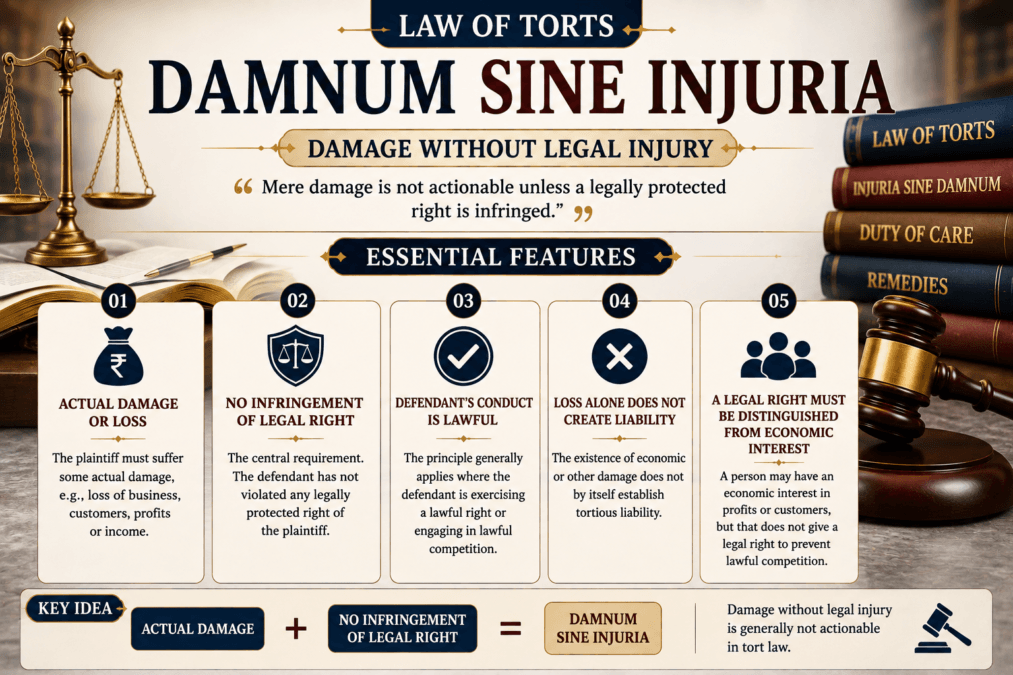
1. Actual damage or loss may exist
The claimant may have suffered genuine economic or other loss.
For example:
- loss of customers;
- loss of profits;
- reduction in business;
- loss of income.
2. No legally protected right is infringed
This is the central feature.
The claimant has suffered damage, but the defendant has not violated a legal right of the claimant.
3. The defendant’s conduct may be lawful
The principle commonly arises where the defendant is exercising a lawful right or engaging in lawful competition.
4. Damage alone does not establish tortious liability
The fact that a person has suffered financial loss does not automatically establish a tort.
5. There must be a recognised legal wrong for liability
If the defendant’s conduct independently constitutes negligence, nuisance, trespass, defamation, unlawful interference or another recognised wrong, the mere fact that the claimant has suffered damage cannot be used to avoid liability.
6. Cases
Leading Case — Gloucester Grammar School Case
Gloucester Grammar School Case (1410)
This is the classic and leading illustration of Damnum Sine Injuria. The surviving Year Book report is the historical source for the case.
Facts
The plaintiff operated a grammar school.
A schoolmaster established another school nearby and competed with the plaintiff.
The competition resulted in students moving away from the plaintiff’s school, causing the plaintiff to suffer a reduction in fees and financial loss.
The plaintiff sought compensation for the loss.
Issue
Whether the plaintiff could recover damages for financial loss caused by the defendant’s competing school.
Decision
The claim was not actionable merely because the plaintiff suffered financial loss.
The defendant had not infringed any legally protected right of the plaintiff by establishing the competing school.
Principle
The case illustrates:
Damage caused by lawful competition, without infringement of a legal right, is Damnum Sine Injuria and is not actionable merely because financial loss has occurred.
The case is consistently identified as the classic authority for the maxim.
Exam importance
Remember:
Gloucester Grammar School Case = Damnum Sine Injuria
Chasemore v Richards
Chasemore v Richards (1859)
This is an important related authority concerning damage resulting from the lawful exercise of rights in relation to underground water. The House of Lords decision is reported at 7 H.L.C. 349.
Facts
The plaintiff operated a mill that depended upon water.
The defendant sank a well on his own land and extracted underground water.
This reduced the water available to the plaintiff’s mill and caused economic loss.
Decision
The plaintiff could not recover merely because the defendant’s activity caused loss.
The defendant’s use of the underground water did not infringe a legally protected right of the plaintiff in the circumstances of the case.
Principle
The case illustrates that:
Actual loss does not necessarily create liability where no legally protected right has been infringed.
Importance
It is best presented as a related authority, rather than calling it the leading case of Damnum Sine Injuria.
Mogul Steamship Co Ltd v McGregor, Gow & Co
Mogul Steamship Co Ltd v McGregor, Gow & Co [1892] A.C. 25
This is an important historical authority concerning competition, economic loss and lawful means.
Facts
A group of shipowners formed an association and adopted commercial arrangements designed to strengthen their position in the market.
The plaintiff alleged that the defendants’ conduct harmed its business and caused economic loss.
Decision
The House of Lords rejected the claim because the defendants’ conduct, on the facts and legal framework of the case, did not involve unlawful means giving rise to the claimed cause of action.
Importance
The case demonstrates that:
Economic loss caused by competition is not automatically actionable where the defendant’s conduct is otherwise lawful.
Important qualification
Do not write:
“All competition causing economic loss is lawful.”
That is too broad.
The case is a historical authority on lawful competition and economic torts, not a blanket statement of modern competition law.
Bradford Corporation v Pickles
Bradford Corporation v Pickles [1895]
This is another important related authority, particularly concerning lawful conduct and motive.
Facts
Pickles owned land from which underground water flowed towards the Bradford Corporation’s water supply.
He interfered with the flow of underground water on his land.
The Corporation alleged that Pickles acted with an improper motive and intended to put pressure on the Corporation.
Decision
The House of Lords held that the legality of the defendant’s conduct was not transformed merely because the defendant acted with a malicious or improper motive.
Principle
The case is commonly associated with the proposition that:
A lawful act does not ordinarily become unlawful merely because it is motivated by an improper purpose.
Importance for Tort Law
The case helps students distinguish:
Lawful act + bad motive
from
Unlawful act + legal injury
The legality of the conduct remains central.
H.R. Krishnamurthy v State of Karnataka
H.R. Krishnamurthy v State of Karnataka
Karnataka High Court, 13 April 2018
The petitioner argued that the opening of another licensed liquor shop would reduce his business and therefore cause him damage.
The Karnataka High Court rejected the argument, describing the situation as a classic case of Damnum Sine Injuria, because the petitioner could not identify a legal right to exclude another licensed competitor.
Importance
This case is particularly useful because it applies the classical principle to a modern commercial situation.
Business loss caused by lawful competition does not itself establish a tort where there is no legally protected right to exclude the competitor.
7. Damnum Sine Injuria vs Injuria Sine Damnum
This distinction is extremely important for LL.B. examinations.
| Damnum Sine Injuria | Injuria Sine Damnum |
| Damage without legal injury | Legal injury without actual damage |
| Actual loss is suffered | Actual loss may be absent |
| No legally protected right is infringed | A legally protected right is infringed |
| Loss alone is generally insufficient | Legal injury may itself be actionable |
| Gloucester Grammar School Case | Ashby v White |
| Chasemore v Richards — related authority | Municipal Board of Agra v Asharfi Lal — Indian illustration |
Easy Formula
Damnum Sine Injuria
Damage + No Legal Injury
Injuria Sine Damnum
Legal Injury + No Actual Damage
8. Simple Examples
Example 1 — Lawful Competition
A owns a stationery shop.
B opens another stationery shop nearby and sells products at lower prices.
A loses customers and profits.
If B is competing lawfully and has not infringed any legal right of A:
Damnum Sine Injuria may apply.
Example 2 — New Restaurant
A operates a restaurant.
B opens a new restaurant in the same locality.
B attracts some of A’s customers.
A’s profits decrease.
A has suffered damage, but the loss alone does not establish a tort.
Example 3 — Competition in Professional Services
A lawfully provides a professional service.
B begins providing the same service and attracts some of A’s clients through lawful competition.
A suffers economic loss.
Unless B’s conduct involves an independent legal wrong, the loss itself does not necessarily amount to actionable legal injury.
9. When Damnum Sine Injuria Does NOT Protect the Defendant
This is an important limitation.
The maxim does not mean that a defendant can cause any amount of damage without liability.
If the defendant’s conduct infringes a legally protected right or satisfies the requirements of another recognised cause of action, liability may arise.
For example, depending upon the facts, liability may arise through:
- negligence;
- nuisance;
- trespass;
- defamation;
- fraud;
- unlawful interference;
- intimidation;
- breach of a legal duty; or
- another recognised tort.
Therefore:
Damage alone is insufficient — but the existence of damage does not prevent liability where a separate legal wrong is established.
10. Is Every Economic Loss Damnum Sine Injuria?
No.
This is an important modern qualification.
Economic loss can be legally actionable in appropriate circumstances.
For example, modern tort law recognises specific causes of action involving economic interests, including certain forms of:
- negligent misstatement;
- unlawful interference;
- economic torts;
- nuisance; and
- breach of a recognised duty.
Therefore, the correct proposition is:
Economic loss without infringement of a legal right or another recognised cause of action is generally not actionable merely because loss has occurred.
11. Leading cases of Damnum Sine Injuria
| Case | Importance |
| Gloucester Grammar School Case (1410) | Leading/classic illustration of Damnum Sine Injuria |
| Chasemore v Richards (1859) | Related authority — lawful use of underground water and resulting loss |
| Mogul Steamship Co v McGregor, Gow & Co (1892) | Related authority — lawful competition and economic loss |
| Bradford Corporation v Pickles (1895) | Related authority — lawful act and improper motive |
| H.R. Krishnamurthy v State of Karnataka (2018) | Indian illustration — loss from lawful competition |
12. Short Exam Answer
What is Damnum Sine Injuria?
Damnum Sine Injuria means damage without legal injury. It is a legal maxim which expresses the principle that mere loss or damage does not ordinarily give rise to an action in tort unless a legally protected right has been infringed or another recognised cause of action is established. The classic illustration is the Gloucester Grammar School Case (1410), where lawful competition caused financial loss to an existing school but did not infringe any legal right. Related authorities include Chasemore v Richards (1859), Mogul Steamship Co v McGregor, Gow & Co (1892) and Bradford Corporation v Pickles (1895). In India, H.R. Krishnamurthy v State of Karnataka (2018) provides a modern illustration involving economic loss from lawful competition.
13. Quick Revision
Maxim
Damnum Sine Injuria
Meaning
Damage without legal injury
Nature
Legal maxim/principle — not an independent tort
Leading case
Gloucester Grammar School Case (1410)
Related cases
- Chasemore v Richards (1859)
- Mogul Steamship Co v McGregor, Gow & Co (1892)
- Bradford Corporation v Pickles (1895)
- H.R. Krishnamurthy v State of Karnataka (2018)
Opposite maxim
Injuria Sine Damnum
Leading case for opposite maxim
Ashby v White (1703)
One-line formula
Actual Damage + No Infringement of a Legally Protected Right = Damnum Sine Injuria
Conclusion
Damnum Sine Injuria teaches that actual damage and legal injury are not the same thing. A person may suffer genuine financial loss without having a legal cause of action.
The classic example is the Gloucester Grammar School Case, where competition caused financial loss but did not infringe the plaintiff’s legal rights.
The principle should therefore be understood as:
“Damage alone is not enough; there must be legal injury or another recognised legal wrong.”
This makes Damnum Sine Injuria the natural counterpart to Injuria Sine Damnum.
FAQs — Damnum Sine Injuria
1. What is Damnum Sine Injuria in tort law?
Damnum Sine Injuria means damage without legal injury. It means that actual loss alone does not ordinarily create tortious liability when no legally protected right has been infringed.
2. What is the leading case of Damnum Sine Injuria?
The Gloucester Grammar School Case (1410) is the classic and leading illustration. A competing school caused financial loss to the plaintiff, but no legal right of the plaintiff was violated.
3. Is Damnum Sine Injuria a tort?
No. It is a legal maxim/principle, not an independent tort. It explains why mere damage without infringement of a legal right is generally insufficient for a tort claim.
4. What is the difference between Damnum Sine Injuria and Injuria Sine Damnum?
Damnum Sine Injuria means actual damage without legal injury, whereas Injuria Sine Damnum means legal injury without actual damage. The classic cases are Gloucester Grammar School Case and Ashby v White, respectively.
5. Can economic loss be actionable despite Damnum Sine Injuria?
Yes. Economic loss can be actionable when it results from a recognised legal wrong, such as certain economic torts, negligence, nuisance or unlawful interference. The maxim does not mean that all economic loss is legally irrelevant.
Classmate Pulse Spiral Notebook ✏️ Need a Spiral Notebook for Everyday Writing? A spiral notebook…

Latest Scholarships & Fellowships 2026–27: Open Opportunities for Upcoming call
Latest Scholarships & Research Fellowships 2026–27 Last Verified: 30 September 2026 Students, researchers, PhD scholars…
Writing & Research Resources: Useful Books, Tools & Essentials for Writers and Researchers
Whether you are an author, content writer, law student, academic researcher, PhD scholar, teacher, or…