
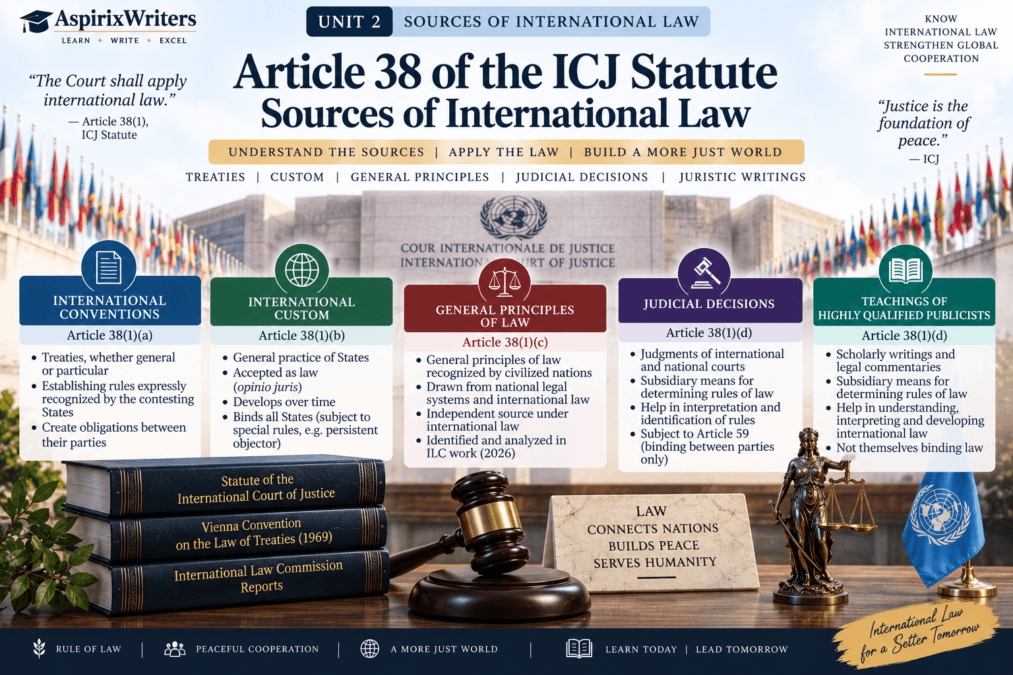
Article 38 of ICJ Statute: Sources of International Law
Introduction
After understanding the basic meaning and nature of International Law, the next important question is:
From where do the rules of International Law come?
The principal starting point for answering this question is Article 38 of the Statute of the International Court of Justice (ICJ).
Article 38 identifies the legal materials that the Court applies when deciding disputes submitted to it. It refers to:
- International conventions;
- International custom;
- General principles of law; and
- Judicial decisions and the teachings of highly qualified publicists as subsidiary means for determining rules of law.
Article 38(2) additionally provides for decision ex aequo et bono when the parties agree.
Authoritative source: Statute of the International Court of Justice.
Don’t Miss New Law Opportunities!
Join our WhatsApp community for verified updates on Law Jobs, Internships, Competitions, Scholarships, LLB Notes & more.
1. What is Article 38 of the ICJ Statute?
Article 38 is one of the most important provisions in the study of the Sources of International Law.
The provision begins by stating that the Court, whose function is to decide disputes in accordance with International Law, shall apply specified legal materials.
The official text of Article 38(1) identifies:
“international conventions”
“international custom”
“general principles of law”
and, subject to Article 59, judicial decisions and the teachings of highly qualified publicists as “subsidiary means” for determining rules of law.
Authoritative source: Article 38(1), Statute of the International Court of Justice, official ICJ text.
2. Text of Article 38
For examination purposes, students should know the structure of Article 38 accurately.
Article 38(1) provides that the Court shall apply:
(a) International Conventions
“international conventions, whether general or particular, establishing rules expressly recognized by the contesting states” (Article 38(1)(a), Statute of the ICJ).
(b) International Custom
“international custom, as evidence of a general practice accepted as law” (Article 38(1)(b), Statute of the ICJ)
(c) General Principles of Law
“the general principles of law recognized by civilized nations” ( Article 38(1)(c), Statute of the ICJ.)
(d) Judicial Decisions and Juristic Writings
Judicial decisions and the teachings of the most highly qualified publicists are described as:
“subsidiary means for the determination of rules of law” (Article 38(1)(d), Statute of the ICJ.)
Article 38(2)
Article 38(2) provides that Article 38 does not prejudice the Court’s power to decide a case ex aequo et bono, if the parties agree.
3. Four Categories under Article 38(1)
The basic structure can be remembered as:
Article 38
↓
International Conventions
International Custom
General Principles of Law
Judicial Decisions + Teachings as Subsidiary Means
This structure forms the foundation for the detailed topics that follow in Unit 2.
4. International Conventions — Article 38(1)(a)
The first category is:
International conventions, whether general or particular, establishing rules expressly recognized by the contesting States.
In modern terminology, international conventions are generally discussed as treaties or international agreements.
A treaty may establish legal obligations between its parties according to the applicable rules of treaty law.
Examples
Important examples include:
- Vienna Convention on the Law of Treaties, 1969;
- United Nations Convention on the Law of the Sea, 1982;
- Vienna Convention on Diplomatic Relations, 1961.
The International Law Commission’s official records confirm that its work on the law of treaties resulted in draft articles in 1966 and subsequently the Vienna Convention on the Law of Treaties, 1969. (Authoritative source: International Law Commission, “Law of treaties — Texts, instruments and final reports.”)
Important qualification
A treaty generally binds its parties according to the applicable rules of treaty law. Therefore, a treaty should not automatically be treated as creating obligations for every State.
5. International Custom — Article 38(1)(b)
Article 38(1)(b) refers to:
“international custom, as evidence of a general practice accepted as law”
Customary International Law is therefore generally identified through two constituent elements:
- General practice
- Acceptance of that practice as law — opinio juris
The International Law Commission’s 2018 Conclusions on Identification of Customary International Law expressly explain that customary International Law derives from practice accepted as law and identify these two constituent elements.(ILC, Draft Conclusions on Identification of Customary International Law, 2018).
Customary International Law = General Practice + Opinio Juris
However, students should understand that identifying custom requires a careful assessment of the relevant practice and evidence; it is not enough merely to show that States have behaved similarly. (ILC, Identification of Customary International Law).
6. General Principles of Law — Article 38(1)(c)
Article 38(1)(c) recognizes:
“the general principles of law recognized by civilized nations”
The terminology of Article 38 reflects the wording adopted when the Statute was drafted. In contemporary legal writing, the expression “general principles of law” is normally used without reproducing the historical phrase “civilized nations” as a substantive classification.
Contemporary ILC Position
The International Law Commission has undertaken extensive work on general principles of law.
The ILC’s work examines, among other matters:
- general principles derived from national legal systems;
- general principles formed within the international legal system;
- identification of such principles;
- their functions; and
- their relationship with other sources of International Law.
Authoritative source: International Law Commission, General Principles of Law — Analytical Guide.
The ILC adopted draft conclusions on general principles of law on second reading during its 2026 session and recommended that the General Assembly take note of and disseminate them. This is an important current development for students studying the subject. (International Law Commission, Seventy-seventh session, 2026.)
General principles of law are an independent category under Article 38(1)(c). They should not simply be described as “principles used only when treaties and custom fail.”
The ILC’s work recognizes their distinct status while also examining their relationship with other sources.
Authoritative source: ILC, General Principles of Law.
7. Judicial Decisions — Article 38(1)(d)
Article 38(1)(d) identifies judicial decisions as a subsidiary means for determining rules of law. (Article 38(1)(d), Statute of the ICJ.)
Judicial decisions can help courts and lawyers:
- identify existing rules;
- interpret treaties;
- assess customary International Law;
- clarify general principles;
- understand the application of legal rules to particular facts.
But Are Judicial Decisions a Primary Source?
Article 38 itself places judicial decisions under the category of subsidiary means.
Therefore, students should avoid writing:
“Court judgments are a primary source of International Law under Article 38.”
That would not accurately reflect the wording of Article 38(1)(d).
The role of judicial decisions in determining and developing International Law is nevertheless important.
The ILC is currently studying subsidiary means for the determination of rules of International Law, including the nature and function of judicial decisions.
Authoritative source: International Law Commission, Subsidiary Means for the Determination of Rules of International Law.
8. Teachings of Highly Qualified Publicists
Article 38(1)(d) also refers to:
“the teachings of the most highly qualified publicists of the various nations”
The expression generally refers to the writings of recognized scholars of International Law.
Examples may include:
- academic treatises;
- scholarly monographs;
- authoritative legal commentaries;
- specialized research.
Function
Scholarly writings can assist in:
- explaining existing legal rules;
- identifying State practice;
- examining historical development;
- interpreting legal concepts;
- understanding competing legal positions.
However, scholarly writing does not become binding International Law merely because a respected scholar supports a particular proposition.
It remains a subsidiary means under Article 38(1)(d).
9. Why Does Article 38 Call Judicial Decisions and Writings “Subsidiary Means”?
Article 38 does not place judicial decisions and scholarly writings in the same textual category as conventions, custom and general principles.
Instead, Article 38(1)(d) describes them as means for determining rules of law.
The ILC’s ongoing work on subsidiary means specifically examines their function and their relationship with Article 38(1)(d). (ILC, Subsidiary Means for the Determination of Rules of International Law).
Therefore:
Treaties / Custom / General Principles
→ legal categories identified in Article 38
Judicial Decisions / Qualified Scholarly Writings
→ subsidiary means for determining rules of law
10. Article 59 of the ICJ Statute and Judicial Decisions
Article 38(1)(d) expressly makes judicial decisions subject to Article 59 of the ICJ Statute.
Article 59 provides:
“The decision of the Court has no binding force except between the parties and in respect of that particular case.”
Meaning
A judgment of the ICJ is binding upon the parties to that particular case, but Article 59 prevents the judgment from automatically becoming universally binding precedent for all States.
Article 38(1)(d) + Article 59
= Judicial decisions are subsidiary means, while an ICJ judgment has binding force between the parties and in respect of the particular case.
11. Is Article 38 an Exhaustive List of All Sources of International Law?
Article 38 is the central textual starting point for identifying the sources and subsidiary means applied by the ICJ.
However, contemporary international law practice involves additional legal materials and processes that do not fit neatly into a simplistic four-item list.
The official UN Audiovisual Library material on the ICJ Statute notes that Article 38 is not necessarily exhaustive and discusses materials such as unilateral juridical acts of States and resolutions of international organizations in appropriate contexts.
Authoritative source: United Nations Audiovisual Library of International Law, Statute of the International Court of Justice.
Important Qualification
This does not mean that every resolution of an international organization automatically constitutes a binding source of International Law.
The legal significance of a particular resolution or other international instrument depends upon its legal basis, wording, circumstances, subsequent practice and applicable rules.
12. Article 38 and International Organizations
International organizations can produce various types of legal materials, including:
- constituent treaties;
- decisions;
- resolutions;
- regulations;
- declarations;
- institutional practice.
Their legal effect differs according to the instrument and the authority under which it was adopted.
Therefore, students should avoid the blanket statement:
“UN resolutions are sources of International Law under Article 38.”
A more accurate statement is:
Certain resolutions or decisions of international organizations may have legal significance depending upon their legal basis and circumstances; they do not all automatically constitute binding rules of International Law.
13. Article 38(2): Ex Aequo et Bono
Article 38(2) provides that Article 38(1) does not prejudice the Court’s power to decide a case ex aequo et bono, if the parties agree. (Article 38(2), Statute of the ICJ.)
Meaning
The expression ex aequo et bono broadly refers to deciding according to considerations of fairness or equity rather than applying only the ordinary legal rules.
However, the Court can exercise this power only if the parties agree.
The Court may decide ex aequo et bono only where the parties agree.
14. Article 38 and Equity
Equity can arise in International Law in different ways and should not automatically be equated with ex aequo et bono.
A court may apply legal rules while taking equitable considerations into account where the applicable law permits or requires it.
By contrast, Article 38(2) specifically concerns the exceptional power to decide ex aequo et bono with the agreement of the parties.
Equity within legal reasoning
≠
Ex aequo et bono under Article 38(2)
15. Is There a Hierarchy Among Article 38 Sources?
Students sometimes memorize a hierarchy such as:
Treaty > Custom > General Principles > Judicial Decisions
This should not be treated as a universal hierarchy established by Article 38.
Article 38 lists the relevant categories, but it does not expressly establish a general ranking among treaties, customary International Law and general principles.
The ILC’s work on general principles has specifically considered the absence of hierarchy between sources of International Law. (International Law Commission, work on General Principles of Law).
16. Article 38 and Jus Cogens
Jus cogens, or peremptory norms of general International Law, is not separately listed as a fifth category in Article 38.
However, jus cogens has a special legal status in contemporary International Law.
The ILC completed its work on peremptory norms of general international law (jus cogens) in 2022 and adopted draft conclusions with commentaries.
Authoritative source: International Law Commission, Draft Conclusions on Identification and Legal Consequences of Peremptory Norms of General International Law (Jus Cogens), 2022.
Jus cogens concerns the special legal status and consequences of peremptory norms, rather than simply constituting another item added to Article 38’s list.
17. Article 38 and the Modern Study of Sources
Article 38 remains the starting point for the study of International Law, but modern legal analysis requires students to examine:
- treaties;
- customary International Law;
- general principles of law;
- judicial decisions;
- scholarly writings;
- acts and practice of international organizations;
- unilateral acts and declarations where legally relevant;
- peremptory norms;
- other recognized legal materials and processes.
The ILC’s current programme demonstrates this continuing development. Its work includes topics such as customary International Law, general principles of law, jus cogens and subsidiary means.
Authoritative source: International Law Commission, official list of topics and texts.
18. Article 38 as a Starting Point, Not a Mechanical Checklist
A common mistake in examination answers is to treat Article 38 as a mechanical checklist.
A better method is:
Step 1
Identify the relevant legal question.
Step 2
Determine whether a treaty rule applies.
Step 3
Consider customary International Law.
Step 4
Consider general principles of law where relevant.
Step 5
Use judicial decisions and qualified scholarly writings as subsidiary means for determining the applicable rule.
Step 6
Consider other legally relevant materials where appropriate.
This approach reflects the fact that identifying International Law requires legal analysis rather than merely selecting an item from a list.
19. Relationship Between Article 38 and Unit 2
This article is the foundation of Unit 2.
The remaining topics will examine each component in greater detail:
Topic 1
Article 38 of the ICJ Statute
Topic 2
International Treaties
Topic 3
Customary International Law
Topic 4
General Principles of Law
Topic 5
Judicial Decisions and Juristic Writings
Topic 6
Resolutions of International Organizations and Other Relevant Materials
Topic 7
Jus Cogens, Obligations Erga Omnes and Related Concepts
Topic 8
Relationship, Conflict and Development of Sources
Thus, this article should introduce Article 38 without duplicating the detailed treatment that follows.
20. Article 38 — Important Table for Revision
| Article | Subject | Main Point |
| 38(1)(a) | International conventions | Treaty/convention rules recognized by the contesting States |
| 38(1)(b) | International custom | General practice accepted as law |
| 38(1)(c) | General principles of law | General principles recognized under International Law |
| 38(1)(d) | Judicial decisions | Subsidiary means for determining rules of law |
| 38(1)(d) | Teachings of qualified publicists | Subsidiary means for determining rules of law |
| 38(2) | Ex aequo et bono | Possible only with agreement of the parties |
Source: Statute of the International Court of Justice, Article 38.
21. Important Distinctions for Examination
Treaty vs Custom
Treaty: generally based on agreement between States or other treaty parties.
Custom: develops through general practice accepted as law.
Custom vs General Principles
Custom: practice + acceptance as law.
General principles: a distinct category under Article 38(1)(c).
Primary Legal Categories vs Subsidiary Means
Article 38 distinguishes the first three categories from judicial decisions and qualified scholarly writings, which it calls subsidiary means.
Judicial Decision vs Binding Precedent
An ICJ judgment is binding between the parties in the particular case under Article 59, but it does not automatically become universally binding precedent.
Article 38 vs All International Legal Materials
Article 38 is fundamental, but contemporary International Law contains additional legally relevant materials and processes that require separate analysis.
22. Common Mistakes to Avoid
Mistake 1
“Article 38 contains a complete hierarchy of sources.”
Not correct.
Mistake 2
“Judicial decisions are primary sources of International Law.”
Article 38(1)(d) describes them as subsidiary means.
Mistake 3
“Every UN resolution is binding International Law.”
Not correct. Legal effect depends upon the particular resolution and its legal basis.
Mistake 4
“Every treaty provision is customary International Law.”
Not correct.
Mistake 5
“Jus cogens is the fifth source under Article 38.”
This is an oversimplification.
Mistake 6
“ICJ judgments bind every State.”
Article 59 limits the binding force of an ICJ decision to the parties and the particular case.
23. Summery
Discuss Article 38 of the Statute of the International Court of Justice as a statement of the Sources of International Law.
Introduction
Article 38 of the Statute of the International Court of Justice is a central provision for understanding the sources of International Law. It identifies the legal materials that the Court applies when deciding disputes submitted to it.
Main Sources
Article 38(1)(a) refers to international conventions.
Article 38(1)(b) refers to international custom, described as evidence of a general practice accepted as law.
Article 38(1)(c) refers to general principles of law.
Article 38(1)(d) identifies judicial decisions and the teachings of highly qualified publicists as subsidiary means for determining rules of law.
Ex Aequo et Bono
Article 38(2) permits the Court to decide a case ex aequo et bono where the parties agree.
Importance
Article 38 provides the fundamental framework for studying sources of International Law. However, its categories should not be treated as a simplistic hierarchy, and contemporary International Law also requires consideration of other legally relevant materials and processes.
Conclusion
Article 38 remains a fundamental starting point for the identification and application of International Law, while modern practice demonstrates that the study of sources requires careful examination of treaties, custom, general principles, subsidiary means and other legally relevant materials.
Article 38 of the ICJ Statute
Article 38 is an important provision concerning the sources of International Law. Under Article 38(1), the International Court of Justice applies international conventions, international custom and general principles of law. Judicial decisions and the teachings of highly qualified publicists are recognized as subsidiary means for determining rules of law. Article 38(2) permits the Court to decide a case ex aequo et bono if the parties agree.
Article 38 therefore provides the principal framework for studying the sources of International Law.
25. Short Notes
Article 38(1)(a)
Deals with international conventions.
Article 38(1)(b)
Deals with international custom based on general practice accepted as law.
Article 38(1)(c)
Recognizes general principles of law.
Article 38(1)(d)
Recognizes judicial decisions and qualified scholarly writings as subsidiary means.
Article 38(2)
Deals with ex aequo et bono.
25. Frequently Asked Questions
1. What is Article 38 of the ICJ Statute?
Article 38 identifies the legal materials applied by the ICJ when deciding disputes according to International Law.
2. What are the main categories listed in Article 38(1)?
International conventions, international custom and general principles of law, together with judicial decisions and qualified scholarly writings as subsidiary means.
3. What is the meaning of Article 38(1)(b)?
It refers to international custom as evidence of a general practice accepted as law.
4. Are judicial decisions binding on all States?
No. Under Article 59, an ICJ decision has binding force between the parties and in respect of the particular case.
5. Can the ICJ decide a case on the basis of equity?
The Court may decide ex aequo et bono under Article 38(2) only if the parties agree.
27. Quick Revision
Remember:
38(1)(a) → Conventions
38(1)(b) → Custom
38(1)(c) → General Principles
38(1)(d) → Judicial Decisions + Qualified Publicists
38(2) → Ex Aequo et Bono
Custom
Practice + Opinio Juris
Judicial Decisions
Subsidiary means
Article 59
Binding between parties in particular case
Important caution
Article 38 ≠ simplistic hierarchy of sources
28. Key Takeaways
- Article 38 is the principal starting point for studying the sources of International Law.
- Article 38(1)(a) concerns international conventions.
- Article 38(1)(b) concerns international custom.
- Article 38(1)(c) concerns general principles of law.
- Article 38(1)(d) treats judicial decisions and qualified scholarly writings as subsidiary means.
- Article 38(2) concerns ex aequo et bono.
- Customary International Law involves general practice and acceptance as law.
- Judicial decisions are not universally binding precedent under Article 59.
- Article 38 should not be treated as a simplistic hierarchy.
- Contemporary developments by the ILC continue to refine understanding of general principles and subsidiary means.
Authoritative References
- International Court of Justice, Statute of the International Court of Justice, Articles 38 and 59.
- International Law Commission, Draft Conclusions on Identification of Customary International Law, 2018.
- International Law Commission, General Principles of Law — Analytical Guide and Draft Conclusions.
- International Law Commission, Subsidiary Means for the Determination of Rules of International Law.
- International Law Commission, Draft Conclusions on Identification and Legal Consequences of Peremptory Norms of General International Law (Jus Cogens), 2022.
- International Law Commission, Law of Treaties — Draft Articles and Vienna Convention on the Law of Treaties, 1969.
About the Author
Dr. Rekha Khandelwal, Ph.D. in Law, is a legal academic and researcher specializing in legal education, legal research and contemporary legal developments.
Read more about Dr. Rekha Khandelwal → https://aspirixwriters.com/dr-rekha-khandelwal/
Don’t Miss New Law Opportunities!
Join our WhatsApp community for verified updates on Law Jobs, Internships, Competitions, Scholarships, LLB Notes & more.
Unit 1: Foundations of International Law
- Meaning, Definitions, Nature, Scope and Importance of International Law
- Basis, Binding Force and Sanctions of International Law
- Historical development of International Law
- Sources of International Law-Basic Introduction
Explore