
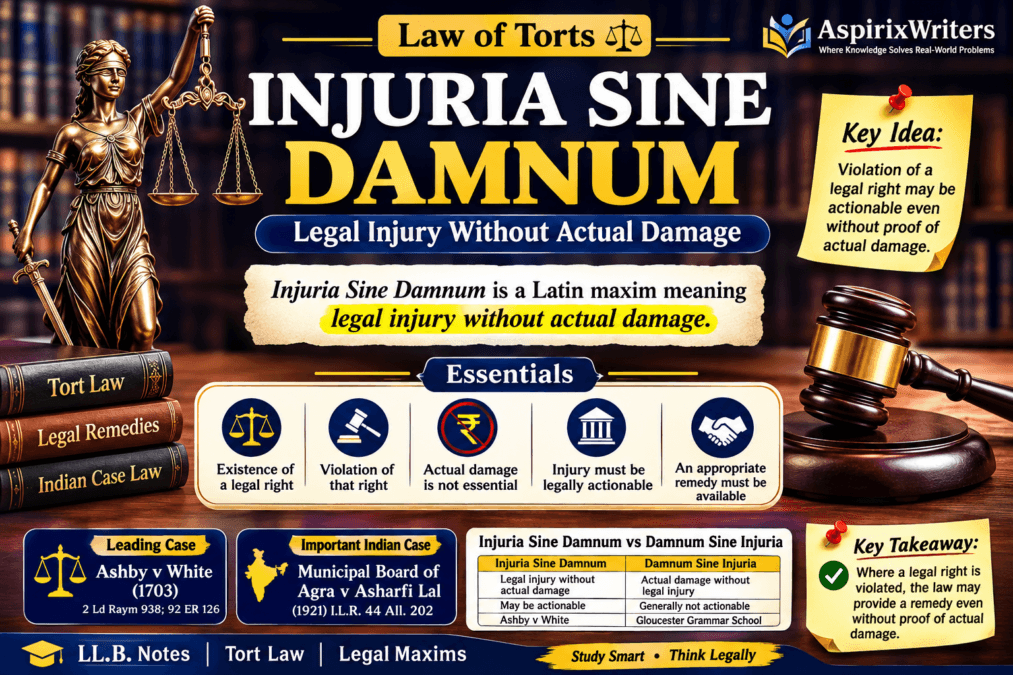
Injuria Sine Damnum — Legal Injury Without Actual Damage
1. Meaning of Injuria Sine Damnum
Injuria Sine Damnum is a Latin legal maxim meaning “legal injury without actual damage.”
In simple words, it means that when a person’s legally recognised right is violated, the person may have a cause of action even though no actual financial loss or measurable damage has been suffered.
The maxim consists of three words:
- Injuria — infringement or violation of a legal right
- Sine — without
- Damnum — actual damage or loss
Therefore:
Infringement of a legal right + No actual damage = Injuria Sine Damnum
The maxim forms part of the basic principles of legal damage in the Law of Torts, alongside Damnum Sine Injuria and Ubi Jus Ibi Remedium. University tort syllabi commonly place these concepts under the constituents of tort.
2. What Is Meant by “Legal Injury”?
The word injuria does not necessarily mean physical injury.
In this context, it means:
Violation or infringement of a legal right.
For example, if a person has a legally protected right to vote and another person unlawfully prevents that person from voting, there may be a legal injury, even if the person suffers no financial loss.
Thus, students should remember:
Legal injury ≠ Physical injury
and
Damage ≠ Legal injury
A person may suffer actual loss without suffering a legally actionable injury. Conversely, a person may suffer a legal injury without measurable actual damage.
3. Principle of Injuria Sine Damnum
The principle is that the infringement of a legal right may itself be sufficient to found an action, even when the claimant cannot prove actual financial damage.
However, this does not mean that every inconvenience, disappointment, emotional upset or loss automatically becomes a tort.
The claimant must establish:
- a legally recognised right;
- an infringement of that right; and
- an actionable legal wrong.
Therefore, the correct approach is:
Legal right → Violation → Legal injury → Appropriate remedy
4. Relationship with Ubi Jus Ibi Remedium
Injuria Sine Damnum is closely connected with the maxim:
Ubi Jus Ibi Remedium
“Where there is a right, there is a remedy.”
The connection can be understood as follows:
If the law recognises a person’s legal right and another person wrongfully infringes that right, the law may provide a remedy even when the claimant cannot demonstrate actual financial damage.
This is why Ashby v White is important for both principles.
But the two maxims are not identical:
| Ubi Jus Ibi Remedium | Injuria Sine Damnum |
| Where there is a legal right, there is a remedy | Legal injury without actual damage |
| Focuses on availability of legal remedy | Focuses on violation of legal right despite absence of actual damage |
| General legal principle | Principle concerning legal damage |
| Closely associated with Ashby v White | Ashby v White is the leading authority |
5. Cases
Leading Case— Ashby v White
Ashby v White (1703) 2 Ld Raym 938; 92 ER 126.
This is the leading and most important case for Injuria Sine Damnum. The historical report and later legal materials identify the case with the principle that infringement of a right can give rise to an action even in the absence of financial loss.
Facts
Ashby was a qualified voter at a parliamentary election.
White, the returning officer, wrongfully refused to receive Ashby’s vote.
The candidate for whom Ashby wished to vote was nevertheless elected.
Therefore, Ashby did not suffer an identifiable financial loss as a consequence of his vote being rejected.
Issue
Could Ashby maintain an action when his legal right to vote had been infringed even though he could not show actual financial loss?
Principle
The case is traditionally treated as establishing the important proposition that the infringement of a legal right may constitute actionable injury even without proof of actual financial loss.
Importance
Ashby v White is therefore the primary case to remember for:
- Injuria Sine Damnum
- Ubi Jus Ibi Remedium
- protection of legal rights
- legal injury without measurable damage
The reported history of the case is somewhat more nuanced than the simplified textbook account: Holt CJ’s famous reasoning was initially in the minority in the King’s Bench proceedings, and the later reversal occurred in the House of Lords. Therefore, for academically careful notes, it is better to say that the case is the classic authority traditionally associated with the maxim, rather than oversimplifying its procedural history.
Municipal Board of Agra v Asharfi Lal
The Municipal Board of Agra v Asharfi Lal (1921) I.L.R. 44 All. 202
This is an important Indian illustration of the principle.
Facts
Asharfi Lal was entitled to be included on the electoral roll.
His name was wrongly omitted from the roll, which deprived him of the ability to exercise his right to vote.
The issue concerned the legal consequences of wrongful deprivation of that electoral right.
Decision / Principle
The Allahabad High Court stated that where a duly qualified person is wrongfully omitted from the electoral roll and thereby deprived of the right to vote, the person suffers a legal wrong and may have a remedy against the person responsible for the wrongful deprivation.
Importance
The case is particularly valuable for Indian LL.B. students because it demonstrates the application of the principle in an Indian context.
Exam point
Wrongful interference with a legally recognised right may constitute actionable legal injury even where actual financial loss is absent.
C. Sarvothama Rao v Chairman, Municipal Council
C. Sarvothama Rao v Chairman, Municipal Council, 1923 Madras High Court
This case further discussed the protection of electoral rights.
The Madras High Court referred to Ashby v White and Municipal Board of Agra v Asharfi Lal, recognising that wrongful deprivation of the right to vote or stand as a candidate could give rise to an action. The Court also pointed out that the principle could be subject to qualifications depending upon the capacity in which the relevant public authority acted.
Importance
This case is useful for showing that the principle is not an unlimited rule: the nature of the defendant’s legal authority and the circumstances of the interference still matter.
6. Essentials of Injuria Sine Damnum
For an examination answer, remember these essential points.
1. Existence of a legal right
The claimant must possess a right recognised and protected by law.
2. Violation of the legal right
There must be an infringement or wrongful interference with that right.
3. Actual damage is not essential
The claimant does not necessarily have to prove financial loss or measurable damage.
4. The wrong must be legally actionable
A mere personal grievance, disappointment or moral complaint is not automatically an actionable tort.
5. An appropriate remedy must be available
Depending upon the nature of the right and the legal wrong, the remedy may include damages, injunction, declaration or another legally recognised form of relief.
7. Simple Examples
Example 1 — Right to Vote
A is legally qualified to vote.
B, without lawful justification, prevents A from exercising that right.
A suffers no financial loss.
This may constitute Injuria Sine Damnum.
The focus is on the violation of A’s legal right, not on monetary loss.
Example 2 — Trespass
A enters B’s land without lawful authority.
B cannot demonstrate any physical damage to the land.
The unauthorised interference with B’s legally protected possessory right may nevertheless be actionable, subject to the rules governing trespass.
Example 3 — False Imprisonment
A is unlawfully detained.
A does not suffer financial loss.
The unlawful interference with A’s personal liberty can itself constitute actionable legal injury.
8. Injuria Sine Damnum and Actionable Per Se
The maxim is often discussed with the concept of actionable per se.
An act is described as actionable per se where the law treats the wrongful act itself as sufficient to found an action without requiring proof of actual damage.
Examples traditionally discussed in tort law include certain forms of:
- trespass to land;
- trespass to the person;
- false imprisonment; and
- libel.
However, students should be careful:
Not every case involving a legal right automatically becomes actionable merely by using the expression “actionable per se.”
The particular tort and its own legal requirements must still be established.
9. Important Indian Constitutional Cases — Related but Distinct
A major correction from the earlier version is necessary here.
Cases such as Rudul Sah, Bhim Singh and Nilabati Behera are important in the development of effective remedies for violations of fundamental rights, but they should not be presented as ordinary private-law examples of Injuria Sine Damnum.
They belong primarily to the development of constitutional/public-law compensation.
A. Rudul Sah v State of Bihar
Rudul Sah v State of Bihar (1983) 4 SCC 141
Rudul Sah remained imprisoned for more than fourteen years even after his acquittal.
The Supreme Court awarded monetary compensation in proceedings under Article 32.
The Court’s approach became an important foundation for the development of constitutional compensation for serious violations of fundamental rights.
Relevance to this topic
It demonstrates the broader principle that a serious violation of a legally protected constitutional right should have an effective remedy.
Classification: Constitutional/public-law remedy, not a conventional private tort action.
Bhim Singh v State of J&K
Bhim Singh, MLA v State of Jammu & Kashmir (1985) 4 SCC 677; AIR 1986 SC 494
Bhim Singh, a Member of the Legislative Assembly of Jammu & Kashmir, was arrested in circumstances that prevented him from attending the Assembly session.
The Supreme Court found serious violations of his constitutional safeguards and awarded compensation.
The judgment is an important authority for the development of constitutional compensation for violation of personal liberty.
Relevance
It illustrates the development of an effective constitutional remedy, rather than being treated as a direct application of the private-law maxim.
Saheli v Commissioner of Police
Saheli, A Women’s Resources Centre v Commissioner of Police, Delhi (1990) 1 SCC 422; AIR 1990 SC 513
The case concerned allegations of police violence and the liability of the State in relation to the conduct of its police officers.
The Supreme Court awarded compensation in the proceedings.
Relevance
The case is useful in understanding the development of State liability and constitutional/public-law compensation.
Classification: Related constitutional tort/public-law development, rather than a primary authority for Injuria Sine Damnum.
Nilabati Behera v State of Orissa
Nilabati Behera v State of Orissa (1993) 2 SCC 746; AIR 1993 SC 1960
The case concerned the death of the petitioner’s son while in police custody.
The Supreme Court recognised monetary compensation as a public-law remedy for violation of fundamental rights.
The Court’s decision is particularly important because it clearly distinguished public-law compensation from an ordinary private-law remedy in tort.
Importance
For LL.B. students, remember:
Nilabati Behera = Constitutional/public-law compensation for violation of fundamental rights.
10. Injuria Sine Damnum vs Damnum Sine Injuria
This distinction is extremely important for LL.B. examinations.
| Injuria Sine Damnum | Damnum Sine Injuria |
| Legal injury without actual damage | Actual damage without legal injury |
| A legal right is violated | No legal right is violated |
| Actual financial loss is not essential | Actual loss alone is insufficient |
| May be actionable | Generally not actionable |
| Ashby v White | Gloucester Grammar School Case |
| Municipal Board of Agra v Asharfi Lal | Gloucester Grammar School, Bradford Corporation v Pickles |
Easy formula
Injuria Sine Damnum
Legal right violated + No actual loss = Action may lie
Damnum Sine Injuria
Actual loss + No legal right violated = Generally no action
11. Important Cases
| Case | Importance |
| Ashby v White (1703) | Leading authority — Injuria Sine Damnum |
| Municipal Board of Agra v Asharfi Lal (1921) | Important Indian illustration |
| C. Sarvothama Rao v Chairman, Municipal Council (1923) | Indian development concerning electoral rights |
| Gloucester Grammar School Case | Leading contrast — Damnum Sine Injuria |
| Bradford Corporation v Pickles (1895) | Related principle concerning lawful acts, damage and motive |
| Ushaben v Bhagyalaxmi Chitra Mandir (AIR 1978 Guj 13) | Related/contrast case concerning legally cognisable injury |
| Rudul Sah v State of Bihar (1983) | Constitutional/public-law compensation |
| Bhim Singh v State of J&K (1985) | Constitutional/public-law compensation |
| Saheli v Commissioner of Police (1990) | Constitutional tort/State liability |
| Nilabati Behera v State of Orissa (1993) | Constitutional/public-law compensation |
11. Short Exam Answer
What is Injuria Sine Damnum?
Injuria Sine Damnum means legal injury without actual damage. It refers to the infringement of a legally recognised right even though the claimant has suffered no measurable financial loss. The leading authority is Ashby v White (1703), where a qualified voter was wrongfully prevented from exercising his voting right. The case is traditionally regarded as the classic illustration of the principle that violation of a legal right may be actionable even without proof of actual damage. In India, Municipal Board of Agra v Asharfi Lal (1921) provides an important illustration concerning wrongful deprivation of an electoral right. The maxim should be distinguished from Damnum Sine Injuria, where actual loss occurs without infringement of a legal right.
12. Quick Revision
Maxim
Injuria Sine Damnum
Meaning
Legal injury without actual damage
Leading case
Ashby v White (1703)
Important Indian case
Municipal Board of Agra v Asharfi Lal (1921)
Contrast
Damnum Sine Injuria
Leading contrast case
Gloucester Grammar School Case
Constitutional development
Rudul Sah → Bhim Singh → Saheli → Nilabati Behera
Formula
Legal Right + Violation + No Actual Damage = Injuria Sine Damnum
Conclusion
- 1. Law of Torts — Meaning and Definition of Tort
- 2. Is It “Law of Tort” or “Law of Torts”?
- 3. Essential Elements of Tortious Liability
- 4. Mental Elements in Tort — Intention, Motive, Malice & Fault
- 5. Tort and Other Civil Wrongs
- 6. Development of Law of Torts in England and India
- 7. Ubi Jus Ibi Remedium
Injuria Sine Damnum demonstrates that the existence of actual financial loss is not always necessary for a tortious claim. The central concern is whether a legally recognised right has been infringed.
The classic authority remains Ashby v White. In the Indian context, Municipal Board of Agra v Asharfi Lal is an important illustration of wrongful interference with an electoral right. The later cases of Rudul Sah, Bhim Singh, Saheli and Nilabati Behera show a separate and important development: Indian constitutional courts have recognised effective public-law remedies, including compensation, for serious violations of fundamental rights.
Exam takeaway:
Injuria Sine Damnum = Violation of a legal right is actionable even without proof of actual damage, subject to the requirements and limitations of the particular cause of action.
FAQs — Injuria Sine Damnum
1. What is Injuria Sine Damnum in tort law?
Injuria Sine Damnum means legal injury without actual damage. It means that infringement of a legally recognised right may be actionable even when the plaintiff cannot prove actual financial or physical loss.
2. What is the leading case of Injuria Sine Damnum?
The leading case is Ashby v White (1703). The plaintiff, a qualified voter, was wrongfully prevented from voting. Although he could not show actual financial loss, the infringement of his legal right was treated as actionable.
3. What is an example of Injuria Sine Damnum?
If a person is legally entitled to vote but is unlawfully prevented from exercising that right, the person may have a cause of action even if the person suffers no monetary loss. This illustrates legal injury without actual damage.
4. What is the difference between Injuria Sine Damnum and Damnum Sine Injuria?
Injuria Sine Damnum means legal injury without actual damage, whereas Damnum Sine Injuria means actual damage without infringement of a legal right. Ashby v White is the classic example of the former, while the Gloucester Grammar School Case is the classic example of the latter.
5. Is actual damage necessary to claim Injuria Sine Damnum?
No, actual damage is not necessarily required. Where a legally protected right has been infringed, the violation itself may constitute actionable legal injury. However, the claimant must still establish the requirements of the particular cause of action.